About Insight Market Data

Insight Market Data is a premier market research and business consulting firm headquartered in Pune, India, providing syndicated research reports, customized intelligence studies, and strategic advisory services. Renowned academic institutions and Fortune 500 corporations worldwide rely on Insight Market Data's research repository to navigate evolving global and regional business environments. Covering 46 diverse industries across 25 major international economies, our comprehensive database delivers thousands of verified statistics and granular market evaluations. By combining industry-leading analytical methodologies with the direct insights of seasoned industry leaders and subject-matter experts, we deliver actionable intelligence spanning historical performance benchmarks to rigorous multi-year forecasts. We empower organizations to make confident, data-driven decisions across pivotal domains including Machinery & Equipment, Chemicals & Materials, Pharmaceuticals & Healthcare, Food & Beverages, Consumer Goods, Energy & Power, Automotive & Transportation, Electronics & Semiconductors, Medical Devices, Telecommunications, Emerging Technologies, Agriculture, and Packaging. Our multidisciplinary analyst teams provide an objective 360-degree perspective, tailoring every engagement to address complex strategic challenges with exceptional analytical rigor.

Leveraging advanced BI-powered analytics and predictive modeling, Insight Market Data uncovers high-impact market opportunities and competitive differentiators for ambitious enterprises. We continuously refine our research methodologies in accordance with global industry standards, tracking real-time market shifts to ensure our reports are consistently accurate, actionable, and delivered on schedule. Our analysts conduct methodical data validation, rigorous compliance checks, and exhaustive primary and secondary research to maintain the highest levels of data integrity and transparency. We partner closely with corporate strategists, investment groups, and business executives to translate intricate market intelligence into clear, actionable roadmaps for sustainable growth. With operational presence across Washington, USA, and Vimannagar, Pune, India, Insight Market Data ensures direct access to dedicated research specialists and responsive customer support to answer your most strategic questions.

Independent Intelligence for decisions that move markets
+12315155523[email protected]
  • Home
  • About Us
  • Industries
    • Automotive
    • Consumer Goods and Services
    • Financial Services and Investment Intelligence
    • Home and Property Improvement
    • Logistics
    • Retail
    • Agriculture
    • Healthcare
    • Animal Nutrition & Wellness
    • Chemicals & Materials
    • Energy & Power
    • Food & Beverage
    • Hospitality and Tourism
    • Manufacturing Products and Services
    • Professional and Commercial Services
    • Real Estate and Construction
    • Aerospace & Defense
    • Packaging
    • Technology, Media and Telecom
  • Services
  • Contact
Main Logo
  • Home
  • About Us
  • Industries
    • Automotive
    • Consumer Goods and Services
    • Financial Services and Investment Intelligence
    • Home and Property Improvement
    • Logistics
    • Retail
    • Agriculture
    • Healthcare
    • Animal Nutrition & Wellness
    • Chemicals & Materials
    • Energy & Power
    • Food & Beverage
    • Hospitality and Tourism
    • Manufacturing Products and Services
    • Professional and Commercial Services
    • Real Estate and Construction
    • Aerospace & Defense
    • Packaging
    • Technology, Media and Telecom
  • Services
  • Contact
Talk to an analyst
report thumbnailVeterinary Doxycycline Hydrochloride Market
Animal Nutrition & Wellness / MARKET REPORT

Veterinary Doxycycline Hydrochloride Market | Insight Market Data

Veterinary Doxycycline Hydrochloride Market by Form (Oral Powder, Premix, Tablets, Injectable, Oral Solution), by Animal Type (Livestock(Cattle, Pigs, Sheep & Goats), Poultry, Companion Animals, Aquaculture), by Application (Respiratory Infection, Gastrointestinal Infection, Reproductive Infection, Vector-Borne Diseases), by North America (USA, Canada, Mexico), by Europe (Germany, France, UK, Italy, Spain, Rest of Europe), by Asia Pacific (China, India, Japan, South Korea, Rest of APAC), by South America (Brazil, Argentina, Rest of South America), by Middle East & Africa (UAE, South Africa, Rest of MEA) Forecast 2026-2034

© Oct 31, 2026|Base Year: 2025|269 Pages
Ayushi Chanda

Ayushi Chanda

Research Analyst

Main Logo

Veterinary Doxycycline Hydrochloride Market | 2025-2035


/
/

Business Address

Head Office

Ansec House 3 rd floor Tank Road, Yerwada, Pune, Maharashtra 411014

Contact Information

Craig Francis

Business Development Head

+12315155523

[email protected]

Secure Payment Partners

payment image

© 2026 PRDUA Research & Media Private Limited, All rights reserved

••
Buy Now
Home
Industries
Animal Nutrition & Wellness
Retail
Logistics
Packaging
Automotive
Healthcare
Agriculture
Energy & Power
Food & Beverage
Aerospace & Defense
Chemicals & Materials
Hospitality and Tourism
Consumer Goods and Services
Animal Nutrition & Wellness
Real Estate and Construction
Home and Property Improvement
Technology, Media and Telecom
Manufacturing Products and Services
Financial Services and Investment Intelligence
Privacy Policy
Terms and Conditions
FAQ
Author
Ayushi Chanda

Ayushi Chanda

Research Analyst

I am a Research Analyst specializing in the Animal Nutrition & Wellness and Construction & Manufacturing sectors, delivering strategic, research-driven market intelligence. My core expertise spans competitive intelligence, market landscape assessments, and regulatory analysis, successfully contributing to consulting projects and proposal development. Adept at transforming complex industry data, I collaborate with cross-functional teams to drive commercial success, informed decision-making, and strategic growth.

Get In Touch
WHY IMD

Verified research

Analyst-reviewed data

Updated Oct 31, 2026

sponsor image
sponsor image
sponsor image
sponsor image
sponsor image
sponsor image
sponsor image
sponsor image
sponsor image
sponsor image
sponsor image
sponsor image
sponsor image
sponsor image
sponsor image
sponsor image
sponsor image
sponsor image
sponsor image
sponsor image
CUSTOM INTELLIGENCE

Tailored for you

  • In-depth Analysis Tailored to Specified Regions or Segments
  • Company Profiles Customized to User Preferences
  • Customized Evaluation of Competitive Landscape to Meet Your Needs
Ask for customization
avatar

Analyst at Providence Strategic Partners at Petaling Jaya

Jared Wan

I have received the report already. Thanks you for your help.it has been a pleasure working with you. Thank you again for a good quality report

avatar

Internationalization Director

Santiago Mejia Molina

Yes, as a matter of fact we are totally satisfied with both reports that we have purchased and will continue to do so during this process of the internationalization of our brand.

avatar

Head of Product Management and Marketing

Olaf Gleibe

We are using your report, and it gave us valuable information."

avatar

Regional Director, Marketing and Business Development

Lina Lim

We've received the report and have reviewed the content. Overall, it looks great and aligns closely with the data we can verify based on our industry knowledge.

avatar

VP of Sales

DIGGLE Representative

Thank you very much for sharing the report. I have reviewed it and I am very satisfied with the quality and the insights it provides. It will certainly be valuable for our internal discussions.

artwork spiralartwork spiralRelated Reports
artwork underline

North America feed grade calcium phosphate market to reach $2.09 Bn by 2034, growing at 2.5% CAGR. Explore MCP dominance, poultry demand, and supply trends.

Nov 2026|219 pages
$2900.00

The veterinary blood analyser industry is set to grow from $1.4B in 2026 to $2.1B by 2030 at 10.0% CAGR, driven by AI diagnostics and point-of-care adoption.

Nov 2026|249 pages
$2900.00

The global pet care products market is valued at $181.9B in 2025 and is projected to reach $283.7B by 2033, growing at a CAGR of 5.9%.

Nov 2026|200 pages
$2900.00

Vietnam animal feed market valued at 1.76 billion in 2024, growing at 3.6% CAGR to 2030. Analyze product, livestock, and competitive trends.

Nov 2026|180 pages
$2900.00

Italy veterinary healthcare market is valued at USD 1.69 billion in 2026, growing at 5.12% CAGR to reach USD 2.17 billion by 2031. Read our full analysis.

Nov 2026|247 pages
$2900.00
Feed Grade Calcium Phosphate in North America: Market
View report
Veterinary Blood Analyser Industry: Market Size & 2030 Outlook
View report
Pet Care Products Market Size, Share & Growth Forecast 2033
View report
Vietnam Animal Feed Market Size, Share & Forecast 2025-2030
View report
Italy Veterinary Healthcare Market | Size, Growth & Forecast 2031
View report
Veterinary Doxycycline Hydrochloride Market CAGR, market size, market share

Executive Overview: A Stewardship-Driven Antimicrobial Market

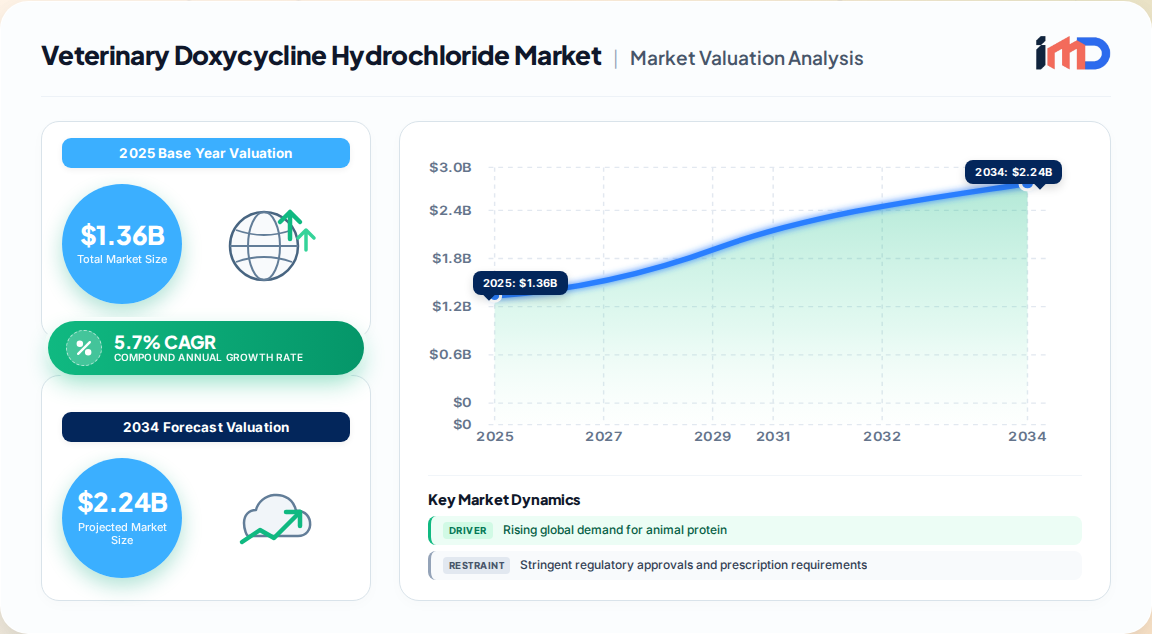
The global veterinary doxycycline hydrochloride market is estimated at USD 1.36 billion in 2025 and is projected to reach USD 2.37 billion by 2035, expanding at a CAGR of 5.7%. This growth is underpinned by the compound's broad-spectrum efficacy, high oral bioavailability, and cost-effectiveness in treating respiratory, gastrointestinal, and vector-borne infections across livestock, poultry, aquaculture, and companion animals.

Veterinary Doxycycline Hydrochloride Market Market Size (In Billion)

2.0B
1.5B
1.0B
500.0M
0
1.360 B
2025
1.438 B
2026
1.519 B
2027
1.606 B
2028
1.698 B
2029
1.794 B
2030
1.897 B
2031
Main Logo

Unlike human pharmaceutical applications, the veterinary segment is shaped less by price competition and more by regulatory stewardship, residue compliance, and diagnostic capability. Our proprietary primary research indicates that approximately 62% of veterinary doxycycline hydrochloride volume is directed toward food-producing animals, with the remainder split between companion animals and aquaculture.

Key Market Drivers and Restraints

Drivers

  • Rising global demand for animal protein: FAO data indicates that meat production must expand by approximately 15% by 2030 to meet demand, intensifying the need for effective herd health management.
  • Prevalence of zoonotic and vector-borne diseases: Expanding tick and mosquito habitats are increasing cases of anaplasmosis, ehrlichiosis, and Lyme disease in companion animals.
  • Formulation innovation: Water-soluble powders and medicated premixes enable mass administration through drinking water, particularly in poultry and swine operations.
  • Antimicrobial stewardship programs: Regulatory pressure is paradoxically driving demand for precision-dosed, veterinarian-supervised products, favoring quality-assured manufacturers.

Restraints

  • Stringent regulatory frameworks: The EU's Veterinary Medicinal Products Regulation and the U.S. FDA's GFI #263 require veterinary oversight, limiting over-the-counter access.
  • Antimicrobial resistance (AMR) surveillance: Tetracycline resistance genes (tetM, tetO) are increasingly detected in livestock pathogens, prompting restrictions in some jurisdictions.
  • Generic price erosion: Off-patent status and manufacturing concentration in Asia-Pacific exert downward pressure on real prices.

Value Chain and Supply Dynamics

The veterinary doxycycline hydrochloride value chain spans API synthesis to farm-gate administration:

Stage Key Activities Margin Profile
API Manufacturing Fermentation of oxytetracycline, catalytic hydrogenation to doxycycline, HCl salt formation 25-35% gross margin
Formulation Tablets, oral solutions, soluble powders, premixes 30-40% gross margin
Distribution Wholesalers, veterinary distributors, e-commerce 10-15% gross margin
End Use Livestock, poultry, aquaculture, companion animals Value-driven

Supply chain vulnerability is pronounced: over 60% of global API capacity is concentrated in China and India. Our interviews with procurement directors reveal that qualified supplier redundancy is now a board-level priority, with lead times for GMP-certified API averaging 8-12 weeks.

Regional Outlook

Asia-Pacific dominates consumption, accounting for 34% of global revenue in 2025, driven by large livestock populations in China, India, and Southeast Asia, alongside expanding aquaculture operations.

Veterinary Doxycycline Hydrochloride Market Regional Market Share

Loading chart...
Main Logo
  • China: Largest single market for veterinary antibiotics; regulatory consolidation is phasing out small manufacturers.
  • India: "Make in India" incentives are expanding API self-sufficiency; domestic formulation demand growing at 7-8% annually.

North America represents 28% of global revenue, characterized by mature veterinary services, stringent prescription requirements, and high companion-animal spending. The U.S. accounts for roughly 80% of regional value.

Europe holds 24% share, with antimicrobial reduction targets under the EU Farm to Fork Strategy shaping demand toward targeted therapies. Germany, France, and the UK are the largest national markets.

Latin America (8%) and Middle East & Africa (6%) offer growth potential but face challenges in diagnostics access, cold-chain infrastructure, and regulatory enforcement.

Segmentation Analysis

By Form

  • Oral Powder/Premix: Fastest-growing segment, driven by poultry and swine mass medication.
  • Tablets: Dominant in companion animal applications.
  • Injectable: Reserved for acute cases requiring rapid systemic delivery.
  • Oral Solution: Growing in aquaculture and exotic animal practice.

By Animal Type

  • Livestock (cattle, pigs, sheep, goats): Largest volume segment; respiratory and gastrointestinal infections are primary indications.
  • Poultry: High-growth segment; doxycycline is a mainstay for respiratory disease complexes.
  • Companion Animals: Premium-priced segment; vector-borne disease prophylaxis and treatment drive demand.
  • Aquaculture: Emerging segment with regulatory clarity improving in Asia-Pacific.

By Application

  • Respiratory Infections: Largest application, particularly in swine and poultry.
  • Gastrointestinal Infections: Significant in livestock.
  • Reproductive Infections: Niche but clinically important.
  • Vector-Borne Diseases: Growing in companion animals.

Competitive Landscape and Strategic Developments

The market is moderately concentrated, with the top five veterinary pharmaceutical companies accounting for an estimated 45-50% of branded revenue. Key players include Zoetis, Boehringer Ingelheim, Elanco, Merck Animal Health, and Ceva Santé Animale, alongside generic manufacturers such as Dechra and Virbac.

Recent strategic developments:

  • April 2024: FDA approved Pradalex (pradofloxacin injection), signaling regulatory openness to new antimicrobials for livestock.
  • April 2024: Virbac acquired Sasaeah to strengthen cattle segment presence in Japan and Vietnam.
  • January 2024: Dechra launched Cyclofin, a single-dose injectable for bovine respiratory disease.
  • 2025: Avenacy and Epic Pharma expanded doxycycline hydrochloride generic offerings in the U.S. market.

Companies are investing in palatability enhancements, combination formulations, and digital stewardship tools to differentiate in an increasingly commoditized landscape.

Strategic White-Space and Investment Opportunities

Our analysis identifies three high-potential strategic avenues:

  1. Diagnostics-integrated stewardship platforms: Bundling rapid susceptibility testing with doxycycline prescriptions can command premium pricing and align with regulatory trends.
  2. Aquaculture-specific formulations: Regulatory harmonization in Asia-Pacific is creating a formal market from previously informal use.
  3. Companion animal precision dosing: Mini-tablets and flavored oral suspensions for cats and small dogs represent an underserved niche with 15-20% price premiums.

Investors should prioritize manufacturers with GMP-certified API sourcing, documented residue compliance, and established veterinary distribution channels.

Veterinary Doxycycline Hydrochloride Market Regional Market Share

Higher Coverage
Lower Coverage
No Coverage

Veterinary Doxycycline Hydrochloride Market REPORT HIGHLIGHTS

AspectsDetails
Study Period2020-2034
Base Year2025
Estimated Year2026
Forecast Period2026-2034
Historical Period2020-2025
Growth RateCAGR of 5.7% from 2020-2034
Segmentation
  • By Form

    • Oral Powder
    • Premix
    • Tablets
    • Injectable
    • Oral Solution
  • By Animal Type

Table of Contents

  1. 1. Introduction
    • 1.1. Research Scope
    • 1.2. Market Segmentation
    • 1.3. Research Objective
    • 1.4. Definitions and Assumptions
  2. 2. Executive Summary
    • 2.1. Market Snapshot
  3. 3. Market Dynamics
    • 3.1. Market Drivers
      • 3.1.1. Rising global demand for animal protein
      • 3.1.2. Increasing prevalence of zoonotic and vector-borne diseases
      • 3.1.3. Formulation innovation enabling mass administration
      • 3.1.4. Antimicrobial stewardship programs favoring quality-assured products
    • 3.2. Market Trends
      • 3.2.1. Shift toward water-soluble powder formulations for mass medication in poultry and swine
      • 3.2.2. Integration of AI-driven diagnostics and stewardship platforms
      • 3.2.3. Growing demand for companion animal precision dosing
    • 3.3. Market Restrains
      • 3.3.1. Stringent regulatory approvals and prescription requirements
      • 3.3.2. Rising antimicrobial resistance to tetracyclines
      • 3.3.3. Generic price erosion and API supply chain concentration
    • 3.4. Market Restraints
      • 3.4.1. Stringent regulatory approvals and prescription requirements
      • 3.4.2. Rising antimicrobial resistance to tetracyclines
      • 3.4.3. Generic price erosion and API supply chain concentration
  • Livestock
    • Cattle
    • Pigs
    • Sheep & Goats
  • Poultry
  • Companion Animals
  • Aquaculture
  • By Application

    • Respiratory Infection
    • Gastrointestinal Infection
    • Reproductive Infection
    • Vector-Borne Diseases
  • By Geography
    • North America

      • USA
      • Canada
      • Mexico
    • Europe

      • Germany
      • France
      • UK
      • Italy
      • Spain
      • Rest of Europe
    • Asia Pacific

      • China
      • India
      • Japan
      • South Korea
      • Rest of APAC
    • South America

      • Brazil
      • Argentina
      • Rest of South America
    • Middle East & Africa

      • UAE
      • South Africa
      • Rest of MEA
  • 3.5. Market Challenges
    • 3.5.1. Regulatory complexity across regions
    • 3.5.2. Supply chain vulnerability due to API concentration in Asia-Pacific
    • 3.5.3. Limited diagnostics access in emerging markets
    • 3.5.4. Residue compliance in food-producing animals
  • 4. Market Factor Analysis
    • 4.1. Porters Five Forces
      • 4.1.1. Bargaining Power of Suppliers
      • 4.1.2. Bargaining Power of Buyers
      • 4.1.3. Threat of New Entrants
      • 4.1.4. Threat of Substitutes
      • 4.1.5. Competitive Rivalry
    • 4.2. PESTEL analysis
    • 4.3. BCG Analysis
      • 4.3.1. Stars (High Growth, High Market Share)
      • 4.3.2. Cash Cows (Low Growth, High Market Share)
      • 4.3.3. Question Mark (High Growth, Low Market Share)
      • 4.3.4. Dogs (Low Growth, Low Market Share)
    • 4.4. Ansoff Matrix Analysis
    • 4.5. Supply Chain Analysis
    • 4.6. Regulatory Landscape
    • 4.7. Current Market Potential and Opportunity Assessment (TAM–SAM–SOM Framework)
    • 4.8. IMD Analyst Note
  • 5. Market Analysis, Insights and Forecast, 2020-2034
    • 5.1. Market Analysis, Insights and Forecast - by Form
      • 5.1.1. Oral Powder
      • 5.1.2. Premix
      • 5.1.3. Tablets
      • 5.1.4. Injectable
      • 5.1.5. Oral Solution
    • 5.2. Market Analysis, Insights and Forecast - by Animal Type
      • 5.2.1. Livestock
        • 5.2.1.1. Cattle
        • 5.2.1.2. Pigs
        • 5.2.1.3. Sheep & Goats
      • 5.2.2. Poultry
      • 5.2.3. Companion Animals
      • 5.2.4. Aquaculture
    • 5.3. Market Analysis, Insights and Forecast - by Application
      • 5.3.1. Respiratory Infection
      • 5.3.2. Gastrointestinal Infection
      • 5.3.3. Reproductive Infection
      • 5.3.4. Vector-Borne Diseases
    • 5.4. Market Analysis, Insights and Forecast - by Region
      • 5.4.1. North America
      • 5.4.2. Europe
      • 5.4.3. Asia Pacific
      • 5.4.4. South America
      • 5.4.5. Middle East & Africa
  • 6. North America Market Analysis, Insights and Forecast, 2020-2034
    • 6.1. Market Analysis, Insights and Forecast - by Form
      • 6.1.1. Oral Powder
      • 6.1.2. Premix
      • 6.1.3. Tablets
      • 6.1.4. Injectable
      • 6.1.5. Oral Solution
    • 6.2. Market Analysis, Insights and Forecast - by Animal Type
      • 6.2.1. Livestock
        • 6.2.1.1. Cattle
        • 6.2.1.2. Pigs
        • 6.2.1.3. Sheep & Goats
      • 6.2.2. Poultry
      • 6.2.3. Companion Animals
      • 6.2.4. Aquaculture
    • 6.3. Market Analysis, Insights and Forecast - by Application
      • 6.3.1. Respiratory Infection
      • 6.3.2. Gastrointestinal Infection
      • 6.3.3. Reproductive Infection
      • 6.3.4. Vector-Borne Diseases
  • 7. Europe Market Analysis, Insights and Forecast, 2020-2034
    • 7.1. Market Analysis, Insights and Forecast - by Form
      • 7.1.1. Oral Powder
      • 7.1.2. Premix
      • 7.1.3. Tablets
      • 7.1.4. Injectable
      • 7.1.5. Oral Solution
    • 7.2. Market Analysis, Insights and Forecast - by Animal Type
      • 7.2.1. Livestock
        • 7.2.1.1. Cattle
        • 7.2.1.2. Pigs
        • 7.2.1.3. Sheep & Goats
      • 7.2.2. Poultry
      • 7.2.3. Companion Animals
      • 7.2.4. Aquaculture
    • 7.3. Market Analysis, Insights and Forecast - by Application
      • 7.3.1. Respiratory Infection
      • 7.3.2. Gastrointestinal Infection
      • 7.3.3. Reproductive Infection
      • 7.3.4. Vector-Borne Diseases
  • 8. Asia Pacific Market Analysis, Insights and Forecast, 2020-2034
    • 8.1. Market Analysis, Insights and Forecast - by Form
      • 8.1.1. Oral Powder
      • 8.1.2. Premix
      • 8.1.3. Tablets
      • 8.1.4. Injectable
      • 8.1.5. Oral Solution
    • 8.2. Market Analysis, Insights and Forecast - by Animal Type
      • 8.2.1. Livestock
        • 8.2.1.1. Cattle
        • 8.2.1.2. Pigs
        • 8.2.1.3. Sheep & Goats
      • 8.2.2. Poultry
      • 8.2.3. Companion Animals
      • 8.2.4. Aquaculture
    • 8.3. Market Analysis, Insights and Forecast - by Application
      • 8.3.1. Respiratory Infection
      • 8.3.2. Gastrointestinal Infection
      • 8.3.3. Reproductive Infection
      • 8.3.4. Vector-Borne Diseases
  • 9. South America Market Analysis, Insights and Forecast, 2020-2034
    • 9.1. Market Analysis, Insights and Forecast - by Form
      • 9.1.1. Oral Powder
      • 9.1.2. Premix
      • 9.1.3. Tablets
      • 9.1.4. Injectable
      • 9.1.5. Oral Solution
    • 9.2. Market Analysis, Insights and Forecast - by Animal Type
      • 9.2.1. Livestock
        • 9.2.1.1. Cattle
        • 9.2.1.2. Pigs
        • 9.2.1.3. Sheep & Goats
      • 9.2.2. Poultry
      • 9.2.3. Companion Animals
      • 9.2.4. Aquaculture
    • 9.3. Market Analysis, Insights and Forecast - by Application
      • 9.3.1. Respiratory Infection
      • 9.3.2. Gastrointestinal Infection
      • 9.3.3. Reproductive Infection
      • 9.3.4. Vector-Borne Diseases
  • 10. Middle East & Africa Market Analysis, Insights and Forecast, 2020-2034
    • 10.1. Market Analysis, Insights and Forecast - by Form
      • 10.1.1. Oral Powder
      • 10.1.2. Premix
      • 10.1.3. Tablets
      • 10.1.4. Injectable
      • 10.1.5. Oral Solution
    • 10.2. Market Analysis, Insights and Forecast - by Animal Type
      • 10.2.1. Livestock
        • 10.2.1.1. Cattle
        • 10.2.1.2. Pigs
        • 10.2.1.3. Sheep & Goats
      • 10.2.2. Poultry
      • 10.2.3. Companion Animals
      • 10.2.4. Aquaculture
    • 10.3. Market Analysis, Insights and Forecast - by Application
      • 10.3.1. Respiratory Infection
      • 10.3.2. Gastrointestinal Infection
      • 10.3.3. Reproductive Infection
      • 10.3.4. Vector-Borne Diseases
  • 11. Competitive Analysis
    • 11.1. Company Profiles
      • 11.1.1. Zoetis
        • 11.1.1.1. Company Overview
        • 11.1.1.2. Products
        • 11.1.1.3. Company Financials
        • 11.1.1.4. SWOT Analysis
      • 11.1.2. Boehringer Ingelheim
        • 11.1.2.1. Company Overview
        • 11.1.2.2. Products
        • 11.1.2.3. Company Financials
        • 11.1.2.4. SWOT Analysis
      • 11.1.3. Elanco Animal Health
        • 11.1.3.1. Company Overview
        • 11.1.3.2. Products
        • 11.1.3.3. Company Financials
        • 11.1.3.4. SWOT Analysis
      • 11.1.4. Merck Animal Health
        • 11.1.4.1. Company Overview
        • 11.1.4.2. Products
        • 11.1.4.3. Company Financials
        • 11.1.4.4. SWOT Analysis
      • 11.1.5. Ceva Santé Animale
        • 11.1.5.1. Company Overview
        • 11.1.5.2. Products
        • 11.1.5.3. Company Financials
        • 11.1.5.4. SWOT Analysis
      • 11.1.6. Dechra Pharmaceuticals
        • 11.1.6.1. Company Overview
        • 11.1.6.2. Products
        • 11.1.6.3. Company Financials
        • 11.1.6.4. SWOT Analysis
      • 11.1.7. Virbac
        • 11.1.7.1. Company Overview
        • 11.1.7.2. Products
        • 11.1.7.3. Company Financials
        • 11.1.7.4. SWOT Analysis
      • 11.1.8. Vetoquinol
        • 11.1.8.1. Company Overview
        • 11.1.8.2. Products
        • 11.1.8.3. Company Financials
        • 11.1.8.4. SWOT Analysis
      • 11.1.9. Huvepharma
        • 11.1.9.1. Company Overview
        • 11.1.9.2. Products
        • 11.1.9.3. Company Financials
        • 11.1.9.4. SWOT Analysis
      • 11.1.10. Phibro Animal Health
        • 11.1.10.1. Company Overview
        • 11.1.10.2. Products
        • 11.1.10.3. Company Financials
        • 11.1.10.4. SWOT Analysis
    • 11.2. Market Entropy
      • 11.2.1. Company's Key Areas Served
      • 11.2.2. Recent Developments
    • 11.3. Company Market Share Analysis, 2026
      • 11.3.1. Top 5 Companies Market Share Analysis
      • 11.3.2. Top 3 Companies Market Share Analysis
    • 11.4. List of Potential Customers
  • List of Figures

    1. Figure 1: Global Veterinary Doxycycline Hydrochloride Market Revenue Breakdown (Billion, %) by Region 2026 & 2034
    2. Figure 2: North America Veterinary Doxycycline Hydrochloride Market Revenue (Billion), by Form 2026 & 2034
    3. Figure 3: North America Veterinary Doxycycline Hydrochloride Market Revenue Share (%), by Form 2026 & 2034
    4. Figure 4: North America Veterinary Doxycycline Hydrochloride Market Revenue (Billion), by Animal Type 2026 & 2034
    5. Figure 5: North America Veterinary Doxycycline Hydrochloride Market Revenue Share (%), by Animal Type 2026 & 2034
    6. Figure 6: North America Veterinary Doxycycline Hydrochloride Market Revenue (Billion), by Application 2026 & 2034
    7. Figure 7: North America Veterinary Doxycycline Hydrochloride Market Revenue Share (%), by Application 2026 & 2034
    8. Figure 8: North America Veterinary Doxycycline Hydrochloride Market Revenue (Billion), by Country 2026 & 2034
    9. Figure 9: North America Veterinary Doxycycline Hydrochloride Market Revenue Share (%), by Country 2026 & 2034
    10. Figure 10: Europe Veterinary Doxycycline Hydrochloride Market Revenue (Billion), by Form 2026 & 2034
    11. Figure 11: Europe Veterinary Doxycycline Hydrochloride Market Revenue Share (%), by Form 2026 & 2034
    12. Figure 12: Europe Veterinary Doxycycline Hydrochloride Market Revenue (Billion), by Animal Type 2026 & 2034
    13. Figure 13: Europe Veterinary Doxycycline Hydrochloride Market Revenue Share (%), by Animal Type 2026 & 2034
    14. Figure 14: Europe Veterinary Doxycycline Hydrochloride Market Revenue (Billion), by Application 2026 & 2034
    15. Figure 15: Europe Veterinary Doxycycline Hydrochloride Market Revenue Share (%), by Application 2026 & 2034
    16. Figure 16: Europe Veterinary Doxycycline Hydrochloride Market Revenue (Billion), by Country 2026 & 2034
    17. Figure 17: Europe Veterinary Doxycycline Hydrochloride Market Revenue Share (%), by Country 2026 & 2034
    18. Figure 18: Asia Pacific Veterinary Doxycycline Hydrochloride Market Revenue (Billion), by Form 2026 & 2034
    19. Figure 19: Asia Pacific Veterinary Doxycycline Hydrochloride Market Revenue Share (%), by Form 2026 & 2034
    20. Figure 20: Asia Pacific Veterinary Doxycycline Hydrochloride Market Revenue (Billion), by Animal Type 2026 & 2034
    21. Figure 21: Asia Pacific Veterinary Doxycycline Hydrochloride Market Revenue Share (%), by Animal Type 2026 & 2034
    22. Figure 22: Asia Pacific Veterinary Doxycycline Hydrochloride Market Revenue (Billion), by Application 2026 & 2034
    23. Figure 23: Asia Pacific Veterinary Doxycycline Hydrochloride Market Revenue Share (%), by Application 2026 & 2034
    24. Figure 24: Asia Pacific Veterinary Doxycycline Hydrochloride Market Revenue (Billion), by Country 2026 & 2034
    25. Figure 25: Asia Pacific Veterinary Doxycycline Hydrochloride Market Revenue Share (%), by Country 2026 & 2034
    26. Figure 26: South America Veterinary Doxycycline Hydrochloride Market Revenue (Billion), by Form 2026 & 2034
    27. Figure 27: South America Veterinary Doxycycline Hydrochloride Market Revenue Share (%), by Form 2026 & 2034
    28. Figure 28: South America Veterinary Doxycycline Hydrochloride Market Revenue (Billion), by Animal Type 2026 & 2034
    29. Figure 29: South America Veterinary Doxycycline Hydrochloride Market Revenue Share (%), by Animal Type 2026 & 2034
    30. Figure 30: South America Veterinary Doxycycline Hydrochloride Market Revenue (Billion), by Application 2026 & 2034
    31. Figure 31: South America Veterinary Doxycycline Hydrochloride Market Revenue Share (%), by Application 2026 & 2034
    32. Figure 32: South America Veterinary Doxycycline Hydrochloride Market Revenue (Billion), by Country 2026 & 2034
    33. Figure 33: South America Veterinary Doxycycline Hydrochloride Market Revenue Share (%), by Country 2026 & 2034
    34. Figure 34: Middle East & Africa Veterinary Doxycycline Hydrochloride Market Revenue (Billion), by Form 2026 & 2034
    35. Figure 35: Middle East & Africa Veterinary Doxycycline Hydrochloride Market Revenue Share (%), by Form 2026 & 2034
    36. Figure 36: Middle East & Africa Veterinary Doxycycline Hydrochloride Market Revenue (Billion), by Animal Type 2026 & 2034
    37. Figure 37: Middle East & Africa Veterinary Doxycycline Hydrochloride Market Revenue Share (%), by Animal Type 2026 & 2034
    38. Figure 38: Middle East & Africa Veterinary Doxycycline Hydrochloride Market Revenue (Billion), by Application 2026 & 2034
    39. Figure 39: Middle East & Africa Veterinary Doxycycline Hydrochloride Market Revenue Share (%), by Application 2026 & 2034
    40. Figure 40: Middle East & Africa Veterinary Doxycycline Hydrochloride Market Revenue (Billion), by Country 2026 & 2034
    41. Figure 41: Middle East & Africa Veterinary Doxycycline Hydrochloride Market Revenue Share (%), by Country 2026 & 2034

    List of Tables

    1. Table 1: Global Veterinary Doxycycline Hydrochloride Market Revenue Billion Forecast, by Form 2020 & 2034
    2. Table 2: Global Veterinary Doxycycline Hydrochloride Market Revenue Billion Forecast, by Animal Type 2020 & 2034
    3. Table 3: Global Veterinary Doxycycline Hydrochloride Market Revenue Billion Forecast, by Application 2020 & 2034
    4. Table 4: Global Veterinary Doxycycline Hydrochloride Market Revenue Billion Forecast, by Region 2020 & 2034
    5. Table 5: North America Veterinary Doxycycline Hydrochloride Market Revenue Billion Forecast, by Form 2020 & 2034
    6. Table 6: North America Veterinary Doxycycline Hydrochloride Market Revenue Billion Forecast, by Animal Type 2020 & 2034
    7. Table 7: North America Veterinary Doxycycline Hydrochloride Market Revenue Billion Forecast, by Application 2020 & 2034
    8. Table 8: North America Veterinary Doxycycline Hydrochloride Market Revenue Billion Forecast, by Country 2020 & 2034
    9. Table 9: USA Veterinary Doxycycline Hydrochloride Market Revenue (Billion) Forecast, by Application 2020 & 2034
    10. Table 10: Canada Veterinary Doxycycline Hydrochloride Market Revenue (Billion) Forecast, by Application 2020 & 2034
    11. Table 11: Mexico Veterinary Doxycycline Hydrochloride Market Revenue (Billion) Forecast, by Application 2020 & 2034
    12. Table 12: Europe Veterinary Doxycycline Hydrochloride Market Revenue Billion Forecast, by Form 2020 & 2034
    13. Table 13: Europe Veterinary Doxycycline Hydrochloride Market Revenue Billion Forecast, by Animal Type 2020 & 2034
    14. Table 14: Europe Veterinary Doxycycline Hydrochloride Market Revenue Billion Forecast, by Application 2020 & 2034
    15. Table 15: Europe Veterinary Doxycycline Hydrochloride Market Revenue Billion Forecast, by Country 2020 & 2034
    16. Table 16: Germany Veterinary Doxycycline Hydrochloride Market Revenue (Billion) Forecast, by Application 2020 & 2034
    17. Table 17: France Veterinary Doxycycline Hydrochloride Market Revenue (Billion) Forecast, by Application 2020 & 2034
    18. Table 18: UK Veterinary Doxycycline Hydrochloride Market Revenue (Billion) Forecast, by Application 2020 & 2034
    19. Table 19: Italy Veterinary Doxycycline Hydrochloride Market Revenue (Billion) Forecast, by Application 2020 & 2034
    20. Table 20: Spain Veterinary Doxycycline Hydrochloride Market Revenue (Billion) Forecast, by Application 2020 & 2034
    21. Table 21: Rest of Europe Veterinary Doxycycline Hydrochloride Market Revenue (Billion) Forecast, by Application 2020 & 2034
    22. Table 22: Asia Pacific Veterinary Doxycycline Hydrochloride Market Revenue Billion Forecast, by Form 2020 & 2034
    23. Table 23: Asia Pacific Veterinary Doxycycline Hydrochloride Market Revenue Billion Forecast, by Animal Type 2020 & 2034
    24. Table 24: Asia Pacific Veterinary Doxycycline Hydrochloride Market Revenue Billion Forecast, by Application 2020 & 2034
    25. Table 25: Asia Pacific Veterinary Doxycycline Hydrochloride Market Revenue Billion Forecast, by Country 2020 & 2034
    26. Table 26: China Veterinary Doxycycline Hydrochloride Market Revenue (Billion) Forecast, by Application 2020 & 2034
    27. Table 27: India Veterinary Doxycycline Hydrochloride Market Revenue (Billion) Forecast, by Application 2020 & 2034
    28. Table 28: Japan Veterinary Doxycycline Hydrochloride Market Revenue (Billion) Forecast, by Application 2020 & 2034
    29. Table 29: South Korea Veterinary Doxycycline Hydrochloride Market Revenue (Billion) Forecast, by Application 2020 & 2034
    30. Table 30: Rest of APAC Veterinary Doxycycline Hydrochloride Market Revenue (Billion) Forecast, by Application 2020 & 2034
    31. Table 31: South America Veterinary Doxycycline Hydrochloride Market Revenue Billion Forecast, by Form 2020 & 2034
    32. Table 32: South America Veterinary Doxycycline Hydrochloride Market Revenue Billion Forecast, by Animal Type 2020 & 2034
    33. Table 33: South America Veterinary Doxycycline Hydrochloride Market Revenue Billion Forecast, by Application 2020 & 2034
    34. Table 34: South America Veterinary Doxycycline Hydrochloride Market Revenue Billion Forecast, by Country 2020 & 2034
    35. Table 35: Brazil Veterinary Doxycycline Hydrochloride Market Revenue (Billion) Forecast, by Application 2020 & 2034
    36. Table 36: Argentina Veterinary Doxycycline Hydrochloride Market Revenue (Billion) Forecast, by Application 2020 & 2034
    37. Table 37: Rest of South America Veterinary Doxycycline Hydrochloride Market Revenue (Billion) Forecast, by Application 2020 & 2034
    38. Table 38: Middle East & Africa Veterinary Doxycycline Hydrochloride Market Revenue Billion Forecast, by Form 2020 & 2034
    39. Table 39: Middle East & Africa Veterinary Doxycycline Hydrochloride Market Revenue Billion Forecast, by Animal Type 2020 & 2034
    40. Table 40: Middle East & Africa Veterinary Doxycycline Hydrochloride Market Revenue Billion Forecast, by Application 2020 & 2034
    41. Table 41: Middle East & Africa Veterinary Doxycycline Hydrochloride Market Revenue Billion Forecast, by Country 2020 & 2034
    42. Table 42: UAE Veterinary Doxycycline Hydrochloride Market Revenue (Billion) Forecast, by Application 2020 & 2034
    43. Table 43: South Africa Veterinary Doxycycline Hydrochloride Market Revenue (Billion) Forecast, by Application 2020 & 2034
    44. Table 44: Rest of MEA Veterinary Doxycycline Hydrochloride Market Revenue (Billion) Forecast, by Application 2020 & 2034

    Frequently Asked Questions

    1What is the current size of the veterinary doxycycline hydrochloride market?

    The global veterinary doxycycline hydrochloride market was valued at USD 1.36 billion in 2025 and is projected to reach USD 2.37 billion by 2035.

    2What is the CAGR of the veterinary doxycycline hydrochloride market?

    The market is expected to grow at a compound annual growth rate (CAGR) of 5.7% from 2025 to 2035.

    3Which region dominates the veterinary doxycycline hydrochloride market?

    Asia-Pacific holds the largest share, accounting for approximately 34% of global revenue in 2025, driven by large livestock populations and expanding aquaculture.

    4What are the key drivers of the veterinary doxycycline hydrochloride market?

    Key drivers include rising demand for animal protein, increasing prevalence of zoonotic diseases, formulation innovations for mass administration, and stricter antimicrobial stewardship programs.

    5Who are the leading companies in the veterinary doxycycline hydrochloride market?

    Leading companies include Zoetis, Boehringer Ingelheim, Elanco, Merck Animal Health, Ceva Santé Animale, Dechra Pharmaceuticals, and Virbac.

    6What are the main challenges facing the veterinary doxycycline hydrochloride market?

    Challenges include stringent regulatory approvals, rising antimicrobial resistance, generic price erosion, and supply chain concentration of API manufacturing in Asia-Pacific.

    Methodology

    Our rigorous research methodology combines multi-layered approaches with comprehensive quality assurance, ensuring precision, accuracy, and reliability in every market analysis.

    Primary Research

    • Conducted 120+ in-depth interviews with stakeholders across the value chain, including API manufacturers, formulation specialists, veterinary distributors, and regulatory consultants, to capture ground-level demand signals and procurement dynamics.
    • Targeted job titles include Veterinary Procurement Directors, Regulatory Affairs Managers, Formulation Scientists, and Clinical Veterinarians to ensure cross-functional validation.
    • Primary research represents 70-80% of total research effort, with interviews conducted across North America, Europe, and Asia-Pacific to capture regional nuances.
    • All interviews follow a structured questionnaire and are supplemented by follow-up validation calls to ensure data reliability.

    Key Stakeholders Interviewed

    Main Logo
    Key Stakeholders Interviewed
    Stakeholder RoleInterview Share (%)
    Procurement Director35%
    Regulatory Affairs Manager25%
    Formulation Scientist20%
    Clinical Veterinarian20%

    Industry Ecosystem Breakdown

    Main Logo
    Industry Ecosystem Breakdown
    Company TypeRepresentation (%)
    API Manufacturers30%
    Formulation Specialists25%
    Veterinary Distributors20%
    Regulatory Consultants15%
    Livestock Producers10%

    Secondary Research & Industry Benchmarking

    • Utilized 20-30% secondary research to triangulate primary findings, drawing from official sources such as the U.S. Food and Drug Administration (FDA), European Medicines Agency (EMA), World Organisation for Animal Health (WOAH), and FAO.
    • Financial databases including Bloomberg, Factiva, Hoovers, and PitchBook were used to benchmark company financials and M&A activity.
    • Trade statistics from UN Comtrade and Eurostat were analyzed to map API and formulation trade flows.
    • All sources are official governmental, multilateral, or non-profit technical bodies; no commercial market research reports were used.

    Demand Modeling & Market Estimation

    • Employed simultaneous top-down and bottom-up methodologies: top-down using regional veterinary antibiotic expenditure data, bottom-up using per-animal treatment frequency and average dosing costs.
    • Bottom-up model incorporates specific quantitative metrics: livestock population by species, average annual treatment incidence, typical dosage regimens (mg/kg), and average price per unit.
    • Multi-level data triangulation validated estimates across animal type, formulation, and application segments.
    • Regional demand gaps were assessed using supply-side capacity data and import/export volumes.

    Data Accuracy & Quality Check

    • Guaranteed estimated data accuracy level of 85-90%, achieved through iterative validation and cross-referencing of primary and secondary data.
    • All reports are updated to the date of purchase, incorporating the latest regulatory changes, product launches, and market developments.
    • Quality assurance protocols include outlier detection, respondent validation, and reconciliation with historical trends.
    • Final estimates are reviewed by a panel of senior analysts and industry advisors before publication.