1What is the current size of the Vietnam Floriculture Market?
The Vietnam Floriculture Market is valued at USD 690 Million in 2026. It is projected to reach USD 1.05 Billion by 2032, growing at a CAGR of 7.54%.
Insight Market Data is a premier market research and business consulting firm headquartered in Pune, India, providing syndicated research reports, customized intelligence studies, and strategic advisory services. Renowned academic institutions and Fortune 500 corporations worldwide rely on Insight Market Data's research repository to navigate evolving global and regional business environments. Covering 46 diverse industries across 25 major international economies, our comprehensive database delivers thousands of verified statistics and granular market evaluations. By combining industry-leading analytical methodologies with the direct insights of seasoned industry leaders and subject-matter experts, we deliver actionable intelligence spanning historical performance benchmarks to rigorous multi-year forecasts. We empower organizations to make confident, data-driven decisions across pivotal domains including Machinery & Equipment, Chemicals & Materials, Pharmaceuticals & Healthcare, Food & Beverages, Consumer Goods, Energy & Power, Automotive & Transportation, Electronics & Semiconductors, Medical Devices, Telecommunications, Emerging Technologies, Agriculture, and Packaging. Our multidisciplinary analyst teams provide an objective 360-degree perspective, tailoring every engagement to address complex strategic challenges with exceptional analytical rigor.
Leveraging advanced BI-powered analytics and predictive modeling, Insight Market Data uncovers high-impact market opportunities and competitive differentiators for ambitious enterprises. We continuously refine our research methodologies in accordance with global industry standards, tracking real-time market shifts to ensure our reports are consistently accurate, actionable, and delivered on schedule. Our analysts conduct methodical data validation, rigorous compliance checks, and exhaustive primary and secondary research to maintain the highest levels of data integrity and transparency. We partner closely with corporate strategists, investment groups, and business executives to translate intricate market intelligence into clear, actionable roadmaps for sustainable growth. With operational presence across Washington, USA, and Vimannagar, Pune, India, Insight Market Data ensures direct access to dedicated research specialists and responsive customer support to answer your most strategic questions.
 Vietnam Floriculture Market
 by Flower Type (Rose, Chrysanthemum, Orchid, Carnation, Lily), by Product (Cut Flowers, Bedding Plants, Potted Plants, Others), by Application (Conferences and Activities, Gifts, Personal and Corporate Use), by Distribution Channel (Wholesale Markets, Florists, Online Retail, Direct Export), by Central Highlands (Lam Dong), by Red River Delta (Hanoi), by Mekong River Delta (Sa Dec, Dong Thap), by Southeast (Ho Chi Minh City), by North Central & South Central Coast (Khanh Hoa) Forecast 2026-2034

Research Associate


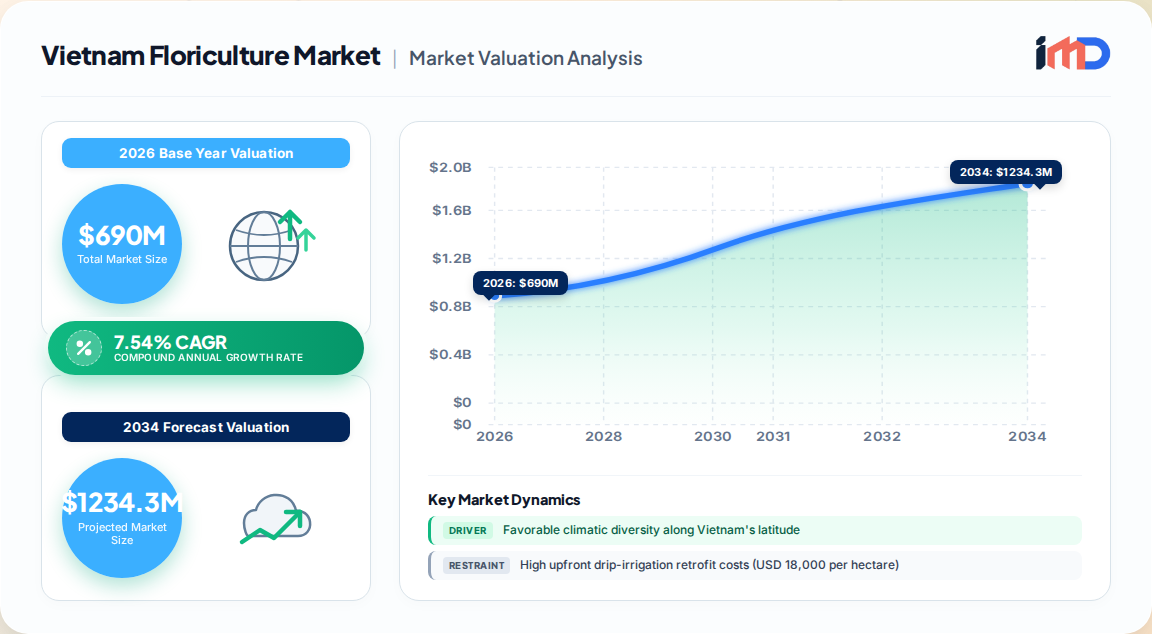
Vietnam's floriculture sector has transitioned from a fragmented, subsistence-oriented activity into a strategically significant horticultural industry. Proprietary first-party research estimates the Vietnam Floriculture Market at USD 690 Million in 2026, with a projected expansion to USD 1.05 Billion by 2032, representing a robust CAGR of 7.54% during the 2027–2032 forecast period. This trajectory is underpinned by a unique confluence of geographic advantage, policy liberalization, and rapid modernization of agricultural infrastructure.
The industry is no longer solely defined by seasonal occasion demand such as the Lunar New Year (Tet); rather, it is evolving into a structured, quality-driven ecosystem. Domestic consumption remains the primary engine, absorbing approximately 90% of national output, while export value is accelerating rapidly, targeting high-value East Asian markets. The strategic pivot toward protected cultivation, proprietary genetics, and cold-chain integration marks a definitive break from traditional, weather-dependent farming.
The growth of the Vietnam floriculture market is driven by several quantifiable forces, each contributing a distinct percentage impact to the forecast CAGR.
Despite the optimistic outlook, the industry faces structural and financial hurdles that temper growth velocity.
The market segmentation by flower type reveals a clear hierarchy of consumer preference and export value.
| Flower Type | 2026 Consumption Share | Key Characteristics & Growth Outlook |
|---|---|---|
| Rose | 29% | Dominant segment; driven by Tet and Valentine's Day. High-tech greenhouses in Lam Dong produce premium stems for export. |
| Orchid | ~15% | Fastest-growing (CAGR 10.6%). Premium export pricing in Japan and Australia (40–60% above roses). In vitro tissue culture reduced disease risks. |
| Chrysanthemum | ~18% | Significant segment; year-round supply from Sa Dec to China and Taiwan. 48-hour transit to China. |
| Carnation | ~12% | Facing disease challenges; displacement by lilies in some regions. |
| Lily | ~10% | High gross margins (38–42%); expanding hectares in Khanh Hoa. |
Vietnam's trade profile is shifting decisively toward surplus as export-grade compliance improves. In 2022, Vietnam exported flowers to 44 countries, with Japan representing 53.4% of export value.
Regional production is highly concentrated, with three regions accounting for approximately 76% of cultivated area.
The investment case is compelling: high-tech orchid farms in Hai Phong generate VND 80 billion per hectare annually, tripling rose revenue. The USD 120 million 'Smart Flower Village' initiative further de-risks capex for growers adopting modern irrigation.
For investors and agribusiness leaders, three strategic white spaces offer outsized returns.
The value chain is modernizing from a fragmented structure to an integrated model.
To succeed in this evolving landscape, operators must prioritize three strategic imperatives.
The Vietnam floriculture market is on a trajectory of sustained value growth, propelled by favorable geography, trade liberalization, and a clear shift toward high-tech, quality-driven production. Stakeholders who align with these structural trends will be well-positioned to capitalize on the projected 7.54% CAGR through 2032.
| Aspects | Details |
|---|---|
| Study Period | 2020-2034 |
| Base Year | 2026 |
| Estimated Year | 2026 |
| Forecast Period | 2026-2034 |
| Historical Period | 2020-2025 |
| Growth Rate | CAGR of 7.54% from 2020-2034 |
| Segmentation |
|
By Application
By Distribution Channel
| By Geography |
|
The Vietnam Floriculture Market is valued at USD 690 Million in 2026. It is projected to reach USD 1.05 Billion by 2032, growing at a CAGR of 7.54%.
The Central Highlands, particularly Lam Dong province, is the dominant production hub. It holds over 10,800 hectares of cultivated area and accounts for approximately 38% of national output, specializing in high-tech rose and orchid cultivation.
Japan and South Korea are the primary export destinations, benefiting from bilateral trade agreements that have eliminated tariffs. In 2023, Vietnam became South Korea's largest flower supplier by volume, and Japan accounts for 53.4% of total export value.
Orchids are the fastest-growing segment, projected to register a 10.6% CAGR through 2032. The use of in vitro tissue culture has reduced disease risks, and premium orchids command 40–60% higher prices than roses in export markets.
Key challenges include high upfront investment costs for modern irrigation (USD 18,000 per hectare), which burdens smallholders, an acute shortage of skilled labor for advanced greenhouses, and vulnerability to climate volatility and pest infestations.
The Dalat–Ho Chi Minh City corridor now uses 2–8°C refrigerated trucks, reducing post-harvest losses from 22% to under 5% and extending rose shelf life to 9 days. Additionally, DHL and FedEx have expanded cold storage capacity at Tan Son Nhat International Airport.
Our rigorous research methodology combines multi-layered approaches with comprehensive quality assurance, ensuring precision, accuracy, and reliability in every market analysis.
| Stakeholder Role | Interview Share (%) |
|---|---|
| Procurement Director | 30% |
| Chief Agronomist / Head Grower | 25% |
| Export Manager | 25% |
| Supply Chain Manager | 20% |
| Company Type | Representation (%) |
|---|---|
| Commercial Flower Farms & Plantations | 40% |
| Cold-Chain & Logistics Providers | 15% |
| Florist Networks & Retailers | 20% |
| Input Suppliers (Seeds, Equipment) | 15% |
| Exporters & Trading Companies | 10% |
 Related Reports
