1What is the market size for wire harnesses for agriculture vehicles in 2026?
The global market is estimated at USD 3.79 Billion in 2026 and is projected to reach USD 5.30 Billion by 2032, growing at a CAGR of 5.83%.
Insight Market Data is a premier market research and business consulting firm headquartered in Pune, India, providing syndicated research reports, customized intelligence studies, and strategic advisory services. Renowned academic institutions and Fortune 500 corporations worldwide rely on Insight Market Data's research repository to navigate evolving global and regional business environments. Covering 46 diverse industries across 25 major international economies, our comprehensive database delivers thousands of verified statistics and granular market evaluations. By combining industry-leading analytical methodologies with the direct insights of seasoned industry leaders and subject-matter experts, we deliver actionable intelligence spanning historical performance benchmarks to rigorous multi-year forecasts. We empower organizations to make confident, data-driven decisions across pivotal domains including Machinery & Equipment, Chemicals & Materials, Pharmaceuticals & Healthcare, Food & Beverages, Consumer Goods, Energy & Power, Automotive & Transportation, Electronics & Semiconductors, Medical Devices, Telecommunications, Emerging Technologies, Agriculture, and Packaging. Our multidisciplinary analyst teams provide an objective 360-degree perspective, tailoring every engagement to address complex strategic challenges with exceptional analytical rigor.
Leveraging advanced BI-powered analytics and predictive modeling, Insight Market Data uncovers high-impact market opportunities and competitive differentiators for ambitious enterprises. We continuously refine our research methodologies in accordance with global industry standards, tracking real-time market shifts to ensure our reports are consistently accurate, actionable, and delivered on schedule. Our analysts conduct methodical data validation, rigorous compliance checks, and exhaustive primary and secondary research to maintain the highest levels of data integrity and transparency. We partner closely with corporate strategists, investment groups, and business executives to translate intricate market intelligence into clear, actionable roadmaps for sustainable growth. With operational presence across Washington, USA, and Vimannagar, Pune, India, Insight Market Data ensures direct access to dedicated research specialists and responsive customer support to answer your most strategic questions.

 Wire Harnesses for Agriculture Vehicles: Market
 by Type (Standard Wire Harness, Custom Wire Harness), by Application (Engine and Powertrain, Body Lighting and Cabin, Sensor and Telematics, Implement and ISOBUS Communication, High-Voltage and Electrification), by Conductor Material (Copper, Aluminum), by Voltage Rating (Low Voltage, High Voltage), by Sales Channel (OEM, Aftermarket), by Vehicle Type (Tractors, Combines, Sprayers, Harvesters, Telehandlers, Others), by North America (USA, Canada, Mexico), by Europe (Germany, France, Italy, Spain, UK), by Asia-Pacific (China, India, Japan, South Korea, Australia), by South America (Brazil, Argentina), by Middle East & Africa (South Africa, GCC, North Africa) Forecast 2026-2034

Research Associate

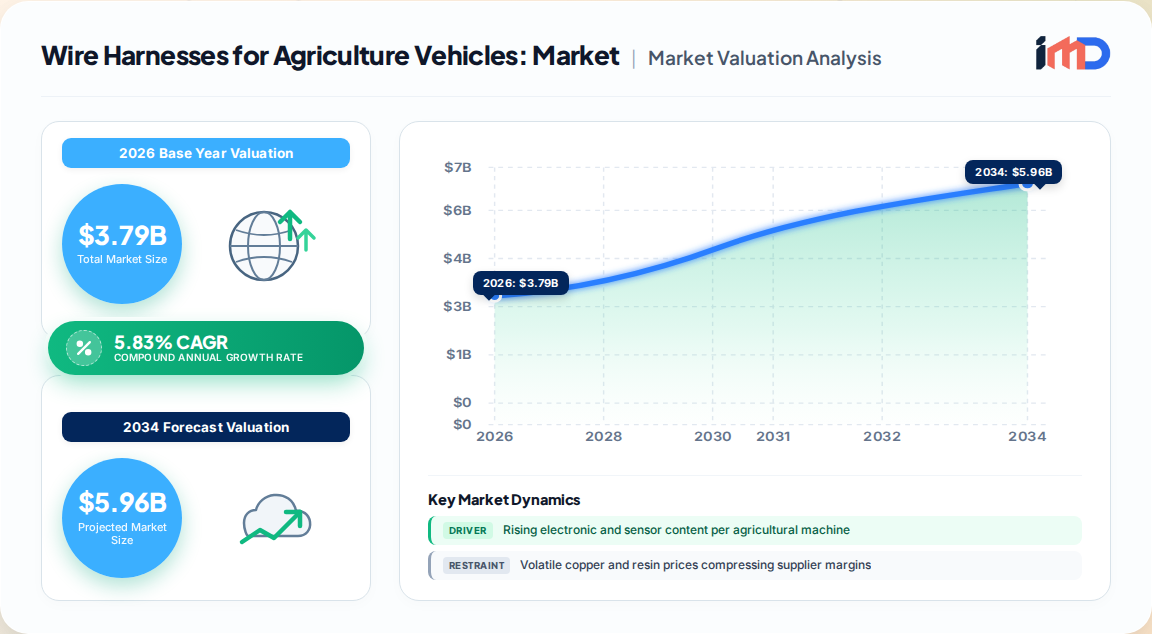
The global market for wire harnesses for agriculture vehicles is estimated at USD 3.79 Billion in 2026 and is projected to expand at a CAGR of 5.83% to reach USD 5.30 Billion by 2032, based on our proprietary primary research and expert interview program. Wire harnesses in agricultural machinery are integrated assemblies of conductors, terminals, connectors, protective coverings, and routing hardware that distribute power and signals across tractors, combines, sprayers, harvesters, and telehandlers. Unlike passenger-car looms, agricultural harnesses must survive extreme vibration, mud, chemical fertilizers and pesticides, UV radiation, thermal cycling, and frequent field service exposure.
The market is undergoing a structural transformation from simple point-to-point wiring toward modular, networked, and zonal electrical architectures that support sensors, electronic control units (ECUs), displays, ISOBUS implement communication, precision-guidance systems, and automated functions. This shift is elevating connector integrity, electromagnetic compatibility (EMC), sealing, weight management, and standardized interfaces to strategic procurement priorities.
The competitive landscape includes harness specialists and diversified tier-one suppliers such as Popular Systems, Aptiv PLC, Kyungshin Corporation, Dhoot Transmission Private Limited, and Spark Minda Group (Minda Corporation Limited), alongside global wiring leaders that serve adjacent automotive and industrial segments.
Demand for agricultural vehicle harnesses is driven by the increasing electronic content per machine, the adoption of precision-farming systems, tightening emissions and safety regulations, and the need to reduce machine downtime during narrow operating windows.
| Driver | Estimated Impact on CAGR (percentage points) | Geographic Relevance |
|---|---|---|
| Rising electronic and sensor content per agricultural machine | +1.6 | Global |
| Precision agriculture and guidance-system adoption | +1.3 | North America, Europe, Asia-Pacific |
| ISOBUS and implement-communication standardization | +0.9 | Europe, North America |
| Electrification of compact and specialty agricultural equipment | +0.8 | Europe, China, North America |
| Regulatory mandates for safety and emissions telematics | +0.7 | EU, U.S., Japan |
Principal restraints include volatile copper and resin prices, which can compress supplier margins by an estimated 0.8 to 1.0 percentage points of CAGR, as well as the mismatch between rising harness complexity and the availability of skilled assembly labor in ASEAN and Latin America. Environmental qualification costs and long OEM validation cycles also slow platform turnover.
Agricultural equipment electrical systems are moving from discrete wiring toward modular, networked architectures. This transition increases the importance of connector families that remain sealed and serviceable after thousands of hours of field operation. Design priorities now include:
Artificial intelligence is influencing harness design and operations through computer-aided routing optimization, anomaly detection, and predictive maintenance workflows. When combined with vehicle telemetry, AI can identify patterns associated with connector degradation, insulation damage, intermittent faults, or abnormal electrical loads, allowing maintenance teams to prioritize inspections before failures interrupt harvest or planting schedules.
AI also supports manufacturing quality control by analyzing images and end-of-line test data for missing terminals, incorrect routing, incomplete seals, and assembly deviations. These applications do not replace engineering validation; they increase the value of structured design data, traceability, and standardized components across the harness lifecycle.
North America is characterized by large, technologically advanced machinery and extensive precision-farming adoption, with strong attention to serviceability and uptime. Europe emphasizes efficiency, environmental performance, safety, and electronic integration under harmonized EU technical expectations. Asia-Pacific spans highly automated machinery markets and smaller-scale farming systems, creating varied requirements for cost control, modularity, localization, and resistance to tropical or monsoonal conditions.
| Region | Market Share (2026, estimated) | Key Demand Characteristics |
|---|---|---|
| Asia-Pacific | 38% | Localization, cost control, tropical protection, high-volume tractor platforms |
| North America | 24% | Large machinery, precision agriculture, uptime and serviceability |
| Europe | 22% | Safety, efficiency, ISOBUS integration, environmental performance |
| South America | 9% | Dust, moisture, vibration, adaptable replacement solutions |
| Middle East & Africa | 7% | Heat, dust, water management, robust maintainable assemblies |
By application, engine and powertrain harnesses remain the largest volume segment, while sensor, telematics, and precision-agriculture harnesses are the fastest-growing cluster, reflecting the proliferation of guidance, yield-monitoring, and implement-control electronics. Cab and lighting harnesses represent a stable replacement and upgrade market.
The value chain spans conductor and insulation suppliers, terminal and connector manufacturers, protective covering and sealing specialists, harness assemblers, and OEM integration teams. Tier-one harness suppliers increasingly co-design with agricultural OEMs and implement makers, taking responsibility for routing validation, environmental qualification, and end-of-line electrical testing.
Procurement priorities for industry leaders include:
Automated inspection and traceability reduce assembly variation, while diagnostic guidance and replaceable subassemblies shorten field repairs. Suppliers that combine engineering depth with repeatable production quality, faster launch timing, and lower warranty stress are best positioned to capture share.
Competition in agricultural vehicle harnesses is shifting from component pricing toward systems-level engineering. Leading suppliers are investing in design automation, digital twins, and regional manufacturing footprints to serve OEMs across multiple continents. Key strategic priorities include:
Our primary interviews suggest that suppliers capable of demonstrating field-proven reliability over extended service intervals can command premium pricing and preferred-supplier status. The market rewards a balance of scale, customization, and consistent execution across regions.
The wire harnesses for agriculture vehicles market is poised for steady expansion, reaching USD 5.30 Billion by 2032 at a 5.83% CAGR. Success will depend on designing modular, serviceable, and environmentally robust harness platforms that support the connected, automated, and increasingly electrified agricultural machinery of the next decade. Industry leaders should prioritize field-validated qualification, digital traceability, and regional supply resilience to capture growth across diverse agricultural markets.
| Aspects | Details |
|---|---|
| Study Period | 2020-2034 |
| Base Year | 2026 |
| Estimated Year | 2026 |
| Forecast Period | 2026-2034 |
| Historical Period | 2020-2025 |
| Growth Rate | CAGR of 5.83% from 2020-2034 |
| Segmentation |
|
By Conductor Material
By Voltage Rating
By Sales Channel
By Vehicle Type
| By Geography |
|
The global market is estimated at USD 3.79 Billion in 2026 and is projected to reach USD 5.30 Billion by 2032, growing at a CAGR of 5.83%.
Asia-Pacific holds the largest share at approximately 38% in 2026, driven by high tractor and harvester production in China, India, and Japan, followed by North America and Europe.
Rising electronic and sensor content per machine, precision-agriculture adoption, ISOBUS standardization, and electrification of compact equipment are the primary growth drivers, contributing an estimated 5.3 percentage points to CAGR.
Key players include Popular Systems, Aptiv PLC, Kyungshin Corporation, Dhoot Transmission Private Limited, and Spark Minda Group (Minda Corporation Limited), among other global and regional harness specialists.
Our rigorous research methodology combines multi-layered approaches with comprehensive quality assurance, ensuring precision, accuracy, and reliability in every market analysis.
| Stakeholder Role | Interview Share (%) |
|---|---|
| Vice President of Engineering | 30% |
| Procurement Director | 28% |
| Platform Chief Engineer | 25% |
| Aftermarket Service Manager | 17% |
| Company Type | Representation (%) |
|---|---|
| Agricultural OEM electrical architecture teams | 30% |
| Tier-one harness assemblers | 25% |
| Connector and terminal component manufacturers | 20% |
| Precision-agriculture electronics suppliers | 15% |
| Independent field-service and retrofit specialists | 10% |
 Related Reports
