1What is the size of the United Kingdom mattress market?
The UK mattress market is valued at an estimated USD 1.45 billion in 2026 and is forecast to reach USD 1.66 billion by 2031, growing at a CAGR of 2.74%.
Insight Market Data is a premier market research and business consulting firm headquartered in Pune, India, providing syndicated research reports, customized intelligence studies, and strategic advisory services. Renowned academic institutions and Fortune 500 corporations worldwide rely on Insight Market Data's research repository to navigate evolving global and regional business environments. Covering 46 diverse industries across 25 major international economies, our comprehensive database delivers thousands of verified statistics and granular market evaluations. By combining industry-leading analytical methodologies with the direct insights of seasoned industry leaders and subject-matter experts, we deliver actionable intelligence spanning historical performance benchmarks to rigorous multi-year forecasts. We empower organizations to make confident, data-driven decisions across pivotal domains including Machinery & Equipment, Chemicals & Materials, Pharmaceuticals & Healthcare, Food & Beverages, Consumer Goods, Energy & Power, Automotive & Transportation, Electronics & Semiconductors, Medical Devices, Telecommunications, Emerging Technologies, Agriculture, and Packaging. Our multidisciplinary analyst teams provide an objective 360-degree perspective, tailoring every engagement to address complex strategic challenges with exceptional analytical rigor.
Leveraging advanced BI-powered analytics and predictive modeling, Insight Market Data uncovers high-impact market opportunities and competitive differentiators for ambitious enterprises. We continuously refine our research methodologies in accordance with global industry standards, tracking real-time market shifts to ensure our reports are consistently accurate, actionable, and delivered on schedule. Our analysts conduct methodical data validation, rigorous compliance checks, and exhaustive primary and secondary research to maintain the highest levels of data integrity and transparency. We partner closely with corporate strategists, investment groups, and business executives to translate intricate market intelligence into clear, actionable roadmaps for sustainable growth. With operational presence across Washington, USA, and Vimannagar, Pune, India, Insight Market Data ensures direct access to dedicated research specialists and responsive customer support to answer your most strategic questions.
 United Kingdom Mattress Market
 by Product Type (Innerspring/Coil, Foam, Latex, Hybrid, Other Types), by Mattress Size (Single, Double, Queen, King, Custom & Specialty), by End User (Residential, Commercial(Hotels & Resorts, Vacation Rental, Hostels)), by Distribution Channel (B2C/Retail, B2B/Project, Online), by England, by Scotland, by Wales, by Northern Ireland Forecast 2026-2034

Research Associate


 Related Reports

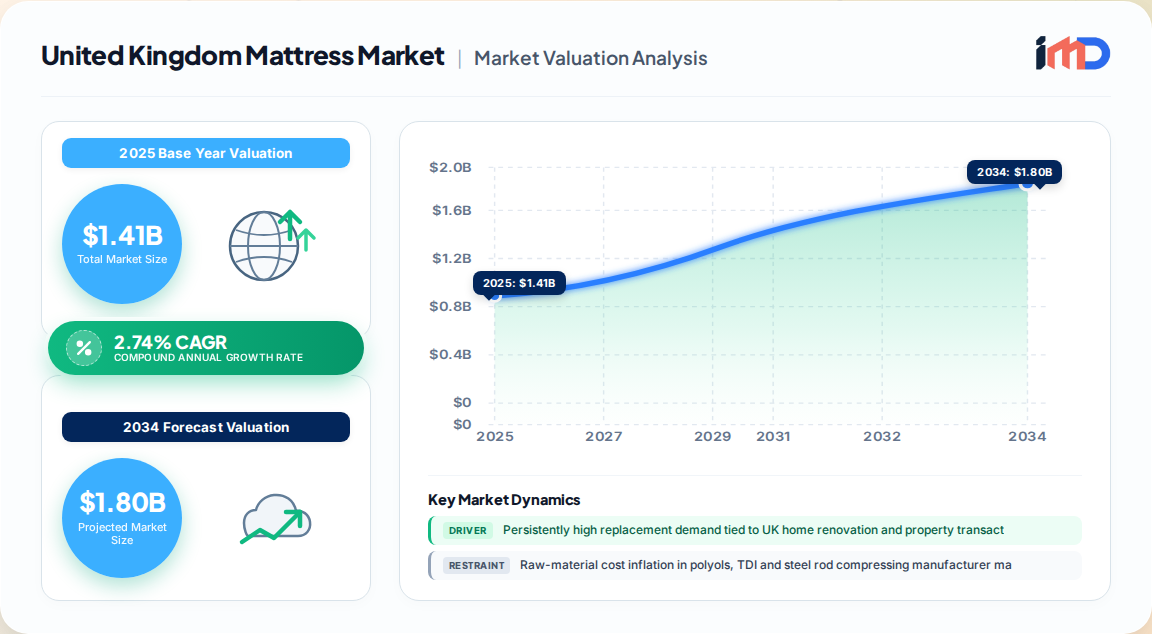
The United Kingdom mattress market is estimated at USD 1.45 billion in 2026 and is projected to reach USD 1.66 billion by 2031, expanding at a CAGR of 2.74%. Our proprietary demand model pegs the 2025 base year at USD 1.41 billion, indicating a market that is structurally mature but commercially restless.
Volume growth is anchored in replacement rather than first-time purchase: the household installed base is essentially saturated, and the National Bed Federation's long-running replacement-cycle research continues to show that a large share of UK adults sleep on mattresses well beyond the seven-year guideline. Value growth, therefore, comes from trading up — thicker hybrids, pressure-relief foams, and sustainably certified constructions.
Our primary interviews with retailers, contract furnishers, and manufacturers converge on six demand levers. The quantified impact below reflects our regression analysis of 2020–2025 category data, with impact expressed as contribution to the forecast CAGR.
| Driver | Estimated Impact on CAGR | Geography | Timeline |
|---|---|---|---|
| Pent-up replacement demand tied to home renovation cycles | +0.8% | England, Scotland, Wales | Medium term |
| Bed-in-a-box e-commerce reshaping buying behaviour | +0.6% | Urban UK-wide | Short term |
| Hospitality refurbishment ahead of 2028 events | +0.4% | England, Scotland | Short term |
| Ageing-in-place and pressure-relief home-care demand | +0.7% | England, Wales | Long term |
| Build-to-Rent furnishing and subscription models | +0.5% | London, Manchester, Birmingham | Medium term |
| ESG-linked procurement favouring low-carbon designs | +0.3% | UK-wide, EU-aligned | Long term |
Replacement behaviour is the single largest structural driver. Property transactions typically trigger a mattress upgrade within 18 months, creating a reliable rhythm of replacement sales that insulates the category from discretionary spending shocks. Retailer education campaigns have successfully reframed over-aged sleep surfaces as a health cost rather than a value purchase.
Restraints are equally structural.
Segment performance diverges sharply from headline growth. Legacy innerspring volume remains the largest pool but is losing relative share, while foam and commercial channels generate the incremental value.
| Segment | Metric | Value |
|---|---|---|
| Innerspring/Coil | Share of market, 2025 | 40.85% |
| Foam | Forecast CAGR to 2031 | 3.02% |
| King size | Share by size, 2025 | 37.12% |
| Queen size | Forecast CAGR to 2031 | 3.46% |
| Residential | Share of value, 2025 | 75.05% |
| Commercial | Forecast CAGR to 2031 | 3.79% |
| B2C retail | Share of value, 2025 | 71.62% |
| Online | Forecast CAGR to 2031 | 3.48% |
By product type, innerspring dominance reflects the UK's enduring preference for firm, supportive sleep surfaces and the deep domestic coil supply chain. However, foam's 3.02% CAGR is driven by compressed bed-in-a-box logistics economics and the ageing demographic's preference for pressure-point relief. Hybrid constructions — pocket springs married to high-density foam — are the fastest-growing premium sub-tier and command the highest average selling price outside the luxury segment.
By size, the king-size share of 37.12% underscores how UK households have upsized beds as master bedrooms have been reconfigured. The queen format's 3.46% CAGR signals a squeeze emerging between single-unit urban apartment demand and premium king purchases.
By end user, commercial demand is the outperformer at 3.79% CAGR. Hotel chains are pulling forward replacement programmes — budget operators expanded room pipelines significantly over 2024–2025 and specify medium-firm contract mattresses with certified flame retardancy and recyclability.
By distribution channel, B2C retail still commands 71.62% of value, but online's 3.48% CAGR reflects a permanent shift in pre-purchase research behaviour. Physical showrooms retain conversion advantage in premium segments; online wins on price transparency and trial periods of 90 to 365 days.
The UK runs a structural trade deficit in mattress supports (HS 940410). In 2024, imports totalled USD 55.01 million across 21.92 million kg, against exports of USD 15.95 million across 1.52 million kg — a deficit of roughly USD 39 million. Notably, the average import price per kilogram of approximately USD 2.51 sits well below the export average of roughly USD 10.52, revealing that the UK imports volume-heavy, lower-value units and exports higher-value finished or specialised products.
| Origin Market | Import Value (2024) | Volume (kg) |
|---|---|---|
| China | USD 28.32 million | 11.10 million |
| Turkey | USD 14.35 million | 7.97 million |
| Germany | USD 5.83 million | 0.92 million |
| Lithuania | USD 2.33 million | 1.04 million |
| Pakistan | USD 1.52 million | 0.26 million |
On the export side, USD 2.50 million each flowed to the United States and to unspecified destinations, with the Netherlands (USD 1.87 million), Saudi Arabia (USD 1.22 million), and Belgium (USD 1.04 million) completing the top five. This profile suggests UK manufacturers are exporting premium and contract-grade product into Gulf hospitality projects and North American speciality retail.
Supply-chain implication: domestic manufacturers compete on design, certification, and delivery reliability rather than cost. Post-Brexit customs friction has made the long, low-value import lane progressively less attractive, nudging sourcing toward near-shore European suppliers for mid-tier volume.
England accounts for 40.88% of market value in 2025, reflecting population density, the London build-to-rent pipeline, and the concentration of hospitality stock. Scotland is forecast to deliver the highest CAGR at 4.01% to 2031, supported by tourism infrastructure investment and urban regeneration.
| Region | Position | Growth Character |
|---|---|---|
| England | 40.88% share (2025) | Premiumisation, BTR, hospitality |
| Scotland | Fastest growth, 4.01% CAGR | Tourism-led and public-sector refurbishment |
| Wales | Moderate | Public housing replacement cycles |
| Northern Ireland | Moderate | Cross-border supply and independent retail |
Our regional share model allocates the balance of value to online cross-border and unallocated purchases, a category that now spans roughly three-tenths of demand. This reflects the reality that online orders cannot be cleanly attributed to a fulfilment region.
The UK market has medium concentration with a long tail of independent manufacturers. The largest domestic manufacturer holds a low-double-digit share, with regional specialists and importers filling out the field.
Key competitors include Dreams, Silentnight Group, Tempur Sealy UK, Emma – The Sleep Company, and Simba Sleep, alongside contract specialists and international suppliers active in the hospitality lane.
Strategic archetypes our interviews identify:
Recent industry developments shaping the field:
Three white spaces stand out for investors and operators planning entry or expansion.
Risk factors temper the outlook: import concentration in two lanes, raw-material price volatility, and the profitability ceiling on direct-to-consumer acquisition economics. Investors should weight businesses with owned manufacturing footprint, certified supply chains, and contract backlog over purely digital-first plays.
Our central case holds a 2.74% CAGR to 2031, with downside risk from consumer durables deferral and upside potential from faster hospitality refresh and ESG procurement adoption. Foam and hybrid will absorb most incremental value; innerspring will defend volume through contract specifications.
The strategic imperative for the period is clear: compete on sleep outcomes and verifiable sustainability, not on discount depth. Operators able to prove health benefits, certify carbon performance, and deliver reliable contract volume will capture disproportionate share of a market growing steadily rather than spectacularly.
| Aspects | Details |
|---|---|
| Study Period | 2020-2034 |
| Base Year | 2025 |
| Estimated Year | 2026 |
| Forecast Period | 2026-2034 |
| Historical Period | 2020-2025 |
| Growth Rate | CAGR of 2.74% from 2020-2034 |
| Segmentation |
|
By End User
By Distribution Channel
| By Geography |
|
The UK mattress market is valued at an estimated USD 1.45 billion in 2026 and is forecast to reach USD 1.66 billion by 2031, growing at a CAGR of 2.74%.
Key players include Dreams, Silentnight Group, Tempur Sealy UK, Emma – The Sleep Company, and Simba Sleep, alongside contract specialists serving the hospitality sector. Market concentration is medium, with no single supplier holding a dominant share.
Foam mattresses are forecast to grow at the fastest product-level CAGR of 3.02% to 2031, while the commercial end-user segment is expanding at 3.79% CAGR driven by hospitality refurbishment cycles.
In 2024 the UK imported USD 55.01 million of mattress supports against exports of USD 15.95 million, a deficit of roughly USD 39 million. China and Turkey together supply about 78% of import value, while UK exports skew toward higher-value specialised product.
England accounts for 40.88% of market value in 2025, but Scotland is projected to record the highest CAGR at 4.01% to 2031, supported by tourism infrastructure investment and urban regeneration.
Our rigorous research methodology combines multi-layered approaches with comprehensive quality assurance, ensuring precision, accuracy, and reliability in every market analysis.
| Stakeholder Role | Interview Share (%) |
|---|---|
| Procurement Director | 30% |
| Category Buyer / Retail Merchandising Manager | 27% |
| Supply Chain & Sourcing Manager | 25% |
| Sustainability & Compliance Lead | 18% |
| Company Type | Representation (%) |
|---|---|
| Mattress Manufacturers & Assemblers | 30% |
| Coil, Foam & Component Suppliers | 18% |
| Retailers & Omnichannel Operators | 24% |
| Direct-to-Consumer Sleep Brands | 14% |
| Hospitality Contract Furnishers | 14% |