1What is the current market size of the deer hunting blinds industry?
The global deer hunting blinds market was valued at USD 373 million in 2025 and is projected to reach USD 700 million by 2035, growing at a CAGR of 6.5%.
Insight Market Data is a premier market research and business consulting firm headquartered in Pune, India, providing syndicated research reports, customized intelligence studies, and strategic advisory services. Renowned academic institutions and Fortune 500 corporations worldwide rely on Insight Market Data's research repository to navigate evolving global and regional business environments. Covering 46 diverse industries across 25 major international economies, our comprehensive database delivers thousands of verified statistics and granular market evaluations. By combining industry-leading analytical methodologies with the direct insights of seasoned industry leaders and subject-matter experts, we deliver actionable intelligence spanning historical performance benchmarks to rigorous multi-year forecasts. We empower organizations to make confident, data-driven decisions across pivotal domains including Machinery & Equipment, Chemicals & Materials, Pharmaceuticals & Healthcare, Food & Beverages, Consumer Goods, Energy & Power, Automotive & Transportation, Electronics & Semiconductors, Medical Devices, Telecommunications, Emerging Technologies, Agriculture, and Packaging. Our multidisciplinary analyst teams provide an objective 360-degree perspective, tailoring every engagement to address complex strategic challenges with exceptional analytical rigor.
Leveraging advanced BI-powered analytics and predictive modeling, Insight Market Data uncovers high-impact market opportunities and competitive differentiators for ambitious enterprises. We continuously refine our research methodologies in accordance with global industry standards, tracking real-time market shifts to ensure our reports are consistently accurate, actionable, and delivered on schedule. Our analysts conduct methodical data validation, rigorous compliance checks, and exhaustive primary and secondary research to maintain the highest levels of data integrity and transparency. We partner closely with corporate strategists, investment groups, and business executives to translate intricate market intelligence into clear, actionable roadmaps for sustainable growth. With operational presence across Washington, USA, and Vimannagar, Pune, India, Insight Market Data ensures direct access to dedicated research specialists and responsive customer support to answer your most strategic questions.
 Deer Hunting Blinds Market
 by Type (Ground Blinds, Tree Stands), by Material (Fabric, Metal), by Deployment (Portable, Fixed), by Application (Deer Hunting, Waterfowl Hunting), by End User (Recreational Hunters, Professional Hunters), by North America (USA, Canada, Mexico), by Europe (Germany, UK, France), by Asia Pacific (China, Japan, India), by South America (Brazil, Argentina), by Middle East & Africa (South Africa, UAE) Forecast 2026-2034

Research Associate


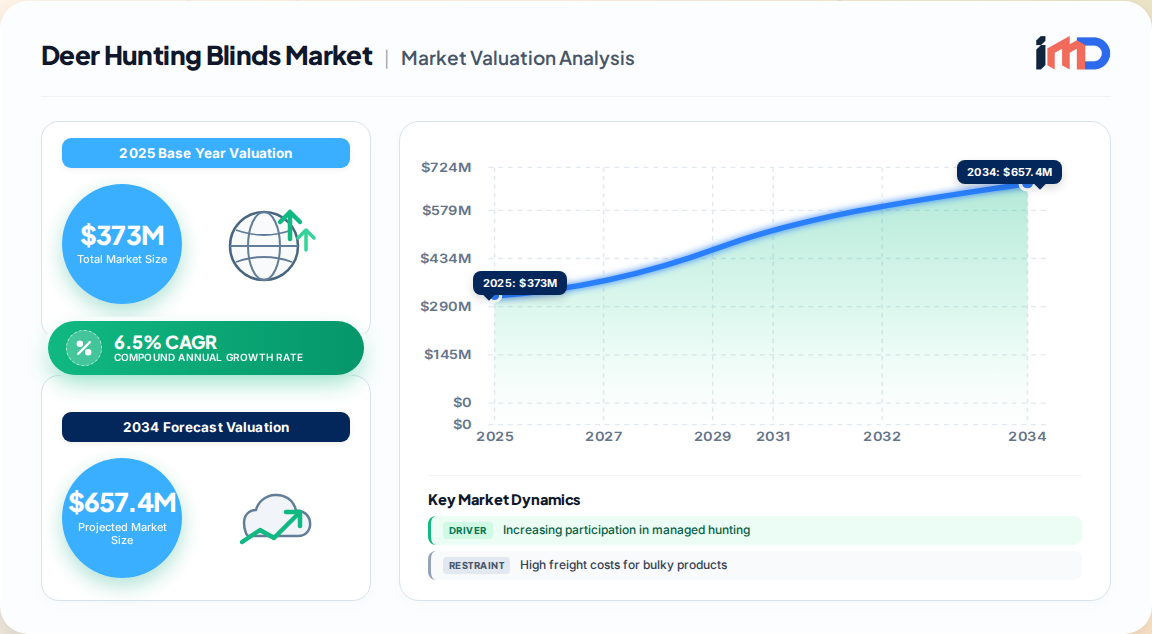
The global deer hunting blinds market represents a specialized, high-value segment within the broader outdoor recreation and hunting equipment industry. Our proprietary primary research estimates the market at USD 373 Million in 2025, with a projected expansion to USD 700 Million by 2035, registering a CAGR of 6.5% during the forecast period. This growth is underpinned by sustained participation in regulated hunting across North America and parts of Europe, coupled with a clear consumer shift toward premium, durable, and technologically integrated concealment solutions.
Deer hunting blinds are no longer mere utilitarian shelters; they have evolved into sophisticated platforms that integrate sound isolation, scent control, modular construction, and enhanced field-of-view engineering. The market is characterized by a mix of established outdoor brands and specialized regional fabricators, with North America commanding the dominant share of global demand. Key buying centers include individual recreational hunters, commercial outfitters, and wildlife management agencies.
The deer hunting blinds market is propelled by a confluence of demographic, regulatory, and technological factors. Our primary interviews with industry stakeholders reveal that the demand for comfort and concealment is reshaping product design and procurement strategies.
Despite positive growth fundamentals, the market faces several structural headwinds that constrain faster expansion.
The deer hunting blinds value chain is characterized by a fragmented upstream supply base and a distribution network that is increasingly reliant on specialized dealers and direct-to-consumer models.
Table: Value Chain Margin Pools (Indicative)
| Stage | Key Activities | Margin Range |
|---|---|---|
| Raw Materials | Lumber, steel, fabrics | 5–10% |
| Component Manufacturing | Windows, doors, hardware | 15–25% |
| Blind Assembly | Final product assembly | 20–30% |
| Distribution/Retail | Dealer and retail sales | 10–20% |
Source: Proprietary primary research and expert interviews.
The deer hunting blinds market can be segmented across multiple dimensions, reflecting diverse hunter preferences and use cases.
By Product Type
By Material
By Deployment
By Application
By End User
North America, particularly the United States, represents the largest and most mature market for deer hunting blinds, driven by strong hunting culture, extensive private land ownership, and a well-developed dealer network. The U.S. accounts for an estimated 60% of global demand, with the Midwest and Southern states being key consumption regions. Europe follows as the second-largest market, with countries like Germany, France, and the UK showing steady demand for high-quality blinds, albeit at a smaller scale. The Asia-Pacific region is nascent but growing, primarily in countries with developing hunting tourism sectors.
The competitive environment is characterized by a mix of national brands and regional specialists, each vying for market share through product differentiation, dealer relationships, and brand reputation.
Table: Competitive Positioning Matrix
| Company Type | Key Strengths | Typical Strategies |
|---|---|---|
| Large Outdoor Brands | Broad distribution, brand recognition | Mass production, retail partnerships, acquisitions |
| Regional Specialists | Craftsmanship, customization, durability | Dealer networks, warranties, word-of-mouth |
| Modular/Portable Innovators | Lightweight, easy setup, affordability | E-commerce, direct sales, quick shipping |
The deer hunting blinds market exhibits limited international trade in finished products due to high freight costs and bulky dimensions. However, components and materials are actively traded globally.
Source: Proprietary primary research, trade association data, and official customs statistics.
Our analysis identifies several underserved segments and emerging opportunities for market participants.
Procurement professionals and outfitters should consider the following factors when selecting blind suppliers:
Table: Procurement Checklist
| Criterion | Key Questions | Weight (Indicative) |
|---|---|---|
| Durability | Warranty length? Materials used? | 30% |
| Cost | Total cost including shipping and installation? | 25% |
| Customization | Options for size, windows, accessories? | 20% |
| Logistics | Lead time? Shipping cost? Assembly complexity? | 15% |
| After-Sales | Parts availability? Support responsiveness? | 10% |
Market participants can leverage the Ansoff Matrix to identify growth pathways.
Table: Ansoff Matrix for Deer Hunting Blinds
| Existing Markets | New Markets | |
|---|---|---|
| Existing Products | Market Penetration | Market Development |
| New Products | Product Development | Diversification |
| Aspects | Details |
|---|---|
| Study Period | 2020-2034 |
| Base Year | 2025 |
| Estimated Year | 2026 |
| Forecast Period | 2026-2034 |
| Historical Period | 2020-2025 |
| Growth Rate | CAGR of 6.5% from 2020-2034 |
| Segmentation |
|
By Deployment
By Application
By End User
| By Geography |
|
The global deer hunting blinds market was valued at USD 373 million in 2025 and is projected to reach USD 700 million by 2035, growing at a CAGR of 6.5%.
North America holds the largest share, accounting for approximately 62% of global demand, driven by a strong hunting culture and extensive private land ownership.
Key trends include the rising demand for modular and portable blinds, integration of silent window systems, increased focus on scent control, and the use of durable, weather-resistant materials.
Recreational hunters, commercial outfitters, hunting clubs, and wildlife management agencies are the primary end users. Recreational hunters represent the largest segment.
Challenges include seasonality of demand, high freight costs for bulky products, price sensitivity among hunters, and volatility in raw material prices.
Our rigorous research methodology combines multi-layered approaches with comprehensive quality assurance, ensuring precision, accuracy, and reliability in every market analysis.
| Stakeholder Role | Interview Share (%) |
|---|---|
| Procurement Director | 30% |
| Operations Manager | 25% |
| Senior Buyer | 20% |
| Wildlife Management Official | 15% |
| Product Development Manager | 10% |
| Company Type | Representation (%) |
|---|---|
| Blind Manufacturers (Hard-sided & Elevated) | 35% |
| Component & Material Suppliers | 25% |
| Outdoor Retailers & Dealers | 20% |
| Commercial Outfitters & Hunting Lodges | 15% |
| Wildlife Management Agencies | 5% |
 Related Reports
