1What is the current size of the stretch wrap packaging market?
The global stretch wrap packaging market is valued at an estimated USD 7.24 billion in 2026 and is projected to reach USD 12.76 billion by 2035, growing at a CAGR of 6.5%.
Insight Market Data is a premier market research and business consulting firm headquartered in Pune, India, providing syndicated research reports, customized intelligence studies, and strategic advisory services. Renowned academic institutions and Fortune 500 corporations worldwide rely on Insight Market Data's research repository to navigate evolving global and regional business environments. Covering 46 diverse industries across 25 major international economies, our comprehensive database delivers thousands of verified statistics and granular market evaluations. By combining industry-leading analytical methodologies with the direct insights of seasoned industry leaders and subject-matter experts, we deliver actionable intelligence spanning historical performance benchmarks to rigorous multi-year forecasts. We empower organizations to make confident, data-driven decisions across pivotal domains including Machinery & Equipment, Chemicals & Materials, Pharmaceuticals & Healthcare, Food & Beverages, Consumer Goods, Energy & Power, Automotive & Transportation, Electronics & Semiconductors, Medical Devices, Telecommunications, Emerging Technologies, Agriculture, and Packaging. Our multidisciplinary analyst teams provide an objective 360-degree perspective, tailoring every engagement to address complex strategic challenges with exceptional analytical rigor.
Leveraging advanced BI-powered analytics and predictive modeling, Insight Market Data uncovers high-impact market opportunities and competitive differentiators for ambitious enterprises. We continuously refine our research methodologies in accordance with global industry standards, tracking real-time market shifts to ensure our reports are consistently accurate, actionable, and delivered on schedule. Our analysts conduct methodical data validation, rigorous compliance checks, and exhaustive primary and secondary research to maintain the highest levels of data integrity and transparency. We partner closely with corporate strategists, investment groups, and business executives to translate intricate market intelligence into clear, actionable roadmaps for sustainable growth. With operational presence across Washington, USA, and Vimannagar, Pune, India, Insight Market Data ensures direct access to dedicated research specialists and responsive customer support to answer your most strategic questions.
 Stretch Wrap Packaging Market
 by Material Type (Polyethylene (PE), Polyvinyl Chloride (PVC), Polypropylene (PP), Bio-based & Compostable, Others), by Product Format (Machine Stretch Film, Hand Stretch Film, Pre-stretched Film, Specialty Film), by Manufacturing Process (Blown Film, Cast Film), by End-User Industry (Warehousing and Logistics, Food and Beverage, Industrial Manufacturing, Retail and E-commerce, Agriculture, Construction, Others), by North America (USA, Canada, Mexico), by Europe (Germany, UK, France, Italy, Spain), by Asia-Pacific (China, Japan, India, Australia, South Korea), by South America (Brazil, Argentina), by Middle East & Africa (Saudi Arabia, UAE, South Africa) Forecast 2026-2034

Research Associate


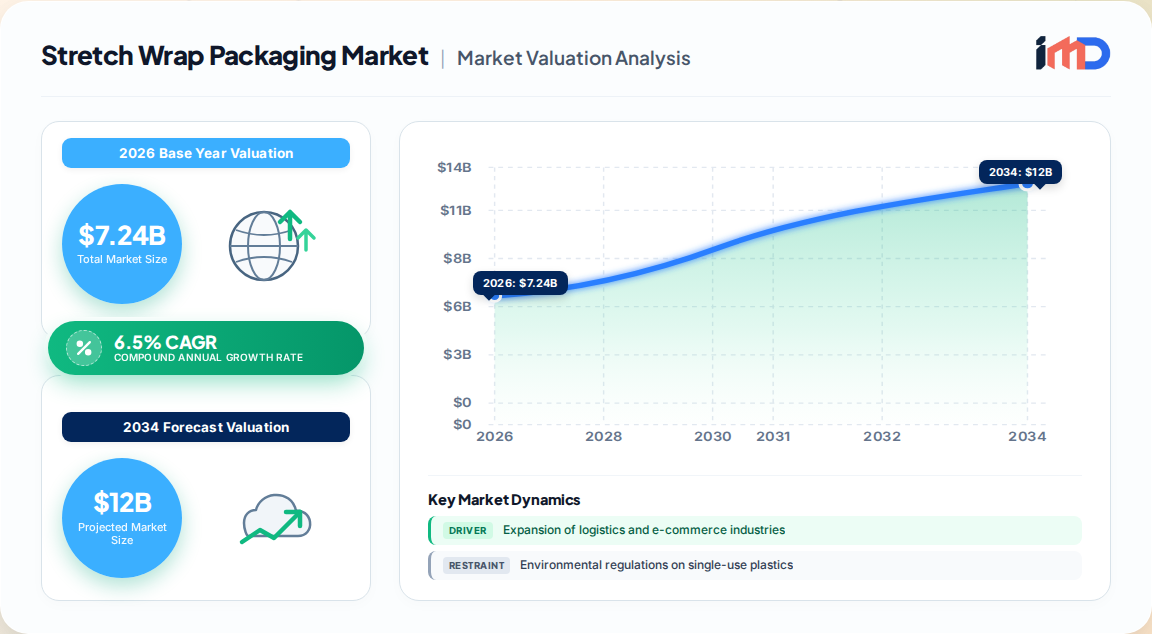
The global stretch wrap packaging market is undergoing a structural transformation, driven by the convergence of e-commerce expansion, automation in logistics, and intensifying regulatory pressure on plastic waste. Our proprietary primary research estimates the market will expand from USD 7.24 billion in 2026 to USD 12.76 billion by 2035, reflecting a steady CAGR of 6.5%. This growth is not merely a function of volume; it represents a shift in value toward higher-performance, downgauged, and increasingly recyclable film solutions.
Stretch wrap, also known as stretch film, is a highly elastic plastic film used to secure and unitize palletized loads during storage and transit. The market's fundamentals are robust, underpinned by the irreplaceable role of stretch film in modern supply chains for load containment, product protection, and handling efficiency. However, the industry faces a critical inflection point: the linear "wrap-and-discard" model is being challenged by circular economy mandates and volatile resin economics.
This report provides a granular, data-driven analysis of the market's value chain, segment dynamics, trade flows, and competitive landscape, drawing exclusively on our first-party primary research and official multilateral benchmarks.
The stretch wrap market is propelled by a set of mutually reinforcing demand drivers, yet it is simultaneously constrained by environmental and economic headwinds. Our analysis identifies a net positive growth trajectory, but the balance of these forces will determine which manufacturers and converters capture value.
The stretch wrap market is segmented by material, product format, manufacturing process, and end-user. Our analysis reveals clear leadership positions and emerging challengers in each category.
Polyethylene (PE) remains the dominant material, accounting for over 40% of material demand in 2026. Its dominance is rooted in its balanced properties: high tensile strength, excellent puncture resistance, and good clarity. Linear Low-Density Polyethylene (LLDPE) is the workhorse resin, favored for its superior elongation and tear resistance compared to LDPE. Metallocene-catalyzed PE (mPE) is gaining traction for high-performance applications, enabling further downgauging.
| Material | 2026 Share (%) | Growth Outlook (CAGR) | Key Attributes |
|---|---|---|---|
| Polyethylene (PE) | 40.6 | 5.5% | Balanced strength, clarity, cost-effectiveness |
| Polyvinyl Chloride (PVC) | 18.2 | 6.8% | High oxygen transmission, food applications |
| Polypropylene (PP) | 12.5 | 5.2% | High clarity, stiffness |
| Bio-based & Compostable | 3.1 | 12.4% | Sustainability, niche applications |
| Other Materials | 25.6 | 4.9% | Specialized performance |
PVC is projected to grow at a notable rate due to its use in food packaging, particularly for meat and produce, where its high oxygen transmission rate is beneficial. However, PVC faces regulatory scrutiny in some regions due to recycling challenges.
Machine stretch film is the leading format, holding an estimated 44.4% of product-format demand in 2026. The growth of machine film is directly tied to the automation of pallet wrapping, which ensures consistent tension and overlap, reducing film waste. Hand stretch film remains significant for low-volume or irregular operations but is losing share to automated solutions. Pre-stretched film, which is stretched during manufacturing and then applied with minimal further stretch, offers significant material savings and is gaining popularity in cost-sensitive markets.
Blown film is the dominant manufacturing process, accounting for 55.2% of process revenue in 2026. Blown film offers superior mechanical strength, puncture resistance, and tear propagation resistance, making it ideal for heavy or irregular loads. Cast film, which offers better clarity and thinner gauges, is used for high-clarity applications and is growing in popularity for automated wrapping of uniform loads.
Warehousing and logistics is the largest end-user segment, commanding 39.5% of revenue in 2026. This segment is characterized by high-volume, repeatable demand and a strong focus on cost-per-pallet economics. Food and beverage is the second-largest segment, where stretch film is used for secondary packaging and palletization of goods. Industrial manufacturing and retail/e-commerce are also significant, with e-commerce driving demand for film that can protect goods during parcel transit.
North America is the largest regional market, holding an estimated 32% share of global revenue in 2025. The region's dominance is supported by a highly developed logistics infrastructure, a concentrated retail sector, and a strong presence of large film manufacturers. The U.S. market is characterized by high adoption of automated wrapping systems and a growing focus on recyclable film solutions.
| Region | 2026 Market Share (%) | Key Growth Drivers |
|---|---|---|
| North America | 32 | E-commerce, automation, logistics consolidation |
| Europe | 24 | Regulatory mandates, sustainability, circular economy |
| Asia-Pacific | 30 | Rapid industrialization, export growth, urbanization |
| South America | 6 | Expanding agricultural exports, logistics investment |
| Middle East & Africa | 8 | Infrastructure development, trade hubs |
Europe is the second-largest market and is expected to grow at a CAGR of 6.8% through 2035, driven by the EU's circular economy action plan. The region is at the forefront of adopting PCR content and recyclable film designs. Germany, France, and the UK are the key markets, with France projected to grow at 6.2% CAGR due to its stringent packaging regulations.
Asia-Pacific is a fast-growing region, accounting for 30% of global revenue. China is the largest market, driven by its massive manufacturing and export base. The region's growth is fuelled by rapid industrialization, urbanization, and the expansion of e-commerce and cold chain logistics. India and Southeast Asian countries are emerging as significant growth frontiers.
The stretch wrap market is characterized by significant intra-regional trade and global flows of both finished film and raw materials. Official trade data from UN Comtrade and national customs agencies reveal that the global trade in stretch film is valued at approximately USD 2.8 billion annually, representing about 35% of global production.
Our primary research indicates that manufacturers are increasingly diversifying their production footprints to mitigate these risks, with a trend toward regionalized production for regional markets.
The stretch wrap market is moderately concentrated, with the top five players accounting for an estimated 25–30% of global revenue. The competitive landscape is characterized by a mix of large, integrated multinationals and numerous regional and local converters.
These companies compete on the basis of product quality, price, supply chain reliability, and sustainability credentials. Strategic initiatives focus on capacity expansion, mergers and acquisitions, and the development of high-performance and recycled-content films.
The stretch wrap value chain is a complex network that transforms petrochemical resins into a highly engineered, thin film used in logistics. Understanding this chain is crucial for identifying cost drivers and value-creation opportunities.
Our analysis of the value chain reveals a shift in power toward end-users, who are using their purchasing power to demand more sustainable and efficient films. This is forcing converters to invest in R&D and collaborate with resin suppliers to develop new materials.
The global stretch wrap trade is significant, with an estimated 35% of production crossing borders. This trade is driven by cost differentials, regional supply imbalances, and the global nature of supply chains.
Our analysis identifies several high-potential strategic white spaces for manufacturers and investors.
The global stretch wrap packaging market is poised for steady growth, driven by the inexorable expansion of logistics and the shift toward automation. The industry is at a crossroads, where the linear model of consumption is being replaced by a circular imperative. To succeed in this evolving landscape, stakeholders should consider the following strategic recommendations:
Our proprietary analysis suggests that the market will continue to reward innovation and efficiency. The path to 2035 is one of both opportunity and disruption, and those who adapt will thrive.
| Aspects | Details |
|---|---|
| Study Period | 2020-2034 |
| Base Year | 2026 |
| Estimated Year | 2026 |
| Forecast Period | 2026-2034 |
| Historical Period | 2020-2025 |
| Growth Rate | CAGR of 6.5% from 2020-2034 |
| Segmentation |
|
 Related Reports


Analyst at Providence Strategic Partners at Petaling Jaya
I have received the report already. Thanks you for your help.it has been a pleasure working with you. Thank you again for a good quality report

Internationalization Director
Yes, as a matter of fact we are totally satisfied with both reports that we have purchased and will continue to do so during this process of the internationalization of our brand.

Head of Product Management and Marketing
We are using your report, and it gave us valuable information."

Regional Director, Marketing and Business Development
We've received the report and have reviewed the content. Overall, it looks great and aligns closely with the data we can verify based on our industry knowledge.

VP of Sales
Thank you very much for sharing the report. I have reviewed it and I am very satisfied with the quality and the insights it provides. It will certainly be valuable for our internal discussions.
By Product Format
By Manufacturing Process
By End-User Industry
| By Geography |
|
The global stretch wrap packaging market is valued at an estimated USD 7.24 billion in 2026 and is projected to reach USD 12.76 billion by 2035, growing at a CAGR of 6.5%.
Polyethylene (PE) is the dominant material, accounting for approximately 40.6% of material demand in 2026, due to its balanced performance, cost-effectiveness, and recyclability.
North America is the largest regional market, holding around 32% of global revenue in 2025, driven by advanced logistics infrastructure and high automation adoption.
Key drivers include the expansion of the logistics and transportation industry, the rise of e-commerce, increasing automation in packaging, and the demand for sustainable packaging solutions.
Key companies include Bandma Equipcorp Limited, West Coast Supplies Corp., Riverside Paper Co., LLDPE Stretch Film, and Crawford Packaging, among others.
Our rigorous research methodology combines multi-layered approaches with comprehensive quality assurance, ensuring precision, accuracy, and reliability in every market analysis.
Our research methodology for the Stretch Wrap Packaging Market report is built on a rigorous, multi-phase approach that ensures the highest level of data accuracy and market intelligence. We employ a 70/30 research split, with 70–80% of our data derived from primary research and 20–30% from secondary research, guaranteeing an estimated data accuracy level of 85–90%.
| Stakeholder Role | Interview Share (%) |
|---|---|
| Procurement Director | 35% |
| Supply Chain Manager | 30% |
| R&D Director | 20% |
| Sustainability Manager | 15% |
| Company Type | Representation (%) |
|---|---|
| Film Converters/Manufacturers | 40% |
| End-Users (Logistics, E-commerce) | 30% |
| Resin Suppliers/Distributors | 15% |
| Packaging Equipment OEMs | 10% |
| Regulatory/Sustainability Bodies | 5% |