1What is the size of the cycling water bottle market in 2025?
Our primary research values the global cycling water bottle market at approximately USD 1.12 Billion in 2025, with a projected 7.1% CAGR to reach USD 1.94 Billion by 2033.
Insight Market Data is a premier market research and business consulting firm headquartered in Pune, India, providing syndicated research reports, customized intelligence studies, and strategic advisory services. Renowned academic institutions and Fortune 500 corporations worldwide rely on Insight Market Data's research repository to navigate evolving global and regional business environments. Covering 46 diverse industries across 25 major international economies, our comprehensive database delivers thousands of verified statistics and granular market evaluations. By combining industry-leading analytical methodologies with the direct insights of seasoned industry leaders and subject-matter experts, we deliver actionable intelligence spanning historical performance benchmarks to rigorous multi-year forecasts. We empower organizations to make confident, data-driven decisions across pivotal domains including Machinery & Equipment, Chemicals & Materials, Pharmaceuticals & Healthcare, Food & Beverages, Consumer Goods, Energy & Power, Automotive & Transportation, Electronics & Semiconductors, Medical Devices, Telecommunications, Emerging Technologies, Agriculture, and Packaging. Our multidisciplinary analyst teams provide an objective 360-degree perspective, tailoring every engagement to address complex strategic challenges with exceptional analytical rigor.
Leveraging advanced BI-powered analytics and predictive modeling, Insight Market Data uncovers high-impact market opportunities and competitive differentiators for ambitious enterprises. We continuously refine our research methodologies in accordance with global industry standards, tracking real-time market shifts to ensure our reports are consistently accurate, actionable, and delivered on schedule. Our analysts conduct methodical data validation, rigorous compliance checks, and exhaustive primary and secondary research to maintain the highest levels of data integrity and transparency. We partner closely with corporate strategists, investment groups, and business executives to translate intricate market intelligence into clear, actionable roadmaps for sustainable growth. With operational presence across Washington, USA, and Vimannagar, Pune, India, Insight Market Data ensures direct access to dedicated research specialists and responsive customer support to answer your most strategic questions.
 Cycling Water Bottle Market
 by Material (BPA-free plastic, Stainless Steel, Aluminum, Silicone, Glass, Titanium, Others), by Product Type (Insulated, Non-Insulated, Filter-Integrated, Infuser, Collapsible), by Capacity (500-610ml, 750ml, 1L and Above), by Valve Type (Self-Sealing, Pull-Cap, High-Flow), by Distribution Channel (Specialty Bicycle Retailers, Online, Sporting Goods Chains, Mass Retail), by End User (Professional, Amateur, Commuter, Recreational), by North America (USA, Canada, Mexico), by Europe (Germany, UK, France, Italy, Netherlands), by Asia Pacific (China, Taiwan, Japan, India, South Korea), by South America (Brazil, Argentina), by Middle East & Africa (UAE, South Africa) Forecast 2026-2034

Research Associate


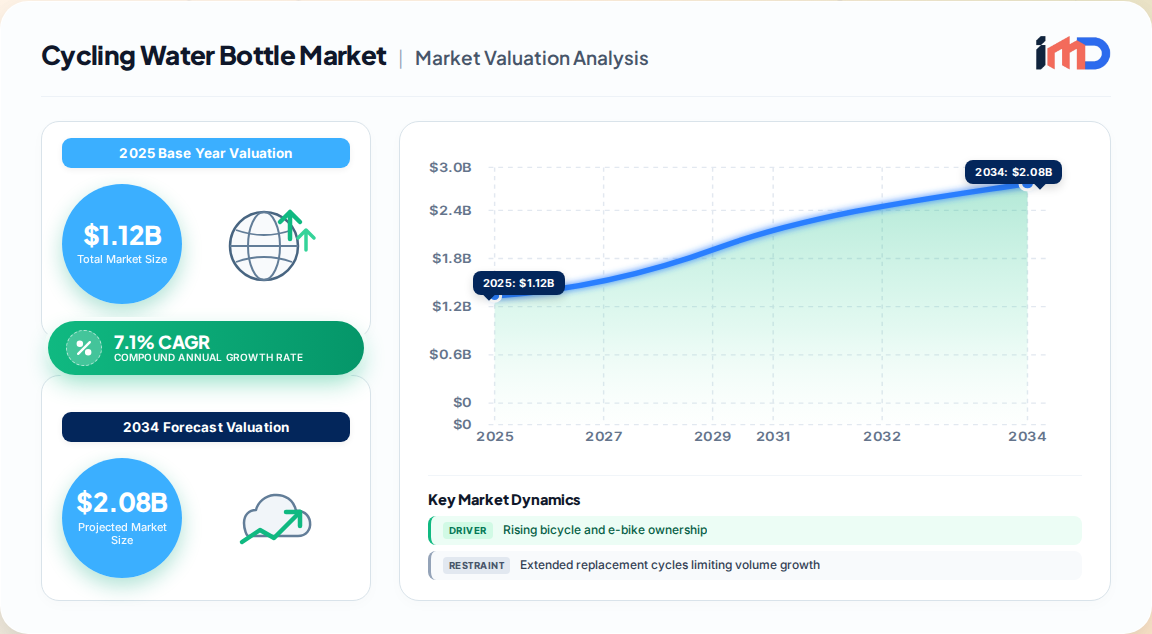
The global cycling water bottle market represents one of the most technically nuanced segments of the broader reusable hydration economy. Our proprietary primary research estimates the market at USD 1.12 Billion in 2025, with a projected expansion to USD 1.94 Billion by 2033, reflecting a CAGR of 7.1% across the forecast window. Growth is structurally anchored in the global bicycle economy, which continues to absorb commuter, gravel, e-bike, and competitive road segments simultaneously.
Unlike general-purpose reusable bottles, cycling-specific bottles are engineered around a constrained interface: cage geometry, bidon retention under vibration, one-handed actuation, and flow rate at sustained exertion. This functional precision insulates the category from commodity substitution and sustains premium pricing.
Demand expansion is being propelled by several reinforcing forces rather than a single catalyst. Our stakeholder interviews across OEM product teams, IBD buyers, and component distributors consistently identified the following drivers as decisive through 2033.
| Material | 2025 Revenue Share | Growth Outlook |
|---|---|---|
| BPA-free plastic (PP, bio-based) | ~48% | Moderate, volume-led |
| Stainless steel (single/double wall) | ~21% | Fast, premium-led |
| Aluminum | ~12% | Stable |
| Silicone / collapsible | ~10% | Emerging, bikepacking-led |
| Glass / titanium / other | ~9% | Niche, high-margin |
Asia-Pacific leads in unit volume, anchored by bicycle manufacturing concentration and expanding domestic cycling participation. North America and Europe lead in value due to premium attach rates and insulated product adoption.
| Region | 2025 Share | Profile |
|---|---|---|
| Asia-Pacific | ~33% | Manufacturing hub; volume-led; China, Taiwan, Japan, India |
| North America | ~29% | High premiumization; gravel and MTB-led |
| Europe | ~26% | Regulatory-driven sustainability; strong road cycling culture |
| South America | ~6% | Emerging; commuter-led |
| Middle East & Africa | ~6% | Niche; adventure and event-led |
Europe is expected to post the strongest value CAGR, supported by EU single-use plastics directives and extended producer responsibility frameworks that favor reusable drinkware in sport and outdoor contexts.
Cycling water bottles sit within a highly traded polymer and metal drinkware supply chain. Trade flows are dominated by Asian contract manufacturers supplying Western brand owners, with finished bottles and components frequently crossing borders multiple times.
The value chain runs from polymer and metal feedstock through component molding, valve assembly, branding, and channel distribution. Margin concentration sits at the valve and cap assembly stage and at brand/cockpit-integration design, rather than at bottle body molding.
Leading players are pursuing three dominant strategies. First, cockpit integration — co-developing bottles with cage and frame systems to lock in specification. Second, sustainability positioning — recycled and bio-based content with verified claims. Third, athlete and event sponsorship — converting performance credibility into premium pricing.
Several under-served opportunities stand out. Insulated bidons that preserve cage fit and one-handed actuation remain technically difficult and lightly competed. Filter-integrated bottles for commuter and bikepacking use have minimal premium incumbency. Finally, electrolyte-dispensing cap architectures offer a differentiated path into the performance nutrition adjacency.
| Aspects | Details |
|---|---|
| Study Period | 2020-2034 |
| Base Year | 2025 |
| Estimated Year | 2026 |
| Forecast Period | 2026-2034 |
| Historical Period | 2020-2025 |
| Growth Rate | CAGR of 7.1% from 2020-2034 |
| Segmentation |
|
By Product Type
By Capacity
By Valve Type
By Distribution Channel
By End User
| By Geography |
|
Our primary research values the global cycling water bottle market at approximately USD 1.12 Billion in 2025, with a projected 7.1% CAGR to reach USD 1.94 Billion by 2033.
BPA-free polypropylene and bio-based polymers hold roughly 48% of revenue share, while insulated stainless steel is the fastest-growing material at an estimated 9.4% CAGR.
Asia-Pacific leads in unit volume with about 33% share, while North America (~29%) and Europe (~26%) lead in value due to premium and insulated product adoption.
Riders increasingly demand thermal performance without sacrificing cage compatibility and one-handed actuation, and brands are willing to pay a premium for differentiated valve and insulation technology.
Key challenges include counterfeit competition in online marketplaces, food-contact compliance costs, cage compatibility fragmentation, and resin price volatility across the supply chain.
Our rigorous research methodology combines multi-layered approaches with comprehensive quality assurance, ensuring precision, accuracy, and reliability in every market analysis.
| Stakeholder Role | Interview Share (%) |
|---|---|
| Product & Category Managers | 32% |
| Procurement & Sourcing Directors | 27% |
| Supply Chain & Logistics Leads | 23% |
| Retail Buyers & Merchandising Heads | 18% |
| Company Type | Representation (%) |
|---|---|
| Bicycle OEM & Component Manufacturers | 30% |
| Bottle & Valve Contract Manufacturers | 25% |
| Specialty Bicycle Retailers (IBD) | 20% |
| Polymer & Metal Material Suppliers | 15% |
| Online & Mass Retail Distributors | 10% |
 Related Reports
