1What is the seed plant breeding market size in 2025?
The seed plant breeding market was valued at USD 18.8 billion in 2025 and is projected to reach USD 62.8 billion by 2035, expanding at a 12.8% CAGR over the forecast period.
Insight Market Data is a premier market research and business consulting firm headquartered in Pune, India, providing syndicated research reports, customized intelligence studies, and strategic advisory services. Renowned academic institutions and Fortune 500 corporations worldwide rely on Insight Market Data's research repository to navigate evolving global and regional business environments. Covering 46 diverse industries across 25 major international economies, our comprehensive database delivers thousands of verified statistics and granular market evaluations. By combining industry-leading analytical methodologies with the direct insights of seasoned industry leaders and subject-matter experts, we deliver actionable intelligence spanning historical performance benchmarks to rigorous multi-year forecasts. We empower organizations to make confident, data-driven decisions across pivotal domains including Machinery & Equipment, Chemicals & Materials, Pharmaceuticals & Healthcare, Food & Beverages, Consumer Goods, Energy & Power, Automotive & Transportation, Electronics & Semiconductors, Medical Devices, Telecommunications, Emerging Technologies, Agriculture, and Packaging. Our multidisciplinary analyst teams provide an objective 360-degree perspective, tailoring every engagement to address complex strategic challenges with exceptional analytical rigor.
Leveraging advanced BI-powered analytics and predictive modeling, Insight Market Data uncovers high-impact market opportunities and competitive differentiators for ambitious enterprises. We continuously refine our research methodologies in accordance with global industry standards, tracking real-time market shifts to ensure our reports are consistently accurate, actionable, and delivered on schedule. Our analysts conduct methodical data validation, rigorous compliance checks, and exhaustive primary and secondary research to maintain the highest levels of data integrity and transparency. We partner closely with corporate strategists, investment groups, and business executives to translate intricate market intelligence into clear, actionable roadmaps for sustainable growth. With operational presence across Washington, USA, and Vimannagar, Pune, India, Insight Market Data ensures direct access to dedicated research specialists and responsive customer support to answer your most strategic questions.
 seed plant breeding Market
 by Type (Traditional Breeding, Biotechnological Breeding(Genetic Engineering, Gene Editing)), by Trait (Herbicide Tolerance, Insect Resistance, Disease Resistance, Abiotic Stress Tolerance, Yield Improvement, Nutritional Enhancement), by Application (Cereals & Grains(Maize, Wheat, Rice, Barley), Oilseeds & Pulses(Soybean, Canola, Sunflower, Peas, Lentils), Fruits & Vegetables(Tomato, Potato, Lettuce, Cabbage, Strawberry), Others(Turf & Ornamentals, Forage Crops, Bioenergy, Pharmaceuticals)), by Molecular Process (QTL Mapping, Marker-Assisted Selection, Marker-Assisted Backcrossing, Genomic Selection), by Marker (Single Nucleotide Polymorphism, Simple Sequence Repeats), by North America (USA, Canada, Mexico), by Europe (Germany, UK, France, Netherlands), by Asia Pacific (China, India, Japan, Australia), by South America (Brazil, Argentina), by Middle East & Africa (South Africa, Saudi Arabia) Forecast 2026-2034

Research Associate


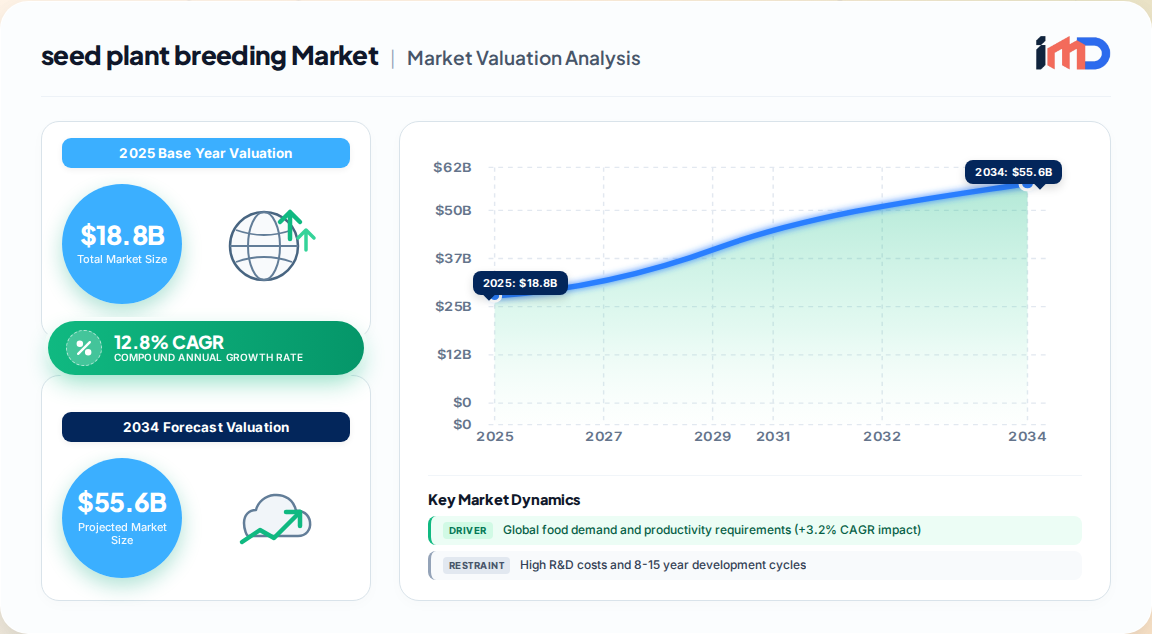
The global seed plant breeding market was valued at USD 18.8 billion in 2025 and is projected to reach USD 62.8 billion by 2035, expanding at a CAGR of 12.8% across the 2026–2035 forecast window. Revenue is expected to hit USD 21.2 billion in 2026 as food-security investment, climate-resilient trait demand, and genomic selection reshape product development priorities.
Our proprietary analysis positions plant breeding as an economically distinctive market: breeding intellectual property monetizes through premium seed, trait royalties, and platform licenses across multiple crop cycles. Improved genetics function as a recurring farm-input purchase rather than a discretionary technology upgrade, which structurally insulates the category from cyclical demand shocks.
| Year | Market Value (USD Billion) |
|---|---|
| 2025 | 18.8 |
| 2026 | 21.2 |
| 2029 | 27.0 |
| 2031 | 34.4 |
| 2033 | 49.4 |
| 2035 | 62.8 |
Annual incremental growth begins at roughly USD 2.4–2.5 billion in the early years and accelerates past USD 7 billion in later stages, culminating in the USD 44.0 billion absolute opportunity.
Global food demand keeps yield improvement at the center of commercial breeding budgets. The Food and Agriculture Organization projects a global population of approximately 9.7 billion by 2050 with materially higher food output required, while arable-land expansion remains constrained. Breeding offers a route to raise output per hectare without land expansion.
| Driver | Approx. CAGR Impact | Impact Timeline |
|---|---|---|
| Global food demand and productivity requirements | +3.2% | Long term |
| Climate adaptation and resilient-trait demand | +2.8% | Long term |
| Genomic technologies and gene editing | +2.5% | Medium term |
Breeding remains capital intensive even as genomic tools compress selection steps. A conventional field-crop variety can require 8–15 years of selection, testing, and registration, while a regulated biotech trait event can require 10–15 years and more than USD 136 million per approved crop-trait combination.
| Restraint | Approx. CAGR Impact | Impact Timeline |
|---|---|---|
| High R&D costs and long development cycles | -1.5% | Long term |
| Germplasm-access restrictions and regulatory fragmentation | -1.2% | Medium term |
The value chain runs from germplasm discovery through commercial seed multiplication and route-to-market — each stage carrying distinct economics and margin structures.
Biotechnological varieties command a 40–80% premium over comparable conventional varieties in several commodity crops because pricing includes trait royalties and agronomy support.
Conventional and traditional breeding remains the anchor of product portfolios, paired with marker-assisted selection to de-risk pipeline decisions while genome editing scales selectively on traits requiring precision or speed.
| Segment Dimension | Leading Category | 2025 Share |
|---|---|---|
| By Type | Traditional / Conventional Breeding | 61.3% (58.3% alt. read) |
| By Trait | Herbicide Tolerance | 31.7%–34.5% |
| By Application | Cereals & Grains / Agriculture | 41.9%–59.4% |
Asia-Pacific is the clear demand center for breeding and CRISPR-enabled crops, holding a dominant 47.8% share (roughly USD 6.4 billion in 2024). North America leads on advanced breeding adoption, government agricultural innovation support, and high-yield variety demand.
The top five players — Bayer AG, Corteva Agriscience, Syngenta Group, BASF SE, and Limagrain (Groupe Limagrain) — collectively held 42.5% of 2025 revenue. Bayer AG led with over 16.9% market share. Vegetable-seed specialists including Bejo Zaden, Enza Zaden, Rijk Zwaan, Sakata, Takii, and KWS SAAT round out a fragmented specialty tier.
Three under-penetrated opportunity zones merit prioritized investment attention through 2035:
The strongest supplier positions through 2030 will combine local adaptation with a clear pathway for trait approval and multiplication.
| Aspects | Details |
|---|---|
| Study Period | 2020-2034 |
| Base Year | 2025 |
| Estimated Year | 2026 |
| Forecast Period | 2026-2034 |
| Historical Period | 2020-2025 |
| Growth Rate | CAGR of 12.8% from 2020-2034 |
| Segmentation |
|
By Application
By Molecular Process
By Marker
| By Geography |
|
The seed plant breeding market was valued at USD 18.8 billion in 2025 and is projected to reach USD 62.8 billion by 2035, expanding at a 12.8% CAGR over the forecast period.
Asia-Pacific is the largest demand center, holding roughly 47.8% share (about USD 6.4 billion), while North America leads on advanced genomic-breeding adoption and trait-stack commercialization.
Bayer AG led with over 16.9% market share in 2025; the top five players — Bayer, Corteva Agriscience, Syngenta Group, BASF SE, and Limagrain — collectively held 42.5% of revenue.
Biotechnological breeding, including gene editing and genomic selection, is scaling fastest, though traditional breeding still anchors portfolios at 61.3% share in 2025.
Growth is driven by global food demand (+3.2% CAGR impact), climate-resilient trait demand (+2.8%), and genomic technologies (+2.5%), with a 9.7 billion global population projected by 2050 requiring materially higher food output.
Our rigorous research methodology combines multi-layered approaches with comprehensive quality assurance, ensuring precision, accuracy, and reliability in every market analysis.
| Stakeholder Role | Interview Share (%) |
|---|---|
| Head of Breeding / Germplasm Director | 36% |
| Regulatory Affairs Manager | 24% |
| Seed Supply Chain & Multiplication Lead | 22% |
| Procurement and Licensing Director | 18% |
| Company Type | Representation (%) |
|---|---|
| Integrated seed-and-trait multinationals | 32% |
| Independent vegetable-seed breeders | 24% |
| Molecular/genotyping service providers | 18% |
| Seed multipliers and distributors | 16% |
| Public-sector breeding programs | 10% |
 Related Reports


Analyst at Providence Strategic Partners at Petaling Jaya
I have received the report already. Thanks you for your help.it has been a pleasure working with you. Thank you again for a good quality report

Internationalization Director
Yes, as a matter of fact we are totally satisfied with both reports that we have purchased and will continue to do so during this process of the internationalization of our brand.

Head of Product Management and Marketing
We are using your report, and it gave us valuable information."

Regional Director, Marketing and Business Development
We've received the report and have reviewed the content. Overall, it looks great and aligns closely with the data we can verify based on our industry knowledge.

VP of Sales
Thank you very much for sharing the report. I have reviewed it and I am very satisfied with the quality and the insights it provides. It will certainly be valuable for our internal discussions.