1What is the current size of the Latin America container terminal operations market?
The market was valued at USD 5.40 Billion in 2024 and is projected to reach USD 7.30 Billion by 2032, growing at a CAGR of 4.40% from 2026 to 2032.
Insight Market Data is a premier market research and business consulting firm headquartered in Pune, India, providing syndicated research reports, customized intelligence studies, and strategic advisory services. Renowned academic institutions and Fortune 500 corporations worldwide rely on Insight Market Data's research repository to navigate evolving global and regional business environments. Covering 46 diverse industries across 25 major international economies, our comprehensive database delivers thousands of verified statistics and granular market evaluations. By combining industry-leading analytical methodologies with the direct insights of seasoned industry leaders and subject-matter experts, we deliver actionable intelligence spanning historical performance benchmarks to rigorous multi-year forecasts. We empower organizations to make confident, data-driven decisions across pivotal domains including Machinery & Equipment, Chemicals & Materials, Pharmaceuticals & Healthcare, Food & Beverages, Consumer Goods, Energy & Power, Automotive & Transportation, Electronics & Semiconductors, Medical Devices, Telecommunications, Emerging Technologies, Agriculture, and Packaging. Our multidisciplinary analyst teams provide an objective 360-degree perspective, tailoring every engagement to address complex strategic challenges with exceptional analytical rigor.
Leveraging advanced BI-powered analytics and predictive modeling, Insight Market Data uncovers high-impact market opportunities and competitive differentiators for ambitious enterprises. We continuously refine our research methodologies in accordance with global industry standards, tracking real-time market shifts to ensure our reports are consistently accurate, actionable, and delivered on schedule. Our analysts conduct methodical data validation, rigorous compliance checks, and exhaustive primary and secondary research to maintain the highest levels of data integrity and transparency. We partner closely with corporate strategists, investment groups, and business executives to translate intricate market intelligence into clear, actionable roadmaps for sustainable growth. With operational presence across Washington, USA, and Vimannagar, Pune, India, Insight Market Data ensures direct access to dedicated research specialists and responsive customer support to answer your most strategic questions.
 Latin America Container Terminal Operations Market
 by Service (Stevedoring, Cargo Handling, Transportation), by Ownership Model (State-Owned, Public-Private Partnership, Fully Private), by Automation Level (Manual, Semi-Automated, Fully Automated), by Container Type (General Containers, Reefer Containers, Specialized Containers), by Brazil, by Peru, by Chile, by Colombia, by Argentina, by Mexico, by Panama, by Rest of Latin America Forecast 2026-2034

Research Associate


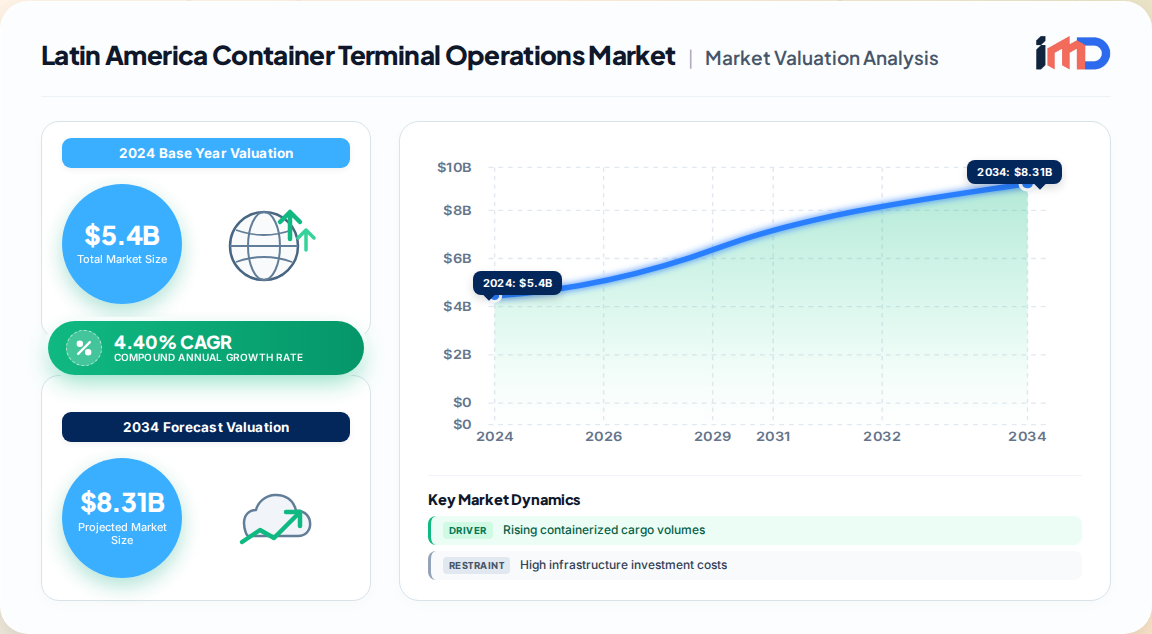
The Latin America container terminal operations market represents a critical node in regional and global supply chains, encompassing stevedoring, cargo handling, transportation, and ancillary logistics services at seaports. Our proprietary primary research estimates the market at USD 5.40 Billion in 2024, with a projected expansion to USD 7.30 Billion by 2032, reflecting a CAGR of 4.40% over the forecast period 2026–2032. This growth trajectory is underpinned by rising containerized cargo volumes, strategic port infrastructure modernization, and deepening public-private concession frameworks across key economies.
Latin America’s port sector is undergoing a structural transformation. Terminal operators are evolving from traditional quay-handling service providers into integrated logistics orchestrators, embedding warehousing, rail links, cold-chain facilities, and customs support into their value propositions. This shift is particularly pronounced in Brazil, Chile, Peru, and Colombia, where concession frameworks are being refined to attract long-term private capital. Competition for transshipment traffic—especially along the Pacific corridor following the commencement of operations at Peru’s Chancay port—is reshaping investment priorities on both Atlantic and Pacific coastlines.
From a segmental perspective, stevedoring remains the dominant service line, while transportation is the fastest-growing service segment. State-owned terminals retain the largest ownership footprint, yet public-private partnerships (PPPs) are expanding at a faster rate. Manual operations still prevail, although fully automated terminals are gaining traction from a low base. General containers lead by container type, but reefer containers are growing more rapidly, driven by agribusiness export cold chains. Brazil commands the largest country-level share, with Peru forecast to record the highest growth rate through 2032.
The value chain for container terminal operations in Latin America comprises port authorities, terminal operators, shipping lines, logistics providers, equipment manufacturers, and technology vendors. Terminal operators sit at the center, orchestrating vessel berthing, container loading and unloading, yard storage, and intermodal transfers. Increasingly, they are integrating inland transportation, warehousing, and customs brokerage to capture a larger share of the logistics value chain.
Our proprietary segmentation analysis, based on primary interviews and operational data, reveals the following structure:
| Segment | Sub-segment | 2024 Share | Growth Outlook (CAGR 2026–2032) |
|---|---|---|---|
| By Service | Stevedoring | 43.5% | Moderate |
| Cargo Handling | Significant | Moderate | |
| Transportation | Growing | 4.81% (fastest) | |
| By Ownership Model | State-Owned | 47.06% | Moderate |
| Public-Private Partnership (PPP) | Growing | 5.15% (fastest) | |
| Fully Private | Niche | Moderate | |
| By Automation Level | Manual | 72.82% | Moderate |
| Semi-Automated | Growing | Above average | |
| Fully Automated | Low base | 6.33% (fastest) | |
| By Container Type | General Containers | 57.43% | Moderate |
| Reefer Containers | Growing | 5.07% (fastest) | |
| Specialized Containers | Niche | Moderate |
Stevedoring’s dominance reflects the foundational nature of quay operations, but transportation services—including intermodal and hinterland connections—are expanding rapidly as operators seek to offer end-to-end solutions. The PPP ownership model is gaining momentum as governments leverage private capital and expertise to modernize assets. Automation remains nascent, yet the push for efficiency and cost control is accelerating adoption, particularly in greenfield and brownfield projects.
Brazil anchors the Latin America container terminal operations market, accounting for an estimated 49% of regional revenue in 2024. The country’s vast agricultural and industrial export base, coupled with a series of port concessions and channel-deepening projects, underpins its leadership. Key ports such as Santos, Paranaguá, and Itajaí are witnessing investments in terminal capacity and landside connectivity.
Peru is the fastest-growing market, with a projected CAGR of 5.31% through 2032. The commencement of commercial operations at Chancay in June 2025 has been a watershed moment, reducing Asia transit times from 35–40 days to 23 days. Chancay handled 200,000 TEUs in the first half of 2026, and its feeder network connects with four key Chilean terminals and northern Pacific ports, including Paita and Guayaquil. This development is reshaping cargo routing along the Pacific coast and intensifying competition among gateway ports.
Chile’s San Antonio expansion, expected to break ground in 2027, will add 6 million TEUs of annual capacity and enhance the country’s ability to accommodate larger vessels. Colombia’s Puerto Antioquia, operational since February 2026, adds New Panamax-ready infrastructure and is strategically located 350 kilometers closer to main production centers than established Caribbean coast terminals.
Argentina and Mexico present moderate growth prospects, with Argentina focusing on port infrastructure investments and Mexico benefiting from nearshoring trends. Panama remains a critical transshipment hub, although direct Asia–South America services may alter its relative share over time.
| Country | 2024 Market Share | 2026–2032 CAGR Outlook | Key Strategic Factors |
|---|---|---|---|
| Brazil | 49% | Moderate | Port concessions, agribusiness exports, channel deepening |
| Peru | 14% | 5.31% (fastest) | Chancay ramp-up, Asia direct services |
| Chile | 12% | Moderate | San Antonio expansion, deep-water access |
| Colombia | 9% | Above average | Puerto Antioquia, PPP investments |
| Argentina | 7% | Moderate | Infrastructure upgrades, regulatory reforms |
| Mexico | 4% | Moderate | Nearshoring, Pacific gateways |
| Panama | 3% | Moderate | Transshipment hub, canal operations |
The Latin America container terminal operations market is characterized by medium concentration, with a mix of global terminal operators and state-owned entities. Major players include DP World Limited, APM Terminals B.V., Mediterranean Shipping Company S.A., CMA CGM Group, and International Container Terminal Services, Inc. (ICTSI), alongside regional operators and port authorities. These companies are actively pursuing expansion through concessions, acquisitions, and strategic partnerships.
Recent developments underscore the dynamism of the sector:
Competitive strategy is increasingly focused on vertical integration, with operators expanding into warehousing, rail, and cold-chain logistics to differentiate their offerings. The race to capture transshipment traffic and direct calls from larger vessels is driving investment in deep-water capacity, crane upgrades, and yard automation. Partnerships with shipping lines and logistics providers are also intensifying, as operators seek to secure volume commitments and optimize asset utilization.
Container terminal operations in Latin America are deeply intertwined with the region’s trade profile. Brazil leads in agricultural exports—soybeans, sugar, coffee, and poultry—which drive reefer and dry container volumes. Chile’s copper and fruit exports, Peru’s minerals and agricultural products, and Colombia’s coffee and oil exports further shape container flows. On the import side, consumer goods, machinery, and electronics from Asia and North America dominate.
The shift toward direct Asia–South America services, exemplified by Chancay’s route to Shanghai, is altering traditional trade patterns. Cargo that previously transshipped through Panama or Mexico can now move directly, reducing handling costs and transit times. This has implications for port competitiveness and hinterland logistics networks. Additionally, nearshoring trends are boosting Mexico’s container traffic, particularly in manufacturing sectors.
Terminal operators must adapt to these changing trade flows by investing in flexible capacity, digital cargo tracking, and cold-chain infrastructure. The growth of e-commerce and just-in-time supply chains further emphasizes the need for reliable, efficient terminal operations.
Our analysis identifies several high-potential white spaces for investors and operators:
The Latin America container terminal operations market is poised for steady expansion, with a CAGR of 4.40% driving the market from USD 5.40 Billion in 2024 to USD 7.30 Billion by 2032. While Brazil will remain the largest market, Peru and Colombia are expected to outpace regional growth, fueled by new capacity and service upgrades. The competitive landscape will continue to evolve as global operators deepen their presence and new concession opportunities emerge.
Key uncertainties include the pace of infrastructure investment, regulatory changes, and global trade tensions. However, the long-term trajectory is positive, supported by demographic growth, rising consumption, and the region’s increasing integration into global supply chains. Terminal operators that embrace automation, sustainability, and vertical integration will be best positioned to capture value in this dynamic market.
| Aspects | Details |
|---|---|
| Study Period | 2020-2034 |
| Base Year | 2024 |
| Estimated Year | 2026 |
| Forecast Period | 2026-2034 |
| Historical Period | 2020-2025 |
| Growth Rate | CAGR of 4.40% from 2020-2034 |
| Segmentation |
|
By Automation Level
By Container Type
| By Geography |
|
The market was valued at USD 5.40 Billion in 2024 and is projected to reach USD 7.30 Billion by 2032, growing at a CAGR of 4.40% from 2026 to 2032.
Brazil accounts for the largest share, representing approximately 49% of the regional market revenue in 2024, driven by its robust agribusiness and industrial export base.
Leading companies include DP World Limited, APM Terminals B.V., Mediterranean Shipping Company S.A., CMA CGM Group, and International Container Terminal Services, Inc. (ICTSI).
Key trends include the expansion of deep-water gateway capacity, public-private concession investments, the rise of reefer container volumes, and the gradual adoption of terminal automation.
Peru is expected to grow at a CAGR of 5.31% through 2032, largely due to the ramp-up of the Chancay port, which has significantly reduced Asia transit times and enhanced Pacific corridor connectivity.
Our rigorous research methodology combines multi-layered approaches with comprehensive quality assurance, ensuring precision, accuracy, and reliability in every market analysis.
| Stakeholder Role | Interview Share (%) |
|---|---|
| Chief Operating Officer (Terminal Operations) | 30% |
| Port Infrastructure Director | 25% |
| Commercial Director (Shipping Line) | 25% |
| Head of Concessions & PPP | 20% |
| Company Type | Representation (%) |
|---|---|
| Global Terminal Operators | 35% |
| State-Owned Port Authorities | 25% |
| PPP Concessionaires | 20% |
| Shipping Line Subsidiaries | 12% |
| Equipment & Technology Vendors | 8% |
 Related Reports
