1What is the current size of the Inland Container Depot and Dry Port Market?
The market was valued at USD 31.04 billion in 2025 and is estimated to reach USD 32.59 billion in 2026, growing to USD 42.50 billion by 2031.
Insight Market Data is a premier market research and business consulting firm headquartered in Pune, India, providing syndicated research reports, customized intelligence studies, and strategic advisory services. Renowned academic institutions and Fortune 500 corporations worldwide rely on Insight Market Data's research repository to navigate evolving global and regional business environments. Covering 46 diverse industries across 25 major international economies, our comprehensive database delivers thousands of verified statistics and granular market evaluations. By combining industry-leading analytical methodologies with the direct insights of seasoned industry leaders and subject-matter experts, we deliver actionable intelligence spanning historical performance benchmarks to rigorous multi-year forecasts. We empower organizations to make confident, data-driven decisions across pivotal domains including Machinery & Equipment, Chemicals & Materials, Pharmaceuticals & Healthcare, Food & Beverages, Consumer Goods, Energy & Power, Automotive & Transportation, Electronics & Semiconductors, Medical Devices, Telecommunications, Emerging Technologies, Agriculture, and Packaging. Our multidisciplinary analyst teams provide an objective 360-degree perspective, tailoring every engagement to address complex strategic challenges with exceptional analytical rigor.
Leveraging advanced BI-powered analytics and predictive modeling, Insight Market Data uncovers high-impact market opportunities and competitive differentiators for ambitious enterprises. We continuously refine our research methodologies in accordance with global industry standards, tracking real-time market shifts to ensure our reports are consistently accurate, actionable, and delivered on schedule. Our analysts conduct methodical data validation, rigorous compliance checks, and exhaustive primary and secondary research to maintain the highest levels of data integrity and transparency. We partner closely with corporate strategists, investment groups, and business executives to translate intricate market intelligence into clear, actionable roadmaps for sustainable growth. With operational presence across Washington, USA, and Vimannagar, Pune, India, Insight Market Data ensures direct access to dedicated research specialists and responsive customer support to answer your most strategic questions.
 Inland Container Depot and Dry Port Market
 by Service (Storage Services, Container Handling, Customs Clearance and Documentation, Intermodal Transfer, Value-Added Services), by Container Type (Dry, Refrigerated, Specialized), by Ownership and Operating Model (Public, Private, Public-Private Partnerships), by End-Use (Shipping Lines/Container Owners, Freight Forwarders/3PLs, Importers/Exporters), by North America (USA, Canada, Mexico), by Europe (Germany, UK, France, Netherlands), by Asia Pacific (China, India, Japan, ASEAN), by South America (Brazil, Argentina, Chile), by Middle East & Africa (UAE, South Africa, Ethiopia, Algeria) Forecast 2026-2034

Research Associate


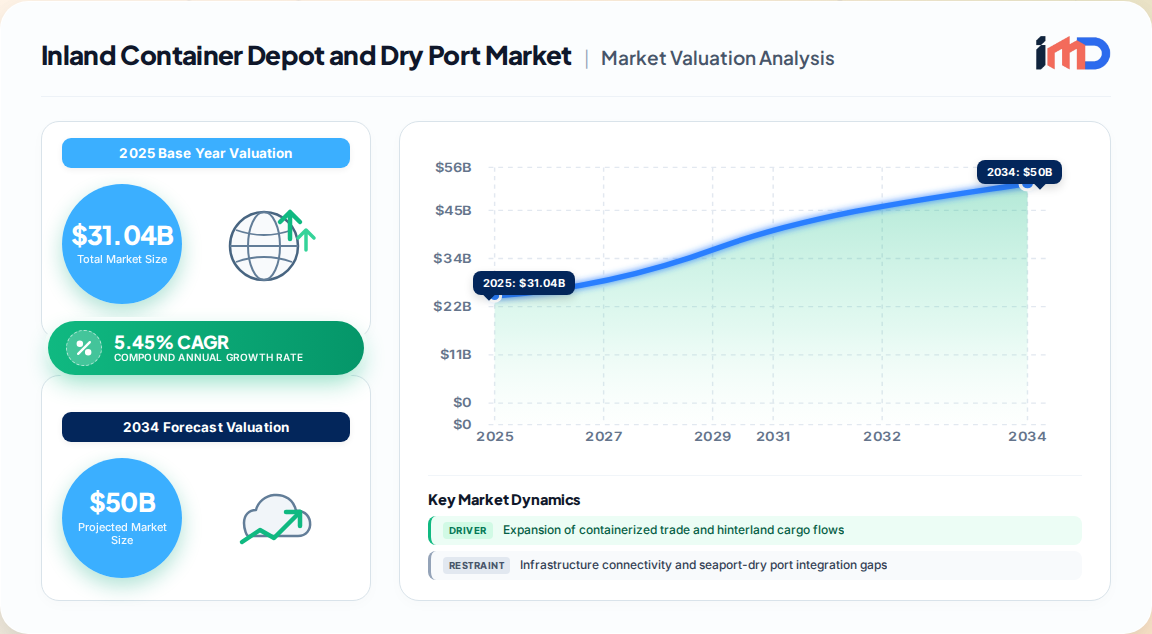
The global inland container depot (ICD) and dry port market represents a critical and rapidly evolving pillar of international trade logistics. Our proprietary primary research estimates the market at USD 31.04 billion in 2025, with a projected trajectory to reach USD 32.59 billion in 2026 and USD 42.50 billion by 2031, advancing at a compound annual growth rate (CAGR) of 5.45% during the forecast period (2026–2031). This expansion is fundamentally decoupled from simple port throughput; it is driven by a structural shift toward inland logistics networks that serve as extended gateways for congested coastal terminals. The market is transitioning from basic empty-container storage yards into sophisticated, digitally enabled multimodal logistics hubs offering customs clearance, cold-chain staging, and value-added services. While North America remains the largest regional market, accounting for 32.10% of global value in 2025, the Asia-Pacific region is the fastest-growing, projected to register a CAGR of 7.48% through 2031. This growth asymmetry reflects aggressive infrastructure investment in rail-linked corridors and manufacturing diversification across India, Vietnam, and China. The competitive landscape is moderately concentrated, featuring a mix of global port operators, state-linked logistics entities, and specialized private operators, all vying for concession terms and strategic inland locations.
The market is propelled by several interconnected macroeconomic and operational factors. Our proprietary driver impact model quantifies the contribution of each factor to the forecast CAGR.
| Driver | % Impact on CAGR Forecast | Geographic Relevance | Impact Timeline |
|---|---|---|---|
| Expansion of Containerized Trade and Hinterland Cargo Flows | +1.2% | Global, strongest in Asia-Pacific and North America | Medium term (2–4 years) |
| Port Congestion and the Shift to Inland Buffer Capacity | +0.9% | Global, concentrated at major gateway ports in Europe, North America, and East Asia | Short term (≤ 2 years) |
| Government Investment in Rail-Linked Multimodal Corridors | +0.8% | India, China, UAE, Sub-Saharan Africa, Central Asia | Medium term (2–4 years) |
| E-Commerce and Distributed Fulfillment Networks | +0.7% | North America, Western Europe, Asia-Pacific | Short term (≤ 2 years) |
| Digital Customs, Single-Window Clearance and Paperless Trade | +0.5% | South Asia, Southeast Asia, Middle East and Africa | Medium term (2–4 years) |
| Depot Electrification and Automation Economics | +0.6% | North America, European Union, East Asia | Long term (≥ 4 years) |
Despite robust demand, the market faces significant headwinds that temper growth.
| Restraint | % Impact on CAGR Forecast | Geographic Relevance | Impact Timeline |
|---|---|---|---|
| Infrastructure Connectivity and Seaport-Dry Port Integration Gaps | -0.7% | Global, most acute in South America and Africa | Medium to Long term |
| Regulatory Complexity and Fragmented Legislative Frameworks | -0.5% | Algeria, Middle East, parts of Asia | Short to Medium term |
| High Operational Costs and Land Scarcity Near Ports | -0.6% | North America, Europe, East Asia | Long term (≥ 4 years) |
The ICD and dry port value chain is a complex network of service providers, infrastructure owners, and regulatory bodies. Our analysis identifies the following key stages and participants:
The value chain is increasingly integrated, with global terminal operators expanding into inland logistics to capture a larger share of the cargo journey. Digital platforms are enabling real-time visibility and seamless data exchange across these stakeholders, reducing dwell times and improving asset utilization.
The ICD and dry port market is directly exposed to global trade dynamics and supply chain disruptions. Key observations from our primary research and trade benchmarks include:
Regional dynamics vary significantly, shaped by trade density, infrastructure investment, and regulatory environments.
| Region | 2025 Market Share | Projected CAGR (2026–2031) | Key Growth Drivers |
|---|---|---|---|
| North America | 32.10% | 5.1% | Advanced intermodal logistics, e-commerce growth, port congestion relief |
| Asia-Pacific | 29.6% | 7.48% | Manufacturing diversification, rail corridor investment, government initiatives (Gati Shakti) |
| Europe | 24.3% | 4.2% | Integrated inland transport networks, sustainability regulations, digitalization |
| Middle East & Africa | 7.8% | 6.5% | Infrastructure modernization, trade expansion, EU-funded projects (Cool Port Addis) |
| South America | 6.2% | 5.8% | Port congestion, agricultural exports, emerging multimodal projects |
The ICD and dry port market is moderately concentrated, with a mix of global logistics giants, state-linked operators, and regional specialists.
Key Players:
Recent Developments:
Our analysis identifies several underpenetrated segments and emerging opportunities for market participants:
For shippers, freight forwarders, and 3PLs, selecting the right ICD or dry port is a critical procurement decision. Our research indicates that buyers should consider the following criteria:
| Criterion | Importance | Key Considerations |
|---|---|---|
| Connectivity and Rail Access | High | Direct rail links to seaports reduce drayage costs and transit times. |
| Customs and Bonded Capabilities | High | Presence of on-site customs officers and digital single-window integration minimizes clearance delays. |
| Cold-Chain Infrastructure | Medium-High | For perishable and pharmaceutical cargo, reefer plugs and temperature monitoring are essential. |
| Digital Visibility and Tracking | Medium | Real-time container tracking and yard management systems improve supply chain transparency. |
| Cost Structure | High | Storage, handling, and value-added service fees vary significantly; negotiate volume discounts. |
| Sustainability Practices | Medium | Increasingly important for compliance with corporate ESG goals; look for electrified equipment and renewable energy use. |
Buyers are advised to adopt a multi-sourcing strategy, contracting with multiple ICDs in key regions to mitigate risk and ensure capacity during peak periods. Long-term contracts with volume commitments can secure preferential rates and service levels.
Several transformative trends are shaping the future of the ICD and dry port market:
The future outlook is positive, with the market poised to benefit from sustained container trade growth, infrastructure investment, and digital innovation. However, success will depend on operators’ ability to navigate regulatory complexities, secure strategic locations, and invest in automation and sustainability.
| Aspects | Details |
|---|---|
| Study Period | 2020-2034 |
| Base Year | 2025 |
| Estimated Year | 2026 |
| Forecast Period | 2026-2034 |
| Historical Period | 2020-2025 |
| Growth Rate | CAGR of 5.45% from 2020-2034 |
| Segmentation |
|
By Container Type
By Ownership and Operating Model
By End-Use
| By Geography |
|
The market was valued at USD 31.04 billion in 2025 and is estimated to reach USD 32.59 billion in 2026, growing to USD 42.50 billion by 2031.
North America held the largest share at 32.10% in 2025, driven by advanced intermodal logistics and e-commerce growth.
By service, other value-added services are projected to grow at the highest CAGR of 7.16% through 2031, while refrigerated containers lead by container type at 7.23% CAGR.
Major companies include Container Corporation of India (CONCOR), A.P. Moller – Maersk, PSA International, DP World, Hapag-Lloyd, CMA CGM, and APM Terminals, among others.
Key drivers include the expansion of containerized trade (contributing +1.2% to CAGR), port congestion (+0.9%), government investment in rail corridors (+0.8%), e-commerce growth (+0.7%), and digital customs (+0.5%).
Our rigorous research methodology combines multi-layered approaches with comprehensive quality assurance, ensuring precision, accuracy, and reliability in every market analysis.
| Stakeholder Role | Interview Share (%) |
|---|---|
| Chief Logistics Officer | 30% |
| Depot Operations Manager | 30% |
| Customs Compliance Director | 25% |
| Head of Intermodal Strategy | 15% |
| Company Type | Representation (%) |
|---|---|
| Inland terminal operators | 40% |
| Global shipping lines | 25% |
| Freight forwarders and 3PLs | 20% |
| Rail freight operators | 10% |
| Customs technology providers | 5% |
 Related Reports
