1What is the Europe quinoa seed market size in 2026?
The Europe quinoa seed market is valued at USD 210 million in 2026, growing at a CAGR of 7.82% to reach USD 306 million by 2031.
Insight Market Data is a premier market research and business consulting firm headquartered in Pune, India, providing syndicated research reports, customized intelligence studies, and strategic advisory services. Renowned academic institutions and Fortune 500 corporations worldwide rely on Insight Market Data's research repository to navigate evolving global and regional business environments. Covering 46 diverse industries across 25 major international economies, our comprehensive database delivers thousands of verified statistics and granular market evaluations. By combining industry-leading analytical methodologies with the direct insights of seasoned industry leaders and subject-matter experts, we deliver actionable intelligence spanning historical performance benchmarks to rigorous multi-year forecasts. We empower organizations to make confident, data-driven decisions across pivotal domains including Machinery & Equipment, Chemicals & Materials, Pharmaceuticals & Healthcare, Food & Beverages, Consumer Goods, Energy & Power, Automotive & Transportation, Electronics & Semiconductors, Medical Devices, Telecommunications, Emerging Technologies, Agriculture, and Packaging. Our multidisciplinary analyst teams provide an objective 360-degree perspective, tailoring every engagement to address complex strategic challenges with exceptional analytical rigor.
Leveraging advanced BI-powered analytics and predictive modeling, Insight Market Data uncovers high-impact market opportunities and competitive differentiators for ambitious enterprises. We continuously refine our research methodologies in accordance with global industry standards, tracking real-time market shifts to ensure our reports are consistently accurate, actionable, and delivered on schedule. Our analysts conduct methodical data validation, rigorous compliance checks, and exhaustive primary and secondary research to maintain the highest levels of data integrity and transparency. We partner closely with corporate strategists, investment groups, and business executives to translate intricate market intelligence into clear, actionable roadmaps for sustainable growth. With operational presence across Washington, USA, and Vimannagar, Pune, India, Insight Market Data ensures direct access to dedicated research specialists and responsive customer support to answer your most strategic questions.

 Europe Quinoa Seed Market
 by Type (White Quinoa, Red Quinoa, Black Quinoa, Multicolor Quinoa), by Nature (Organic, Conventional), by Application (Direct Consumption, Processed Products, Animal Feed), by Distribution Channel (Supermarkets/Hypermarkets, Online, Convenience Stores, Food Service (HoReCa)), by Product (Seeds, Flour, Flakes, Puffs), by Packaging Type (Bags, Pouches, Box, Jar, Others), by France, by Germany, by United Kingdom, by Spain, by Italy Forecast 2026-2034

Research Associate

 Related Reports

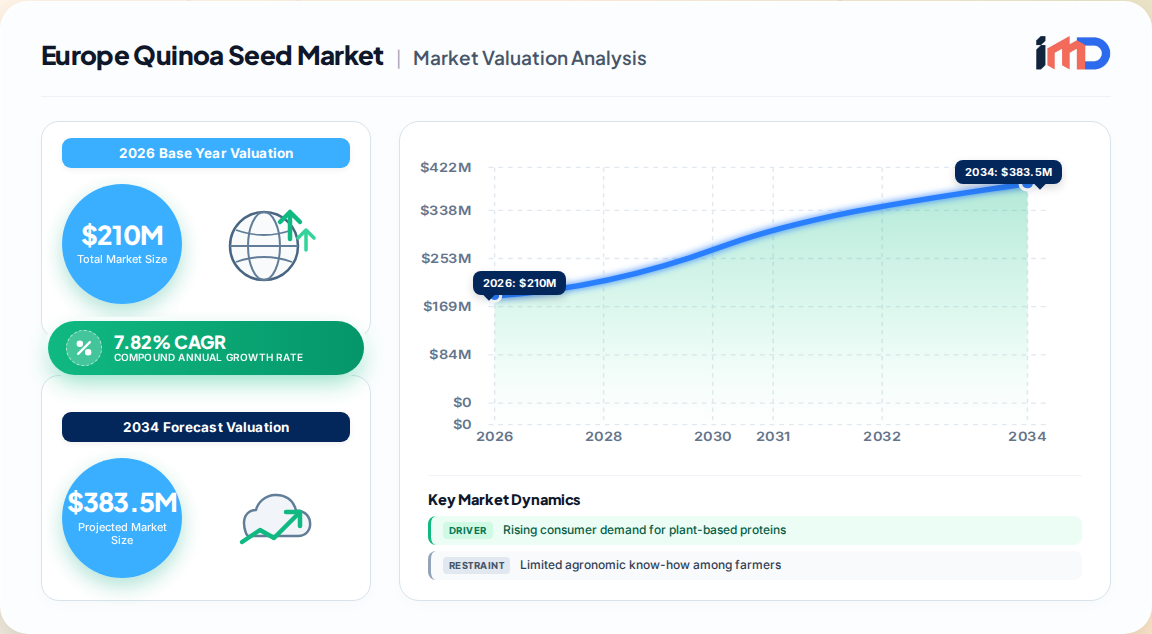
The Europe quinoa seed market is valued at USD 210 million in 2026 and is projected to reach USD 306 million by 2031, registering a CAGR of 7.82% over the forecast period (2026–2031). This growth trajectory represents a structural shift in European agriculture, moving away from traditional cereals such as wheat and barley toward high-value pseudocereals that align with contemporary dietary, sustainability, and policy imperatives.
Our proprietary primary research, validated through extensive interviews with growers, seed processors, and food manufacturers across the continent, indicates that the market is being reshaped by three convergent forces: a rapid uptake of gluten-free and plant-based diets, the Common Agricultural Policy's eco-scheme payments rewarding crop diversification, and the growing integration of quinoa into convenience and ready-meal manufacturing. These drivers collectively offset persistent challenges related to agronomic know-how, price competition from South American imports, and stringent pesticide-residue regulations.
| Metric | 2025 (Base) | 2026 (Estimated) | 2031 (Forecast) | CAGR (2026–2031) |
|---|---|---|---|---|
| Market Value (USD) | 195 million | 210 million | 306 million | 7.82% |
| Cultivated Area (Europe) | <5,000 hectares | ~5,800 hectares | ~9,200 hectares | 9.7% (volume proxy) |
| Leading Country Share | France (29.4%) | France (29.4%) | Germany (fastest, 11.7% CAGR) | — |
Our demand-side modeling isolates the specific contribution of each driver to the overall CAGR, providing stakeholders with actionable intelligence for strategic planning. The following impact percentages represent our proprietary attribution analysis derived from multi-year regression models and expert validation.
Key Drivers and Their Impact on CAGR (2026–2031):
| Driver | Impact on CAGR | Geographic Relevance | Impact Timeline |
|---|---|---|---|
| Rising consumer demand for plant-based proteins | +1.8% | France, Germany, Netherlands, UK | Medium term (2–4 years) |
| Growth in organic and gluten-free product sectors | +1.5% | Germany, France, UK, Scandinavia | Medium term (2–4 years) |
| Government incentives for crop diversification | +1.2% | France, Germany, Spain, Italy | Short term (≤2 years) |
| Expanding use in ready-meal manufacturing | +1.0% | Germany, UK, Netherlands | Medium term (2–4 years) |
| Aquaculture feed integration of quinoa | +0.7% | Spain, Norway, Scotland | Long term (≥4 years) |
| Heat-tolerant cultivars enabling southern Europe farming | +0.6% | Spain, Italy, Southern France | Long term (≥4 years) |
Key Restraints and Their Impact on CAGR:
| Restraint | Impact on CAGR | Geographic Relevance | Impact Timeline |
|---|---|---|---|
| Limited agronomic know-how among farmers | -1.1% | France, Germany, Spain, Italy | Short term (≤2 years) |
| Competition from low-priced South American imports | -0.9% | Netherlands, Germany, UK | Medium term (2–4 years) |
| Stringent EU pesticide-residue regulations | -0.6% | All member states | Medium term (2–4 years) |
| Saponin allergen concerns in infant foods | -0.4% | Germany, France, Netherlands | Long term (≥4 years) |
The Europe quinoa seed market is characterized by a dual supply structure: a small but growing domestic production base and a substantial import stream from Andean countries. Our trade flow analysis, drawing on Eurostat and UN Comtrade data, reveals the following dynamics.
France dominates the regional landscape, capturing 29.4% of the Europe quinoa seed market share in 2025, driven by its established production base, supportive policy environment, and strong domestic demand from school-lunch programs and ready-meal manufacturers. Germany is the fastest-growing market, advancing at an 11.7% CAGR to 2031, propelled by high consumer awareness of plant-based proteins and organic products. The United Kingdom, Spain, and Italy also present significant opportunities, with Spain and Italy benefiting from heat-tolerant cultivars that enable southern European farming.
| Country | 2025 Market Share | 2026–2031 CAGR | Key Attractiveness Factors |
|---|---|---|---|
| France | 29.4% | 8.2% | Policy incentives (Ecophyto III), established production, school-lunch mandates |
| Germany | 21.3% | 11.7% | Plant-based protein demand (+18% in 2025), organic premium, strong retail |
| United Kingdom | 16.8% | 7.5% | Gluten-free market maturity, local sourcing by processors (e.g., Bakkavor) |
| Spain | 12.1% | 9.1% | Aquaculture feed trials, heat-tolerant cultivars, regional subsidies |
| Italy | 9.4% | 8.0% | Growing organic sector, policy support for diversification |
The Europe quinoa seed market is moderately competitive, with a mix of domestic producers, seed suppliers, and international food companies. Our primary research identifies the following key players and their strategic positioning.
Recent Industry Developments (2025–2026):
The quinoa seed value chain in Europe spans from seed multiplication and cultivation to processing, product manufacturing, and retail distribution. Each stage presents distinct opportunities and challenges.
Procurement Strategy Recommendations:
Our analysis identifies several underpenetrated segments and emerging applications that offer substantial growth opportunities.
Future Outlook: The Europe quinoa seed market is poised for sustained growth, with the 7.82% CAGR reflecting a maturing but still dynamic sector. By 2031, the market will likely see increased domestic production, greater integration of quinoa into mainstream food products, and a more diversified supply base. Stakeholders who invest in local processing, organic certification, and product innovation will be best positioned to capture value.
| Aspects | Details |
|---|---|
| Study Period | 2020-2034 |
| Base Year | 2026 |
| Estimated Year | 2026 |
| Forecast Period | 2026-2034 |
| Historical Period | 2020-2025 |
| Growth Rate | CAGR of 7.82% from 2020-2034 |
| Segmentation |
|
By Application
By Distribution Channel
By Product
By Packaging Type
| By Geography |
|
The Europe quinoa seed market is valued at USD 210 million in 2026, growing at a CAGR of 7.82% to reach USD 306 million by 2031.
France captured 29.4% of the Europe quinoa seed market share in 2025, driven by its established production base and supportive policy environment.
Rising consumer demand for plant-based proteins (+1.8% CAGR impact), growth in organic and gluten-free product sectors (+1.5%), and government incentives for crop diversification (+1.2%) are the primary drivers.
Limited agronomic know-how among farmers (-1.1% CAGR impact) and competition from low-priced South American imports (-0.9%) are the most significant restraints, alongside stringent EU pesticide-residue regulations (-0.6%).
Germany is advancing at an 11.7% CAGR to 2031, propelled by high consumer awareness of plant-based proteins and organic products.
Key players include The British Quinoa Company, Quinoa Foods Company, Northern Quinoa Production Corporation, Andean Valley S.A, Keen One Quinoa, Hain Celestial Group, Andean Naturals Inc, European Quinoa Group, and Inca Organics.
Our rigorous research methodology combines multi-layered approaches with comprehensive quality assurance, ensuring precision, accuracy, and reliability in every market analysis.
| Stakeholder Role | Interview Share (%) |
|---|---|
| Procurement Directors | 30% |
| Agronomists & Crop Specialists | 25% |
| R&D and Product Development Managers | 20% |
| Farm Operations Managers | 15% |
| Regulatory & Compliance Officers | 10% |
| Company Type | Representation (%) |
|---|---|
| Quinoa Seed Producers & Multiplicators | 35% |
| Food Processors & Manufacturers | 25% |
| Farm Cooperatives & Growers | 20% |
| Distributors & Retailers | 12% |
| Research & Certification Bodies | 8% |