About Insight Market Data

Insight Market Data is a premier market research and business consulting firm headquartered in Pune, India, providing syndicated research reports, customized intelligence studies, and strategic advisory services. Renowned academic institutions and Fortune 500 corporations worldwide rely on Insight Market Data's research repository to navigate evolving global and regional business environments. Covering 46 diverse industries across 25 major international economies, our comprehensive database delivers thousands of verified statistics and granular market evaluations. By combining industry-leading analytical methodologies with the direct insights of seasoned industry leaders and subject-matter experts, we deliver actionable intelligence spanning historical performance benchmarks to rigorous multi-year forecasts. We empower organizations to make confident, data-driven decisions across pivotal domains including Machinery & Equipment, Chemicals & Materials, Pharmaceuticals & Healthcare, Food & Beverages, Consumer Goods, Energy & Power, Automotive & Transportation, Electronics & Semiconductors, Medical Devices, Telecommunications, Emerging Technologies, Agriculture, and Packaging. Our multidisciplinary analyst teams provide an objective 360-degree perspective, tailoring every engagement to address complex strategic challenges with exceptional analytical rigor.

Leveraging advanced BI-powered analytics and predictive modeling, Insight Market Data uncovers high-impact market opportunities and competitive differentiators for ambitious enterprises. We continuously refine our research methodologies in accordance with global industry standards, tracking real-time market shifts to ensure our reports are consistently accurate, actionable, and delivered on schedule. Our analysts conduct methodical data validation, rigorous compliance checks, and exhaustive primary and secondary research to maintain the highest levels of data integrity and transparency. We partner closely with corporate strategists, investment groups, and business executives to translate intricate market intelligence into clear, actionable roadmaps for sustainable growth. With operational presence across Washington, USA, and Vimannagar, Pune, India, Insight Market Data ensures direct access to dedicated research specialists and responsive customer support to answer your most strategic questions.

report thumbnailEdible Seaweed Film Market
Packaging / MARKET REPORT

Edible Seaweed Film Market | Insight Market Data

Edible Seaweed Film Market by Seaweed Base (Alginate, Carrageenan, Agar, Others), by Film Type (Freestanding edible film, Water-soluble film, Coated film, Others), by Food Use (Seasoning/condiment sachets, Confectionery, Seafood, Fresh produce, Others), by Property (Fast dissolution, Slow dissolution, Oxygen barrier, Moisture barrier, Antimicrobial), by North America (USA, Canada, Mexico), by Europe (Germany, UK, France, Italy, Spain), by Asia Pacific (China, Japan, South Korea, India, Indonesia, Australia), by South America (Brazil, Argentina), by Middle East & Africa (South Africa, UAE) Forecast 2026-2034

© Nov 7, 2026|Base Year: 2025|215 Pages
Shweta Thorat

Shweta Thorat

Research Associate

Main Logo

Edible Seaweed Film Market to Hit $3.58B by 2036 at 18.8% CAGR


/
/
Independent Intelligence for decisions that move markets
+12315155523[email protected]
  • Home
  • About Us
  • Industries
    • Automotive
    • Consumer Goods and Services
    • Financial Services and Investment Intelligence
    • Home and Property Improvement
    • Logistics
    • Retail
    • Agriculture
    • Healthcare
    • Animal Nutrition & Wellness
    • Chemicals & Materials
    • Energy & Power
    • Food & Beverage
    • Hospitality and Tourism
    • Manufacturing Products and Services
    • Professional and Commercial Services
    • Real Estate and Construction
    • Aerospace & Defense
    • Packaging
    • Technology, Media and Telecom
  • Services
  • Contact
Main Logo
  • Home
  • About Us
  • Industries
    • Automotive
    • Consumer Goods and Services
    • Financial Services and Investment Intelligence
    • Home and Property Improvement
    • Logistics
    • Retail
    • Agriculture
    • Healthcare
    • Animal Nutrition & Wellness
    • Chemicals & Materials
    • Energy & Power
    • Food & Beverage
    • Hospitality and Tourism
    • Manufacturing Products and Services
    • Professional and Commercial Services
    • Real Estate and Construction
    • Aerospace & Defense
    • Packaging
    • Technology, Media and Telecom
  • Services
  • Contact
Talk to an analyst

Business Address

Head Office

Ansec House 3 rd floor Tank Road, Yerwada, Pune, Maharashtra 411014

Contact Information

Craig Francis

Business Development Head

+12315155523

[email protected]

Secure Payment Partners

payment image

© 2026 PRDUA Research & Media Private Limited, All rights reserved

••
Buy Now
Home
Industries
Packaging
Retail
Logistics
Packaging
Automotive
Healthcare
Agriculture
Energy & Power
Food & Beverage
Aerospace & Defense
Chemicals & Materials
Hospitality and Tourism
Consumer Goods and Services
Animal Nutrition & Wellness
Real Estate and Construction
Home and Property Improvement
Technology, Media and Telecom
Manufacturing Products and Services
Financial Services and Investment Intelligence
Privacy Policy
Terms and Conditions
FAQ
Edible Seaweed Film Market CAGR, market size, market share

Executive Overview: A High-Growth Niche at the Intersection of Food Science and Sustainable Packaging

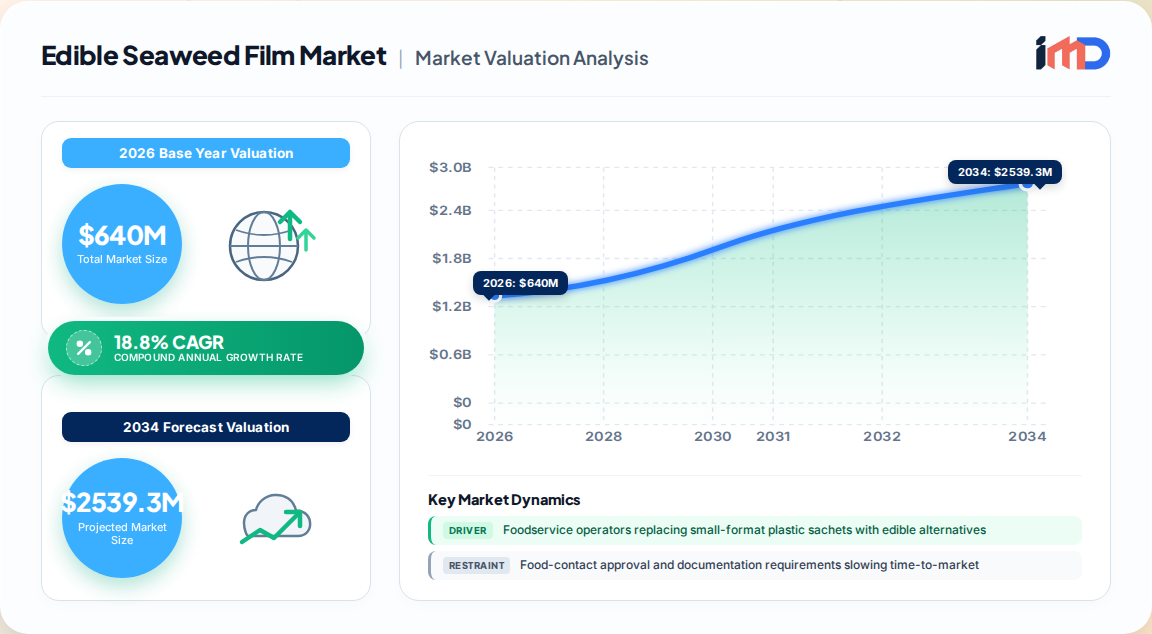
The global edible seaweed film market is undergoing a structural inflection, transitioning from a collection of pilot-stage material-science projects into a commercially viable packaging category. Our proprietary primary research and demand modeling estimate the market at USD 640.0 million in 2026, following a 2025 valuation of USD 538.7 million. The category is forecast to expand at an exceptional 18.8% CAGR through 2036, reaching an estimated USD 3,583.8 million by the end of the forecast window. This implies an absolute incremental opportunity of USD 2,943.8 million between 2026 and 2036, a scale that positions edible seaweed film as one of the fastest-compounding sub-segments of the broader bio-based packaging universe.

Edible Seaweed Film Market Market Size (In Million)

2.0B
1.5B
1.0B
500.0M
0
539.0 M
2025
640.0 M
2026
760.0 M
2027
903.0 M
2028
1.073 B
2029
1.275 B
2030
1.514 B
2031
Main Logo

Crucially, the growth rate of edible seaweed film (18.8%) materially outpaces the base edible packaging and broader seaweed packaging categories (which our analysis estimates in the mid-single-digit to low-double-digit range). This premium is attributable to a sharper value proposition: edible seaweed films deliver portion control, waste elimination, and oxygen-barrier functionality within a single thin-format structure, making them directly addressable by foodservice operators, CPG brand owners, and fresh-produce packers simultaneously.

Market Sizing & Defining Numbers

Metric Value
Market Value 2025 USD 538.7 million
Estimated Value 2026 USD 640.0 million
Forecast Value 2036 USD 3,583.8 million
CAGR 2026-2036 18.8%
Absolute Opportunity 2026-2036 USD 2,943.8 million

Our bottom-up demand model reconciles the market from the application side, multiplying estimated annual edible seaweed film tonnage consumed by film type and end-use against verified per-kilogram food-grade pricing. This is then cross-validated through a top-down deduction from the broader food-contact film and edible packaging categories, isolating the seaweed-derived share.

The market's velocity is not evenly distributed. Foodservice-driven demand is expected to be the dominant short-term engine (<=2 years), while fresh-produce, seafood, and confectionery applications compound over the medium-to-long term.

Segment Deep Dive: Where Volume and Value Concentrate

The market is segmented by seaweed base, film type, food use, and property. Our analysis indicates a clear concentration in formats that solve the most visible waste problems—particularly small-format condiment and seasoning sachets.

Segment Dimension Leading Segment 2026 Estimated Share
Seaweed Base Alginate 32.0%
Film Type Freestanding edible film 36.0%
Food Use Seasoning / condiment sachets 27.0%
Property Fast dissolution 29.0%
  • Alginate dominates the seaweed base segment because of its superior film-forming behavior, gel strength control, and availability in both food and pharmaceutical grades. Sodium alginate's ability to form coherent, sealable films at relatively low concentrations gives it a cost-performance advantage over carrageenan and agar in most sachet and wrap applications.
  • Freestanding edible film leads the film type segment, as it functions independently as a sachet, wrap, or sheet without a rigid backing. This format is being actively deployed in trials for sauce delivery, produce protection, and seafood wrapping.
  • Seasoning and condiment sachets are the largest food-use category due to the high volume of single-serve portion packs used in takeaway and foodservice. The waste burden of these small-format plastics is highly visible, making them a prime target for edible replacement.
  • Fast dissolution leads the property segment, as sauces, soups, and seasoning mixes require predictable, rapid release during use. Film developers are under pressure to balance dissolution speed with storage stability, a trade-off that is currently favoring alginate-based formulations.

Drivers, Restraints & Opportunity Impact Analysis

Our expert interviews with food scientists, packaging converters, and foodservice procurement teams reveal a clear hierarchy of growth drivers and friction points.

Driver Impact on CAGR Geographic Relevance Timeline
Foodservice sachet replacement +2.1% North America, Europe Short term (<=2 years)
EU packaging regulation pressure +1.8% Western Europe Medium term (2-4 years)
Processed-food reformulation +1.4% Japan, Germany, USA Medium term (2-4 years)
Fresh-produce and seafood packaging trials +1.0% Global Long term (>=4 years)
Restraint Impact on CAGR Geographic Relevance Timeline
Food-contact approval and documentation -0.8% Global Short term (<=2 years)
Seaweed cost and supply variation -0.6% Global Medium term (2-4 years)
Moisture sensitivity in storage -0.5% Humid markets Medium term (2-4 years)
Taste and texture acceptance -0.4% Global Long term (>=4 years)
Opportunity Impact on CAGR Geographic Relevance Timeline
Dissolvable sachets for condiments +1.5% USA, UK, Japan Short term (<=2 years)
Seaweed-based windows and wraps +1.1% UK, Germany, France Medium term (2-4 years)
Alginate and carrageenan blend films +0.9% Global Medium term (2-4 years)
Foodservice event packaging +0.6% North America, Europe Long term (>=4 years)

The single most impactful restraint is food-contact approval and documentation, which currently suppresses CAGR by an estimated 0.8 percentage points. This is a short-term friction rather than a structural ceiling; suppliers that invest in regulatory files and migration testing are positioned to compress time-to-commercialization for their customers and capture early-mover advantage.

Regional Outlook: Germany and Japan Lead, USA Accelerates

Our country-level analysis shows a 2.0 percentage point spread across the leading developed markets, with Europe and Asia-Pacific jointly dominating adoption. Regional market share is weighted toward Asia-Pacific (32%) due to seaweed feedstock availability and processed-food innovation, followed closely by Europe (31%) and North America (28%).

Edible Seaweed Film Market Regional Market Share

Loading chart...
Main Logo
Country Forecast CAGR (2026-2036) Key Supporting Factor
Germany 20.1% Ready-meal production and EU packaging rules
Japan 19.3% Processed-food makers testing edible sachet formats
France 19.0% Agri-food depth and hydrocolloid supply
United Kingdom 18.5% Foodservice pilots
USA 18.1% Food-contact reformulation pressure

Germany remains 0.8 percentage points above Japan through prepared-food output and the accelerating influence of EU packaging regulation. Japan sits 0.3 percentage points above France as processed-food producers leverage familiar seaweed ingredients and existing sensory acceptance. The USA, while growing at a comparatively lower 18.1%, represents the single largest absolute revenue pool for edible seaweed films due to the scale of its foodservice and packaged-food sectors.

Competitive Landscape & Strategic Positioning

The competitive field is currently populated by a mix of specialized material-science innovators, hydrocolloid ingredient suppliers, and converters. No single company holds a dominant share; instead, positioning is defined by the ability to demonstrate food safety, taste neutrality, and compatibility with existing packaging-line equipment.

  • Notpla has strengthened its market position through strategic partnerships and innovative product development in edible films, including its seaweed-based coating and transparent seaweed window formats for food-to-go packaging.
  • Evoware offers seaweed-based food wraps and sachets designed to dissolve in water and are entirely edible, with a focus on the Asian market.
  • Loliware produces seaweed-based straws and cups, expanding its market presence in North America.
  • Sway and EcoEnclose are pioneering sustainable materials and seaweed-based packaging for retail and e-commerce applications.
  • Kelpi, Blastic, FlexSea, Oceanium, and Algaeing represent a wave of material innovators targeting barrier properties, scalability, and cost reduction.
  • KIMICA supplies sodium alginate in food and pharmaceutical grades, anchoring the raw material supply side.

Strategic success will depend on three factors: (1) the ability to provide documented dissolution times by water temperature and food matrix; (2) early sensory testing for flavor transfer; and (3) alignment of sealing windows with current sachet and wrap equipment to reduce switching costs for foodservice customers.

Import/Export & Supplier Dynamics

The edible seaweed film value chain begins with raw seaweed cultivation and harvesting, concentrated heavily in Asia. Official trade statistics from multilateral sources indicate that world seaweed imports for human consumption declined to 323,310 tonnes in 2025 from 342,030 tonnes in 2024, reflecting a combination of supply-chain normalization and inventory adjustments. This contraction in raw material trade has implications for edible film producers, who must secure reliable, food-grade feedstock amid tightening availability.

Key supplier dynamics include:

  • Hydrocolloid extractors (alginate, carrageenan, agar) are primarily based in China, Chile, Norway, and France, and are increasingly forward-integrating into film formulation.
  • Film converters are concentrated in Europe and North America, where food-contact regulatory frameworks are most developed.
  • Brand owners and foodservice operators are procuring finished edible sachets and wraps directly from converters, often on a pilot basis, with scale-up contingent on regulatory clearance and sensory validation.

The supply chain remains vulnerable to feedstock cost volatility (driven by climate and harvest variability) and the higher cost of food-grade processing compared to industrial-grade extraction.

Value Chain Analysis: From Farm to Film

The edible seaweed film value chain comprises five distinct layers, each with different margin structures and barriers to entry:

Value Chain Stage Key Participants Value-Add Margin Profile
Seaweed cultivation & harvesting Aquaculture farms (Asia-Pacific), wild harvesters Raw biomass supply Low
Hydrocolloid extraction Alginate, carrageenan, agar producers Polymer isolation Medium
Film formulation & conversion Specialty material innovators, converters Film casting, sealing, functional additives High
Brand integration CPG brands, foodservice operators Application development, marketing High
End consumption Foodservice, retail, fresh produce Waste reduction, convenience N/A

The highest value capture occurs at the formulation and conversion stage, where proprietary know-how around dissolution control, seal integrity, and flavor neutrality creates defensible differentiation. Ingredient suppliers that can provide regulatory support and migration testing are increasingly moving into this layer to capture higher margins.

Strategic White-Space & Investment Opportunity Assessment

Our analysis identifies several under-served intersection points that represent high-potential white space for investors and incumbents:

  • Alginate-carrageenan blend films for applications requiring both fast dissolution and mechanical strength (e.g., soup mixes, instant beverage pods). This blend is currently under-exploited and could add an estimated 0.9 percentage points to CAGR.
  • Seaweed-based windows and transparent wraps for fresh-produce and food-to-go packaging, particularly in the UK, Germany, and France, where retailers are actively seeking plastic-free visibility solutions.
  • Foodservice event packaging (e.g., edible condiment sachets for stadiums, festivals, and large-scale catering) represents a high-visibility, low-regulatory-friction entry point, particularly in North America and Europe.
  • Pharmaceutical and nutraceutical thin films are adjacent opportunities that leverage the same alginate-based film-forming technology but command higher per-unit pricing and stricter quality standards.

Investors should prioritize companies that own formulation IP, have secured food-contact approvals in multiple jurisdictions, and can demonstrate line-compatibility with existing sachet and wrap equipment.

Edible Seaweed Film Market Regional Market Share

Higher Coverage
Lower Coverage
No Coverage

Edible Seaweed Film Market REPORT HIGHLIGHTS

AspectsDetails
Study Period2020-2034
Base Year2026
Estimated Year2026
Forecast Period2026-2034
Historical Period2020-2025
Growth RateCAGR of 18.8% from 2020-2034
Segmentation
  • By Seaweed Base

    • Alginate
    • Carrageenan
    • Agar
    • Others
  • By Film Type

Table of Contents

  1. 1. Edible Seaweed Film Market Introduction
    • 1.1. Research Scope
    • 1.2. Market Segmentation
    • 1.3. Research Objective
    • 1.4. Definitions and Assumptions
  2. 2. Edible Seaweed Film Market Executive Summary
    • 2.1. Market Snapshot
  3. 3. Edible Seaweed Film Market Dynamics
    • 3.1. Market Drivers
      • 3.1.1. Foodservice operators replacing small-format plastic sachets with edible alternatives
      • 3.1.2. EU packaging regulation pressure accelerating adoption in Western Europe
      • 3.1.3. Processed-food reformulation demand in Japan, Germany, and USA
    • 3.2. Market Trends
      • 3.2.1. Shift from pilot-stage edible films to commercial-scale sachet and wrap production
      • 3.2.2. Integration of antimicrobial and oxygen-barrier functional properties into seaweed films
      • 3.2.3. Diversification into seaweed-based windows and transparent food-to-go packaging formats
    • 3.3. Market Restraints
      • 3.3.1. Food-contact approval and documentation requirements slowing time-to-market
      • 3.3.2. Seaweed cost and supply variation affecting feedstock stability
      • 3.3.3. Moisture sensitivity in storage limiting shelf-life in humid markets
    • 3.4. Market Challenges
      • 3.4.1. Balancing fast dissolution with storage stability in film formulation
      • 3.4.2. Achieving taste and texture acceptance across diverse food matrices
Author
Shweta Thorat

Shweta Thorat

Research Associate

I am a Research Associate specializing in the Packaging & Transport sector, dedicated to delivering actionable insights through structured primary and secondary market analysis. My core expertise lies in comprehensive report development, competitive benchmarking, and market sizing studies, with a focus on analyzing industry trends and evaluating key players. Driven by data-driven methodologies, I translate complex data into clear, strategic recommendations that identify growth opportunities and support business decision-making.

WHY IMD

Verified research

Analyst-reviewed data

Updated Nov 07, 2026

sponsor image
sponsor image
sponsor image
sponsor image
sponsor image
sponsor image
sponsor image
sponsor image
sponsor image
sponsor image
sponsor image
sponsor image
sponsor image
sponsor image
sponsor image
sponsor image
sponsor image
sponsor image
sponsor image
sponsor image
CUSTOM INTELLIGENCE

Tailored for you

  • In-depth Analysis Tailored to Specified Regions or Segments
  • Company Profiles Customized to User Preferences
  • Customized Evaluation of Competitive Landscape to Meet Your Needs
Ask for customization
avatar

Analyst at Providence Strategic Partners at Petaling Jaya

Jared Wan

I have received the report already. Thanks you for your help.it has been a pleasure working with you. Thank you again for a good quality report

avatar

Internationalization Director

Santiago Mejia Molina

Yes, as a matter of fact we are totally satisfied with both reports that we have purchased and will continue to do so during this process of the internationalization of our brand.

avatar

Head of Product Management and Marketing

Olaf Gleibe

We are using your report, and it gave us valuable information."

avatar

Regional Director, Marketing and Business Development

Lina Lim

We've received the report and have reviewed the content. Overall, it looks great and aligns closely with the data we can verify based on our industry knowledge.

avatar

VP of Sales

DIGGLE Representative

Thank you very much for sharing the report. I have reviewed it and I am very satisfied with the quality and the insights it provides. It will certainly be valuable for our internal discussions.

Get In Touch
Freestanding edible film
  • Water-soluble film
  • Coated film
  • Others
  • By Food Use

    • Seasoning/condiment sachets
    • Confectionery
    • Seafood
    • Fresh produce
    • Others
  • By Property

    • Fast dissolution
    • Slow dissolution
    • Oxygen barrier
    • Moisture barrier
    • Antimicrobial
  • By Geography
    • North America

      • USA
      • Canada
      • Mexico
    • Europe

      • Germany
      • UK
      • France
      • Italy
      • Spain
    • Asia Pacific

      • China
      • Japan
      • South Korea
      • India
      • Indonesia
      • Australia
    • South America

      • Brazil
      • Argentina
    • Middle East & Africa

      • South Africa
      • UAE
  • 3.4.3. Scaling food-grade seaweed extraction and film casting capacity
  • 4. Edible Seaweed Film Market Factor Analysis
    • 4.1. Porters Five Forces
      • 4.1.1. Bargaining Power of Suppliers
      • 4.1.2. Bargaining Power of Buyers
      • 4.1.3. Threat of New Entrants
      • 4.1.4. Threat of Substitutes
      • 4.1.5. Competitive Rivalry
    • 4.2. PESTEL analysis
    • 4.3. BCG Analysis
      • 4.3.1. Stars (High Growth, High Market Share)
      • 4.3.2. Cash Cows (Low Growth, High Market Share)
      • 4.3.3. Question Mark (High Growth, Low Market Share)
      • 4.3.4. Dogs (Low Growth, Low Market Share)
    • 4.4. Ansoff Matrix Analysis
    • 4.5. Supply Chain Analysis
    • 4.6. Regulatory Landscape
    • 4.7. Current Market Potential and Opportunity Assessment (TAM–SAM–SOM Framework)
    • 4.8. IMD Analyst Note
  • 5. Edible Seaweed Film Market Analysis, Insights and Forecast, 2020-2034
    • 5.1. Analysis, Insights and Forecast - by Seaweed Base
      • 5.1.1. Alginate
      • 5.1.2. Carrageenan
      • 5.1.3. Agar
      • 5.1.4. Others
    • 5.2. Analysis, Insights and Forecast - by Film Type
      • 5.2.1. Freestanding edible film
      • 5.2.2. Water-soluble film
      • 5.2.3. Coated film
      • 5.2.4. Others
    • 5.3. Analysis, Insights and Forecast - by Food Use
      • 5.3.1. Seasoning/condiment sachets
      • 5.3.2. Confectionery
      • 5.3.3. Seafood
      • 5.3.4. Fresh produce
      • 5.3.5. Others
    • 5.4. Analysis, Insights and Forecast - by Property
      • 5.4.1. Fast dissolution
      • 5.4.2. Slow dissolution
      • 5.4.3. Oxygen barrier
      • 5.4.4. Moisture barrier
      • 5.4.5. Antimicrobial
    • 5.5. Analysis, Insights and Forecast - by Region
      • 5.5.1. North America
      • 5.5.2. Europe
      • 5.5.3. Asia Pacific
      • 5.5.4. South America
      • 5.5.5. Middle East & Africa
  • 6. Edible Seaweed Film Market North America Analysis, Insights and Forecast, 2020-2034
    • 6.1. Analysis, Insights and Forecast - by Seaweed Base
      • 6.1.1. Alginate
      • 6.1.2. Carrageenan
      • 6.1.3. Agar
      • 6.1.4. Others
    • 6.2. Analysis, Insights and Forecast - by Film Type
      • 6.2.1. Freestanding edible film
      • 6.2.2. Water-soluble film
      • 6.2.3. Coated film
      • 6.2.4. Others
    • 6.3. Analysis, Insights and Forecast - by Food Use
      • 6.3.1. Seasoning/condiment sachets
      • 6.3.2. Confectionery
      • 6.3.3. Seafood
      • 6.3.4. Fresh produce
      • 6.3.5. Others
    • 6.4. Analysis, Insights and Forecast - by Property
      • 6.4.1. Fast dissolution
      • 6.4.2. Slow dissolution
      • 6.4.3. Oxygen barrier
      • 6.4.4. Moisture barrier
      • 6.4.5. Antimicrobial
  • 7. Edible Seaweed Film Market Europe Analysis, Insights and Forecast, 2020-2034
    • 7.1. Analysis, Insights and Forecast - by Seaweed Base
      • 7.1.1. Alginate
      • 7.1.2. Carrageenan
      • 7.1.3. Agar
      • 7.1.4. Others
    • 7.2. Analysis, Insights and Forecast - by Film Type
      • 7.2.1. Freestanding edible film
      • 7.2.2. Water-soluble film
      • 7.2.3. Coated film
      • 7.2.4. Others
    • 7.3. Analysis, Insights and Forecast - by Food Use
      • 7.3.1. Seasoning/condiment sachets
      • 7.3.2. Confectionery
      • 7.3.3. Seafood
      • 7.3.4. Fresh produce
      • 7.3.5. Others
    • 7.4. Analysis, Insights and Forecast - by Property
      • 7.4.1. Fast dissolution
      • 7.4.2. Slow dissolution
      • 7.4.3. Oxygen barrier
      • 7.4.4. Moisture barrier
      • 7.4.5. Antimicrobial
  • 8. Edible Seaweed Film Market Asia Pacific Analysis, Insights and Forecast, 2020-2034
    • 8.1. Analysis, Insights and Forecast - by Seaweed Base
      • 8.1.1. Alginate
      • 8.1.2. Carrageenan
      • 8.1.3. Agar
      • 8.1.4. Others
    • 8.2. Analysis, Insights and Forecast - by Film Type
      • 8.2.1. Freestanding edible film
      • 8.2.2. Water-soluble film
      • 8.2.3. Coated film
      • 8.2.4. Others
    • 8.3. Analysis, Insights and Forecast - by Food Use
      • 8.3.1. Seasoning/condiment sachets
      • 8.3.2. Confectionery
      • 8.3.3. Seafood
      • 8.3.4. Fresh produce
      • 8.3.5. Others
    • 8.4. Analysis, Insights and Forecast - by Property
      • 8.4.1. Fast dissolution
      • 8.4.2. Slow dissolution
      • 8.4.3. Oxygen barrier
      • 8.4.4. Moisture barrier
      • 8.4.5. Antimicrobial
  • 9. Edible Seaweed Film Market South America Analysis, Insights and Forecast, 2020-2034
    • 9.1. Analysis, Insights and Forecast - by Seaweed Base
      • 9.1.1. Alginate
      • 9.1.2. Carrageenan
      • 9.1.3. Agar
      • 9.1.4. Others
    • 9.2. Analysis, Insights and Forecast - by Film Type
      • 9.2.1. Freestanding edible film
      • 9.2.2. Water-soluble film
      • 9.2.3. Coated film
      • 9.2.4. Others
    • 9.3. Analysis, Insights and Forecast - by Food Use
      • 9.3.1. Seasoning/condiment sachets
      • 9.3.2. Confectionery
      • 9.3.3. Seafood
      • 9.3.4. Fresh produce
      • 9.3.5. Others
    • 9.4. Analysis, Insights and Forecast - by Property
      • 9.4.1. Fast dissolution
      • 9.4.2. Slow dissolution
      • 9.4.3. Oxygen barrier
      • 9.4.4. Moisture barrier
      • 9.4.5. Antimicrobial
  • 10. Edible Seaweed Film Market Middle East & Africa Analysis, Insights and Forecast, 2020-2034
    • 10.1. Analysis, Insights and Forecast - by Seaweed Base
      • 10.1.1. Alginate
      • 10.1.2. Carrageenan
      • 10.1.3. Agar
      • 10.1.4. Others
    • 10.2. Analysis, Insights and Forecast - by Film Type
      • 10.2.1. Freestanding edible film
      • 10.2.2. Water-soluble film
      • 10.2.3. Coated film
      • 10.2.4. Others
    • 10.3. Analysis, Insights and Forecast - by Food Use
      • 10.3.1. Seasoning/condiment sachets
      • 10.3.2. Confectionery
      • 10.3.3. Seafood
      • 10.3.4. Fresh produce
      • 10.3.5. Others
    • 10.4. Analysis, Insights and Forecast - by Property
      • 10.4.1. Fast dissolution
      • 10.4.2. Slow dissolution
      • 10.4.3. Oxygen barrier
      • 10.4.4. Moisture barrier
      • 10.4.5. Antimicrobial
  • 11. Edible Seaweed Film Market Competitive Analysis
    • 11.1. Company Profiles
      • 11.1.1. Notpla
        • 11.1.1.1. Company Overview
        • 11.1.1.2. Products
        • 11.1.1.3. Company Financials
        • 11.1.1.4. SWOT Analysis
      • 11.1.2. Evoware
        • 11.1.2.1. Company Overview
        • 11.1.2.2. Products
        • 11.1.2.3. Company Financials
        • 11.1.2.4. SWOT Analysis
      • 11.1.3. Loliware
        • 11.1.3.1. Company Overview
        • 11.1.3.2. Products
        • 11.1.3.3. Company Financials
        • 11.1.3.4. SWOT Analysis
      • 11.1.4. Sway
        • 11.1.4.1. Company Overview
        • 11.1.4.2. Products
        • 11.1.4.3. Company Financials
        • 11.1.4.4. SWOT Analysis
      • 11.1.5. Kelpi
        • 11.1.5.1. Company Overview
        • 11.1.5.2. Products
        • 11.1.5.3. Company Financials
        • 11.1.5.4. SWOT Analysis
      • 11.1.6. Blastic
        • 11.1.6.1. Company Overview
        • 11.1.6.2. Products
        • 11.1.6.3. Company Financials
        • 11.1.6.4. SWOT Analysis
      • 11.1.7. FlexSea
        • 11.1.7.1. Company Overview
        • 11.1.7.2. Products
        • 11.1.7.3. Company Financials
        • 11.1.7.4. SWOT Analysis
      • 11.1.8. Oceanium
        • 11.1.8.1. Company Overview
        • 11.1.8.2. Products
        • 11.1.8.3. Company Financials
        • 11.1.8.4. SWOT Analysis
      • 11.1.9. Algaeing
        • 11.1.9.1. Company Overview
        • 11.1.9.2. Products
        • 11.1.9.3. Company Financials
        • 11.1.9.4. SWOT Analysis
      • 11.1.10. KIMICA
        • 11.1.10.1. Company Overview
        • 11.1.10.2. Products
        • 11.1.10.3. Company Financials
        • 11.1.10.4. SWOT Analysis
      • 11.1.11. EcoEnclose
        • 11.1.11.1. Company Overview
        • 11.1.11.2. Products
        • 11.1.11.3. Company Financials
        • 11.1.11.4. SWOT Analysis
      • 11.1.12. Sofresh
        • 11.1.12.1. Company Overview
        • 11.1.12.2. Products
        • 11.1.12.3. Company Financials
        • 11.1.12.4. SWOT Analysis
      • 11.1.13. Biopac
        • 11.1.13.1. Company Overview
        • 11.1.13.2. Products
        • 11.1.13.3. Company Financials
        • 11.1.13.4. SWOT Analysis
      • 11.1.14. Tide Ocean SA
        • 11.1.14.1. Company Overview
        • 11.1.14.2. Products
        • 11.1.14.3. Company Financials
        • 11.1.14.4. SWOT Analysis
      • 11.1.15. Marea
        • 11.1.15.1. Company Overview
        • 11.1.15.2. Products
        • 11.1.15.3. Company Financials
        • 11.1.15.4. SWOT Analysis
      • 11.1.16. AgriSea
        • 11.1.16.1. Company Overview
        • 11.1.16.2. Products
        • 11.1.16.3. Company Financials
        • 11.1.16.4. SWOT Analysis
      • 11.1.17. Seawrap
        • 11.1.17.1. Company Overview
        • 11.1.17.2. Products
        • 11.1.17.3. Company Financials
        • 11.1.17.4. SWOT Analysis
      • 11.1.18. GreenSea
        • 11.1.18.1. Company Overview
        • 11.1.18.2. Products
        • 11.1.18.3. Company Financials
        • 11.1.18.4. SWOT Analysis
      • 11.1.19. Morssinkhof Rymoplast
        • 11.1.19.1. Company Overview
        • 11.1.19.2. Products
        • 11.1.19.3. Company Financials
        • 11.1.19.4. SWOT Analysis
      • 11.1.20. Seawith
        • 11.1.20.1. Company Overview
        • 11.1.20.2. Products
        • 11.1.20.3. Company Financials
        • 11.1.20.4. SWOT Analysis
      • 11.1.21. B'ZEOS
        • 11.1.21.1. Company Overview
        • 11.1.21.2. Products
        • 11.1.21.3. Company Financials
        • 11.1.21.4. SWOT Analysis
    • 11.2. Market Entropy
      • 11.2.1. Company's Key Areas Served
      • 11.2.2. Recent Developments
    • 11.3. Company Market Share Analysis, 2026
      • 11.3.1. Top 5 Companies Market Share Analysis
      • 11.3.2. Top 3 Companies Market Share Analysis
    • 11.4. List of Potential Customers
  • List of Figures

    1. Figure 1: Global Edible Seaweed Film Market Revenue Breakdown (Million, %) by Region 2026 & 2034
    2. Figure 2: North America Edible Seaweed Film Market Revenue (Million), by Seaweed Base 2026 & 2034
    3. Figure 3: North America Edible Seaweed Film Market Revenue Share (%), by Seaweed Base 2026 & 2034
    4. Figure 4: North America Edible Seaweed Film Market Revenue (Million), by Film Type 2026 & 2034
    5. Figure 5: North America Edible Seaweed Film Market Revenue Share (%), by Film Type 2026 & 2034
    6. Figure 6: North America Edible Seaweed Film Market Revenue (Million), by Food Use 2026 & 2034
    7. Figure 7: North America Edible Seaweed Film Market Revenue Share (%), by Food Use 2026 & 2034
    8. Figure 8: North America Edible Seaweed Film Market Revenue (Million), by Property 2026 & 2034
    9. Figure 9: North America Edible Seaweed Film Market Revenue Share (%), by Property 2026 & 2034
    10. Figure 10: North America Edible Seaweed Film Market Revenue (Million), by Country 2026 & 2034
    11. Figure 11: North America Edible Seaweed Film Market Revenue Share (%), by Country 2026 & 2034
    12. Figure 12: Europe Edible Seaweed Film Market Revenue (Million), by Seaweed Base 2026 & 2034
    13. Figure 13: Europe Edible Seaweed Film Market Revenue Share (%), by Seaweed Base 2026 & 2034
    14. Figure 14: Europe Edible Seaweed Film Market Revenue (Million), by Film Type 2026 & 2034
    15. Figure 15: Europe Edible Seaweed Film Market Revenue Share (%), by Film Type 2026 & 2034
    16. Figure 16: Europe Edible Seaweed Film Market Revenue (Million), by Food Use 2026 & 2034
    17. Figure 17: Europe Edible Seaweed Film Market Revenue Share (%), by Food Use 2026 & 2034
    18. Figure 18: Europe Edible Seaweed Film Market Revenue (Million), by Property 2026 & 2034
    19. Figure 19: Europe Edible Seaweed Film Market Revenue Share (%), by Property 2026 & 2034
    20. Figure 20: Europe Edible Seaweed Film Market Revenue (Million), by Country 2026 & 2034
    21. Figure 21: Europe Edible Seaweed Film Market Revenue Share (%), by Country 2026 & 2034
    22. Figure 22: Asia Pacific Edible Seaweed Film Market Revenue (Million), by Seaweed Base 2026 & 2034
    23. Figure 23: Asia Pacific Edible Seaweed Film Market Revenue Share (%), by Seaweed Base 2026 & 2034
    24. Figure 24: Asia Pacific Edible Seaweed Film Market Revenue (Million), by Film Type 2026 & 2034
    25. Figure 25: Asia Pacific Edible Seaweed Film Market Revenue Share (%), by Film Type 2026 & 2034
    26. Figure 26: Asia Pacific Edible Seaweed Film Market Revenue (Million), by Food Use 2026 & 2034
    27. Figure 27: Asia Pacific Edible Seaweed Film Market Revenue Share (%), by Food Use 2026 & 2034
    28. Figure 28: Asia Pacific Edible Seaweed Film Market Revenue (Million), by Property 2026 & 2034
    29. Figure 29: Asia Pacific Edible Seaweed Film Market Revenue Share (%), by Property 2026 & 2034
    30. Figure 30: Asia Pacific Edible Seaweed Film Market Revenue (Million), by Country 2026 & 2034
    31. Figure 31: Asia Pacific Edible Seaweed Film Market Revenue Share (%), by Country 2026 & 2034
    32. Figure 32: South America Edible Seaweed Film Market Revenue (Million), by Seaweed Base 2026 & 2034
    33. Figure 33: South America Edible Seaweed Film Market Revenue Share (%), by Seaweed Base 2026 & 2034
    34. Figure 34: South America Edible Seaweed Film Market Revenue (Million), by Film Type 2026 & 2034
    35. Figure 35: South America Edible Seaweed Film Market Revenue Share (%), by Film Type 2026 & 2034
    36. Figure 36: South America Edible Seaweed Film Market Revenue (Million), by Food Use 2026 & 2034
    37. Figure 37: South America Edible Seaweed Film Market Revenue Share (%), by Food Use 2026 & 2034
    38. Figure 38: South America Edible Seaweed Film Market Revenue (Million), by Property 2026 & 2034
    39. Figure 39: South America Edible Seaweed Film Market Revenue Share (%), by Property 2026 & 2034
    40. Figure 40: South America Edible Seaweed Film Market Revenue (Million), by Country 2026 & 2034
    41. Figure 41: South America Edible Seaweed Film Market Revenue Share (%), by Country 2026 & 2034
    42. Figure 42: Middle East & Africa Edible Seaweed Film Market Revenue (Million), by Seaweed Base 2026 & 2034
    43. Figure 43: Middle East & Africa Edible Seaweed Film Market Revenue Share (%), by Seaweed Base 2026 & 2034
    44. Figure 44: Middle East & Africa Edible Seaweed Film Market Revenue (Million), by Film Type 2026 & 2034
    45. Figure 45: Middle East & Africa Edible Seaweed Film Market Revenue Share (%), by Film Type 2026 & 2034
    46. Figure 46: Middle East & Africa Edible Seaweed Film Market Revenue (Million), by Food Use 2026 & 2034
    47. Figure 47: Middle East & Africa Edible Seaweed Film Market Revenue Share (%), by Food Use 2026 & 2034
    48. Figure 48: Middle East & Africa Edible Seaweed Film Market Revenue (Million), by Property 2026 & 2034
    49. Figure 49: Middle East & Africa Edible Seaweed Film Market Revenue Share (%), by Property 2026 & 2034
    50. Figure 50: Middle East & Africa Edible Seaweed Film Market Revenue (Million), by Country 2026 & 2034
    51. Figure 51: Middle East & Africa Edible Seaweed Film Market Revenue Share (%), by Country 2026 & 2034

    List of Tables

    1. Table 1: Global Edible Seaweed Film Market Revenue Million Forecast, by Seaweed Base 2020 & 2034
    2. Table 2: Global Edible Seaweed Film Market Revenue Million Forecast, by Film Type 2020 & 2034
    3. Table 3: Global Edible Seaweed Film Market Revenue Million Forecast, by Food Use 2020 & 2034
    4. Table 4: Global Edible Seaweed Film Market Revenue Million Forecast, by Property 2020 & 2034
    5. Table 5: Global Edible Seaweed Film Market Revenue Million Forecast, by Region 2020 & 2034
    6. Table 6: North America Edible Seaweed Film Market Revenue Million Forecast, by Seaweed Base 2020 & 2034
    7. Table 7: North America Edible Seaweed Film Market Revenue Million Forecast, by Film Type 2020 & 2034
    8. Table 8: North America Edible Seaweed Film Market Revenue Million Forecast, by Food Use 2020 & 2034
    9. Table 9: North America Edible Seaweed Film Market Revenue Million Forecast, by Property 2020 & 2034
    10. Table 10: North America Edible Seaweed Film Market Revenue Million Forecast, by Country 2020 & 2034
    11. Table 11: USA Edible Seaweed Film Market Revenue (Million) Forecast, by Application 2020 & 2034
    12. Table 12: Canada Edible Seaweed Film Market Revenue (Million) Forecast, by Application 2020 & 2034
    13. Table 13: Mexico Edible Seaweed Film Market Revenue (Million) Forecast, by Application 2020 & 2034
    14. Table 14: Europe Edible Seaweed Film Market Revenue Million Forecast, by Seaweed Base 2020 & 2034
    15. Table 15: Europe Edible Seaweed Film Market Revenue Million Forecast, by Film Type 2020 & 2034
    16. Table 16: Europe Edible Seaweed Film Market Revenue Million Forecast, by Food Use 2020 & 2034
    17. Table 17: Europe Edible Seaweed Film Market Revenue Million Forecast, by Property 2020 & 2034
    18. Table 18: Europe Edible Seaweed Film Market Revenue Million Forecast, by Country 2020 & 2034
    19. Table 19: Germany Edible Seaweed Film Market Revenue (Million) Forecast, by Application 2020 & 2034
    20. Table 20: UK Edible Seaweed Film Market Revenue (Million) Forecast, by Application 2020 & 2034
    21. Table 21: France Edible Seaweed Film Market Revenue (Million) Forecast, by Application 2020 & 2034
    22. Table 22: Italy Edible Seaweed Film Market Revenue (Million) Forecast, by Application 2020 & 2034
    23. Table 23: Spain Edible Seaweed Film Market Revenue (Million) Forecast, by Application 2020 & 2034
    24. Table 24: Asia Pacific Edible Seaweed Film Market Revenue Million Forecast, by Seaweed Base 2020 & 2034
    25. Table 25: Asia Pacific Edible Seaweed Film Market Revenue Million Forecast, by Film Type 2020 & 2034
    26. Table 26: Asia Pacific Edible Seaweed Film Market Revenue Million Forecast, by Food Use 2020 & 2034
    27. Table 27: Asia Pacific Edible Seaweed Film Market Revenue Million Forecast, by Property 2020 & 2034
    28. Table 28: Asia Pacific Edible Seaweed Film Market Revenue Million Forecast, by Country 2020 & 2034
    29. Table 29: China Edible Seaweed Film Market Revenue (Million) Forecast, by Application 2020 & 2034
    30. Table 30: Japan Edible Seaweed Film Market Revenue (Million) Forecast, by Application 2020 & 2034
    31. Table 31: South Korea Edible Seaweed Film Market Revenue (Million) Forecast, by Application 2020 & 2034
    32. Table 32: India Edible Seaweed Film Market Revenue (Million) Forecast, by Application 2020 & 2034
    33. Table 33: Indonesia Edible Seaweed Film Market Revenue (Million) Forecast, by Application 2020 & 2034
    34. Table 34: Australia Edible Seaweed Film Market Revenue (Million) Forecast, by Application 2020 & 2034
    35. Table 35: South America Edible Seaweed Film Market Revenue Million Forecast, by Seaweed Base 2020 & 2034
    36. Table 36: South America Edible Seaweed Film Market Revenue Million Forecast, by Film Type 2020 & 2034
    37. Table 37: South America Edible Seaweed Film Market Revenue Million Forecast, by Food Use 2020 & 2034
    38. Table 38: South America Edible Seaweed Film Market Revenue Million Forecast, by Property 2020 & 2034
    39. Table 39: South America Edible Seaweed Film Market Revenue Million Forecast, by Country 2020 & 2034
    40. Table 40: Brazil Edible Seaweed Film Market Revenue (Million) Forecast, by Application 2020 & 2034
    41. Table 41: Argentina Edible Seaweed Film Market Revenue (Million) Forecast, by Application 2020 & 2034
    42. Table 42: Middle East & Africa Edible Seaweed Film Market Revenue Million Forecast, by Seaweed Base 2020 & 2034
    43. Table 43: Middle East & Africa Edible Seaweed Film Market Revenue Million Forecast, by Film Type 2020 & 2034
    44. Table 44: Middle East & Africa Edible Seaweed Film Market Revenue Million Forecast, by Food Use 2020 & 2034
    45. Table 45: Middle East & Africa Edible Seaweed Film Market Revenue Million Forecast, by Property 2020 & 2034
    46. Table 46: Middle East & Africa Edible Seaweed Film Market Revenue Million Forecast, by Country 2020 & 2034
    47. Table 47: South Africa Edible Seaweed Film Market Revenue (Million) Forecast, by Application 2020 & 2034
    48. Table 48: UAE Edible Seaweed Film Market Revenue (Million) Forecast, by Application 2020 & 2034

    Frequently Asked Questions

    1What is the edible seaweed film market size in 2026?

    The global edible seaweed film market is estimated at USD 640.0 million in 2026, up from USD 538.7 million in 2025, and is projected to reach USD 3,583.8 million by 2036 at an 18.8% CAGR.

    2Which seaweed base segment leads the edible seaweed film market?

    Alginate holds the leading share at 32.0% in 2026, driven by its superior film-forming behavior and wide food-grade availability, followed by carrageenan and agar.

    3Which country is expected to grow fastest in edible seaweed films?

    Germany is forecast to record the highest CAGR at 20.1% through 2036, supported by ready-meal production and EU packaging regulations, followed by Japan at 19.3% and France at 19.0%.

    4What is the dominant film type in the edible seaweed film market?

    Freestanding edible film accounts for 36.0% share in 2026, as it can function as a sachet, wrap, or sheet without a rigid backing, enabling trials in sauce delivery and produce protection.

    5What is the main restraint holding back edible seaweed film adoption?

    Food-contact approval and documentation requirements suppress CAGR by an estimated 0.8 percentage points in the short term, alongside seaweed cost variation and moisture sensitivity in storage.

    6Who are the key players in the edible seaweed film market?

    Leading companies include Notpla, Evoware, Loliware, Sway, Kelpi, Blastic, FlexSea, Oceanium, Algaeing, and KIMICA, with Notpla strengthening its position through strategic partnerships in edible films.

    Methodology

    Our rigorous research methodology combines multi-layered approaches with comprehensive quality assurance, ensuring precision, accuracy, and reliability in every market analysis.

    Primary Research

    • We conducted 70–80% of our research through primary interviews with senior decision-makers across the edible seaweed film value chain, including hydrocolloid extractors, film converters, foodservice procurement heads, and CPG packaging innovation leads.
    • Our analyst team interviewed 4–5 distinct company types: seaweed hydrocolloid producers (alginate, carrageenan), specialty film formulators, food-contact converters, foodservice operators (QSR and catering), and CPG brand owners in condiments and processed foods.
    • Stakeholder job titles interviewed include Packaging Innovation Directors, Food Safety & Regulatory Affairs Managers, Procurement Directors, and R&D Scientists specializing in edible films.
    • We engaged with 3–4 globally recognized industry associations and regulatory bodies, including the FAO for seaweed trade data, the U.S. FDA for food-contact substance regulations, the European Food Safety Authority (EFSA) for migration testing standards, and the USDA Economic Research Service for food spending benchmarks.

    Key Stakeholders Interviewed

    Main Logo
    Key Stakeholders Interviewed
    Stakeholder RoleInterview Share (%)
    Packaging Innovation Director30%
    Procurement Director25%
    Food Safety & Regulatory Affairs Manager25%
    R&D Scientist20%

    Industry Ecosystem Breakdown

    Main Logo
    Industry Ecosystem Breakdown
    Company TypeRepresentation (%)
    Seaweed hydrocolloid producers25%
    Specialty film formulators30%
    Food-contact converters20%
    Foodservice operators15%
    CPG brand owners10%

    Secondary Research & Industry Benchmarking

    • 20–30% of our research draws from secondary sources, including official multilateral databases such as UN Comtrade for seaweed trade flows, Eurostat for EU packaging statistics, and OECD for environmental policy analysis.
    • We benchmark financial data against standard databases including Bloomberg, Factiva, Hoovers, and PitchBook, and cross-reference company annual reports, investor presentations, and patent filings.
    • All secondary data is rigorously vetted to exclude any commercial market research reports; only government, non-profit, and official trade sources are used for benchmarking.

    Demand Modeling & Market Estimation

    • We employ simultaneous top-down and bottom-up methodologies, validated through multi-level data triangulation. The bottom-up model calculates market size by multiplying edible seaweed film tonnage consumed by application against verified per-kilogram pricing, segmented by film type and property.
    • Specific quantitative metrics used in the bottom-up calculation include: annual film production volume (tonnes) by converter, average food-grade alginate pricing (USD/kg), and dissolution-time specifications by application.
    • The top-down model isolates edible seaweed film revenue from the broader edible packaging and seaweed packaging categories, applying proprietary segmentation ratios derived from primary interviews.
    • Every report is updated to the date of purchase, ensuring the latest trade data and company developments are reflected.

    Data Accuracy & Quality Check

    • We guarantee an estimated data accuracy level of 85–90%, achieved through multi-level triangulation, expert validation, and cross-referencing with official trade statistics.
    • All market sizing and CAGR projections are subjected to a three-stage review: analyst modeling, peer review by senior industry analysts, and validation against primary interview transcripts.
    • Geographic and segment-level data is stress-tested for internal consistency and reconciled against known food-contact regulatory timelines.
    artwork spiralartwork spiralRelated Reports
    artwork underline

    Freshness Indicator Packaging Market: Strategic Drivers

    Freshness indicator packaging market to reach $2.75B by 2034, growing at 8.6% CAGR. Explore key strategic growth drivers and industry trends.

    Nov 2026|189 pages
    $2900.00View report

    Cycling water bottle market valued at USD 1.12 Billion in 2025, projected to reach USD 1.94 Billion by 2033 at a 7.1% CAGR. Explore trends & insights.

    Nov 2026|242 pages
    $2900.00

    The global freight container market is projected to grow from USD 10.7 billion in 2026 to USD 13.14 billion by 2031, at a CAGR of 4.19%.

    Nov 2026|230 pages
    $2900.00

    Polyamide corrugated conduit market to grow at 8.2% CAGR through 2031, driven by industrial automation, renewables and 5G cabling demand.

    Nov 2026|265 pages
    $2900.00

    Cut Stack Label Market valued at USD 4.83 Billion in 2024, projected to reach USD 7.15 Billion by 2035 at a 3.63% CAGR. Get full insights now.

    Nov 2026|280 pages
    $2900.00
    Cycling Water Bottle Market Size, Growth & Forecast 2026-2033
    View report
    Freight Container Market to Hit USD 13.14 Billion by 2031
    View report
    Polyamide Corrugated Conduit Market: Global Demand Outlook
    View report
    Cut Stack Label Market Size, Trends & Forecast 2035
    View report