1What is the size of the Colombia agriculture market in 2026?
The Colombia agriculture market is estimated at USD 13.72 billion in 2026 and is projected to reach USD 17.15 billion by 2031, growing at a 4.56% CAGR over the forecast period.
Insight Market Data is a premier market research and business consulting firm headquartered in Pune, India, providing syndicated research reports, customized intelligence studies, and strategic advisory services. Renowned academic institutions and Fortune 500 corporations worldwide rely on Insight Market Data's research repository to navigate evolving global and regional business environments. Covering 46 diverse industries across 25 major international economies, our comprehensive database delivers thousands of verified statistics and granular market evaluations. By combining industry-leading analytical methodologies with the direct insights of seasoned industry leaders and subject-matter experts, we deliver actionable intelligence spanning historical performance benchmarks to rigorous multi-year forecasts. We empower organizations to make confident, data-driven decisions across pivotal domains including Machinery & Equipment, Chemicals & Materials, Pharmaceuticals & Healthcare, Food & Beverages, Consumer Goods, Energy & Power, Automotive & Transportation, Electronics & Semiconductors, Medical Devices, Telecommunications, Emerging Technologies, Agriculture, and Packaging. Our multidisciplinary analyst teams provide an objective 360-degree perspective, tailoring every engagement to address complex strategic challenges with exceptional analytical rigor.
Leveraging advanced BI-powered analytics and predictive modeling, Insight Market Data uncovers high-impact market opportunities and competitive differentiators for ambitious enterprises. We continuously refine our research methodologies in accordance with global industry standards, tracking real-time market shifts to ensure our reports are consistently accurate, actionable, and delivered on schedule. Our analysts conduct methodical data validation, rigorous compliance checks, and exhaustive primary and secondary research to maintain the highest levels of data integrity and transparency. We partner closely with corporate strategists, investment groups, and business executives to translate intricate market intelligence into clear, actionable roadmaps for sustainable growth. With operational presence across Washington, USA, and Vimannagar, Pune, India, Insight Market Data ensures direct access to dedicated research specialists and responsive customer support to answer your most strategic questions.
 Colombia Agriculture Market
 by Commodity Type (Cereals and Grains(Rice, Corn, Sorghum, Wheat), Oilseeds and Pulses(Soybean, Palm Oil, Pulses), Coffee(Green Coffee, Specialty Coffee), Fruits and Vegetables(Avocado, Banana, Citrus, Vegetables), Cacao(Fine-Flavor Cacao, Commodity Cacao), Sugar and Others), by Analysis Type (Production Volume, Consumption Value and Volume, Export Value and Volume, Import Value and Volume, Wholesale Price Trend, Seasonality), by Farm Size (Large Farms, Small and Medium-Sized Farms), by Andean Coffee Belt (Antioquia, Huila, Cauca, Nariño, Tolima), by Caribbean and Northern Lowlands (Córdoba, Magdalena, Cesar, Bolívar), by Eastern Plains - Orinoquia (Meta, Casanare, Vichada, Arauca), by Central and Cundiboyacense Highlands (Cundinamarca, Boyacá, Santander), by Pacific and Amazon Fringe (Valle del Cauca, Putumayo) Forecast 2026-2034

Research Associate


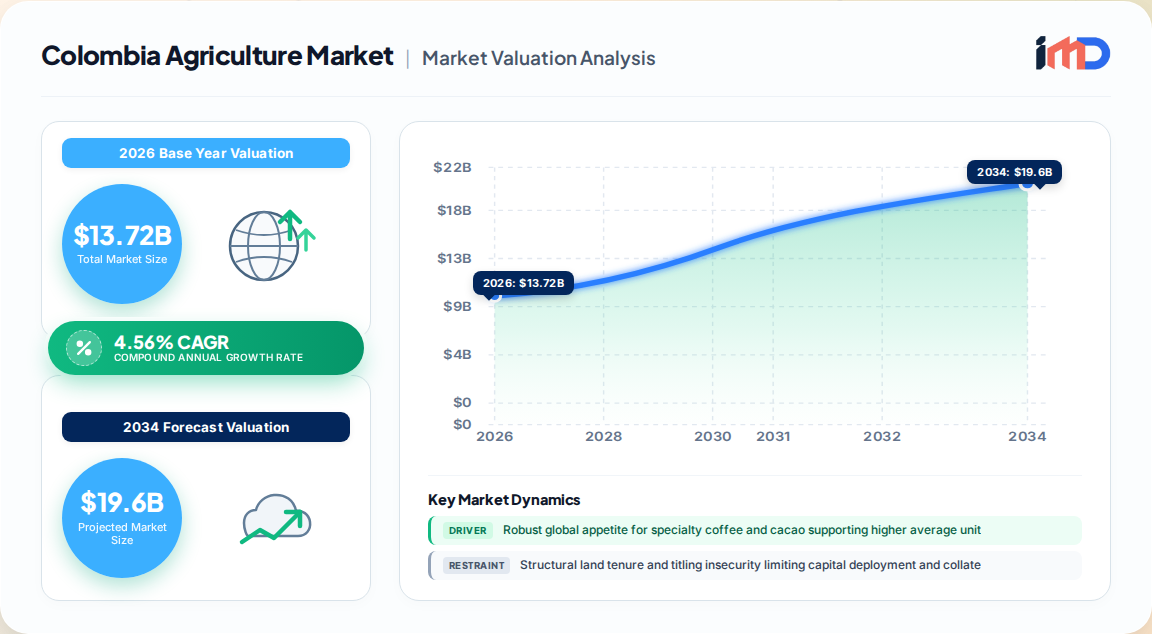
The Colombian agriculture market is valued at USD 13.72 billion in 2026 and is projected to reach USD 17.15 billion by 2031, expanding at a 4.56% CAGR over the forecast window (2026-2031). Our proprietary demand model, triangulated from farm-gate price observations, MinAgricultura planting registries and exporter shipment logs, indicates a market that has moved past the 2023-2024 El Niño shock and is now re-entering a productivity-led growth phase.
Colombia is structurally a high-variance producer: roughly 11 million hectares are currently under agricultural activity, against an estimated 40 million hectares with agronomic potential. That gap — the country's most cited structural opportunity — frames nearly every investment thesis in the sector.
| Metric | Value |
|---|---|
| Market Size (2026) | USD 13.72 Billion |
| Forecast Size (2031) | USD 17.15 Billion |
| CAGR (2026-2031) | 4.56% |
| Study Period | 2021-2031 (historical 2021-2024) |
| Cultivated Area | ~11 million hectares |
| Agri-Potential Land | ~40 million hectares |
| Leading Commodity Segment Share (2025) | Cereals & Grains at 35.1% |
| Fastest-Growing Segment | Oilseeds & Pulses at 5.1% CAGR |
Near-term growth is anchored in three revenue engines: specialty coffee and fine-flavor cacao export premiums, palm-oil-derived biodiesel under national blending mandates, and the rapid scaling of Hass avocado volumes into European and North American retail. Overlaying these is a slower but compounding force — the long-horizon expansion of irrigated grain production in the Orinoquia savanna, which is the single largest latent supply shock available to the Colombian market this decade.
Not all growth narratives carry equal weight. Our driver attribution analysis assigns incremental CAGR contribution to each force, allowing buyers and investors to distinguish structural momentum from episodic pricing effects.
| Driver | CAGR Contribution | Geographic Relevance | Impact Horizon |
|---|---|---|---|
| Global appetite for specialty coffee & cacao | +0.7% | Antioquia, Huila, Santander, Arauca | Medium term (2-4 yrs) |
| Zero-deforestation certification premiums | +0.6% | Orinoquia, Amazon piedmont, Pacific palm zones | Long term (4+ yrs) |
| Public-private irrigation in Orinoquia | +0.5% | Meta, Casanare, Vichada | Long term (4+ yrs) |
| Corporate biodiversity-positive sourcing | +0.4% | Nationwide; fruit and cacao first | Medium term (2-4 yrs) |
| Direct-to-roaster / farm-to-table export platforms | +0.2% | Huila, Nariño, Cauca; emerging avocado/cacao | Short term (0-2 yrs) |
| Parametric crop-loss insurance pilots | +0.1% | Coffee and rice regions nationwide | Medium term (2-4 yrs) |
Specialty coffee is the anchor. Specialty-grade lots represent approximately 40% of national coffee output, with smallholder wet-mill investment and varietal renewal consistently delivering cupping scores above 80 points. Colombian Milds futures touched USD 7,040 per metric ton in January 2025 on Brazilian drought-driven arabica inventory tightness, and the resulting income uplift has funded measurable reinvestment at farm level.
Certification premiums are real, but smaller than headline claims. Fine-flavor cacao from Meta and Santander earns 20%-30% premiums over commodity-grade beans where georeferenced traceability satisfies European Union deforestation regulation. Voluntary carbon credit prices, however, fell to USD 3-5 per metric ton in 2024 — meaning carbon revenue alone does not justify agroforestry conversion. Compliance value, not carbon value, is the operative commercial logic.
Cereals and grains commanded 35.1% of Colombian agriculture market share in 2025, reflecting rice, corn and sorghum's role in national food security and in the feed complex. Oilseeds and pulses are forecast to post the fastest growth at a 5.1% CAGR through 2031, propelled by palm oil biodiesel blending obligations, domestic protein demand and import-substitution pressure on soybean meal.
The input side corroborates the demand signal: cereals and grains account for 53.36% of specialty fertilizer consumption, with corn alone growing at roughly 11% CAGR as a nutrient-intensive crop. Fertigation already represents 58.90% of specialty fertilizer application value, indicating that the highest-yield Colombian growers are investing in precision nutrient delivery rather than broadcast application.
| Commodity Segment | 2025 Position | Growth Outlook |
|---|---|---|
| Cereals & Grains | 35.1% share | Steady; feed-deficit driven imports |
| Oilseeds & Pulses | Growth segment | 5.1% CAGR (fastest) |
| Coffee (green + specialty) | Export premium anchor | Yield recovery post-2024 drought |
| Fruits & Vegetables (incl. avocado) | High-value export | Europe-weighted, strong unit prices |
| Palm Oil | Biodiesel mandate-linked | Certification-gated upside |
Colombia's agricultural trade profile is bifurcated: high-value, certification-dependent exports on one side, and a structural, widening import bill for feed grains and intermediate inputs on the other.
Export side. Agricultural exports reached USD 7.5 billion in 2022 and have continued to diversify beyond the traditional coffee-banana-cut flowers triad. Hass avocado exports hit USD 309 million in 2024, with roughly 70% destined for Europe; the category demonstrated extreme seasonality, surging approximately 350% during the 2025 Super Bowl window. Coffee and cacao remain the premium-price leaders, supported by single-origin traceability and EUDR-compliant georeferencing.
Import side. Colombia is a persistent net importer of yellow corn, soybean meal and wheat, plus the majority of its soluble fertilizer inputs. This creates a structural margin squeeze when the peso weakens or when Black Sea and US Gulf grain prices spike.
Supplier and processor landscape. Multinational processors are deepening traceability-linked procurement relationships rather than pursuing spot-only buying. Notable operational anchors include Daabon Organic and Oleoflores in certified RSPO palm, Yara's low-carbon fertilizer programs (including a USD 100 million Colombian production expansion and the MyCarbon regenerative pasture initiative, which lifted forage yields by 63%), Cosmoagro's Solutec staged-nutrition product line supported by 120 agronomists, PepsiCo's decarbonization program with Yara across 20 potato farms in Mexico, Colombia, Chile and Argentina, and Cargill's Intel4Value training of over 1,100 palm growers on riparian buffers and integrated pest management in 2024.
The Colombian value chain is being re-intermediated. Historically, producer-to-exporter spreads captured value at the aggregation layer; today, direct-to-roaster and farm-to-table export platforms are compressing that spread and returning margin to producers in Huila, Nariño and Cauca.
Growth is not evenly distributed. The Andean coffee belt contributes the largest share of market value because of premium unit pricing, while Orinoquia carries the highest incremental volume potential.
| Region | Value Share | Core Thesis |
|---|---|---|
| Andean Coffee Belt | 34% | Specialty price realization; varietal renewal |
| Caribbean & Northern Lowlands | 21% | Palm, banana, irrigated rice, export logistics |
| Eastern Plains / Orinoquia | 18% | Frontier grain expansion; irrigation PPPs |
| Central Highlands | 16% | Dairy, vegetables, flowers, potatoes |
| Pacific & Amazon Fringe | 11% | Cacao agroforestry, biodiversity premiums |
A USD 99.9 million government-CAF funding agreement signed in August 2024 is accelerating canal construction and soil amendment work across Meta, Casanare and Vichada. Pilot rice and corn plots in the region have already matched leading Brazilian Cerrado yield benchmarks, and double-cropping is becoming viable where dry-season water is secured — the clearest evidence that the Orinoquia thesis has moved from concept to demonstration.
The competitive field is defined less by intra-Colombian rivalry than by who controls certification, traceability and processing capacity. Strategic priorities we observe among leading players:
Notable recent developments include Yara's Climate Choice portfolio and its USD 100 million low-carbon fertilizer expansion in Colombia targeting roughly 60% footprint reduction; PepsiCo and Yara's farming decarbonization program launched in 2025 with a stated ambition to cut on-farm emissions by up to 60%; Cosmoagro's 2024 Solutec staged-nutrition launch; and the 2024 establishment of 3,800 hectares of cacao agroforestry in Orinoquia under IFC technical assistance, integrating carbon sequestration with farmer income growth.
The path to USD 17.15 billion by 2031 rests on converting Colombia's land endowment into irrigated, certified, mechanized production rather than on commodity price inflation. Three white spaces stand out: import substitution in feed grains via Orinoquia double-cropping; certification-backed premiumization of avocado, cacao and specialty coffee into EU and North American retail; and precision nutrition services for the mid-tier grower, where specialty fertilizer penetration remains far below its economic optimum.
The principal risks are climatic and institutional rather than commercial. A severe La Niña event, a prolonged El Niño drought, or stalled progress on land formalization would each compress the forecast trajectory by a material margin. Absent those shocks, productivity improvement, not area expansion, is the primary growth engine — and it is already visible in the data.
| Aspects | Details |
|---|---|
| Study Period | 2020-2034 |
| Base Year | 2026 |
| Estimated Year | 2026 |
| Forecast Period | 2026-2034 |
| Historical Period | 2020-2025 |
| Growth Rate | CAGR of 4.56% from 2020-2034 |
| Segmentation |
|
By Analysis Type
By Farm Size
| By Geography |
|
The Colombia agriculture market is estimated at USD 13.72 billion in 2026 and is projected to reach USD 17.15 billion by 2031, growing at a 4.56% CAGR over the forecast period.
Cereals and grains accounted for 35.1% of Colombia agriculture market share in 2025, driven by rice, corn and sorghum demand for food security and animal feed.
Oilseeds and pulses are forecast to register the highest growth at a 5.1% CAGR through 2031, supported by palm oil biodiesel blending mandates and domestic protein demand.
Specialty-grade coffee represents roughly 40% of national coffee output and earns significant premiums, with Colombian Milds futures peaking at USD 7,040 per metric ton in January 2025.
Colombian avocado exports reached USD 309 million in 2024, with approximately 70% of volumes destined for European markets and a sharp seasonal surge during the Super Bowl window.
A USD 99.9 million government-CAF funding agreement signed in August 2024 is accelerating irrigation canals and soil amendment across Meta, Casanare and Vichada, where pilots have matched Brazilian Cerrado yields.
Our rigorous research methodology combines multi-layered approaches with comprehensive quality assurance, ensuring precision, accuracy, and reliability in every market analysis.
| Stakeholder Role | Interview Share (%) |
|---|---|
| Export & Commercial Director | 32% |
| Agronomy & Sustainability Manager | 27% |
| Procurement Director (Inputs) | 23% |
| Farm Operations Manager | 18% |
| Company Type | Representation (%) |
|---|---|
| Commercial row-crop & grain estates | 28% |
| Coffee & cacao smallholder cooperatives | 24% |
| Palm, sugar & agro-industrial processors | 19% |
| Agricultural input distributors & agronomy services | 17% |
| Export packhouses & trading houses | 12% |
 Related Reports
