1What is the Belgium container glass market size in 2026?
The Belgium container glass market is valued at 845.69 thousand metric tons in 2026 and is projected to reach 921.08 thousand metric tons by 2031, growing at a CAGR of 1.72%.
Insight Market Data is a premier market research and business consulting firm headquartered in Pune, India, providing syndicated research reports, customized intelligence studies, and strategic advisory services. Renowned academic institutions and Fortune 500 corporations worldwide rely on Insight Market Data's research repository to navigate evolving global and regional business environments. Covering 46 diverse industries across 25 major international economies, our comprehensive database delivers thousands of verified statistics and granular market evaluations. By combining industry-leading analytical methodologies with the direct insights of seasoned industry leaders and subject-matter experts, we deliver actionable intelligence spanning historical performance benchmarks to rigorous multi-year forecasts. We empower organizations to make confident, data-driven decisions across pivotal domains including Machinery & Equipment, Chemicals & Materials, Pharmaceuticals & Healthcare, Food & Beverages, Consumer Goods, Energy & Power, Automotive & Transportation, Electronics & Semiconductors, Medical Devices, Telecommunications, Emerging Technologies, Agriculture, and Packaging. Our multidisciplinary analyst teams provide an objective 360-degree perspective, tailoring every engagement to address complex strategic challenges with exceptional analytical rigor.
Leveraging advanced BI-powered analytics and predictive modeling, Insight Market Data uncovers high-impact market opportunities and competitive differentiators for ambitious enterprises. We continuously refine our research methodologies in accordance with global industry standards, tracking real-time market shifts to ensure our reports are consistently accurate, actionable, and delivered on schedule. Our analysts conduct methodical data validation, rigorous compliance checks, and exhaustive primary and secondary research to maintain the highest levels of data integrity and transparency. We partner closely with corporate strategists, investment groups, and business executives to translate intricate market intelligence into clear, actionable roadmaps for sustainable growth. With operational presence across Washington, USA, and Vimannagar, Pune, India, Insight Market Data ensures direct access to dedicated research specialists and responsive customer support to answer your most strategic questions.

 Belgium Container Glass Market
 by End-User (Beverages(Alcoholic(Beer, Wine, Spirits, Other Alcoholic Beverages), Non-Alcoholic(Carbonated Drinks (CSDs), Dairy Product Based Drinks, Juices, Other Non-Alcoholic Beverages)), Food(Jam, Jelly, Marmalades, Honey, Condiments and Sauces, Oil, Pickles), Cosmetics and Personal Care, Pharmaceuticals(excluding Vials and Ampoules), Perfumery), by Color (Flint, Amber, Green, Other Colors), by Flanders, by Wallonia, by Brussels-Capital Forecast 2026-2034

Research Associate

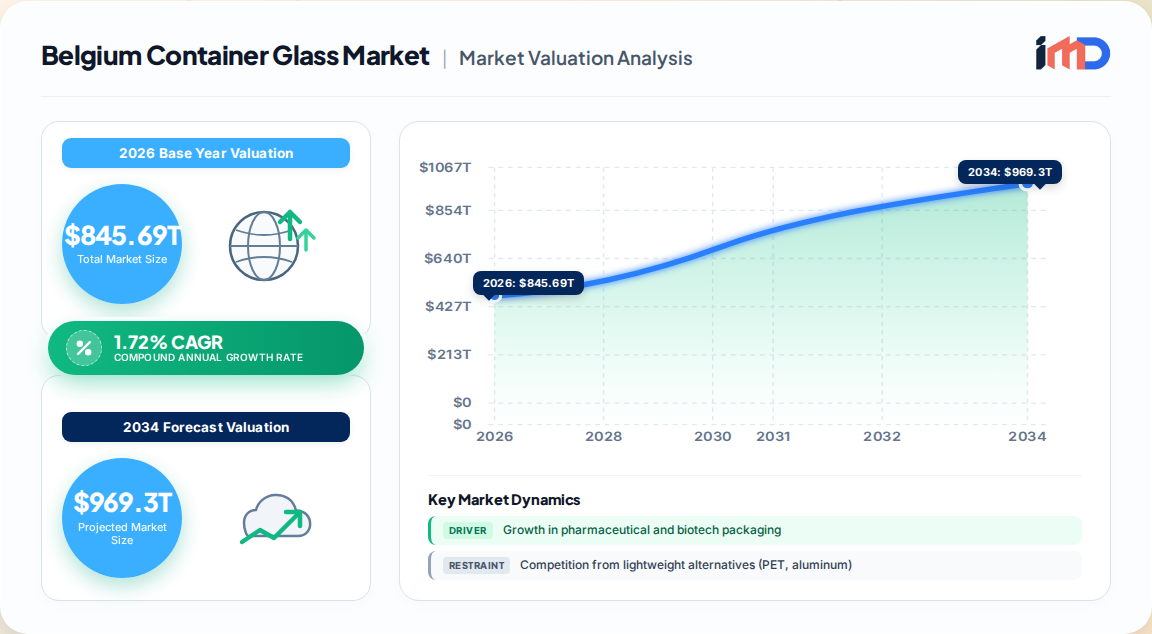
The Belgium container glass market is projected to expand from 845.69 thousand metric tons in 2026 to 921.08 thousand metric tons by 2031, registering a CAGR of 1.72% over the forecast period. This mature market is underpinned by Belgium's strategic position within the EU single market, a 97% glass recycling rate—among the highest globally—and a robust beer and pharmaceutical export ecosystem. The market concentration is medium, with established players leveraging technological capabilities to defend positions amid rising energy costs and competition from lightweight alternatives.
Belgium's container glass sector is characterized by pronounced segmentation: beverages dominate with 59.63% share in 2025, while amber glass is the fastest-growing color segment at a 2.81% CAGR. The country's container glass ecosystem benefits from advanced recycling infrastructure, regulatory frameworks aligned with EU directives, and significant capacity investments, including Ciner Glass Belgium's EUR 504 million facility in Lommel with 1,300 metric tons daily capacity expected by 2026-2027.
The Belgium container glass market features a mix of global and regional players. Key companies include Gerresheimer AG, SAVERGLASS Group, Konings plc, Bormioli Rocco, and AGC Glass Europe SA/NV. These firms compete on technological capabilities, sustainability credentials, and supply-chain efficiency. Recent developments include capacity expansions and investments in low-carbon glass production. For instance, Verallia's Vista bottle line, made entirely of post-consumer cullet, claims 40% energy savings compared to virgin glass production.
Belgium's container glass trade is deeply integrated with EU markets. The country's ports, particularly Antwerp, facilitate exports to Germany, France, and the Netherlands. Import volumes are influenced by demand for specialty glass and competition from low-cost producers. Official trade data from Eurostat indicates that Belgium is a net exporter of container glass, with export values exceeding imports. Key suppliers of raw materials include soda ash, sand, and limestone providers, with recycling infrastructure reducing reliance on virgin materials. The EU's 80.1% glass packaging collection rate and 91% of effectively recycled glass returning to new production bolster supply-chain circularity.
Belgium's container glass demand is concentrated in Flanders, which accounts for an estimated 62% of national consumption, driven by industrial activity and population density. Wallonia represents 22%, while Brussels-Capital accounts for 16%, reflecting lower industrial but higher hospitality demand. The Flemish region benefits from major production facilities and logistics hubs, including the Port of Antwerp. Wallonia's demand is supported by food and beverage processing industries. Brussels, as the EU capital, has high per-capita consumption in hospitality but limited manufacturing.
Opportunities exist in lightweight glass innovation for premium beverages and pharmaceuticals, where design differentiation and sustainability credentials command price premiums. The cosmetics segment offers growth potential, with Belgium positioned as a luxury packaging hub. Additionally, closed-loop recycling systems and smart packaging for pharma and biotech present avenues for value creation. Companies investing in low-carbon glass production, such as hydrogen-fired furnaces, can gain regulatory and customer advantages.
The value chain spans raw material sourcing (sand, soda ash, limestone, recycled cullet), glass melting and forming, and distribution to end-users. Recycling infrastructure is a critical upstream component, with Belgium's high collection rates reducing energy consumption by 2-3% for each 10% increase in recycled glass content. Downstream, brand owners and fillers demand high-quality, sustainable packaging, driving collaboration for design and supply-chain optimization.
Procurement strategies focus on securing low-carbon glass, ensuring supply-chain resilience, and meeting EU recycling targets. Buyers increasingly prioritize suppliers with science-based climate targets, which represent nearly 90% of European output by tonnage. Local sourcing within the EU reduces lead times and tariff risks. For pharmaceutical applications, regulatory compliance (EU GMP, FDA) is paramount, favoring suppliers with certified quality systems.
| Aspects | Details |
|---|---|
| Study Period | 2020-2034 |
| Base Year | 2026 |
| Estimated Year | 2026 |
| Forecast Period | 2026-2034 |
| Historical Period | 2020-2025 |
| Growth Rate | CAGR of 1.72% from 2020-2034 |
| Segmentation |
|
By Color
| By Geography |
|
The Belgium container glass market is valued at 845.69 thousand metric tons in 2026 and is projected to reach 921.08 thousand metric tons by 2031, growing at a CAGR of 1.72%.
Major companies operating in the market include Gerresheimer AG, SAVERGLASS Group, Konings plc, Bormioli Rocco, and AGC Glass Europe SA/NV.
Beverages captured 59.63% of the market share in 2025, driven by Belgium's strong beer culture and tourism-related consumption.
Key drivers include growth in pharmaceutical and biotech packaging, tourism-driven beverage consumption, export potential within the EU, and technological advancements in glass manufacturing.
Belgium achieves a 97% glass recycling rate, positioning it as a European leader in circular economy practices.
Our rigorous research methodology combines multi-layered approaches with comprehensive quality assurance, ensuring precision, accuracy, and reliability in every market analysis.
| Stakeholder Role | Interview Share (%) |
|---|---|
| Procurement Director | 30% |
| Supply Chain Manager | 30% |
| Sustainability Officer | 20% |
| Packaging Development Manager | 20% |
| Company Type | Representation (%) |
|---|---|
| Glass Container Manufacturers | 40% |
| Glass Recycling & Cullet Processors | 20% |
| Beverage & Food Brand Owners | 25% |
| Pharmaceutical Packaging Procurement Teams | 10% |
| Raw Material Suppliers | 5% |
 Related Reports
