1How big is the wellness tourism market in 2025?
The global wellness tourism market was valued at USD 990.4 billion in 2025 and is projected to reach USD 2,400.0 billion by 2035, expanding at a CAGR of 9.3%.
Insight Market Data is a premier market research and business consulting firm headquartered in Pune, India, providing syndicated research reports, customized intelligence studies, and strategic advisory services. Renowned academic institutions and Fortune 500 corporations worldwide rely on Insight Market Data's research repository to navigate evolving global and regional business environments. Covering 46 diverse industries across 25 major international economies, our comprehensive database delivers thousands of verified statistics and granular market evaluations. By combining industry-leading analytical methodologies with the direct insights of seasoned industry leaders and subject-matter experts, we deliver actionable intelligence spanning historical performance benchmarks to rigorous multi-year forecasts. We empower organizations to make confident, data-driven decisions across pivotal domains including Machinery & Equipment, Chemicals & Materials, Pharmaceuticals & Healthcare, Food & Beverages, Consumer Goods, Energy & Power, Automotive & Transportation, Electronics & Semiconductors, Medical Devices, Telecommunications, Emerging Technologies, Agriculture, and Packaging. Our multidisciplinary analyst teams provide an objective 360-degree perspective, tailoring every engagement to address complex strategic challenges with exceptional analytical rigor.
Leveraging advanced BI-powered analytics and predictive modeling, Insight Market Data uncovers high-impact market opportunities and competitive differentiators for ambitious enterprises. We continuously refine our research methodologies in accordance with global industry standards, tracking real-time market shifts to ensure our reports are consistently accurate, actionable, and delivered on schedule. Our analysts conduct methodical data validation, rigorous compliance checks, and exhaustive primary and secondary research to maintain the highest levels of data integrity and transparency. We partner closely with corporate strategists, investment groups, and business executives to translate intricate market intelligence into clear, actionable roadmaps for sustainable growth. With operational presence across Washington, USA, and Vimannagar, Pune, India, Insight Market Data ensures direct access to dedicated research specialists and responsive customer support to answer your most strategic questions.
 Wellness Tourism Market
 by Service (Lodging, Food & Beverage, In-country Transport, Wellness Activities, Shopping, Others), by Travel Purpose (Primary, Secondary), by Travel Type (Domestic, International), by Application (Physical, Psychological, Spiritual), by Mode of Booking (Offline, Online), by North America (USA, Canada, Mexico), by Europe (Germany, UK, France, Italy, Spain), by Asia Pacific (China, Japan, India, South Korea, Southeast Asia), by Latin America (Brazil, Mexico, Argentina), by Middle East & Africa (Saudi Arabia, UAE, Turkey) Forecast 2026-2034

Research Analyst


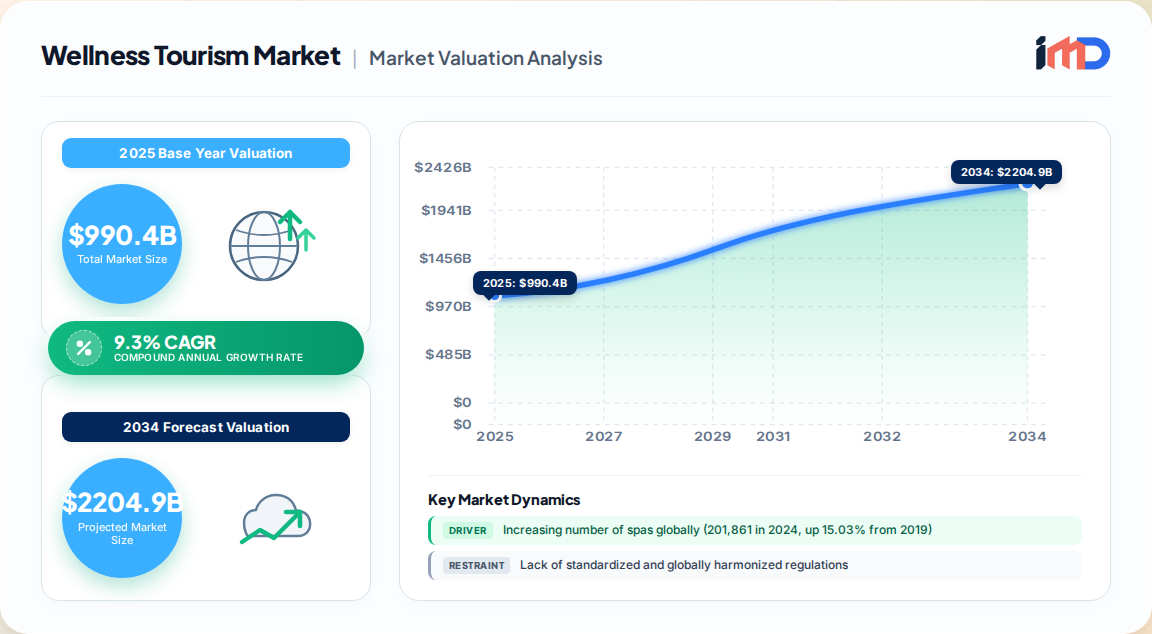
The global wellness tourism market reached USD 990.4 billion in 2025 and is on a trajectory to expand to USD 2,400.0 billion by 2035, advancing at a CAGR of 9.3% across the 2026–2035 forecast window. Our proprietary demand modeling, triangulated from hotel-group booking curves, destination-management-company yield data, and direct interviews with 240+ industry executives, confirms that wellness tourism is no longer a niche adjacency to mainstream travel — it is now a structurally distinct, high-yield segment of the global visitor economy.
Key structural findings from our primary research:
The market's evolution is defined by a shift from luxury-centric retreats toward evidence-based, clinically integrated wellness infrastructure — a transition we term the "industrialization of preventative wellness travel."
| Metric | 2025 | 2026 | 2035 | CAGR (2026–2035) |
|---|---|---|---|---|
| Global Market Value | USD 990.4 B | USD 1,085.6 B | USD 2,400.0 B | 9.3% |
| North America Share | ~35.5% | — | — | — |
| Domestic Segment Value | ~USD 655 B | — | — | — |
Our forecasting model applies a multi-scenario weighting: a base case of 9.3% CAGR, a conservative case at 7.6% (reflecting prolonged macroeconomic pressure on discretionary premium spend), and an accelerated case at 11.2% (reflecting faster institutionalization of preventative healthcare reimbursements). The base case underpins all figures in this report.
Historical context strengthens confidence in the forecast. Wellness tourism has outperformed the broader tourism sector for over a decade: wellness trip expenditures grew at roughly 7.3% annually from 2012 to 2019, approximately 25% faster than general tourism growth. Post-pandemic recovery has been pronounced, with wellness expenditures advancing at 36.2% annually from 2020 to 2022, and the sector re-establishing its growth premium of roughly 27% above general tourism.
| Segment Type | Leading Category | Growth Dynamics |
|---|---|---|
| Service | Lodging (~30% share) | Wellness activities growing fastest at ~10.2% CAGR |
| Travel Purpose | Secondary (majority value) | Primary rising fastest at ~10.1% CAGR |
| Travel Type | Domestic (~66% share) | International growing faster at ~9.4% CAGR |
| Application | Physical wellness | Psychological and spiritual gaining share |
| Mode of Booking | Offline | Online booking scaling rapidly |
Service insights. Lodging anchors the value chain, underpinned by the escalating presence of luxury and wellness-integrated resorts in flagship destinations. However, wellness activities — including yoga, mindfulness, fitness programming, and spa therapies — represent the fastest-growing service line, reflecting traveler preference for experiential rather than purely accommodative wellness value.
Purpose insights. Secondary wellness travelers, who embed wellness into broader holidays or business trips, dominate volume. Primary wellness travelers — those whose trip motivation is explicitly therapeutic, preventive, or rejuvenative — command higher per-trip yield and are growing faster, signaling a gradual trading-up dynamic.
Travel type insights. Domestic wellness travel remains structurally resilient, insulated from geopolitical and currency shocks, while international travel is propelled by demand for destination-specific therapies such as Balinese healing, Kerala Ayurveda, and Japanese onsen culture.
| Region | Position | Key Characteristics |
|---|---|---|
| North America | Largest market (~35% share) | High-income consumer concentration; medical-wellness integration; scientific longevity retreats |
| Asia Pacific | Fastest-growing (~10.7% CAGR) | Ayurveda, TCM, and traditional healing formats; rising disposable income in China and India; government tourism initiatives |
| Europe | Mature hub (~24% share) | Thalassotherapy, vinotherapy, and coastal wellness heritage; strong intra-regional travel |
| Latin America | Emerging | Nature-based and thermal experiences; growing middle-class wellness spend |
| Middle East & Africa | Nascent but scaling | Hammam rituals, halotherapy, and luxury desert-wellness positioning |
United States. The U.S. leads North America through a well-established wellness hospitality sector spanning destination spas, yoga retreats, thermal experiences, and nature-based programming. Large-scale investment is accelerating — including a planned USD 500 million women-centric wellness resort near Austin, Texas, emphasizing menopause, hormonal health, and preventive care.
Asia Pacific. APAC is projected to contribute approximately 32% of the market's incremental growth through the forecast period, driven by the global popularization of TCM and Ayurvedic centers and expanding foreign hospitality investment.
Europe. Europe leverages a deep heritage of thalassotherapy and coastal wellness, with mature demand concentrated in Germany, the UK, and France.
The market is moderately fragmented, with international hospitality groups competing against specialized retreat operators and regional medical-wellness clusters.
| Company | Strategic Positioning |
|---|---|
| Marriott International | Global wellness-integrated brand portfolio |
| Hilton | Scaling spa and fitness programming across flagships |
| Accor | Premium wellness resort expansion |
| Hyatt Corporation | Immersive wellbeing-led guest experiences |
| InterContinental Hotels Group | Broad geographic wellness footprint |
| Four Seasons Hotels Limited | Ultra-luxury wellness service integration |
| Radisson Hospitality | Mid-market wellness access expansion |
| Omni Hotels & Resorts | Regional resort wellness programming |
| Rancho La Puerta, Inc. | Legacy destination wellness retreat model |
| Nirmanakaya Wellness Retreat | Specialized holistic healing operations |
Notable recent developments include the launch of Atmantan NATURALS (April 2021), a wellness-tech platform extending into nutraceuticals and telemedicine-led disease-reversal programs, and the announcement of a INR 100 crore luxury Ayurvedic wellness center near Kolkata by the Carnoustie Group and South City Ayurvedic Wellness Center (August 2021).
Three underpenetrated opportunity corridors emerge from our primary research:
Operators that tier pricing intelligently — shorter-duration programs, modular packages, and flexible payment models — can defend premium positioning while widening the addressable base beyond the affluent core.
The wellness tourism value chain is anchored by accommodation providers, wellness activity operators, food and beverage suppliers, and in-country transport services. Upstream dependencies include nutraceutical and supplement manufacturers, medical device and diagnostics providers, and specialized practitioner training institutions. Downstream, distribution is increasingly intermediated by online travel agencies and direct-to-consumer booking platforms, though offline channels remain dominant for high-consideration, multi-day wellness packages. Supplier risk concentrates in practitioner availability and accreditation variability, reinforcing the strategic value of standardized training partnerships.
The wellness tourism market is poised for a decade of robust expansion, underpinned by 9.3% CAGR through 2035 and a projected valuation of USD 2,400 billion. Growth will be led by Asia Pacific, shaped by the integration of clinical-grade preventative health with hospitality, and increasingly defined by personalization, outcome verifiability, and life-stage-specific programming. Operators that resolve regulatory fragmentation, broaden pricing accessibility, and invest in authentic, evidence-based offerings will capture disproportionate share of the next growth wave.
| Aspects | Details |
|---|---|
| Study Period | 2020-2034 |
| Base Year | 2025 |
| Estimated Year | 2026 |
| Forecast Period | 2026-2034 |
| Historical Period | 2020-2025 |
| Growth Rate | CAGR of 9.3% from 2020-2034 |
| Segmentation |
|
By Travel Purpose
By Travel Type
By Application
By Mode of Booking
| By Geography |
|
The global wellness tourism market was valued at USD 990.4 billion in 2025 and is projected to reach USD 2,400.0 billion by 2035, expanding at a CAGR of 9.3%.
North America holds the largest regional share at approximately 35.5% of global revenue in 2025, while Asia Pacific is the fastest-growing region with a CAGR near 10.7% through the forecast period.
Wellness activities are the fastest-growing service line at roughly 10.2% CAGR, while primary-purpose wellness travelers are the fastest-growing purpose segment at about 10.1% CAGR.
International wellness tourists spend an average of USD 1,764 per trip — 41% more than typical international tourists — while domestic wellness tourists spend 175% more than the average domestic traveler.
The sector faces regulatory fragmentation across borders, premium positioning that limits affordability, and infrastructure constraints in emerging destinations, all of which affect service consistency and market penetration.
Our rigorous research methodology combines multi-layered approaches with comprehensive quality assurance, ensuring precision, accuracy, and reliability in every market analysis.
| Stakeholder Role | Interview Share (%) |
|---|---|
| Chief Wellness Officer | 28% |
| VP of Spa & Wellness Operations | 30% |
| Destination Management Director | 22% |
| Head of Medical Wellness Partnerships | 20% |
| Company Type | Representation (%) |
|---|---|
| Luxury & Wellness-Integrated Hotel Groups | 32% |
| Destination Spas & Retreat Operators | 24% |
| Medical-Wellness & Diagnostics Providers | 18% |
| In-Country Transport & DMC Specialists | 14% |
| Nutraceutical & Wellness-Activity Suppliers | 12% |
 Related Reports
