1What is the current market size of the water management consultancy market?
The global water management consultancy market was valued at $834 million in 2025 and is projected to reach $1.24 billion by 2032, growing at a CAGR of 5.8%.
Insight Market Data is a premier market research and business consulting firm headquartered in Pune, India, providing syndicated research reports, customized intelligence studies, and strategic advisory services. Renowned academic institutions and Fortune 500 corporations worldwide rely on Insight Market Data's research repository to navigate evolving global and regional business environments. Covering 46 diverse industries across 25 major international economies, our comprehensive database delivers thousands of verified statistics and granular market evaluations. By combining industry-leading analytical methodologies with the direct insights of seasoned industry leaders and subject-matter experts, we deliver actionable intelligence spanning historical performance benchmarks to rigorous multi-year forecasts. We empower organizations to make confident, data-driven decisions across pivotal domains including Machinery & Equipment, Chemicals & Materials, Pharmaceuticals & Healthcare, Food & Beverages, Consumer Goods, Energy & Power, Automotive & Transportation, Electronics & Semiconductors, Medical Devices, Telecommunications, Emerging Technologies, Agriculture, and Packaging. Our multidisciplinary analyst teams provide an objective 360-degree perspective, tailoring every engagement to address complex strategic challenges with exceptional analytical rigor.
Leveraging advanced BI-powered analytics and predictive modeling, Insight Market Data uncovers high-impact market opportunities and competitive differentiators for ambitious enterprises. We continuously refine our research methodologies in accordance with global industry standards, tracking real-time market shifts to ensure our reports are consistently accurate, actionable, and delivered on schedule. Our analysts conduct methodical data validation, rigorous compliance checks, and exhaustive primary and secondary research to maintain the highest levels of data integrity and transparency. We partner closely with corporate strategists, investment groups, and business executives to translate intricate market intelligence into clear, actionable roadmaps for sustainable growth. With operational presence across Washington, USA, and Vimannagar, Pune, India, Insight Market Data ensures direct access to dedicated research specialists and responsive customer support to answer your most strategic questions.

 Water Management Consultancy Market
 by Type (Applied Water, Waste Water, Others), by Life Cycle (Strategic Planning Consultancy, Engineering Design Consultancy, Implementation Management Consultancy, Operations and Maintenance Consultancy, Others), by Service Period (Short-Term (3-6 Months), Medium-to-Long-Term (6-24 Months), Long-Term (2 Years and Above)), by Application (Public Facility, Industrial, Residential, Commercial), by North America (USA, Canada, Mexico), by Europe (Germany, UK, France, Italy, Spain, Russia), by Asia Pacific (China, Japan, India, South Korea, Australia, Southeast Asia), by Latin America (Brazil, Argentina, Colombia, Peru, Chile), by Middle East & Africa (Saudi Arabia, UAE, South Africa, Egypt, Turkey) Forecast 2026-2034

Senior Analyst

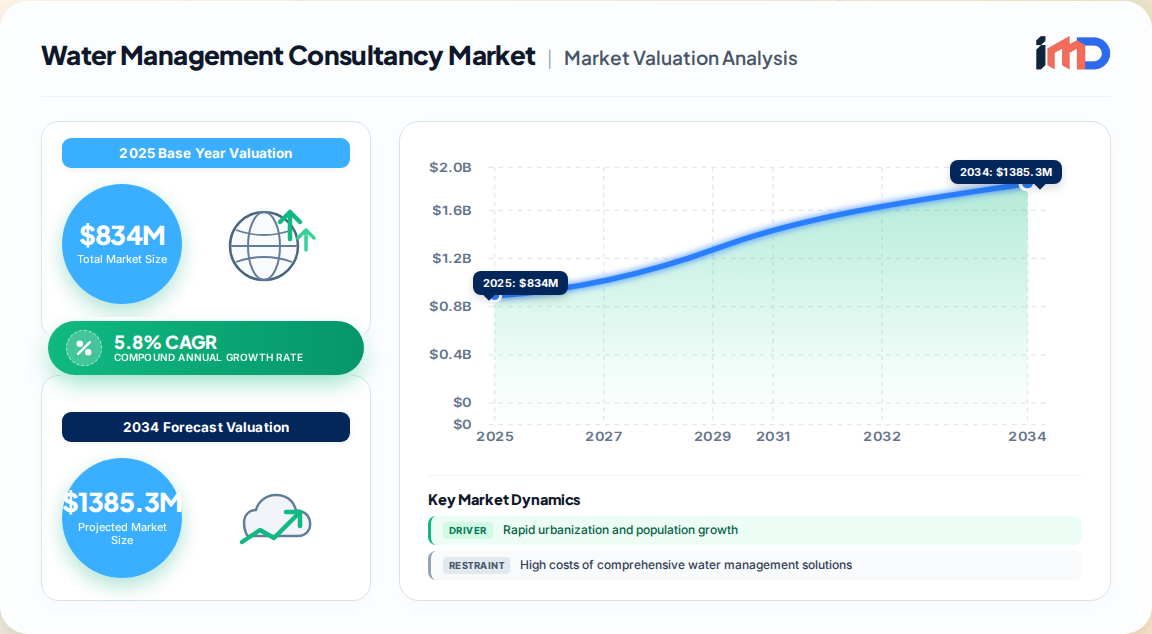
The global water management consultancy market represents a critical segment of the broader environmental services industry, providing specialized advisory, engineering, and strategic support to address escalating water-related challenges. Our proprietary primary research estimates the market will grow from $834 million in 2025 to $1.24 billion by 2032, registering a CAGR of 5.8% . This growth is propelled by the urgent need to modernize aging infrastructure, comply with stringent environmental regulations, and enhance resilience against climate-induced water stress.
Water management consultancy encompasses a range of decision-support services rooted in hydrology, ecology, engineering, and policy. These services are indispensable for diagnosing and mitigating issues related to floods, droughts, pollution, and ecological degradation. Consultants assess water resources, quality, supply-demand balance, and utilization efficiency to develop integrated strategies. These strategies often include water source protection, water-saving technologies, wastewater reuse, sponge city concepts, and water rights allocation. The consulting process itself involves data monitoring, model prediction, solution comparison, economic feasibility analysis, and risk management, ensuring sustainable water resource utilization.
| Metric | Value |
|---|---|
| Base Year (2025) Market Size | $834 Million |
| Forecast Year (2032) Market Size | $1,240 Million |
| CAGR (2025-2032) | 5.8% |
| Largest Region (2025) | Asia-Pacific |
| Fastest-Growing Region | Asia-Pacific |
Rapid urbanization and climate change are twin catalysts reshaping demand for water management consultancy. With the global urban population surpassing 4.5 billion in 2025 and projected to exceed 5.3 billion by 2035, municipalities are allocating up to 5% of annual capital budgets to upgrade water infrastructure, integrate green solutions, and develop resilient systems. This creates a sustained pipeline for consultancies specializing in master planning, feasibility studies, and resilience assessments.
Digitalization and smart water networks are another powerful driver. Global spending on smart water technologies, including sensors, IoT platforms, and AI-driven hydrological forecasting, reached $1.2 billion in 2023 and is forecast to grow at a 6% CAGR through 2030. Utilities increasingly rely on external expertise to deploy digital twins, leakage detection analytics, and real-time demand forecasting, as these systems deliver cost savings of up to 15% for large-scale operators. Consultancies offering end-to-end digital strategy and system integration are experiencing accelerated demand.
Regulatory compliance and cross-border water rights negotiations further stimulate the market. Tighter water-quality standards, such as the European Union's revised Water Framework Directive, mandate comprehensive climate-impact assessments for major water projects. Additionally, strategic mergers and acquisitions among consultancies are expanding geographic footprints, enabling them to capture opportunities in underserved regions like Sub-Saharan Africa and Southeast Asia.
Despite robust growth prospects, the market faces significant headwinds. The high cost of comprehensive water management solutions remains a barrier, particularly for municipalities with constrained fiscal capacity. Large-scale integrated water resource plans often exceed $10 million, forcing decision-makers to prioritize immediate operational fixes over strategic consultancy engagements.
Regulatory hurdles, including complex multi-jurisdictional approval processes, prolong project timelines and inflate costs. Funding gaps in developing economies, where access to green bonds and climate funds is competitive, leave many potential projects unfunded. Furthermore, a shortage of specialized, interdisciplinary consulting talent—professionals who can bridge hydrology, engineering, data science, and policy—constrains the ability of firms to scale operations and meet growing demand.
The water management consultancy value chain spans from upstream data acquisition and modeling to downstream implementation and performance evaluation. Consultancy firms occupy the high-value advisory layer, collaborating with technology providers, engineering contractors, and utility operators. Services are segmented by type, life cycle, service period, and application.
By Type: Applied Water (33%), Waste Water (33%), and Others (34%). The applied water segment focuses on supply optimization and demand management, while waste water addresses treatment, reuse, and discharge compliance. The 'Others' category includes stormwater management, desalination advisory, and ecological restoration consulting.
By Life Cycle: Strategic Planning Consultancy, Engineering Design Consultancy, Implementation Management Consultancy, Operations and Maintenance Consultancy, and Others. The shift toward full-cycle risk management is evident as clients seek partners from project inception through to performance monitoring.
By Service Period: Short-Term (3-6 Months), Medium-to-Long-Term (6-24 Months), and Long-Term (2 Years and Above). Long-term engagements are increasingly favored for integrated water resource management projects and public-private partnerships.
By Application: Public Facility (29%), Industrial (21%), Residential (29%), and Commercial (21%). Public facilities remain the largest application segment, driven by municipal water supply and sanitation projects. However, the industrial segment is gaining traction as manufacturers seek water efficiency and wastewater treatment solutions to meet sustainability targets.
| Segmentation Basis | Segments | Share (2025) |
|---|---|---|
| By Type | Applied Water, Waste Water, Others | 33%, 33%, 34% |
| By Application | Public Facility, Industrial, Residential, Commercial | 29%, 21%, 29%, 21% |
The market exhibits significant regional imbalance, reflecting varying stages of infrastructure development, regulatory maturity, and water stress levels.
Asia-Pacific is the largest and fastest-growing region, with a projected CAGR of 7.1% . Rapid urbanization, industrial expansion, and substantial infrastructure investments in China, India, and Southeast Asia drive demand. China alone represents a significant market, with consulting focused on sponge city development, desalination optimization, and inter-basin water transfer projects.
North America and Europe are mature markets, growing at CAGRs of 4.3% and 4.8%, respectively. Consulting demand centers on upgrading aging water infrastructure, deploying smart water networks, and integrating nature-based solutions for climate resilience. Strict regulatory frameworks, such as the EU Water Framework Directive and the US Clean Water Act, create a steady pipeline for compliance and risk-assessment services.
Latin America and the Middle East & Africa present mixed dynamics. Latin America, with a CAGR of 6.1% , is investing in water supply security and sanitation infrastructure. The Middle East & Africa, growing at 5.4%, is characterized by physical water scarcity, driving demand for desalination expertise, water reuse, and efficiency improvements in water-intensive industries. Sub-Saharan Africa remains in an infrastructure development phase, with consulting focused on small-scale water facilities and sanitation projects.
The market is moderately consolidated, with global engineering and environmental consultancies competing alongside specialized water advisory firms. Key players include WSP, Tetra Tech, Ramboll Group, Arup, Black & Veatch, Atkins, Egis Group, AFRY, Montrose Environmental, Fichtner, Carollo Engineers, NIRAS, Antea Group, GAI Consultants, GOPA Infra, HYDROPHIL, Tonkin Consulting, Harris & Associates, CISPDR, BEWG, Yachiyo Engineering, Nihon Suido Consultants, NJS Co., Ltd, METAWATER, Nippon Koei, Veolia, and China Water Environment.
Competitive strategies revolve around digital transformation, geographic expansion, and service integration. Firms are investing in AI-powered hydrological modeling, digital twin platforms, and data analytics capabilities to differentiate their offerings. Strategic acquisitions enable entry into new markets and the acquisition of specialized talent. For instance, mergers and acquisitions among leading consultancies are expanding service breadth and positioning firms to capture opportunities in emerging regions.
Significant white-space opportunities exist in developing economies where funding gaps and capacity constraints limit access to advanced consultancy services. Innovative financing models, such as public-private partnerships and green bonds, can unlock demand. Additionally, the integration of nature-based solutions and climate adaptation advisory presents a high-growth avenue.
Investors and insurers are increasingly demanding quantitative water risk assessments, extending consultancy services from project demonstration to full-cycle risk management. This trend creates opportunities for firms offering risk modeling, scenario analysis, and resilience benchmarking. Furthermore, the adoption of digital twins and AI-driven forecasting tools is expected to shorten project timelines and elevate the strategic value of consultancy engagements.
As a service-based market, water management consultancy does not involve physical goods trade in the traditional sense. However, the market is influenced by cross-border flows of expertise, data, and technology. Developed regions such as North America and Europe are net exporters of consultancy services, with firms operating globally and transferring knowledge to emerging markets. The Middle East and Asia-Pacific are net importers of specialized expertise, particularly in desalination, smart water systems, and integrated water resource management.
Trade in water-related technologies, such as membrane filtration systems, sensors, and IoT platforms, supports consultancy demand. According to World Bank data, global investment in water infrastructure exceeds $100 billion annually, with a significant portion directed toward developing countries. Consultancies often collaborate with technology suppliers to deliver integrated solutions, creating a symbiotic relationship within the value chain.
To capitalize on growth opportunities, consultancies should prioritize digital innovation, talent development, and geographic diversification. Investing in AI, digital twins, and data analytics will be crucial to meet client demand for efficiency and resilience. Firms should also explore strategic partnerships and acquisitions to access new markets and specialized capabilities. Finally, addressing the talent shortage through training programs and interdisciplinary collaboration will be essential to sustain growth in this dynamic market.
| Aspects | Details |
|---|---|
| Study Period | 2020-2034 |
| Base Year | 2025 |
| Estimated Year | 2026 |
| Forecast Period | 2026-2034 |
| Historical Period | 2020-2025 |
| Growth Rate | CAGR of 5.8% from 2020-2034 |
| Segmentation |
|
By Service Period
By Application
| By Geography |
|
The global water management consultancy market was valued at $834 million in 2025 and is projected to reach $1.24 billion by 2032, growing at a CAGR of 5.8%.
Asia-Pacific is the largest and fastest-growing region, accounting for a significant share of the market and expected to grow at a CAGR of 7.1% through 2032.
Key drivers include rapid urbanization, climate change adaptation needs, digitalization of water utilities, and stringent environmental regulations.
Major players include WSP, Tetra Tech, Ramboll Group, Arup, Black & Veatch, Atkins, Egis Group, AFRY, and Veolia, among others.
Challenges include high costs of comprehensive solutions, funding gaps in developing economies, regulatory hurdles, and a shortage of specialized talent.
Our rigorous research methodology combines multi-layered approaches with comprehensive quality assurance, ensuring precision, accuracy, and reliability in every market analysis.
| Stakeholder Role | Interview Share (%) |
|---|---|
| Chief Sustainability Officer | 25% |
| Water Resources Director | 30% |
| Procurement Manager | 20% |
| Regulatory Affairs Specialist | 15% |
| Project Engineering Lead | 10% |
| Company Type | Representation (%) |
|---|---|
| Water Utility Operators | 30% |
| Engineering & Environmental Consultancies | 25% |
| Technology Providers (IoT, AI) | 20% |
| Government & Regulatory Agencies | 15% |
| Industrial Water Users | 10% |

Analyst at Providence Strategic Partners at Petaling Jaya
I have received the report already. Thanks you for your help.it has been a pleasure working with you. Thank you again for a good quality report

Internationalization Director
Yes, as a matter of fact we are totally satisfied with both reports that we have purchased and will continue to do so during this process of the internationalization of our brand.

Head of Product Management and Marketing
We are using your report, and it gave us valuable information."

Regional Director, Marketing and Business Development
We've received the report and have reviewed the content. Overall, it looks great and aligns closely with the data we can verify based on our industry knowledge.

VP of Sales
Thank you very much for sharing the report. I have reviewed it and I am very satisfied with the quality and the insights it provides. It will certainly be valuable for our internal discussions.
 Related Reports
