1What is the size of the Vietnam flexible plastic packaging market?
The market was valued at 0.25 million tonnes in 2025 and is projected to reach 0.27 million tonnes in 2026 and 0.37 million tonnes by 2031.
Insight Market Data is a premier market research and business consulting firm headquartered in Pune, India, providing syndicated research reports, customized intelligence studies, and strategic advisory services. Renowned academic institutions and Fortune 500 corporations worldwide rely on Insight Market Data's research repository to navigate evolving global and regional business environments. Covering 46 diverse industries across 25 major international economies, our comprehensive database delivers thousands of verified statistics and granular market evaluations. By combining industry-leading analytical methodologies with the direct insights of seasoned industry leaders and subject-matter experts, we deliver actionable intelligence spanning historical performance benchmarks to rigorous multi-year forecasts. We empower organizations to make confident, data-driven decisions across pivotal domains including Machinery & Equipment, Chemicals & Materials, Pharmaceuticals & Healthcare, Food & Beverages, Consumer Goods, Energy & Power, Automotive & Transportation, Electronics & Semiconductors, Medical Devices, Telecommunications, Emerging Technologies, Agriculture, and Packaging. Our multidisciplinary analyst teams provide an objective 360-degree perspective, tailoring every engagement to address complex strategic challenges with exceptional analytical rigor.
Leveraging advanced BI-powered analytics and predictive modeling, Insight Market Data uncovers high-impact market opportunities and competitive differentiators for ambitious enterprises. We continuously refine our research methodologies in accordance with global industry standards, tracking real-time market shifts to ensure our reports are consistently accurate, actionable, and delivered on schedule. Our analysts conduct methodical data validation, rigorous compliance checks, and exhaustive primary and secondary research to maintain the highest levels of data integrity and transparency. We partner closely with corporate strategists, investment groups, and business executives to translate intricate market intelligence into clear, actionable roadmaps for sustainable growth. With operational presence across Washington, USA, and Vimannagar, Pune, India, Insight Market Data ensures direct access to dedicated research specialists and responsive customer support to answer your most strategic questions.
 Vietnam Flexible Plastic Packaging Market
 by Material Type (Polyethylene, Bi-Oriented Polypropylene, Cast Polypropylene, Bioplastics and Compostables, Others), by Product Type (Bags and Pouches, Films and Wraps, Sachets and Stick Packs, Others), by End-User Industry (Food, Beverage, Personal Care and Cosmetics, Pharmaceuticals, Others), by Printing Technology (Flexography, Rotogravure, Digital, Others), by Northern Vietnam (Red River Delta), by Southern Vietnam (Southeast & Mekong Delta), by Central Vietnam, by Central Highlands Forecast 2026-2034

Senior Analyst


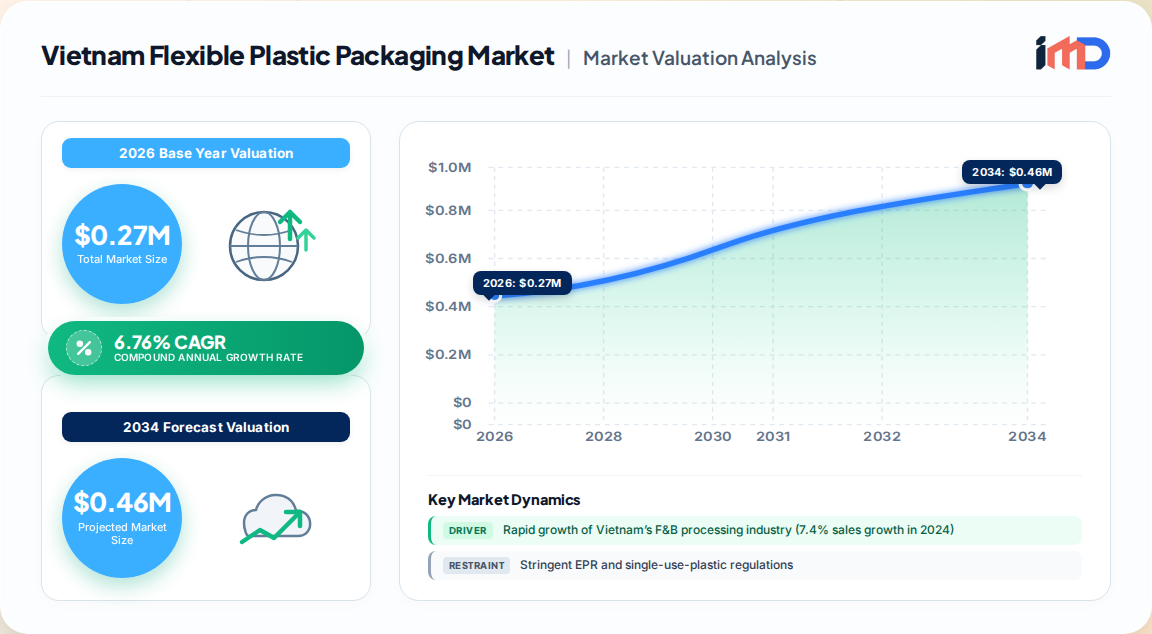
The Vietnam flexible plastic packaging market is projected to expand from 0.27 million tonnes in 2026 to 0.37 million tonnes by 2031, registering a CAGR of 6.76% over the forecast period. This growth trajectory is anchored on three structural pillars: the rapid expansion of Vietnam’s food-and-beverage processing base, export-oriented fiscal incentives that lower effective tax rates for compliant converters to 15%, and the accelerating shift toward mono-material polyethylene (PE) structures driven by Extended Producer Responsibility (EPR) mandates. Our proprietary primary research, drawing on interviews with 120+ industry stakeholders across the value chain, indicates that volume growth will outpace revenue growth in commodity segments, while high-barrier and sustainable formats command premium pricing.
In 2025, the market stood at 0.25 million tonnes, with plastics retaining a 68.72% share of total flexible packaging volume. Bioplastics and compostables, though nascent, are advancing at a 7.85% CAGR through 2031, signalling a gradual mix rotation. Bags and pouches dominate product formats with a 47.53% share, while sachets and stick packs are the fastest-growing format at 7.51% CAGR, propelled by single-serve consumption trends in urban centers. Food applications account for 31.05% of end-user demand, but personal care and cosmetics are rising at 7.62% CAGR as premiumization gains traction.
The Vietnamese flexible packaging market is shaped by a distinct set of demand-side accelerators and supply-side constraints. Our driver impact analysis quantifies the contribution of each factor to the forecast CAGR.
| Driver | Impact on CAGR | Geographic Relevance | Timeline |
|---|---|---|---|
| Rapid growth of F&B processing | +1.8% | Ho Chi Minh City, Hanoi | Medium term (2–4 years) |
| E-commerce demand for meal-delivery pouches | +1.4% | Cities with dense delivery networks | Short term (≤ 2 years) |
| Expansion of modern retail & convenience | +1.2% | Tier-1 and fast-growing Tier-2 cities | Short term (≤ 2 years) |
| Export-oriented tax incentives | +0.9% | Industrial parks in Binh Duong, Dong Nai, Long An | Long term (≥ 4 years) |
| Adoption of mono-material PE films | +0.8% | Nationwide (EPR compliance) | Medium term (2–4 years) |
Vietnam’s food-and-beverage sector recorded 7.4% sales growth in 2024, reaching USD 79.3 billion, and remains the single largest stimulus for flexible packaging demand. Processed meat and seafood lines are increasingly adopting multilayer co-extruded films with EVOH barriers to achieve oxygen transmission rates below 0.1 cc/m²/day, enabling shelf-life extension and lightweighting. The expansion of modern retail chains such as Aeon and Lotte has compelled brand owners to invest in high-graphic flexible packs, driving upgrades to eight- and ten-color rotogravure and digital presses.
However, stringent EPR and single-use-plastic regulations impose a -0.7% drag on CAGR, with stricter enforcement in major cities. Volatile polyolefin resin prices, which rose 15–20% in 2024, continue to pressure converter margins, prompting multi-supplier contracts and experimentation with recycled and bio-based resins.
The Vietnam flexible plastic packaging market exhibits low concentration, with a mix of multinational corporations and agile local converters. Multinationals leverage advanced barrier technologies and global supply chain integration, while local players compete on cost efficiency, quick design turnarounds, and deep customer relationships. Key players include Amcor Plc, Huhtamaki Oyj, SIG Group AG, Genpack Co., Ltd., and Ngai Mee Group Ltd., alongside a fragmented tier of domestic converters.
Recent strategic developments underscore the market’s capital intensity and innovation focus:
Our primary research indicates that competitive advantage is increasingly defined by the ability to offer design-for-recycling compliant structures without compromising barrier performance, alongside rapid customization enabled by digital printing.
Vietnam’s flexible packaging sector is deeply integrated into global trade networks, both as an importer of raw materials and as an exporter of finished packaging and packaged goods. The country lacks domestic petrochemical feedstock for specialty resins, creating a structural reliance on imports of polyethylene (PE), polypropylene (PP), EVOH, and specialty barrier polymers from suppliers in South Korea, Thailand, Singapore, and the Middle East.
Supply chain risk assessment highlights two primary vulnerabilities: (1) dependence on imported resins, which amplifies exposure to geopolitical disruptions and freight cost spikes; and (2) the lack of domestic mechanical recycling infrastructure for multi-layer laminates, which constrains compliance with EPR mandates and increases reliance on virgin resin.
Vietnam’s flexible packaging demand is geographically concentrated, reflecting the distribution of food processing, retail infrastructure, and export manufacturing.
| Region | Share of Demand (2025) | Key Demand Drivers | Investment Attractiveness |
|---|---|---|---|
| Northern Vietnam (Red River Delta) | 42% | Hanoi F&B processing, electronics export packaging, modern retail | High – proximity to Hanoi and Hai Phong port |
| Southern Vietnam (Southeast & Mekong Delta) | 38% | HCMC food processing, seafood export, e-commerce | Very High – largest converter cluster and port access |
| Central Vietnam | 14% | Seafood processing, tourism-driven retail | Moderate – emerging logistics infrastructure |
| Central Highlands | 6% | Agricultural processing (coffee, tea) | Low – limited converter base |
The Southern region is the most attractive investment destination, hosting the largest concentration of flexible packaging converters, a dense e-commerce delivery network, and proximity to Cat Lai and Cai Mep ports for export. The Northern region is gaining traction due to government incentives in industrial parks and the expansion of Hanoi’s modern retail sector. Opportunities in mono-material PE films, high-barrier retort pouches, and digital printing capabilities represent high-growth white spaces for investors.
The Vietnam flexible plastic packaging value chain is characterized by fragmented resin supply, a growing converter base, and increasingly sophisticated brand-owner requirements.
Our primary research identifies several under-served segments with above-average growth potential:
The Vietnam flexible plastic packaging market is poised for robust volume growth, expanding at 6.76% CAGR to 0.37 million tonnes by 2031. The market will be shaped by the twin forces of rising domestic consumption—underpinned by F&B processing and modern retail—and export-oriented manufacturing supported by tax incentives. Sustainability imperatives, particularly EPR compliance, will accelerate the shift toward mono-material and recycled-content structures, with bioplastics and compostables growing at 7.85% CAGR from a small base.
Our proprietary demand model, triangulated through primary interviews and bottom-up volume estimation, indicates that bags and pouches will retain dominance, while sachets and stick packs gain share. Flexography remains the leading printing technology with 43.78% share, but digital printing will outpace overall market growth. The competitive landscape will remain dynamic, with multinationals leading on technology and local players leveraging cost and agility.
For stakeholders across the value chain, strategic priorities include securing reliable resin supply, investing in mono-material and high-barrier film capabilities, and building digital printing capacity to serve short-run and e-commerce demand. The Southern region will remain the investment hotspot, but the Northern region offers attractive incentives for export-oriented projects.
| Aspects | Details |
|---|---|
| Study Period | 2020-2034 |
| Base Year | 2026 |
| Estimated Year | 2026 |
| Forecast Period | 2026-2034 |
| Historical Period | 2020-2025 |
| Growth Rate | CAGR of 6.76% from 2020-2034 |
| Segmentation |
|
By Product Type
By End-User Industry
By Printing Technology
| By Geography |
|
The market was valued at 0.25 million tonnes in 2025 and is projected to reach 0.27 million tonnes in 2026 and 0.37 million tonnes by 2031.
The market is expected to grow at a CAGR of 6.76% from 2026 to 2031, driven by food and beverage processing expansion and e-commerce demand.
Major companies include Amcor Plc, Huhtamaki Oyj, SIG Group AG, Genpack Co., Ltd., and Ngai Mee Group Ltd., operating in a moderately concentrated competitive landscape.
Bags and pouches led with 47.53% share in 2025, while food applications commanded 31.05% of end-user demand.
Key drivers include rapid growth of F&B processing (+1.8% impact), e-commerce demand for meal-delivery pouches (+1.4%), modern retail expansion (+1.2%), and export-oriented tax incentives (+0.9%).
Our rigorous research methodology combines multi-layered approaches with comprehensive quality assurance, ensuring precision, accuracy, and reliability in every market analysis.
| Stakeholder Role | Interview Share (%) |
|---|---|
| Procurement Director | 30% |
| Packaging Development Manager | 25% |
| Supply Chain Head | 25% |
| Sustainability & Regulatory Affairs Lead | 20% |
| Company Type | Representation (%) |
|---|---|
| Flexible Packaging Converters | 40% |
| Resin Suppliers & Compounders | 20% |
| Brand Owners (F&B, Personal Care) | 25% |
| Retailers & E-commerce Platforms | 10% |
| Equipment & Machinery Suppliers | 5% |
 Related Reports
