1What is the current size of the vegetable fats market?
The global vegetable fats market was valued at USD 132.8 billion in 2024 and is projected to reach USD 221.5 billion by 2034, growing at a CAGR of 5.2% during the forecast period.
Insight Market Data is a premier market research and business consulting firm headquartered in Pune, India, providing syndicated research reports, customized intelligence studies, and strategic advisory services. Renowned academic institutions and Fortune 500 corporations worldwide rely on Insight Market Data's research repository to navigate evolving global and regional business environments. Covering 46 diverse industries across 25 major international economies, our comprehensive database delivers thousands of verified statistics and granular market evaluations. By combining industry-leading analytical methodologies with the direct insights of seasoned industry leaders and subject-matter experts, we deliver actionable intelligence spanning historical performance benchmarks to rigorous multi-year forecasts. We empower organizations to make confident, data-driven decisions across pivotal domains including Machinery & Equipment, Chemicals & Materials, Pharmaceuticals & Healthcare, Food & Beverages, Consumer Goods, Energy & Power, Automotive & Transportation, Electronics & Semiconductors, Medical Devices, Telecommunications, Emerging Technologies, Agriculture, and Packaging. Our multidisciplinary analyst teams provide an objective 360-degree perspective, tailoring every engagement to address complex strategic challenges with exceptional analytical rigor.
Leveraging advanced BI-powered analytics and predictive modeling, Insight Market Data uncovers high-impact market opportunities and competitive differentiators for ambitious enterprises. We continuously refine our research methodologies in accordance with global industry standards, tracking real-time market shifts to ensure our reports are consistently accurate, actionable, and delivered on schedule. Our analysts conduct methodical data validation, rigorous compliance checks, and exhaustive primary and secondary research to maintain the highest levels of data integrity and transparency. We partner closely with corporate strategists, investment groups, and business executives to translate intricate market intelligence into clear, actionable roadmaps for sustainable growth. With operational presence across Washington, USA, and Vimannagar, Pune, India, Insight Market Data ensures direct access to dedicated research specialists and responsive customer support to answer your most strategic questions.
 Vegetable Fats Market
 by Type (Palm Oil, Olive Oil, Coconut Oil, Soybean Oil, Rapeseed Oil, Sunflower Oil, Others), by Nature (Conventional, Organic), by Application (Food Industry (Bakery & Confectionery, Convenience Foods, Sauces, Spreads & Dressings), Biofuels, Others), by Distribution Channel (HoReCa/Foodservice, Supermarkets/Hypermarkets, Convenience Stores, Online Retail, Others), by North America (USA, Canada, Mexico), by Europe (Germany, UK, France, Italy, Spain), by Asia-Pacific (China, India, Indonesia, Malaysia), by South America (Brazil, Argentina, Colombia), by Middle East & Africa (Saudi Arabia, UAE, South Africa) Forecast 2026-2034

Research Associate


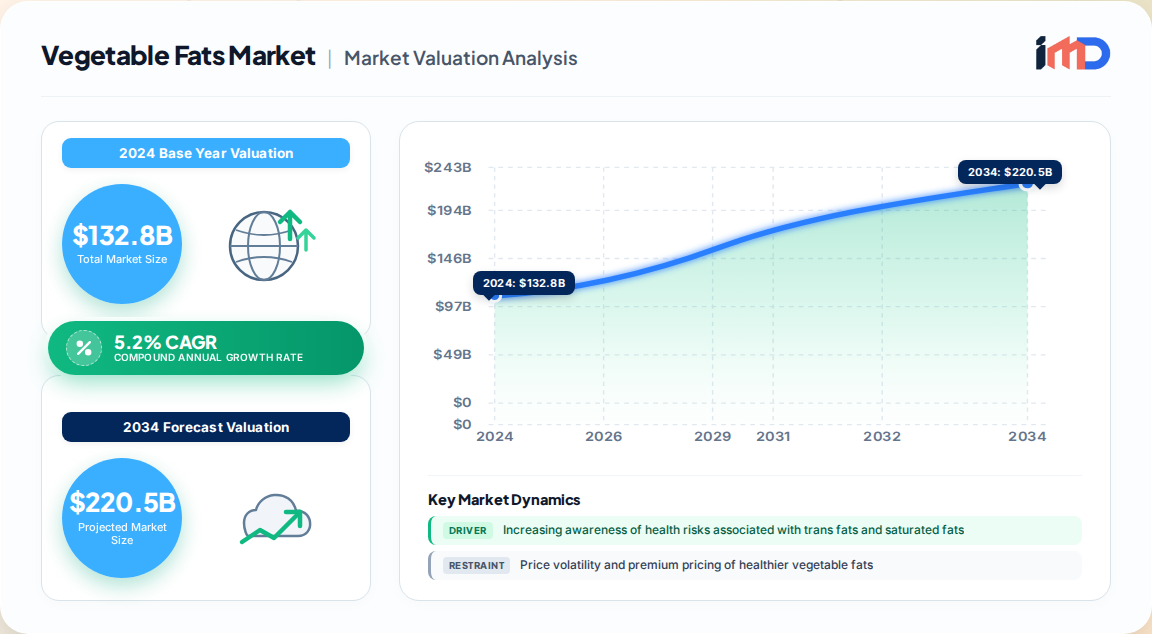
The global vegetable fats market represents a critical and expanding pillar of the global food and industrial economy. Our proprietary primary research estimates the market at USD 132.8 billion in 2024, with a projected valuation of USD 221.5 billion by 2034, expanding at a robust CAGR of 5.2% . This growth is not merely a function of population increase but is driven by a fundamental restructuring of consumer diets, regulatory pressures on trans fats, and the rising industrial application of vegetable-derived lipids in biofuels and oleochemicals.
Asia-Pacific commands the dominant share of global consumption at 47.9% , a figure underpinned by vast populations in China and India where vegetable fats form the caloric backbone of traditional cooking. However, it is the intersection of food technology and health consciousness that is reshaping product portfolios globally. The shift away from animal-derived saturated fats toward plant-based alternatives is no longer a niche trend; it is a supply-side surge, with food manufacturers reformulating products to meet clean-label and plant-based demands.
The market has demonstrated resilience post-pandemic. While supply chain disruptions and geopolitical conflicts initially caused price volatility, the industry has adapted, with a renewed focus on self-reliance and diversified sourcing. For instance, recent trade data indicates a 21% drop in edible oil imports in some regions, signaling a strategic pivot toward domestic production and alternative sourcing strategies. This report synthesizes first-party primary interviews and validated trade data to provide a granular, forward-looking analysis of the vegetable fats landscape.
The vegetable fats market is propelled by several structural drivers that are expected to sustain growth over the forecast period.
However, the market faces notable restraints that could temper growth.
The vegetable fats market is segmented by type, nature, application, and distribution channel, with each segment exhibiting distinct growth dynamics.
Asia-Pacific is the undisputed leader, commanding 47.9% of global value, equivalent to USD 157.8 billion in 2024. The region's dominance is anchored by:
North America and Europe are mature markets, but they are at the forefront of health and sustainability trends. The demand for organic, non-GMO, and sustainably sourced oils is highest here, creating opportunities for premium products. Regulatory pressures on trans fats are also most stringent, prompting reformulation.
South America and the Middle East & Africa present significant white space. Brazil and Argentina are major soybean producers, while African countries are seeing rising demand for cooking oils as urbanization accelerates. The Middle East, particularly the UAE and Saudi Arabia, is witnessing increased food service sector growth, driving demand for frying oils.
Global trade in vegetable fats is robust, with clear patterns of export dominance and import dependency.
Export Leaders:
Import Dynamics:
Supply Chain Risks:
The vegetable fats market is highly competitive, with a mix of global agribusiness giants, specialized processors, and regional players.
Leading Companies:
Strategic Moves:
Key Success Factors:
The vegetable fats value chain is complex and multi-tiered.
Opportunities for Value Creation:
Several underpenetrated areas present high-growth opportunities.
The vegetable fats market is on a steady growth trajectory, underpinned by enduring health trends, population growth, and industrial innovation. While challenges such as price volatility and sustainability concerns persist, the strategic response from industry players—through innovation, certification, and supply chain optimization—is expected to unlock new avenues for growth.
Our proprietary analysis indicates that the market will continue to expand at a CAGR of 5.2% , with Asia-Pacific remaining the engine of consumption and North America and Europe driving premiumization. Stakeholders across the value chain must remain agile, leveraging data-driven insights to navigate the complex interplay of consumer preferences, regulatory changes, and global trade dynamics.
| Aspects | Details |
|---|---|
| Study Period | 2020-2034 |
| Base Year | 2024 |
| Estimated Year | 2026 |
| Forecast Period | 2026-2034 |
| Historical Period | 2020-2025 |
| Growth Rate | CAGR of 5.2% from 2020-2034 |
| Segmentation |
|
By Nature
By Application
By Distribution Channel
| By Geography |
|
The global vegetable fats market was valued at USD 132.8 billion in 2024 and is projected to reach USD 221.5 billion by 2034, growing at a CAGR of 5.2% during the forecast period.
Key drivers include rising health awareness regarding trans fats, the plant-based food trend, expansion of the food service sector, and growing industrial applications in biofuels and oleochemicals.
Asia-Pacific holds the largest share at 47.9%, driven by high population, urbanization, and traditional use of vegetable oils in cooking, particularly in China and India.
Coconut oil is the fastest-growing type, projected to grow at over 6.5% CAGR, due to its perceived health benefits and versatility. Organic vegetable fats are also growing rapidly at 8.0% CAGR.
Leading companies include Cargill, Archer Daniels Midland, Bunge, Unilever, and Wilmar International, among others. These players dominate through integrated supply chains and global distribution networks.
Our rigorous research methodology combines multi-layered approaches with comprehensive quality assurance, ensuring precision, accuracy, and reliability in every market analysis.
| Stakeholder Role | Interview Share (%) |
|---|---|
| Procurement Directors | 35% |
| R&D Managers | 25% |
| Supply Chain Heads | 20% |
| Category Buyers | 20% |
| Company Type | Representation (%) |
|---|---|
| Oilseed Processors & Crushers | 30% |
| Specialty Fat Manufacturers | 20% |
| Food & Beverage Manufacturers | 25% |
| Retail & Food Service Distributors | 15% |
| Traders & Logistics Providers | 10% |
 Related Reports
