1How big is the US auto loan market?
The US auto loan market is valued at approximately USD 707.81 billion in 2026, growing from USD 676.20 billion in 2025, based on our proprietary primary research.
Insight Market Data is a premier market research and business consulting firm headquartered in Pune, India, providing syndicated research reports, customized intelligence studies, and strategic advisory services. Renowned academic institutions and Fortune 500 corporations worldwide rely on Insight Market Data's research repository to navigate evolving global and regional business environments. Covering 46 diverse industries across 25 major international economies, our comprehensive database delivers thousands of verified statistics and granular market evaluations. By combining industry-leading analytical methodologies with the direct insights of seasoned industry leaders and subject-matter experts, we deliver actionable intelligence spanning historical performance benchmarks to rigorous multi-year forecasts. We empower organizations to make confident, data-driven decisions across pivotal domains including Machinery & Equipment, Chemicals & Materials, Pharmaceuticals & Healthcare, Food & Beverages, Consumer Goods, Energy & Power, Automotive & Transportation, Electronics & Semiconductors, Medical Devices, Telecommunications, Emerging Technologies, Agriculture, and Packaging. Our multidisciplinary analyst teams provide an objective 360-degree perspective, tailoring every engagement to address complex strategic challenges with exceptional analytical rigor.
Leveraging advanced BI-powered analytics and predictive modeling, Insight Market Data uncovers high-impact market opportunities and competitive differentiators for ambitious enterprises. We continuously refine our research methodologies in accordance with global industry standards, tracking real-time market shifts to ensure our reports are consistently accurate, actionable, and delivered on schedule. Our analysts conduct methodical data validation, rigorous compliance checks, and exhaustive primary and secondary research to maintain the highest levels of data integrity and transparency. We partner closely with corporate strategists, investment groups, and business executives to translate intricate market intelligence into clear, actionable roadmaps for sustainable growth. With operational presence across Washington, USA, and Vimannagar, Pune, India, Insight Market Data ensures direct access to dedicated research specialists and responsive customer support to answer your most strategic questions.
 US Auto Loan Market
 by Vehicle Type (Passenger Vehicle, Commercial Vehicle), by Vehicle Model (Motorcycles/Scooters, Cars, Pickups, Small Vans, and More), by Ownership (New Vehicles, Used Vehicles), by Provider Type (Banks, Non-Banking Financial Institutions, Fintech Platforms, Captives, and More), by Tenure (Less Than 3 Years, 3-5 Years, More Than 5 Years), by Northeast, by Midwest, by South, by West Forecast 2026-2034

Research Associate


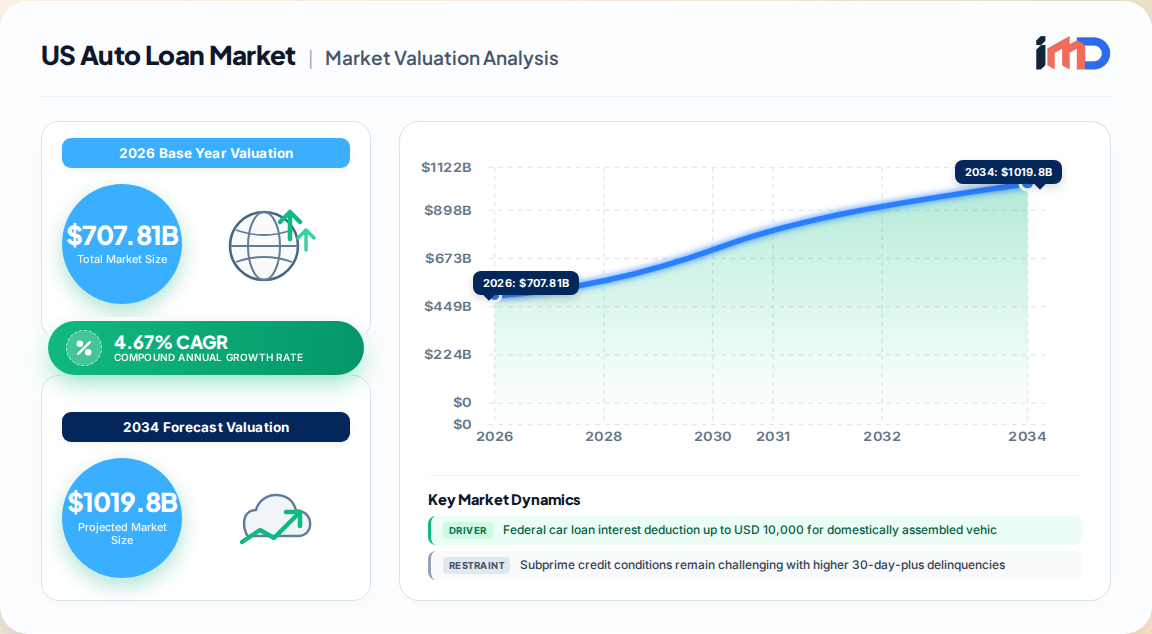
The US auto loan market represents one of the largest consumer credit verticals in the world, with outstanding balances and origination volumes that underpin household mobility and dealer profitability alike. Our proprietary primary research estimates the market at USD 707.81 billion in 2026, rising from USD 676.20 billion in 2025 and projected to reach USD 889.45 billion by 2031, reflecting a CAGR of 4.67% across the forecast window. This growth is not merely a function of vehicle price inflation; it is the product of structural shifts in lender composition, funding access, and digital origination economics that are reshaping who wins in the auto finance value chain.
In April 2026 alone, the market recorded 2.3 million auto loan originations totaling USD 73.7 billion in new loan volume, according to Consumer Financial Protection Bureau data. That monthly run-rate, while showing a modest 0.7% year-over-year decline in origination counts, masks a market in transition: inquiries fell 3.9% year-over-year in August 2026 and the credit tightness index eased 0.5% in June 2026, signaling a supply-side recalibration rather than a demand collapse. Lenders are not retreating; they are re-pricing risk and re-engineering distribution.
The competitive structure is best described as medium concentration, with captive lenders, national banks, fintech platforms, and non-banking financial institutions (NBFCs) jostling for share across prime, near-prime, and subprime tiers. Banks held 29.29% of the market in 2025, but fintech platforms are projected to grow at a 12.28% CAGR through 2031, the fastest of any provider type. Meanwhile, used vehicles accounted for 57.80% of market share in 2025 and are forecast to grow at 6.45% CAGR, cementing their role as the volume anchor of the US auto loan market.
| Market Metric | 2025 Value | 2026 Value | 2031 Forecast | CAGR (2026-2031) |
|---|---|---|---|---|
| US Auto Loan Market Size | USD 676.20 Billion | USD 707.81 Billion | USD 889.45 Billion | 4.67% |
| Monthly Originations (April 2026) | — | 2.3 Million loans | — | — |
| Monthly Loan Volume (April 2026) | — | USD 73.7 Billion | — | — |
The US auto loan market is being propelled by a confluence of policy, funding, and technology factors. The finalized federal car loan interest deduction, which permits up to USD 10,000 for loans on domestically assembled vehicles through 2028, is a targeted affordability lever that supports credit uptake at the margin. Separately, ABS market access has normalized funding costs for prime issuers, with auto ABS representing 34% of the USD 358 billion asset-backed securities issuance recorded by October 2025, exceeding USD 123 billion. This deep securitization channel enables captives and national banks to offer competitive APRs and predictable term funding across cycles.
Digital origination is another structural driver. Wolters Kluwer reported a 7.07% sequential increase in eContracting volume in Q2 2025 and a 9.26% year-over-year rise, compressing time-to-fund and reducing dealer floor-plan exposure. Scaled platforms such as Ally processed 14.6 million applications in 2024 while reporting a 10.41% yield on retail auto receivables, demonstrating that automation and pricing discipline can coexist.
However, the market faces tangible restraints. Subprime credit conditions remain more challenging than prime, with higher 30-day-plus delinquencies within securitized pools in late 2025, prompting tighter underwriting in lower credit tiers. Fluctuating interest rates and elevated operational costs continue to pressure margins, particularly for smaller NBFCs that lack deposit funding. The 0.5% decrease in year-over-year credit tightness in June 2026 suggests some easing, but lenders remain selective.
The US auto loan market is segmented by vehicle type, vehicle model, ownership, provider type, and tenure. Passenger vehicles led with 89.05% of market share in 2025, while commercial vehicles are projected to expand at a 6.08% CAGR through 2031. By vehicle model, cars accounted for 87.35% of share in 2025, but pickups and small vans are forecast to grow at a 7.05% CAGR, reflecting both work-truck demand and lifestyle segment shifts.
Ownership segmentation reveals the dominance of used vehicles, which held 57.80% of the market in 2025 and are projected to grow at 6.45% CAGR through 2031. This is consistent with affordability-led mix shifts, where rising new-vehicle prices push buyers toward the used market. By provider type, banks held 29.29% of market share in 2025, but fintech platforms are the fastest-growing segment at a 12.28% CAGR, driven by digital origination and better funding economics. Captive lenders remain a formidable force, particularly in new-vehicle financing tied to OEM incentives.
Tenure analysis shows that loans longer than five years held 52.70% of market share in 2025 and are projected to grow at a 6.57% CAGR. This lengthening of loan terms is a double-edged sword: it improves monthly affordability but extends negative equity risk and increases lender exposure to depreciation cycles.
| Segment | 2025 Share | Forecast CAGR (to 2031) |
|---|---|---|
| Passenger Vehicles | 89.05% | — |
| Commercial Vehicles | — | 6.08% |
| Cars | 87.35% | — |
| Pickups & Small Vans | — | 7.05% |
| Used Vehicles | 57.80% | 6.45% |
| Banks (Provider) | 29.29% | — |
| Fintech Platforms | — | 12.28% |
| Loans >5 Years | 52.70% | 6.57% |
The competitive landscape of the US auto loan market is characterized by medium concentration and a diverse set of participants. Major players include Wells Fargo & Company, Ally Financial Inc., JPMorgan Chase & Co., Bank of America Corporation, Capital One Financial Corporation, Banco Santander S.A., Toyota Financial Services Corporation, General Motors Financial Company Inc., Ford Motor Credit Company LLC, and U.S. Bancorp. These institutions compete on pricing, dealer relationships, digital capabilities, and funding cost advantages.
Recent developments underscore the market's dynamism. In 2026, the Consumer Financial Protection Bureau reported 2.3 million auto loans originated in April 2026, with USD 73.7 billion in dollar volume, while year-over-year originations decreased 0.7%. The Federal Reserve's December 2025 Truth in Lending thresholds update for 2026 streamlined compliance for higher-value loans, reducing packaging and disclosure friction. VantageScore usage in ABS set new records in 2025, with more than USD 22.5 billion of deals using its models, signaling investor acceptance of alternative scoring in collateral pools.
Captive lenders and fintech platforms are positioned as the fastest growers through 2031, leveraging digital origination and better funding economics. Banks have moderated direct exposure to auto balances through mid-2024, opening space for captives and select nonbanks to leverage the ABS window and retail deposits. The competitive battlefield is shifting from rate-setting to decisioning speed, fraud prevention, and point-of-sale integration.
The US auto loan market exhibits distinct regional dynamics. Based on our proprietary analysis of origination volumes, dealer concentration, and consumer credit profiles, we estimate the South leads with approximately 36% of national market share, followed by the West at 23%, the Midwest at 22%, and the Northeast at 19%. The South's leadership reflects its large population, high vehicle dependence, and substantial dealer networks in states such as Texas and Florida.
The West is the fastest-growing region, driven by strong economic conditions, rising consumer demand for vehicles, and a tech-savvy consumer base that readily adopts online loan applications. California, Texas, and Florida are the densest adoption hubs for digitally authenticated eContracting, given dealer concentration and consumer digital familiarity. Rural markets advance as broadband availability and dealer training improve over the medium term.
From an investment standpoint, the most attractive white-space opportunities lie in fintech-enabled origination platforms targeting near-prime and used-vehicle buyers, as well as data-driven underwriting models that reduce fraud and early-default risk. The commercial vehicle segment, while smaller, offers a 6.08% CAGR growth trajectory and benefits from business fleet renewal cycles.
The value chain of the US auto loan market spans vehicle manufacturers, dealers, lenders, securitization vehicles, and borrowers. OEMs and captives sit at the product end, using financing as a sales tool; banks and NBFCs intermediate credit; fintechs disrupt with speed and UX; and ABS investors provide the funding backbone. The point-of-sale transferability of federal clean-vehicle credits, with early uptake in the Pacific and Mountain states, represents a nascent but promising white space for lenders that can integrate incentive processing into loan origination.
Data-driven underwriting lowers fraud and early-default risk, with fintech adoption concentrated in urban tech corridors. However, the industry faces a talent and technology gap: smaller lenders lack the infrastructure to process millions of applications annually, while scaled platforms compress time-to-decision aggressively. Strategic priorities for the next five years include automating the F&I office, integrating alternative data for thin-file borrowers, and building resilient ABS funding programs that can weather spread volatility.
Investors and lenders must weigh several risks. Declining year-over-year originations (0.7% decrease in April 2026) and falling inquiries (3.9% decrease in August 2026) suggest a cooling at the margin, even as balances grow. Subprime delinquency trends remain a watch item, and longer loan tenures (>5 years at 52.70% share) extend credit risk. Interest rate volatility could compress margins for non-deposit-funded lenders.
Our forecast to 2031 remains constructive: the market is expected to reach USD 889.45 billion at a 4.67% CAGR, supported by used-vehicle volume, fintech growth, and stable ABS access. The commercial vehicle segment (6.08% CAGR), pickups and small vans (7.05% CAGR), and loans longer than five years (6.57% CAGR) represent the fastest-growing sub-segments. Lenders that invest in digital decisioning, alternative data, and funding diversification will be best positioned to capture share in the evolving US auto loan market.
| Aspects | Details |
|---|---|
| Study Period | 2020-2034 |
| Base Year | 2026 |
| Estimated Year | 2026 |
| Forecast Period | 2026-2034 |
| Historical Period | 2020-2025 |
| Growth Rate | CAGR of 4.67% from 2020-2034 |
| Segmentation |
|
By Ownership
By Provider Type
By Tenure
| By Geography |
|
The US auto loan market is valued at approximately USD 707.81 billion in 2026, growing from USD 676.20 billion in 2025, based on our proprietary primary research.
The market is projected to grow at a CAGR of 4.67% from 2026 to 2031, reaching USD 889.45 billion by the end of the forecast period.
Fintech platforms are the fastest-growing provider segment, with a projected CAGR of 12.28% through 2031, driven by digital origination and better funding economics.
Used vehicles accounted for 57.80% of the US auto loan market share in 2025 and are projected to grow at a 6.45% CAGR through 2031.
Major players include Wells Fargo & Company, Ally Financial Inc., JPMorgan Chase & Co., Bank of America Corporation, Capital One Financial Corporation, Toyota Financial Services Corporation, and General Motors Financial Company Inc., among others.
Our rigorous research methodology combines multi-layered approaches with comprehensive quality assurance, ensuring precision, accuracy, and reliability in every market analysis.
| Stakeholder Role | Interview Share (%) |
|---|---|
| Chief Lending Officer | 30% |
| VP of Auto Finance | 25% |
| Head of Credit Risk | 25% |
| Captive Finance Director | 20% |
| Company Type | Representation (%) |
|---|---|
| Captive Finance Companies | 30% |
| National and Regional Banks | 25% |
| Fintech Lending Platforms | 20% |
| Non-Banking Financial Institutions | 15% |
| Auto ABS Issuers and Structured Finance Desks | 10% |
 Related Reports
