1What is the current size of the unmanned ground vehicle market?
The global unmanned ground vehicle market is estimated at USD 3.02 billion in 2026 and is projected to reach USD 4.45 billion by 2031, growing at a CAGR of 8.06%.
Insight Market Data is a premier market research and business consulting firm headquartered in Pune, India, providing syndicated research reports, customized intelligence studies, and strategic advisory services. Renowned academic institutions and Fortune 500 corporations worldwide rely on Insight Market Data's research repository to navigate evolving global and regional business environments. Covering 46 diverse industries across 25 major international economies, our comprehensive database delivers thousands of verified statistics and granular market evaluations. By combining industry-leading analytical methodologies with the direct insights of seasoned industry leaders and subject-matter experts, we deliver actionable intelligence spanning historical performance benchmarks to rigorous multi-year forecasts. We empower organizations to make confident, data-driven decisions across pivotal domains including Machinery & Equipment, Chemicals & Materials, Pharmaceuticals & Healthcare, Food & Beverages, Consumer Goods, Energy & Power, Automotive & Transportation, Electronics & Semiconductors, Medical Devices, Telecommunications, Emerging Technologies, Agriculture, and Packaging. Our multidisciplinary analyst teams provide an objective 360-degree perspective, tailoring every engagement to address complex strategic challenges with exceptional analytical rigor.
Leveraging advanced BI-powered analytics and predictive modeling, Insight Market Data uncovers high-impact market opportunities and competitive differentiators for ambitious enterprises. We continuously refine our research methodologies in accordance with global industry standards, tracking real-time market shifts to ensure our reports are consistently accurate, actionable, and delivered on schedule. Our analysts conduct methodical data validation, rigorous compliance checks, and exhaustive primary and secondary research to maintain the highest levels of data integrity and transparency. We partner closely with corporate strategists, investment groups, and business executives to translate intricate market intelligence into clear, actionable roadmaps for sustainable growth. With operational presence across Washington, USA, and Vimannagar, Pune, India, Insight Market Data ensures direct access to dedicated research specialists and responsive customer support to answer your most strategic questions.

 Unmanned Ground Vehicle Market
 by Application (Military, Civil and Commercial), by Mobility (Wheeled, Tracked, Legged, Hybrid, Snake/Articulated), by Size Class (Micro, Small, Medium, Large, Very Large, Extremely Large), by Mode of Operation (Tele-operated, Autonomous, Tethered, Hybrid), by Component (Hardware, Software and AI Stacks, Services), by Power Source (Battery-Electric, Hybrid-Electric, Diesel/Gasoline, Hydrogen Fuel Cell, Solar-Assisted), by Payload (Light Duty, Medium Duty, Heavy Duty, Ultra-Heavy Duty), by North America (USA, Canada, Mexico), by Europe (Germany, UK, France, Italy, Spain, Switzerland, Russia, Turkey, Benelux, Nordics), by Asia-Pacific (China, Japan, South Korea, India, Australia, Singapore, Malaysia, Indonesia, Thailand), by Middle East and Africa (UAE, Saudi Arabia, South Africa, Israel, Egypt, Qatar, Kuwait), by South America (Brazil, Argentina, Chile, Colombia, Peru) Forecast 2026-2034

Research Analyst

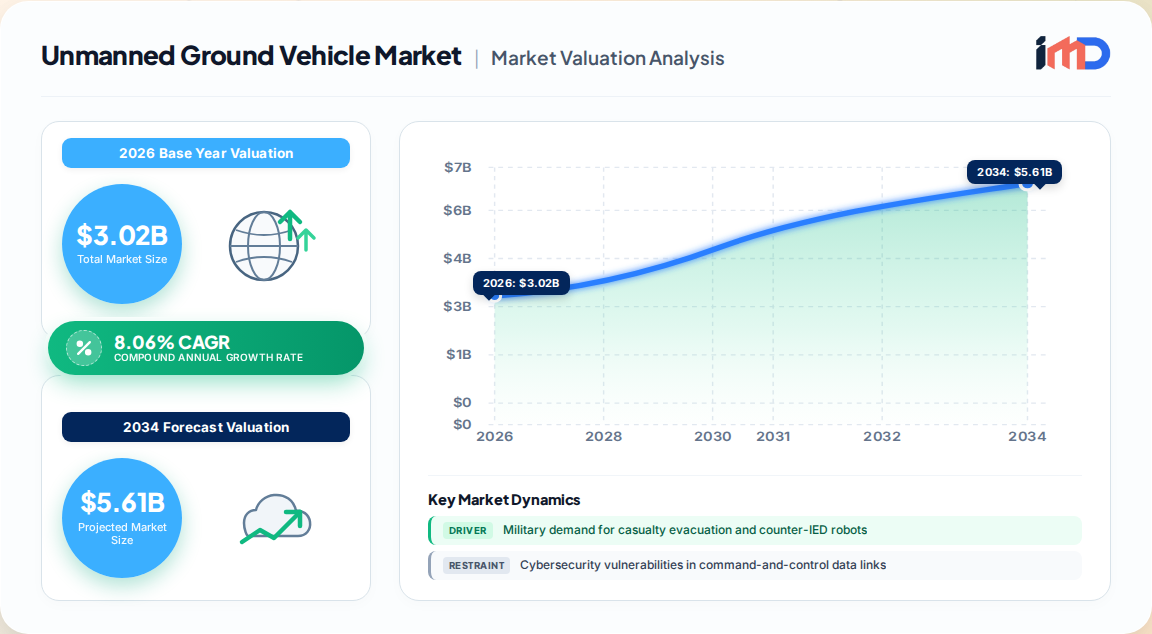
The global Unmanned Ground Vehicle (UGV) Market is experiencing a structural inflection point. Our proprietary primary research estimates the market at USD 3.02 billion in 2026, on a trajectory to reach USD 4.45 billion by 2031, expanding at a robust 8.06% CAGR. This growth is not merely a cyclical rebound but a fundamental re-rating of ground robotics as militaries pivot toward manned-unmanned teaming (MUM-T) and commercial operators race to automate hazardous, repetitive, and high-value tasks.
| Metric | 2026 (Base) | 2031 (Forecast) | CAGR (2026–2031) |
|---|---|---|---|
| Global Market Value | USD 3.02 Billion | USD 4.45 Billion | 8.06% |
| Military Share of Revenue | 69.63% (2025) | ~64% (2031e) | 7.2% |
| Fastest-Growing Application | Civil & Commercial | — | 8.27% |
| Fastest-Growing Region | Europe | — | 10.19% |
| Largest Regional Market | North America | — | 7.8% |
Military platforms remain the anchor segment, generating USD 2.10 billion in 2025, but commercial adoption is broad-based. Civil and commercial use cases are projected to expand at an 8.27% CAGR through 2031, driven by warehouse logistics, mining, agriculture, and infrastructure inspection.
Wheeled UGVs captured 50.89% of 2025 deployments due to superior speed and energy efficiency on paved surfaces. However, tracked configurations are forecast to register the highest growth at 9.11% CAGR, as defense buyers prioritize stability, traction, and load-carrying capacity in rugged terrain.
Tele-operated systems accounted for 68.56% of 2025 installations, reflecting mature, reliable technology and doctrine. Autonomous and hybrid modes are projected to rise at a 10.85% CAGR, as AI-enabled navigation and sensor fusion mature.
Battery-electric solutions accounted for 52.67% of 2025 sales, but hybrid-electric drivetrains are expanding at 11.75% CAGR, offering extended range and reduced logistics burden for military fleets.
North America's 39.12% revenue share in 2025 is underpinned by the US Army's MUM-T doctrine and robust procurement pipelines. Europe's 10.19% CAGR reflects urgency in force protection and cross-border collaborative programs. The Asia-Pacific region presents the largest long-term volume opportunity, with China, India, South Korea, and Japan expanding indigenous robotics capabilities and homeland security applications.
| Region | Revenue Share | Growth Outlook |
|---|---|---|
| North America | 39.12% | Moderate (7.8% CAGR) |
| Europe | 24.5% | Strong (10.19% CAGR) |
| Asia-Pacific | 27.8% | Strong (9.4% CAGR) |
| Middle East & Africa | 5.2% | Moderate (8.1% CAGR) |
| South America | 3.4% | Emerging (7.5% CAGR) |
Competitive advantage increasingly concentrates around software stacks, interoperability credentials, and RaaS pricing. Mid-tier logistics firms face low switching costs, enabling new entrants to target niche white spaces with modular payload designs. Defense integrators, meanwhile, are strengthening positions through MUM-T compatibility and secure data links.
The most attractive investment opportunities lie at the intersection of autonomy software and vertical-specific applications. Mining haulage, agricultural field robotics, and warehouse-to-door logistics represent high-growth adjacencies where UGV technology can be adapted with modest hardware changes but significant software customization.
| Segment | Growth Potential | Entry Barrier | Strategic Attractiveness |
|---|---|---|---|
| Warehouse logistics | High | Medium | High (proven ROI) |
| Mining haulage | High | High | High (contractual stickiness) |
| Agriculture robotics | Medium | Medium | Emerging (fragmented) |
| Defense sustainment | Medium | Very High | High (budget visibility) |
| EOD and security | Medium | High | Stable (replacement cycle) |
Stakeholders across the UGV value chain must prepare for a decade of accelerated adoption. The market will reward vendors who can demonstrate interoperability, modularity, and software upgradability, while commercial buyers should prioritize RaaS models to reduce technology risk. Policymakers should focus on standards development for autonomous navigation and secure communications to unlock cross-border procurement and commercial scaling.
| Aspects | Details |
|---|---|
| Study Period | 2020-2034 |
| Base Year | 2026 |
| Estimated Year | 2026 |
| Forecast Period | 2026-2034 |
| Historical Period | 2020-2025 |
| Growth Rate | CAGR of 8.06% from 2020-2034 |
| Segmentation |
|
By Size Class
By Mode of Operation
By Component
By Power Source
By Payload
| By Geography |
|
The global unmanned ground vehicle market is estimated at USD 3.02 billion in 2026 and is projected to reach USD 4.45 billion by 2031, growing at a CAGR of 8.06%.
Europe is the fastest-growing region, with a projected CAGR of 10.19% through 2031, driven by cross-border defense programs and industrial automation incentives.
Key drivers include military demand for casualty evacuation and counter-IED robots, warehouse automation, mining haulage autonomy, and falling solid-state LiDAR costs.
Military applications led with 69.63% revenue share in 2025, although civil and commercial use cases are growing faster at an 8.27% CAGR.
Leading players include General Dynamics Land Systems, Rheinmetall AG, Elbit Systems, Textron Systems, Thales, Teledyne FLIR Defense, and Milrem Robotics, among others.
Our rigorous research methodology combines multi-layered approaches with comprehensive quality assurance, ensuring precision, accuracy, and reliability in every market analysis.
| Stakeholder Role | Interview Share (%) |
|---|---|
| Procurement Director | 30% |
| UGV Program Manager | 25% |
| Automation Director | 25% |
| Robotics Procurement Officer | 20% |
| Company Type | Representation (%) |
|---|---|
| Defense Prime Contractors | 35% |
| Autonomous Mobile Robot Manufacturers | 25% |
| Sensor and LiDAR Suppliers | 15% |
| Autonomy Software Developers | 15% |
| Systems Integrators | 10% |
 Related Reports
