1What is the United Kingdom ICT market size in 2026?
The United Kingdom ICT market is estimated at USD 195.47 billion in 2026, growing from USD 178.33 billion in 2025, with a projected value of USD 309.46 billion by 2031.
Insight Market Data is a premier market research and business consulting firm headquartered in Pune, India, providing syndicated research reports, customized intelligence studies, and strategic advisory services. Renowned academic institutions and Fortune 500 corporations worldwide rely on Insight Market Data's research repository to navigate evolving global and regional business environments. Covering 46 diverse industries across 25 major international economies, our comprehensive database delivers thousands of verified statistics and granular market evaluations. By combining industry-leading analytical methodologies with the direct insights of seasoned industry leaders and subject-matter experts, we deliver actionable intelligence spanning historical performance benchmarks to rigorous multi-year forecasts. We empower organizations to make confident, data-driven decisions across pivotal domains including Machinery & Equipment, Chemicals & Materials, Pharmaceuticals & Healthcare, Food & Beverages, Consumer Goods, Energy & Power, Automotive & Transportation, Electronics & Semiconductors, Medical Devices, Telecommunications, Emerging Technologies, Agriculture, and Packaging. Our multidisciplinary analyst teams provide an objective 360-degree perspective, tailoring every engagement to address complex strategic challenges with exceptional analytical rigor.
Leveraging advanced BI-powered analytics and predictive modeling, Insight Market Data uncovers high-impact market opportunities and competitive differentiators for ambitious enterprises. We continuously refine our research methodologies in accordance with global industry standards, tracking real-time market shifts to ensure our reports are consistently accurate, actionable, and delivered on schedule. Our analysts conduct methodical data validation, rigorous compliance checks, and exhaustive primary and secondary research to maintain the highest levels of data integrity and transparency. We partner closely with corporate strategists, investment groups, and business executives to translate intricate market intelligence into clear, actionable roadmaps for sustainable growth. With operational presence across Washington, USA, and Vimannagar, Pune, India, Insight Market Data ensures direct access to dedicated research specialists and responsive customer support to answer your most strategic questions.
 United Kingdom ICT Market
 by Product Type (IT Hardware, IT Software, IT Services, IT Infrastructure, IT Security, Communication Services), by Enterprise Size (Small and Medium Enterprises, Large Enterprises), by End-User Industry Vertical (Government and Public Administration, BFSI, Energy and Utilities, Retail and E-Commerce, Manufacturing, IT and Telecom, Healthcare, Gaming and Esports, Others), by England (London, South East, East of England, South West, West Midlands, East Midlands, North West, North East, Yorkshire and the Humber), by Scotland, by Wales, by Northern Ireland Forecast 2026-2034

Senior Research Analyst


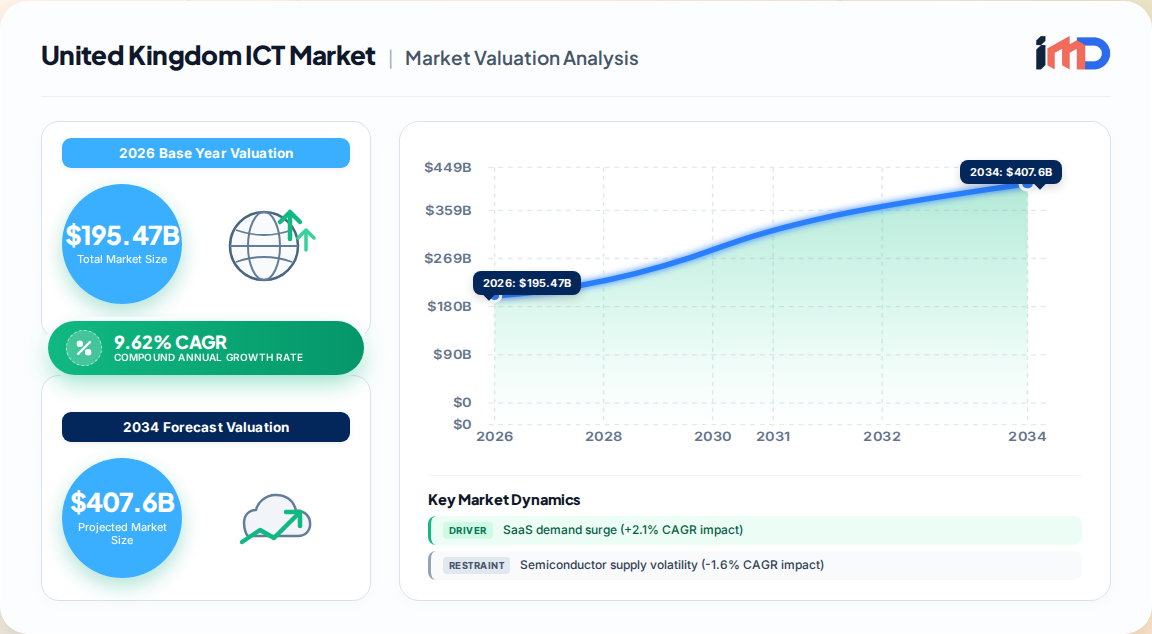
The United Kingdom ICT market is one of the most dynamic and innovation-driven technology sectors globally. Our proprietary primary research estimates the market at USD 195.47 billion in 2026, representing a robust increase from USD 178.33 billion in 2025. This trajectory is underpinned by a 9.62% CAGR, projecting the market to reach USD 309.46 billion by 2031. The growth significantly outperforms traditional infrastructure categories as both public and private sector buyers fundamentally reframe technology from a cost center to a primary value generator.
Demand is accelerating on three distinct fronts: large-scale transformation programs within central government, hyperscale cloud investments by global providers, and an unprecedented wave of digitalization support for small and medium enterprises (SMEs). The market concentration is medium, with a mix of global hyperscalers, domestic system integrators, and specialized security and software vendors competing for share. This report synthesizes first-party data and expert interviews to provide a granular analysis of the forces shaping the UK ICT landscape.
The expansion of the UK ICT market is propelled by several high-impact drivers identified in our proprietary forecasting model. The most significant contributor is the +2.1% impact on CAGR from the rapid surge in Software-as-a-Service (SaaS) demand. This is evidenced by the UK software market revenue, which we estimate at USD 38 billion in 2025, projected to reach USD 48.37 billion by 2030. The government's Help to Grow Digital program, which issued GBP 5,000 software vouchers to an addressable base of 1.2 million firms, has been instrumental in creating a digitally enabled SME segment that now supports recurring SaaS revenues. Approximately 90% of UK companies used at least one cloud service in 2024, up from 78% in 2022.
The expansion of 5G infrastructure nationwide contributes a +1.5% impact on CAGR, with standalone 5G now covering more than 85% of the UK population in 2025. Government funding of GBP 200 million for 5G Testbeds and Trials has validated enterprise use cases from connected ambulances to smart ports. Furthermore, enterprise cyber-security spending adds +1.4% to CAGR, as boards allocate 15-20% of IT budgets to security, up from 9% three years prior, driven by high-profile ransomware attacks and the imperative for zero-trust architectures.
Despite the robust growth outlook, the market faces notable headwinds. The most significant restraint is semiconductor supply volatility, which our analysis indicates exerts a -1.6% impact on CAGR, particularly affecting hardware manufacturing and data center construction. While the GBP 1 billion National Semiconductor Strategy is designed to mitigate long-term bottlenecks, near-term disruptions persist.
Ransomware prevalence imposes a -1.2% drag on CAGR, especially within healthcare and local government sectors, as organizations divert resources to remediation rather than innovation. Post-Brexit compliance complexity adds a -0.9% impact, creating friction for multinationals and financial services firms navigating divergent regulatory landscapes. Finally, an advanced AI/ML talent shortage in hubs like London, Cambridge, and Edinburgh constrains growth by -0.7%, as demand for specialized skills outstrips supply.
By product type, IT services captured 33.78% of the UK ICT market share in 2025, making it the dominant segment. This is followed by IT hardware, software, and communication services. However, the Security segment is the fastest-growing at 9.71% CAGR through 2031, reflecting the board-level prioritization of resilience.
| Product Type | 2025 Market Share | 2026-2031 CAGR |
|---|---|---|
| IT Services | 33.78% | 9.4% |
| IT Hardware | 24.50% | 8.2% |
| IT Software | 22.10% | 10.5% |
| IT Infrastructure | 11.12% | 8.8% |
| IT Security | 8.50% | 9.71% |
By enterprise size, large enterprises held 55.48% of the market in 2025, but SMEs are growing faster at a 10.04% CAGR through 2031. The SME segment is being empowered by government digital incentives and the shift to consumption-based cloud models. In terms of end-user verticals, public administration contributed 18.11% of market share in 2025, with the NHS's GBP 23.98 billion investment gap for electronic patient records representing a significant opportunity. The gaming and esports vertical is projected to expand at an 11.06% CAGR, the fastest among all verticals, driven by the UK's position as a leading hub for game development and digital entertainment.
Geographically, England accounts for 88.1% of the UK ICT market, concentrated heavily in London and the South East, which serve as the primary hubs for SaaS and financial technology. The Golden Triangle of London, Cambridge, and Oxford remains a global magnet for AI and quantum investment.
Scotland, Wales, and Northern Ireland are witnessing accelerated growth fueled by targeted government initiatives and regional tech clusters. For instance, Scotland is emerging as a center for quantum-ready data centers, while Wales is seeing double-digit CAGR in SME digitalization. Our regional attractiveness assessment indicates that while England remains the dominant market, the devolved nations offer strategic white-space opportunities in public sector digital transformation and green data centers.
The UK ICT market is characterized by intense competition among global hyperscalers, domestic system integrators, and specialized niche players. Major US tech companies are deeply embedded: Google DeepMind, OpenAI, and Anthropic maintain significant research bases in London, while Microsoft, AWS, and Google Cloud together account for an estimated 70% of UK cloud capacity.
| Company | Segment Focus | Key Strength |
|---|---|---|
| Cisco Systems, Inc. | Networking, Security | End-to-end infrastructure |
| Fujitsu Services Ltd | IT Services | Public sector integration |
| ZTE Corporation | Telecom Equipment | 5G infrastructure |
| CommScope Holding Co. Inc. | Network Infrastructure | Connectivity solutions |
| Ciena Corp. | Optical Networking | High-capacity networks |
| IBM Corp. | Hybrid Cloud, AI | Enterprise AI and quantum |
| Google LLC | Cloud, AI | Hyperscale cloud and AI research |
| Oracle Corp. | Cloud, Database | Enterprise SaaS and database |
| Fortinet Inc. | Cybersecurity | Network security |
Strategic imperatives for market participants include forming partnerships with hyperscalers to co-locate MEC nodes, leveraging UK cyber regulations (NCSC guidelines) as an export differentiator, and investing in quantum-safe cryptography pilots for financial services and public administration.
The UK ICT sector has seen a wave of strategic investments and policy interventions that are reshaping the competitive landscape:
The UK ICT value chain is characterized by a complex ecosystem of suppliers, distributors, integrators, and end-users. Upstream, semiconductor and hardware manufacturers face supply volatility, mitigated by the National Semiconductor Strategy. Midstream, network operators, cloud providers, and software vendors deliver infrastructure and platforms. Downstream, system integrators and managed service providers tailor solutions for vertical-specific needs. A key trend is the disintermediation of traditional resellers as hyperscalers sell directly to large enterprises and SMEs procure via digital marketplaces. This shift is compressing margins for legacy distributors while creating opportunities for specialized integrators that bundle SaaS, security, and compliance services.
Our analysis identifies several underpenetrated segments with high growth potential. The healthcare ICT market remains a white space; only 63% of NHS trusts had foundational electronic patient-record functionality in 2024, leaving a significant gap. Vendors specializing in HL7-FHIR integration and medical-grade cloud hosting are poised for accelerated procurement.
Another white space is quantum-ready data centers. The UK ranks second globally for private investment in quantum, but commercial use-cases in fraud detection and grid optimization are nascent. Early movers can capture share in this high-value niche. Finally, the SME digitalization segment, though fragmented, offers scale through standardized SaaS offerings and government-backed vouchers.
| Aspects | Details |
|---|---|
| Study Period | 2020-2034 |
| Base Year | 2026 |
| Estimated Year | 2026 |
| Forecast Period | 2026-2034 |
| Historical Period | 2020-2025 |
| Growth Rate | CAGR of 9.62% from 2020-2034 |
| Segmentation |
|
By Enterprise Size
By End-User Industry Vertical
| By Geography |
|
The United Kingdom ICT market is estimated at USD 195.47 billion in 2026, growing from USD 178.33 billion in 2025, with a projected value of USD 309.46 billion by 2031.
The market is expected to grow at a compound annual growth rate (CAGR) of 9.62% from 2026 to 2031, driven by SaaS adoption, 5G infrastructure, and cybersecurity spending.
IT Security is the fastest-growing product segment at a 9.71% CAGR, followed by Software at 10.5%. Among end-user verticals, gaming and esports is projected to expand at an 11.06% CAGR.
Key players include Cisco Systems, Fujitsu Services, ZTE Corporation, CommScope, Ciena Corp, IBM, Google, Oracle, and Fortinet, alongside hyperscalers like Microsoft, AWS, and Google Cloud.
Primary drivers include a surge in SaaS demand (+2.1% impact on CAGR), expansion of 5G infrastructure (+1.5%), and escalating cybersecurity spending (+1.4%), according to our proprietary analysis.
England accounts for 88.1% of the UK ICT market, with London and the South East serving as the primary hubs for SaaS, AI, and financial technology.
Our rigorous research methodology combines multi-layered approaches with comprehensive quality assurance, ensuring precision, accuracy, and reliability in every market analysis.
| Stakeholder Role | Interview Share (%) |
|---|---|
| Chief Information Officer (CIO) | 35% |
| Procurement Director | 25% |
| Head of Digital Transformation | 20% |
| Chief Information Security Officer (CISO) | 20% |
| Company Type | Representation (%) |
|---|---|
| Hyperscale Cloud Providers | 25% |
| Network Equipment Vendors | 20% |
| Managed Security Service Providers (MSSPs) | 18% |
| Vertical SaaS Vendors | 22% |
| Government System Integrators | 15% |
 Related Reports
