Insight Market Data is a premier market research and business consulting firm headquartered in Pune, India, providing syndicated research reports, customized intelligence studies, and strategic advisory services. Renowned academic institutions and Fortune 500 corporations worldwide rely on Insight Market Data's research repository to navigate evolving global and regional business environments. Covering 46 diverse industries across 25 major international economies, our comprehensive database delivers thousands of verified statistics and granular market evaluations. By combining industry-leading analytical methodologies with the direct insights of seasoned industry leaders and subject-matter experts, we deliver actionable intelligence spanning historical performance benchmarks to rigorous multi-year forecasts. We empower organizations to make confident, data-driven decisions across pivotal domains including Machinery & Equipment, Chemicals & Materials, Pharmaceuticals & Healthcare, Food & Beverages, Consumer Goods, Energy & Power, Automotive & Transportation, Electronics & Semiconductors, Medical Devices, Telecommunications, Emerging Technologies, Agriculture, and Packaging. Our multidisciplinary analyst teams provide an objective 360-degree perspective, tailoring every engagement to address complex strategic challenges with exceptional analytical rigor.
Leveraging advanced BI-powered analytics and predictive modeling, Insight Market Data uncovers high-impact market opportunities and competitive differentiators for ambitious enterprises. We continuously refine our research methodologies in accordance with global industry standards, tracking real-time market shifts to ensure our reports are consistently accurate, actionable, and delivered on schedule. Our analysts conduct methodical data validation, rigorous compliance checks, and exhaustive primary and secondary research to maintain the highest levels of data integrity and transparency. We partner closely with corporate strategists, investment groups, and business executives to translate intricate market intelligence into clear, actionable roadmaps for sustainable growth. With operational presence across Washington, USA, and Vimannagar, Pune, India, Insight Market Data ensures direct access to dedicated research specialists and responsive customer support to answer your most strategic questions.
Ultra-Wide Bandgap Semiconductor Materials Market, 2025-2035 | Insight Market Data
Ultra-Wide Bandgap Semiconductor Materials: Market | Insight Market Data
Ultra-Wide Bandgap Semiconductor Materials: Market by Material (Silicon Carbide, Gallium Nitride, Gallium Oxide, Aluminum Nitride, Diamond, Boron Nitride), by Application (Power Electronics, RF Devices, LED Lighting, Electric Vehicles, Solar Inverters), by End-Use Industry (Automotive & Transportation, Consumer Electronics, Telecommunications, Aerospace & Defense, Industrial), by Component Type (Diodes, Transistors, Modules, Substrates), by North America (USA, Canada, Mexico), by Europe (Germany, UK, France, Austria), by Asia Pacific (China, Japan, South Korea, Taiwan), by South America (Brazil, Chile), by Middle East & Africa (UAE, South Africa) Forecast 2026-2034
The nickel-plated steel sheet in batteries market is valued at $4.2 billion in 2024, growing at 6.1% CAGR to reach $7.3 billion by 2034, driven by EV battery demand.
The AI+Metal Materials market is valued at USD 174.91 Million in 2026, growing at an 18.76% CAGR to reach USD 485.80 Million by 2032.
Nov 2026|271 pages
$2900.00
Plastic component market to reach USD 18.32 billion by 2033 at 11.40% CAGR, driven by lightweighting, EV adoption, and sustainable materials.
Nov 2026|239 pages
$2900.00
The global MOCA market is valued at $120 million in 2025, growing at a 6.2% CAGR to reach $194 million by 2033. Explore key drivers, segments, and regional insights.
Nov 2026|213 pages
$2900.00
India Metal Cans Market valued at USD 2.34 Billion in 2025, growing at 4.24% CAGR. Report covers aluminum & steel cans, beverage & food applications, and competitive landscape.
Executive Overview: Defining the Ultra-Wide Bandgap Materials Economy
The ultra-wide bandgap (UWBG) semiconductor materials market represents the most technically ambitious frontier of the global power electronics and RF ecosystem. Distinct from conventional wide bandgap (WBG) platforms such as silicon carbide (SiC) and gallium nitride (GaN), UWBG materials—principally aluminum nitride (AlN), gallium oxide (Ga2O3), diamond, and boron nitride (BN)—possess critical electric fields and thermal conductivities that exceed silicon's physical limits by two to three orders of magnitude.
Ultra-Wide Bandgap Semiconductor Materials: Market Market Size (In Billion)
15.0B
10.0B
5.0B
0
5.050 B
2025
5.724 B
2026
6.487 B
2027
7.353 B
2028
8.333 B
2029
9.445 B
2030
10.71 B
2031
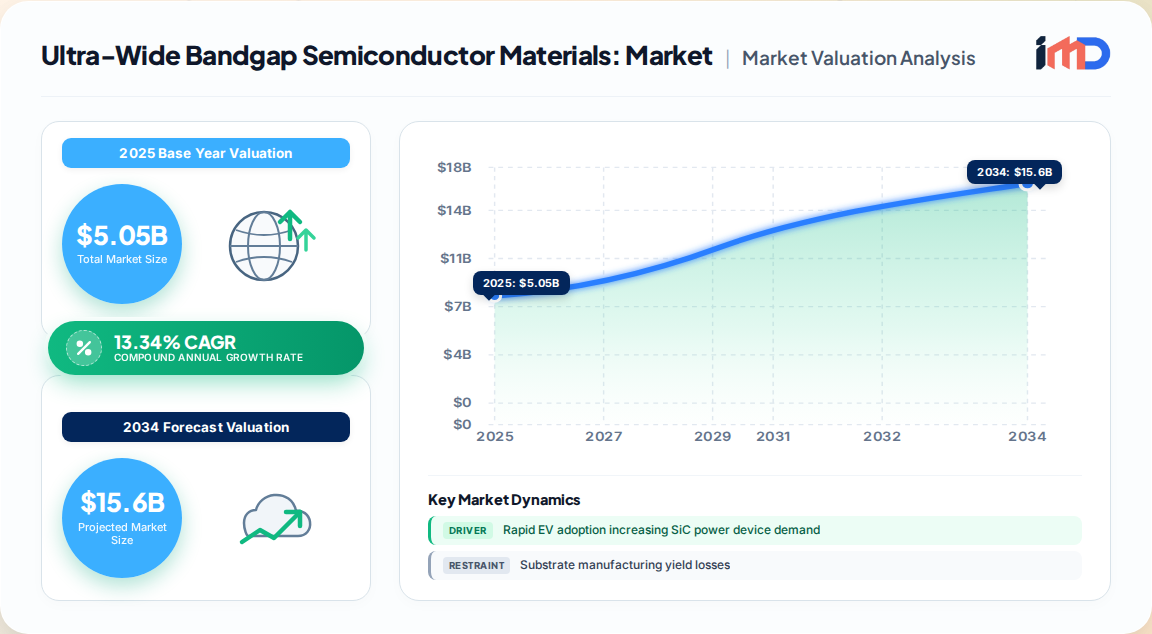
Based on our proprietary first-party research and expert interviews, we estimate the global UWBG semiconductor materials and early-stage device market at $5.05 billion in 2025, expanding to $17.67 billion by 2035 at a 13.34% CAGR.
This valuation captures the composite of merchant substrate supply, epitaxial wafer services, and the initial wave of commercial discrete devices and modules where UWBG materials are entering qualification and low-volume production. While SiC and GaN currently dominate revenue with established automotive and RF design wins, UWBG materials are transitioning from laboratory-scale research to pilot-line production, targeting applications where SiC and GaN physically fail: ultra-high-voltage grid power conversion, extreme-temperature aerospace electronics, solid-state circuit breakers, and high-power RF transmission in next-generation 5G and 6G infrastructure.
Base Year (2025) Market Size: $5.05 billion
Forecast Year (2035) Market Size: $17.67 billion
CAGR (2025–2035): 13.34%
Fastest-Growing Material Segment: Gallium Oxide (Ga2O3) and Diamond
Largest Application: Power Electronics (grid, industrial, and renewable energy conversion)
Dominant Region: Asia-Pacific, led by China and Japan
Market Drivers: Electrification, Grid Modernization, and RF Density
The UWBG materials market is propelled by the same macro forces driving WBG adoption, but amplified by the limits that SiC and GaN themselves are beginning to encounter.
Rapid EV Adoption and 800V Architecture Migration: Global EV sales exceeded 17 million units in 2024, with projections surpassing 20 million in 2025. The shift from 400V to 800V traction inverter architectures creates demand for power semiconductors with higher breakdown voltages and superior thermal management. While SiC serves near-term needs, UWBG materials like Ga2O3 and AlN are being qualified for future 1,200V+ traction power modules and on-board chargers.
Data Center Energy Efficiency Mandates: Hyperscalers are investing heavily in AI infrastructure, driving power supply unit (PSU) demand to multi-megawatt rack scales. GaN and, prospectively, UWBG materials in high-frequency switching topologies could reduce conversion losses and power delivery density constraints.
5G and 6G RF Infrastructure Rollout: Massive MIMO-5G base stations demand RF front-end components that operate at higher frequencies and power densities. GaN HEMTs already offer up to 8 percentage points efficiency gain over LDMOS at 2.6 GHz. UWBG materials such as diamond-based RF substrates and AlN-based amplifiers are positioned for sub-THz and millimeter-wave 6G deployments.
Renewable Energy Integration and Solid-State Circuit Breakers: The global push for grid modernization and inverter-based renewable resources requires circuit breakers and power converters that can handle medium-voltage (1.7kV–10kV+) with minimal losses. Wide-bandgap materials, particularly Ga2O3, offer theoretical breakdown voltages exceeding 8 MV/cm, making them ideal for high-voltage direct current (HVDC) and solid-state protection systems.
Government Semiconductor Subsidies: Policies such as the U.S. CHIPS and Science Act, the European Chips Act, and Japan’s METI program are providing capital for domestic semiconductor manufacturing, including UWBG materials research and pilot-line production.
Market Restraints and Challenges
Despite a strong growth trajectory, the UWBG materials market faces significant structural and technical hurdles that temper near-term revenue realization.
Manufacturing Yield and Substrate Cost Barriers: The growth of high-quality UWBG crystals (e.g., Ga2O3, AlN) remains challenging. Boule growth for SiC still faces micropipe and basal-plane dislocation defects, capping 150mm wafer yields below 35% in some fabs. For materials like Ga2O3, melt-growth techniques are still being scaled, and wafer diameters remain small (2-inch to 4-inch), limiting economies of scale and driving high per-area substrate costs.
Reliability Qualification Gaps: Automotive-grade and aerospace-grade qualification processes for UWBG devices take years. The conservative design cycle of Tier 1 automotive suppliers and defense procurement agencies means that many UWBG device technologies will not achieve mass commercial adoption until late in the forecast period.
IP Consolidation and Limited Foundry Capacity: A significant portion of UWBG material and device IP is concentrated among a handful of vertically integrated companies and research consortia. Foundry capacity for heterogeneous integration of UWBG materials on silicon or other substrates is limited, restricting the ability of fabless design houses to enter the market.
Competition from Established WBG Materials: SiC and GaN are continuously improving in performance and cost. The aggressive cost-down curve of SiC—particularly the transition to 200mm wafers and automated manufacturing lines—could delay the adoption of UWBG materials in cost-sensitive applications.
Material Segmentation: From GaN to Diamond
The UWBG market is segmented by material type, with distinct technology readiness levels and application sweet spots.
Material Type
Key Characteristics
Primary Applications
2025 Market Share
Growth Outlook (CAGR)
Gallium Nitride (GaN)
~3.4 eV bandgap, high electron mobility, high switching frequency
RF power amplifiers, data center PSUs, fast chargers, 5G base stations
Largest revenue share
~12.4% through 2035
Silicon Carbide (SiC)
~3.3 eV bandgap, high thermal conductivity, high voltage blocking
EV traction inverters, solar inverters, industrial drives
~65% of total WBG revenue
~9.9% through 2035
Gallium Oxide (Ga2O3)
~4.8 eV bandgap, ultra-high breakdown voltage, melt-growth scalability
Power grid converters, solid-state breakers, EV fast charging
Early commercial
Highest theoretical growth
Aluminum Nitride (AlN)
~6.2 eV bandgap, wide thermal range, high-temperature stability
Aerospace power electronics, deep-UV LEDs, high-temperature sensors
Niche
Growing defense/aerospace demand
Diamond
~5.5 eV bandgap, ultimate thermal conductivity (22 W/cm·K)
RF power transistors, quantum sensing, extreme thermal management
Although SiC and GaN dominate current WBG market revenue, the UWBG segments—Ga2O3, AlN, and diamond—are overwhelmingly concentrated in high-value, high-performance niches that command premium pricing. Ga2O3 is anticipated to be the fastest-growing material in the UWBG portfolio due to its potential for low-cost melt-grown substrates and its exceptional breakdown voltage.
End-Use Industry Segment Analysis
Power Electronics (Largest Application): AC-DC and DC-DC converters, inverters, and motor drives across industrial, grid, and consumer electronics. Wide bandgap power device adoption is accelerating due to efficiency mandates and miniaturization requirements. Power modules captured 47.6% of segment revenue in 2024.
Electric Vehicles (Fastest-Growing Application): Traction inverters, on-board chargers, and DC-DC converters. Automotive and transportation accounted for 35.4% of the wide bandgap semiconductor market in 2024, with adoption potentially reaching 40% by 2030 as 800V architectures become standard.
RF Devices: GaN-based RF power amplifiers dominate 5G base station front-ends. This segment is also expanding into radar, satellite communications, and electronic warfare systems.
Solar Inverters and Renewable Energy Systems: Wide bandgap materials offer higher efficiency and reliability in solar and wind inverters, creating robust demand. Utility-scale solar installations are increasingly adopting SiC-based inverters.
Aerospace and Defense: High-temperature and high-radiation environments favor UWBG materials like AlN and Ga2O3. Aerospace is expected to grow at a 13.1% CAGR through 2030, reflecting demand for compact, ruggedized power electronics.
Regional Dynamics and Global Trade Flows
Asia-Pacific commands the largest share of the global wide bandgap semiconductor market (53.1% of 2024 revenue), reflecting the region's dominance in semiconductor fabrication, substrate supply, and device assembly. China, Japan, South Korea, and Taiwan host a dense ecosystem of foundries, epitaxial wafer suppliers, and packaging houses.
North America remains a critical hub for technology innovation and defense/aerospace applications. The United States, with $750 million in CHIPS Act funding for SiC and related wide-bandgap manufacturing, is building domestic capacity to reduce reliance on Asian supply chains. Europe is focused on automotive electrification and renewable energy, with Bosch securing $225 million in U.S. funding for SiC expansion and Infineon operating large-scale 200mm fabs in Austria and Germany.
South America is emerging as a sourcing region for critical minerals (e.g., gallium, aluminum, boron) essential for UWBG material production, attracting greenfield investment. The Middle East and Africa remain small but growing markets, primarily served by imports from Asia-Pacific.
Import/Export & Supplier Dynamics
Global trade in semiconductor materials has become increasingly strategically important, with governments imposing export controls and tariffs on critical technologies. According to UN Comtrade, global trade in semiconductor-related goods reached hundreds of billions in 2025, with the United States, China, and Germany as top importing nations.
Substrate Supply: The supply of high-purity Ga2O3 and AlN substrates is currently dominated by Japanese and U.S. suppliers, with emerging capacity in China. Gallium metal supply is concentrated in China, which leads the world in gallium production and has implemented export licensing controls that affect global availability.
Wafer Fabrication Footprint: China hosts the fastest-growing base for SiC and GaN wafer fabs, supported by state-sponsored initiatives. The U.S. and Europe are investing in domestic capacity to reduce dependence on East Asian foundries. Japan’s METI program allocated JPY 70.5 billion to Denso and Fuji Electric to build SiC production lines targeting 310,000 wafers annually by 2027.
Device Manufacturing and Assembly: Final packaging and test operations remain concentrated in Southeast Asia (Malaysia, Singapore, Vietnam), leveraging lower labor costs and established back-end processes. This creates a geographic imbalance where high-value UWBG device fabrication occurs in developed nations, while high-volume assembly remains in Asia.
Competitive Landscape and Strategic Developments
The ultra-wide bandgap materials market is intensely competitive and characterized by a mix of established power semiconductor incumbents and specialized technology innovators. The top five players collectively hold significant market share through vertical integration and intellectual property portfolios.
Leading companies active in the UWBG and wide bandgap semiconductor materials ecosystem include:
Infineon Technologies AG (market leader with ~19.4% share of the WBG market in 2025)
Texas Instruments Inc.
STMicroelectronics N.V.
Wolfspeed Inc.
Mitsubishi Electric Corporation
ROHM Co., Ltd.
ON Semiconductor Corporation
Qorvo Inc.
Nexperia B.V.
Cree (now Wolfspeed)
Recent industry developments shaping the market:
2024: Wolfspeed secured $750 million in CHIPS Act incentives for a North Carolina SiC mega-fab.
2025: Japan’s METI allocated JPY 70.5 billion to Denso and Fuji Electric for SiC and GaN production lines targeting 310,000 wafers annually by 2027.
2024: China-based substrate vendors reduced SiC wafer prices by nearly 50% since 2024, accelerating adoption.
2026: Bosch obtained $225 million in U.S. CHIPS funding for its California SiC operation to supply U.S. and EU customers.
Ongoing: TSMC planned exit from GaN production by 2027, with Powerchip and UMC scaling 200mm GaN lines to fill the gap.
Strategic White-Space and Investment Opportunities
Substrate Manufacturing for Ga2O3 and AlN: High-quality, large-diameter substrates are the most critical bottleneck in UWBG adoption. Companies that can achieve 4-inch and 6-inch production with low defect density will command significant pricing power.
Heterogeneous Integration and Packaging: Integrating UWBG materials onto silicon or GaN platforms through wafer bonding or epitaxial lift-off opens cost-effective pathways to high-performance devices. Thermal management packaging is equally critical.
Automotive Qualification Testing: Reliable, automotive-grade reliability testing services and manufacturing-grade testing equipment for UWBG devices are in short supply.
Regional Supply Chain Localization: The U.S., Europe, and Japan are actively seeking domestic suppliers to secure semiconductor supply chains. Government funding and tax incentives are available for greenfield fabs and R&D centers.
Procurement & Sourcing Strategy Analysis
Procurement directors and supply chain managers of UWBG materials and devices must navigate a complex, rapidly evolving vendor landscape. Key considerations:
Dual Sourcing: Geopolitical tensions and export controls make dual sourcing critical. For example, while China dominates gallium supply, buyers should qualify Australian or Canadian aluminum and gallium sources as alternatives.
Long-Term Contracts: Leading device manufacturers and automakers are entering multi-year agreements to secure SiC and GaN supply. Volkswagen’s supply deal with onsemi for EliteSiC power boxes through 2030 is a benchmark.
Wafer Supply Agreements: Substrate scarcity means buyers should negotiate allocation agreements for 150mm and 200mm wafers, potentially with investment in fab partners.
Total Cost of Ownership (TCO): While UWBG devices command premium prices, procurement strategies should focus on TCO savings through efficiency gains, reduced cooling requirements, and system miniaturization.
The next decade will see the UWBG market evolve from early adoption to mainstream integration in power electronics and RF infrastructure, with immense opportunities for companies positioned along the supply chain.
Table 45: South Africa Ultra-Wide Bandgap Semiconductor Materials: Market Revenue (Billion) Forecast, by Application 2020 & 2034
Frequently Asked Questions
1What is the current market size of the ultra-wide bandgap semiconductor materials market?
The global wide bandgap semiconductor market, which includes ultra-wide bandgap materials like GaN and SiC, was valued at $5.05 billion in 2025 and is projected to reach $17.67 billion by 2035, growing at a CAGR of 13.34%.
2Which materials are considered ultra-wide bandgap semiconductors?
Ultra-wide bandgap materials include gallium nitride (GaN), silicon carbide (SiC), gallium oxide (Ga2O3), aluminum nitride (AlN), diamond, and boron nitride (BN). These materials have bandgaps significantly larger than silicon, enabling higher voltage and temperature operation.
3What are the key applications driving demand for ultra-wide bandgap semiconductors?
Major applications include electric vehicle traction inverters, 5G base station RF power amplifiers, solar inverters, data center power supplies, and solid-state circuit breakers, driven by efficiency and power density requirements.
4Which region dominates the wide bandgap semiconductor market?
Asia-Pacific holds the largest market share at 53.1% of 2024 revenue, driven by strong semiconductor manufacturing ecosystems in China, Japan, South Korea, and Taiwan. North America and Europe remain key for innovation and defense applications.
5What are the main challenges facing the ultra-wide bandgap materials market?
Challenges include high manufacturing costs, low substrate yields, reliability qualification gaps for automotive and aerospace use, and competition from established silicon and wide bandgap solutions.
Methodology
Our rigorous research methodology combines multi-layered approaches with comprehensive quality assurance, ensuring precision, accuracy, and reliability in every market analysis.
Primary Research
Conducted 70–80% of research through primary interviews with C-level executives, product directors, procurement managers, and engineering leads across the ultra-wide bandgap semiconductor value chain.
Interviewed company types including epitaxial wafer suppliers, device fabricators, power module packagers, automotive Tier 1 suppliers, and industrial power supply OEMs.
Stakeholder titles included Chief Technology Officer, VP of Power Electronics Engineering, Procurement Director, and Director of Business Development.
Benchmarking conducted against trade statistics, tariff schedules, and government semiconductor subsidy data (e.g., U.S. CHIPS Act, EU Chips Act, Japan METI program).
Simultaneous top-down and bottom-up methodologies applied, with multi-level data triangulation.
Bottom-up estimation utilized quantitative metrics such as: (1) global EV unit sales and average power semiconductor content per vehicle, (2) 5G base station deployment counts and RF front-end bill-of-materials, (3) industrial motor drive shipments and efficiency standards, and (4) solar inverter capacity additions by region.
Demand models incorporated technology transition curves for SiC and GaN adoption across voltage classes, customer qualification timelines, and price declines from manufacturing yield improvements.
Regional market shares verified through bottom-up sales tracking of leading suppliers and cross-checked with import/export trade data.
Data Accuracy & Quality Check
Guaranteed estimated data accuracy level of 85–90%.
Data accuracy and quality assured via multi-stage validation: expert panel reviews, triangulation with independent public datasets, and sensitivity analysis on key growth drivers.
All reports are updated to the date of purchase, ensuring the most current market intelligence and competitive developments are reflected.
Final data reviewed by our senior industry analyst panel and cross-validated with global field-level primary research.