1What is the tire silent cotton market size in 2025?
The global tire silent cotton market was valued at USD 376 Million in 2025 and is projected to reach USD 562 Million by 2032, growing at a 6.0% CAGR over the forecast period.
Insight Market Data is a premier market research and business consulting firm headquartered in Pune, India, providing syndicated research reports, customized intelligence studies, and strategic advisory services. Renowned academic institutions and Fortune 500 corporations worldwide rely on Insight Market Data's research repository to navigate evolving global and regional business environments. Covering 46 diverse industries across 25 major international economies, our comprehensive database delivers thousands of verified statistics and granular market evaluations. By combining industry-leading analytical methodologies with the direct insights of seasoned industry leaders and subject-matter experts, we deliver actionable intelligence spanning historical performance benchmarks to rigorous multi-year forecasts. We empower organizations to make confident, data-driven decisions across pivotal domains including Machinery & Equipment, Chemicals & Materials, Pharmaceuticals & Healthcare, Food & Beverages, Consumer Goods, Energy & Power, Automotive & Transportation, Electronics & Semiconductors, Medical Devices, Telecommunications, Emerging Technologies, Agriculture, and Packaging. Our multidisciplinary analyst teams provide an objective 360-degree perspective, tailoring every engagement to address complex strategic challenges with exceptional analytical rigor.
Leveraging advanced BI-powered analytics and predictive modeling, Insight Market Data uncovers high-impact market opportunities and competitive differentiators for ambitious enterprises. We continuously refine our research methodologies in accordance with global industry standards, tracking real-time market shifts to ensure our reports are consistently accurate, actionable, and delivered on schedule. Our analysts conduct methodical data validation, rigorous compliance checks, and exhaustive primary and secondary research to maintain the highest levels of data integrity and transparency. We partner closely with corporate strategists, investment groups, and business executives to translate intricate market intelligence into clear, actionable roadmaps for sustainable growth. With operational presence across Washington, USA, and Vimannagar, Pune, India, Insight Market Data ensures direct access to dedicated research specialists and responsive customer support to answer your most strategic questions.
 Tire Silent Cotton Market
 by Type (Polyurethane, Polyester, Others), by Application (Commercial Vehicle Tires, Passenger Vehicle Tires), by Asia-Pacific (China, Japan, Korea, Southeast Asia, India, Australia, Rest of Asia Pacific), by North America (United States, Canada, Mexico), by Europe (Germany, France, UK, Italy, Russia), by Middle East & Africa (Egypt, South Africa, Israel, Turkey, GCC Countries), by Latin America (Brazil, Rest of Latin America) Forecast 2026-2034

Research Analyst


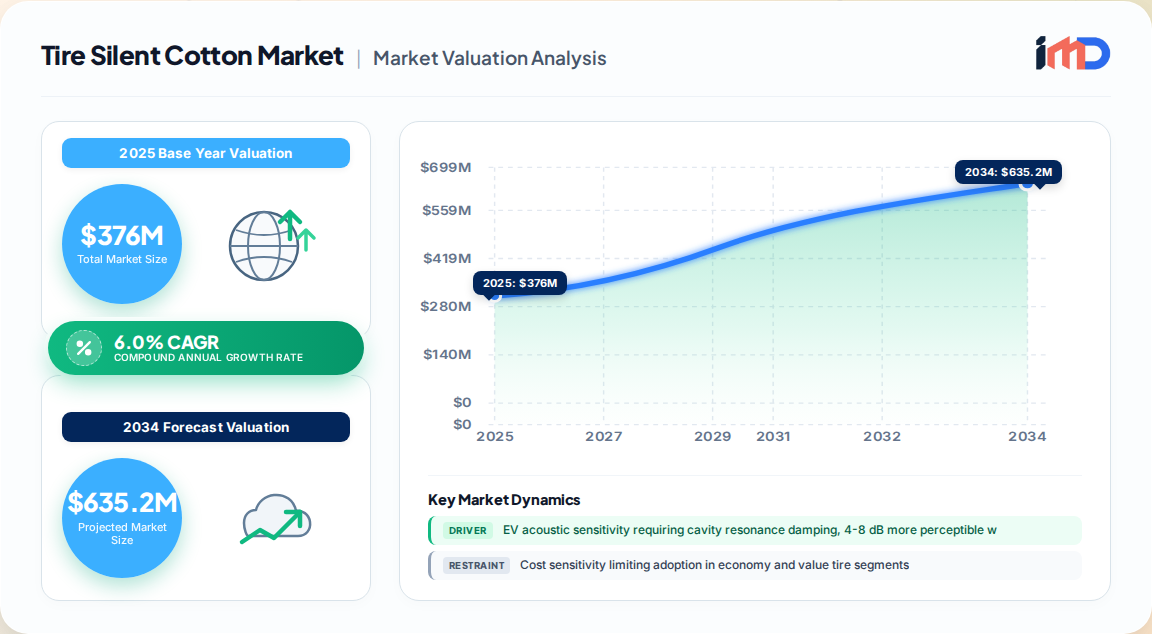
The global tire silent cotton market reached USD 376 Million in 2025 and is projected to expand to USD 562 Million by 2032, advancing at a 6.0% CAGR across the 2026-2032 forecast window. Global production stood at approximately 330 kilotons in 2024, with average realized prices near USD 1,100 per ton — a pricing floor that is steadily eroding as mass production scale expands into mid-range vehicle fitments.
Tire silent cotton is an acoustic absorption material installed on the inner wall of a tire, engineered to damp cavity resonance noise generated by tire-road contact. Its commercial relevance has shifted from a luxury-vehicle differentiator to a baseline NVH (Noise, Vibration, Harshness) specification, driven overwhelmingly by electrification.
| Metric | 2025 Value | 2032 Projection |
|---|---|---|
| Market Size | USD 376 Million | USD 562 Million |
| Forecast CAGR (2026-2032) | 6.0% | 6.0% |
| Production Volume (2024) | ~330 kt | Expanding |
| Average Price | ~USD 1,100/ton | Declining |
Segment dynamics reveal a market where cost-performance trade-offs and vehicle duty cycles dictate adoption velocity.
By Material Type
By Application
Our proprietary demand modeling isolates four structural growth engines:
The tire silent cotton value chain spans four tightly coupled tiers:
Margin pressure concentrates in the converter tier, where scale economics and formulation IP determine defensibility. Suppliers investing in recyclable, bio-based, and low-VOC variants are positioning for premium OEM procurement mandates tied to carbon-neutrality commitments.
| Region | Growth Momentum | Adoption Character |
|---|---|---|
| Asia-Pacific | 7.3% | China's NEV dominance; dense urban traffic; rapid materials innovation |
| Latin America | 6.3% | Expanding vehicle production; supply-chain consistency challenges |
| Middle East & Africa | 5.6% | Heat and long-distance duty cycles demand high-load validation |
| Europe | 4.9% | Lifecycle documentation; circularity and noise regulation leadership |
| North America | 4.4% | Comfort expectations; advanced manufacturing; sustainability procurement |
Asia-Pacific anchors global growth, combining the largest automotive manufacturing base with the highest NEV penetration. Europe's slower headline rate masks a premium mix — lifecycle assessment requirements and harmonized sustainability rules make it the most technically demanding market. North America trails on volume growth but leads on per-unit specification sophistication in luxury and EV segments.
Trade flows follow automotive manufacturing gravity. China has emerged as both the largest production base for silent cotton materials and a growing exporter of finished acoustic tire components, supported by integrated polyester and polyurethane supply chains. Europe and Japan retain technology leadership in high-performance polyurethane formulations, exporting premium materials to North American and Asian OEM programs.
The competitive field blends diversified chemical majors, acoustic material specialists, and regional formulators. Strategic differentiation is shifting from commodity fiber supply toward engineered composite systems with verified acoustic performance, lightweighting benefits, and sustainability documentation.
Key strategic white-space opportunities:
Companies that pair disciplined acoustic validation with data-enabled formulation and region-specific deployment will convert renewable-material interest into verified, defensible tire performance.
| Aspects | Details |
|---|---|
| Study Period | 2020-2034 |
| Base Year | 2025 |
| Estimated Year | 2026 |
| Forecast Period | 2026-2034 |
| Historical Period | 2020-2025 |
| Growth Rate | CAGR of 6.0% from 2020-2034 |
| Segmentation |
|
| By Geography |
|
The global tire silent cotton market was valued at USD 376 Million in 2025 and is projected to reach USD 562 Million by 2032, growing at a 6.0% CAGR over the forecast period.
Electric vehicles lack engine noise that normally masks tire cavity resonance, making road noise 4-8 dB more perceptible. This drives automakers to specify acoustic tire materials as standard fitment in EV platforms.
Polyester holds approximately 40% share, followed by polyurethane at 30%, driven by cost efficiency and mature fiber processing infrastructure for high-volume passenger applications.
Asia-Pacific leads with 7.3% growth momentum, anchored by China's dominant new energy vehicle market, dense urban traffic, and rapid materials innovation.
Global average market prices stood near USD 1,100 per ton in 2024, with costs declining as mass production scales and penetration expands into mid-range vehicle segments.
Our rigorous research methodology combines multi-layered approaches with comprehensive quality assurance, ensuring precision, accuracy, and reliability in every market analysis.
| Stakeholder Role | Interview Share (%) |
|---|---|
| Procurement Director | 30% |
| NVH and Acoustic Engineering Lead | 28% |
| Materials R&D Manager | 24% |
| Tire Platform Program Manager | 18% |
| Company Type | Representation (%) |
|---|---|
| Acoustic material formulators and converters | 32% |
| Polyester and polyurethane fiber suppliers | 24% |
| Tire manufacturers and inner-liner integrators | 22% |
| OEM NVH and platform engineering teams | 14% |
| Distributors and channel partners | 8% |
 Related Reports
