1What is the size of the Switzerland hospitality market in 2026?
The Switzerland hospitality market is valued at **USD 15.70 Billion in 2026** and is projected to reach **USD 19.18 Billion by 2032**, growing at a **4.75% CAGR**.
Insight Market Data is a premier market research and business consulting firm headquartered in Pune, India, providing syndicated research reports, customized intelligence studies, and strategic advisory services. Renowned academic institutions and Fortune 500 corporations worldwide rely on Insight Market Data's research repository to navigate evolving global and regional business environments. Covering 46 diverse industries across 25 major international economies, our comprehensive database delivers thousands of verified statistics and granular market evaluations. By combining industry-leading analytical methodologies with the direct insights of seasoned industry leaders and subject-matter experts, we deliver actionable intelligence spanning historical performance benchmarks to rigorous multi-year forecasts. We empower organizations to make confident, data-driven decisions across pivotal domains including Machinery & Equipment, Chemicals & Materials, Pharmaceuticals & Healthcare, Food & Beverages, Consumer Goods, Energy & Power, Automotive & Transportation, Electronics & Semiconductors, Medical Devices, Telecommunications, Emerging Technologies, Agriculture, and Packaging. Our multidisciplinary analyst teams provide an objective 360-degree perspective, tailoring every engagement to address complex strategic challenges with exceptional analytical rigor.
Leveraging advanced BI-powered analytics and predictive modeling, Insight Market Data uncovers high-impact market opportunities and competitive differentiators for ambitious enterprises. We continuously refine our research methodologies in accordance with global industry standards, tracking real-time market shifts to ensure our reports are consistently accurate, actionable, and delivered on schedule. Our analysts conduct methodical data validation, rigorous compliance checks, and exhaustive primary and secondary research to maintain the highest levels of data integrity and transparency. We partner closely with corporate strategists, investment groups, and business executives to translate intricate market intelligence into clear, actionable roadmaps for sustainable growth. With operational presence across Washington, USA, and Vimannagar, Pune, India, Insight Market Data ensures direct access to dedicated research specialists and responsive customer support to answer your most strategic questions.
 Switzerland Hospitality Industry
 by Type (Chain Hotels, Independent Hotels), by Accommodation Class (Service Apartments, Budget and Economy Hotels, Mid and Upper Mid-scale Hotels, Luxury Hotels), by Booking Channel (Direct Digital, OTAs, Corporate/MICE, Wholesale and Traditional Agents), by Zurich Region, by Lake Geneva Region, by Espace Mittelland, by Northwestern Switzerland, by Eastern Switzerland, by Central Switzerland, by Ticino Forecast 2026-2034

Research Associate


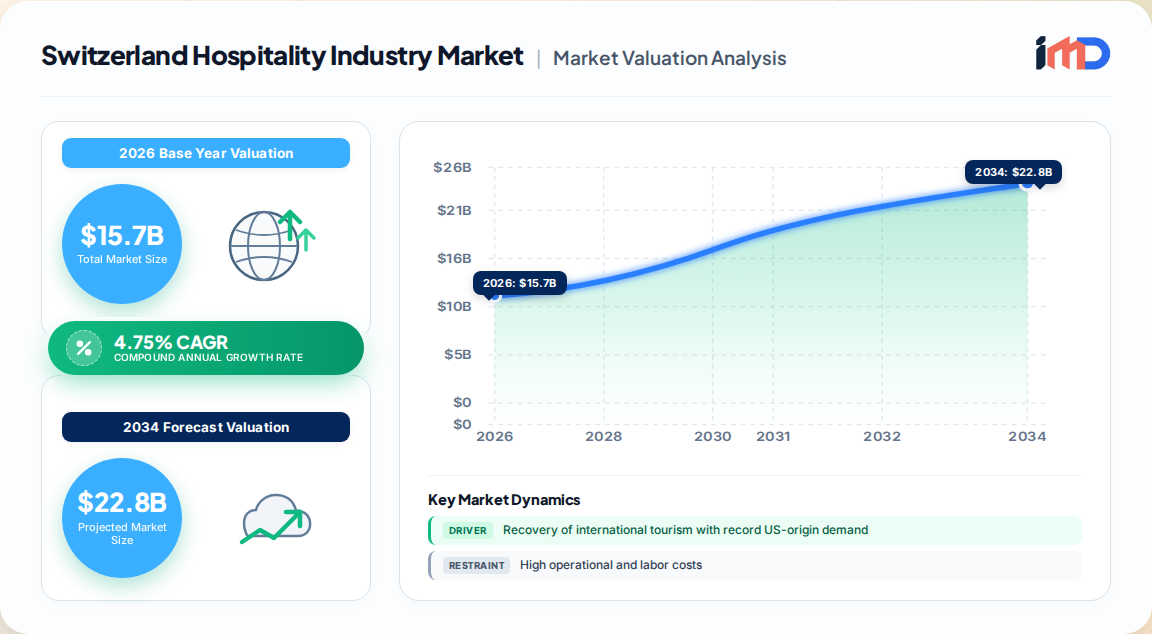
The Switzerland hospitality industry represents one of Europe’s most resilient and high-yield accommodation markets, characterized by constrained physical supply, premium pricing power, and a balanced domestic-international demand base. Our proprietary primary research and expert interview program estimates the market at USD 15.70 Billion in 2026, expanding at a 4.75% CAGR to reach USD 19.18 Billion by 2032.
This growth trajectory is not volume-led; it is yield-led. Switzerland recorded 43.9 million hotel overnight stays in 2025 — including 22.8 million foreign and 21.1 million domestic nights — establishing a demand baseline that supports aggressive room-rate optimization. With national room occupancy at 56.8% in 2025 and projected to rise toward 62.1% by 2032, operators are prioritizing revenue-per-available-room (RevPAR) expansion through premium positioning rather than greenfield capacity additions.
The sector’s competitive structure is uniquely fragmented: approximately 4,456 accommodation players operate nationally, with independent hotels commanding 69.78% of market share in 2025. This fragmentation coexists with a high-value luxury profit pool, where five-star properties generate roughly USD 488 per overnight stay — nearly four times the USD 129 yield of three-star properties.
| Key Metric | 2025 Base | 2032 Forecast |
|---|---|---|
| Market Size | USD 15.08 Billion | USD 19.18 Billion |
| Hotel Overnight Stays | 43.9 Million | 49.1 Million |
| Room Occupancy | 56.8% | 62.1% |
| Revenue per Overnight Stay | USD 166 | USD 210 (est.) |
| Total Accommodation Players | 4,456 | ~4,500 |
Independent hotels dominate the Swiss market with 69.78% share in 2025, reflecting the country’s strong tradition of boutique and family-owned establishments offering personalized service and authentic local experiences. However, chain hotels are projected to grow faster at a 4.72% CAGR through 2031 as international brands expand their Swiss footprints.
Recent chain expansion underscores this momentum: IHG Hotels & Resorts extended its DACH multi-property development deal targeting 60 hotels by 2035, while Radisson Hotel Group opened its 447-room Radisson Hotel & Suites Zurich — the largest hotel in the Zurich metropolitan region — bringing its Swiss portfolio to over 2,300 rooms.
| Segment | 2025 Share | Forecast CAGR (2026-2032) |
|---|---|---|
| Mid and Upper-Mid-scale Hotels | 48.05% | 4.3% |
| Luxury Hotels | 27.5% (est.) | 5.1% |
| Budget and Economy Hotels | 16.4% (est.) | 3.8% |
| Service Apartments | 8.0% (est.) | 6.56% |
Mid- and upper-mid-scale properties lead by share, but service apartments are the fastest-growing format at a 6.56% CAGR, driven by extended-stay corporate demand and blended work-leisure travel. Luxury maintains the highest revenue-per-stay economics, with five-star properties generating approximately USD 488 per overnight stay.
The Zurich Region captures 25.10% of national market share, anchored by 4.2 million hotel nights in Zurich city alone. The Lake Geneva Region follows closely, generating approximately 11.5 million hotel nights in 2025 and benefiting from Geneva’s 67.9% room occupancy — the highest among major Swiss hubs. Graubünden is projected to grow fastest at a 4.75% CAGR, driven by alpine luxury and wellness tourism.
Switzerland’s hospitality demand is geographically concentrated across internationally connected cities and established alpine destinations, creating a two-tier investment landscape: prime urban gateways with tight supply and resilient corporate demand, versus seasonal alpine resorts with premium rate potential but higher volatility.
| Region | 2025 Share | Key Demand Driver | Investment Signal |
|---|---|---|---|
| Zurich Region | 25.10% | Finance, biotech, MICE | Tight supply, strong RevPAR |
| Lake Geneva Region | 24.10% | Geneva diplomacy, luxury leisure | Highest occupancy (67.9% Geneva) |
| Espace Mittelland | 14.20% | Bern administrative, cultural tourism | Stable, moderate yield |
| Northwestern Switzerland | 9.80% | Basel life sciences, pharma | Corporate MICE anchor |
| Eastern Switzerland | 9.60% | Alpine leisure, spa clusters | Seasonal, wellness-led |
| Central Switzerland | 8.90% | Lucerne leisure, lake tourism | Long-haul leisure exposure |
| Ticino | 8.30% | Italian-speaking leisure, cross-border | Price-sensitive, growth potential |
For investors, the key operating question is how effectively properties convert constrained room capacity into higher occupancy, stronger guest yield, and lower distribution leakage. Prime urban markets — Zurich, Geneva, Basel — offer the strongest asset economics, with room occupancy materially tighter than the 56.8% national average. Alpine destinations reward brand conversion and wellness repositioning.
The Swiss market is characterized by low concentration and a mix of global brands and strong domestic operators. Key strategic themes include brand conversion of independent properties, digital distribution investment, and luxury/wellness repositioning.
The Swiss hospitality value chain is characterized by high fixed-cost intensity, premium service standards, and increasingly digitized distribution. Key procurement categories include:
Procurement risk centers on labor availability, energy costs, and exchange-rate exposure. Operators that lock in multi-year energy contracts, invest in staff retention, and diversify feeder-market exposure are best positioned to protect margins through 2032.
| Existing Markets | New Markets | |
|---|---|---|
| Existing Products | Yield optimization via dynamic pricing and direct-booking | Attract Gulf and Asian long-haul demand |
| New Products | Service apartments, wellness retreats in urban hubs | Medical tourism packages, eco-certified alpine resorts |
The Switzerland hospitality industry is entering a mature, yield-led phase. Market value is projected to expand from USD 15.70 Billion in 2026 to USD 19.18 Billion by 2032, with overnight stays rising more slowly (~1.6% annually) to approximately 49.1 million. The resulting value-volume spread reflects increasing revenue per stay, premium long-haul demand, occupancy improvement, and tighter direct-channel economics.
Success will hinge on three levers: (1) converting constrained capacity into higher guest yield through premium and luxury positioning; (2) reducing distribution leakage via direct digital channels; and (3) differentiating through sustainability certification, wellness programming, and experiential offerings that justify Switzerland’s premium price point. Operators that execute on these levers — while managing labor costs and exchange-rate risk — will capture disproportionate value in Europe’s most resilient hospitality market.
| Aspects | Details |
|---|---|
| Study Period | 2020-2034 |
| Base Year | 2026 |
| Estimated Year | 2026 |
| Forecast Period | 2026-2034 |
| Historical Period | 2020-2025 |
| Growth Rate | CAGR of 4.75% from 2020-2034 |
| Segmentation |
|
By Booking Channel
| By Geography |
|
The Switzerland hospitality market is valued at **USD 15.70 Billion in 2026** and is projected to reach **USD 19.18 Billion by 2032**, growing at a **4.75% CAGR**.
Mid- and upper-mid-scale hotels led with **48.05% share in 2025**, while service apartments are the fastest-growing format at a **6.56% CAGR** through 2031.
Key players include **Accor SA, Marriott International, IHG Hotels & Resorts, Radisson Hotel Group, Hilton Worldwide, Hyatt Hotels Corporation, Kempinski Hotels, Mövenpick Hotels & Resorts, Swissôtel, Bürgenstock Hotels & Resorts, Victoria-Jungfrau Collection AG, and Sorell Hotels Switzerland**.
The **Zurich Region captured 25.10%** of national market share in 2025, followed by the Lake Geneva Region, which generated approximately **11.5 million hotel nights**.
Swiss hotels recorded **43.9 million overnight stays in 2025**, including 22.8 million foreign and 21.1 million domestic nights.
Key drivers include **international tourism recovery (+0.8 pp CAGR impact), digital booking expansion (+0.6 pp), wellness and gastro-tourism (+0.4 pp), biotech corporate demand (+0.5 pp), and sustainability incentives (+0.3 pp)**.
National room occupancy stood at **56.8% in 2025**, with Geneva reaching **67.9%** and Basel **60.3%**, and is projected to rise to **62.1% by 2032**.
Our rigorous research methodology combines multi-layered approaches with comprehensive quality assurance, ensuring precision, accuracy, and reliability in every market analysis.
| Stakeholder Role | Interview Share (%) |
|---|---|
| General Manager | 28% |
| Revenue Management Director | 22% |
| Chief Executive Officer | 18% |
| Asset Management Head | 16% |
| Hotel Owner / Proprietor | 11% |
| Procurement Director | 5% |
| Company Type | Representation (%) |
|---|---|
| Chain Hotel Operators | 32% |
| Independent Hotel Owners | 28% |
| Serviced Apartment Providers | 14% |
| Wellness & Resort Operators | 12% |
| Hospitality Technology Vendors | 9% |
| OTA & Channel Managers | 5% |
 Related Reports
