1What is the size of the sustainable jewelry market in 2025?
Our proprietary research estimates the global sustainable jewelry market at USD 11.7 Billion in 2025, projected to reach USD 24.1 Billion by 2034.
Insight Market Data is a premier market research and business consulting firm headquartered in Pune, India, providing syndicated research reports, customized intelligence studies, and strategic advisory services. Renowned academic institutions and Fortune 500 corporations worldwide rely on Insight Market Data's research repository to navigate evolving global and regional business environments. Covering 46 diverse industries across 25 major international economies, our comprehensive database delivers thousands of verified statistics and granular market evaluations. By combining industry-leading analytical methodologies with the direct insights of seasoned industry leaders and subject-matter experts, we deliver actionable intelligence spanning historical performance benchmarks to rigorous multi-year forecasts. We empower organizations to make confident, data-driven decisions across pivotal domains including Machinery & Equipment, Chemicals & Materials, Pharmaceuticals & Healthcare, Food & Beverages, Consumer Goods, Energy & Power, Automotive & Transportation, Electronics & Semiconductors, Medical Devices, Telecommunications, Emerging Technologies, Agriculture, and Packaging. Our multidisciplinary analyst teams provide an objective 360-degree perspective, tailoring every engagement to address complex strategic challenges with exceptional analytical rigor.
Leveraging advanced BI-powered analytics and predictive modeling, Insight Market Data uncovers high-impact market opportunities and competitive differentiators for ambitious enterprises. We continuously refine our research methodologies in accordance with global industry standards, tracking real-time market shifts to ensure our reports are consistently accurate, actionable, and delivered on schedule. Our analysts conduct methodical data validation, rigorous compliance checks, and exhaustive primary and secondary research to maintain the highest levels of data integrity and transparency. We partner closely with corporate strategists, investment groups, and business executives to translate intricate market intelligence into clear, actionable roadmaps for sustainable growth. With operational presence across Washington, USA, and Vimannagar, Pune, India, Insight Market Data ensures direct access to dedicated research specialists and responsive customer support to answer your most strategic questions.
 Sustainable Jewelry Market
 by Material (Recycled Precious Metals, Ethically Sourced Gemstones, Lab-Grown/Synthetic Gemstones, Others), by Product (Rings, Necklaces & Pendants, Earrings, Bracelets & Bangles, Brooches & Pins, Others), by Distribution Channel (Online Retail/E-Commerce, Branded & Multi-Brand Stores, Specialty Sustainable Jewelry Boutiques, Department Stores & Luxury Retailers, Others), by End-User (Men, Women, Children), by Price (Low, Medium, High), by North America (United States, Canada, Mexico), by Europe (Germany, United Kingdom, France, Italy, Russia, Spain, Denmark, Sweden, Switzerland, Luxembourg), by Asia Pacific (China, Japan, India, South East Asia, South Korea, Australia, Taiwan, Singapore), by South America (Brazil, Argentina, Colombia, Peru, Chile), by Middle East (Saudi Arabia, Turkey, UAE, Egypt, Qatar), by Africa (South Africa, East Africa, West Africa, North Africa) Forecast 2026-2034

Research Analyst


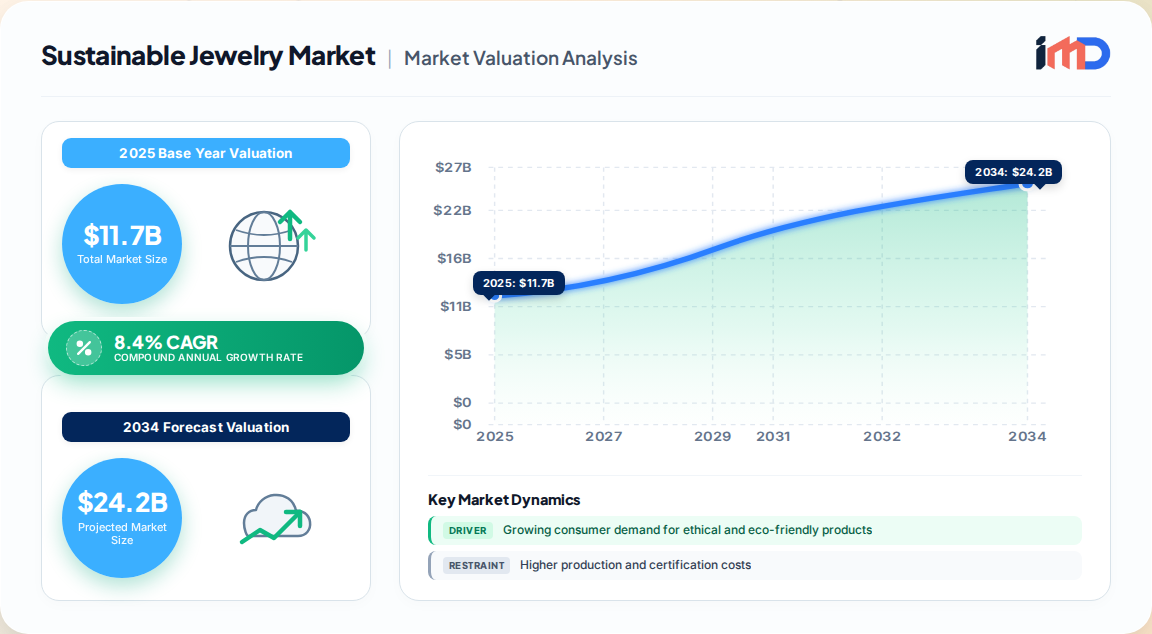
The global sustainable jewelry market is undergoing a structural transformation, shifting from a niche ethical preference to a mainstream retail imperative. Our proprietary primary research and expert interview program estimates the market at USD 11.7 Billion in 2025, with a projected expansion to USD 24.1 Billion by 2034, representing a robust 8.4% CAGR across the 2026-2034 forecast window. This growth is not merely a cyclical uptick; it reflects a durable re-wiring of consumer values, material innovation, and regulatory compliance across the entire jewelry value chain.
What distinguishes the current cycle is the convergence of three forces: a generational shift in purchasing psychology, the commercial scaling of lab-grown diamonds and recycled precious metals, and the institutionalization of traceability standards. Jewelry is no longer sold purely on aesthetics and karat weight; it is increasingly sold on provenance, carbon narrative, and verifiable ethical sourcing.
| Metric | Value |
|---|---|
| Market Size (2025) | USD 11.7 Billion |
| Forecast Size (2034) | USD 24.1 Billion |
| CAGR (2026-2034) | 8.4% |
| Largest Region | Europe |
| Fastest-Growing Region | Asia-Pacific |
| Leading Product Segment | Rings (~28.5% share) |
| Leading Material Segment | Recycled Precious Metals |
The expansion of sustainable jewelry is being propelled by a set of mutually reinforcing demand and supply-side drivers.
Despite its trajectory, the market faces real headwinds that temper the growth curve.
The market segments along four primary axes: material, product, distribution channel, and end-user.
| Segment Axis | Leading Segment | Approx. Share (2025) |
|---|---|---|
| Material | Recycled Precious Metals | Dominant |
| Material (growth) | Lab-Grown Diamonds | Fastest-growing |
| Product | Rings | ~28.5% |
| Product | Earrings | ~22.5% |
| Distribution | Online Retail / E-Commerce | Fastest-growing |
| End-User | Women | Largest |
Europe holds the largest regional share of sustainable jewelry consumption, underpinned by high consumer awareness, stringent regulation, and established ethical brands. North America follows closely, with the U.S. jewelry market alone valued at USD 78.9 Billion in 2025, providing the broad base from which sustainable lines are scaling. Asia-Pacific is the high-growth frontier, led by China and India, where rising disposable incomes and urbanization are colliding with emerging sustainability awareness. South America and the Middle East & Africa are earlier-stage but showing accelerating adoption through local artisans and ethical-mining initiatives.
| Region | Character | 2025 Size / Position |
|---|---|---|
| Europe | Largest market | Mature, regulation-led |
| North America | Strong second | U.S. base ~USD 78.9 Billion jewelry |
| Asia-Pacific | Fastest growth | China, India lead |
| South America | Emerging | Artisan-led |
| Middle East & Africa | Early-stage | Ethical-mining opportunity |
The competitive field is led by vertically integrated brands that control or verify their supply chains. Leaders include Pandora, Tiffany & Co., Chopard, Brilliant Earth, and Bulgari, each leveraging sustainability as a core brand pillar rather than a marketing afterthought.
The sustainable jewelry value chain spans ethical mining and recycled-metal recovery, refining, gemstone cutting and lab-growing, design, manufacturing, and retail. The critical pressure points sit at the upstream and midstream: verifying origin at the mine or recycler, and maintaining chain of custody through refining and setting. Industry associations and certification bodies are increasingly the arbiters of legitimacy, and brands that bring verification in-house or contract it transparently are best positioned.
The sustainable jewelry market is entering a decisive decade. At 8.4% CAGR to USD 24.1 Billion by 2034, the winners will be those that treat sustainability not as a compliance cost but as a product and brand differentiator. Material innovation, verified provenance, and digital-first distribution are the three pillars of competitive advantage. The market's trajectory is robust, but value will concentrate among brands that can prove, not merely claim, their ethical credentials.
| Aspects | Details |
|---|---|
| Study Period | 2020-2034 |
| Base Year | 2025 |
| Estimated Year | 2026 |
| Forecast Period | 2026-2034 |
| Historical Period | 2020-2025 |
| Growth Rate | CAGR of 8.4% from 2020-2034 |
| Segmentation |
|
By Distribution Channel
By End-User
By Price
| By Geography |
|
Our proprietary research estimates the global sustainable jewelry market at USD 11.7 Billion in 2025, projected to reach USD 24.1 Billion by 2034.
The market is forecast to grow at a CAGR of 8.4% during 2026-2034, driven by ethical sourcing and lab-grown material adoption.
Europe holds the largest regional share, followed closely by North America, while Asia-Pacific is the fastest-growing region led by China and India.
Lab-grown diamonds are the fastest-growing material segment, offering accessible luxury entry points alongside recycled precious metals.
Key players include Pandora, Tiffany & Co., Chopard, Brilliant Earth, and Bulgari, all leveraging provenance and material innovation as brand pillars.
Our rigorous research methodology combines multi-layered approaches with comprehensive quality assurance, ensuring precision, accuracy, and reliability in every market analysis.
| Stakeholder Role | Interview Share (%) |
|---|---|
| Procurement Director | 30% |
| Sustainability & Compliance Officer | 28% |
| Head of Merchandising | 24% |
| Supply Chain Manager | 18% |
| Company Type | Representation (%) |
|---|---|
| Retail Jewelry Brands & DTC Retailers | 30% |
| Lab-Grown Diamond & Gemstone Producers | 22% |
| Recycled Precious Metal Refiners | 18% |
| Ethical Mining & Sourcing Firms | 15% |
| Certification & Traceability Providers | 15% |
 Related Reports
