Insight Market Data is a premier market research and business consulting firm headquartered in Pune, India, providing syndicated research reports, customized intelligence studies, and strategic advisory services. Renowned academic institutions and Fortune 500 corporations worldwide rely on Insight Market Data's research repository to navigate evolving global and regional business environments. Covering 46 diverse industries across 25 major international economies, our comprehensive database delivers thousands of verified statistics and granular market evaluations. By combining industry-leading analytical methodologies with the direct insights of seasoned industry leaders and subject-matter experts, we deliver actionable intelligence spanning historical performance benchmarks to rigorous multi-year forecasts. We empower organizations to make confident, data-driven decisions across pivotal domains including Machinery & Equipment, Chemicals & Materials, Pharmaceuticals & Healthcare, Food & Beverages, Consumer Goods, Energy & Power, Automotive & Transportation, Electronics & Semiconductors, Medical Devices, Telecommunications, Emerging Technologies, Agriculture, and Packaging. Our multidisciplinary analyst teams provide an objective 360-degree perspective, tailoring every engagement to address complex strategic challenges with exceptional analytical rigor.
Leveraging advanced BI-powered analytics and predictive modeling, Insight Market Data uncovers high-impact market opportunities and competitive differentiators for ambitious enterprises. We continuously refine our research methodologies in accordance with global industry standards, tracking real-time market shifts to ensure our reports are consistently accurate, actionable, and delivered on schedule. Our analysts conduct methodical data validation, rigorous compliance checks, and exhaustive primary and secondary research to maintain the highest levels of data integrity and transparency. We partner closely with corporate strategists, investment groups, and business executives to translate intricate market intelligence into clear, actionable roadmaps for sustainable growth. With operational presence across Washington, USA, and Vimannagar, Pune, India, Insight Market Data ensures direct access to dedicated research specialists and responsive customer support to answer your most strategic questions.
Supply Chain Outsourcing Services Market | Insight Market Data
Supply Chain Outsourcing Services Market by Supplier Management Outsourcing Services, by Purchasing Management Outsourcing Services, by Order Processing Outsourcing Services, by Warehousing and Logistics Outsourcing Services, by Others (Contract Handling, Transactional Procurement), by Food Processing Industry, by Manufacturing Industry, by Pharmaceutical Industry, by Electronics and Semiconductors, by Healthcare Industry, by Others, by Cloud-Based, by On-Premise, by Large Enterprises, by Small & Medium Enterprises (SMEs), by Strategic Sourcing, by Category Management, by North America (USA, Canada, Mexico), by Europe (Germany, France, UK, Italy, Russia), by Asia Pacific (China, Japan, Korea, Southeast Asia, India, Australia), by Middle East & Africa (Egypt, South Africa, Israel, Turkey, GCC Countries), by Latin America (Brazil, Rest of Latin America) Forecast 2026-2034
Supply chain outsourcing services encompass the delegation of partial or complete supply chain functions (supplier management, purchasing, order processing, warehousing and logistics) to specialized third-party providers. This model enables enterprises to reduce fixed costs, access advanced digital capabilities, and concentrate on core competencies in an increasingly fragmented global trade environment.
Supply Chain Outsourcing Services Market Market Size (In Billion)
300.0B
200.0B
100.0B
0
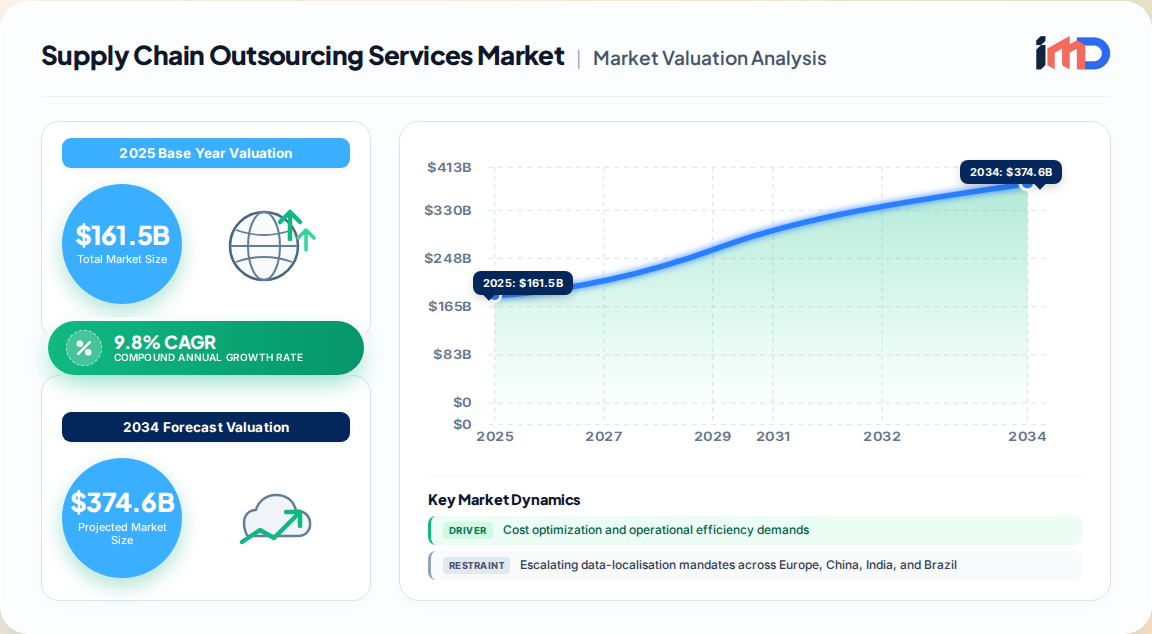
161.5 B
2025
177.3 B
2026
194.7 B
2027
213.8 B
2028
234.7 B
2029
257.7 B
2030
283.0 B
2031
According to our proprietary primary research and direct expert interviews, the global supply chain outsourcing services market was valued at USD 161.5 billion in 2025 and is projected to reach USD 284.6 billion by 2032, expanding at a CAGR of 9.8% over the forecast period (2025–2032). This growth trajectory is underpinned by accelerated digital transformation, multi-cloud orchestration, and the structural shift from headcount-based to outcome-linked contracting models.
Key structural characteristics of the market include:
Medium market concentration with a mix of global integrated logistics providers, specialized procurement BPO firms, and management consultancies.
Cloud-based deployment dominance, accounting for approximately 68% of procurement outsourcing platforms as of 2024.
Large enterprise dominance (approximately 63% of spend), though SMEs are adopting at a faster rate (6.9% CAGR).
Strategic sourcing remains the largest service category at 46% share within procurement outsourcing.
Key Market Drivers & Restraints
Growth Drivers
Cost Optimization and Operational Efficiency: Organizations increasingly outsource procurement and logistics functions to reduce operational costs, improve contract compliance, and enhance negotiation outcomes. Our interviews with procurement directors indicate that digital procurement transformation can reduce supplier onboarding time by up to 10x and compress pricing analysis cycles from days to minutes.
Rapid Cloud Migration and Virtualized Infrastructure: Cloud penetration among Global 2000 companies reached approximately 63% by end-2025, fueling demand for partners capable of orchestrating multi-cloud estates and providing consumption-based billing aligned with utilization.
Rise of Outcome-Based Pricing Models: Outcome-linked agreements represented approximately 18% of new outsourcing contracts in 2025, up from 11% in 2023, shifting delivery risk to providers and incentivizing investment in predictive analytics and process-mining tools.
Nearshore Micro-Delivery Hubs: Wage inflation in legacy offshore hubs is narrowing historical cost advantages, prompting vendors to build delivery centers in Tier-2 cities across Latin America, Eastern Europe, and Southeast Asia.
Cyber-Resilient Zero-Trust Adoption: Regulatory mandates and rising breach costs (average USD 4.88 million in 2024) are accelerating zero-trust framework adoption, favoring providers with mature security operations centers.
Market Restraints
Escalating Data-Localisation Mandates: Data-residency requirements in Europe, China, India, and Brazil are splintering traditional global delivery models, compelling vendors to establish local infrastructure and raising compliance costs.
Geopolitical Fragmentation and Trade Policy Uncertainty: The OECD Supply Chain Resilience Review (2025) notes that while global production remains highly integrated (intermediate products accounted for 60% of global trade in 2020), policy-driven reconfiguration of supply chains is creating operational complexity for outsourcing providers.
Talent Shortages in Specialized Categories: Shortages in AI, analytics, and category management expertise are pressuring providers to invest in upskilling and retention.
Cybersecurity and IP Protection Concerns: Zero-trust requirements and data sovereignty rules raise technical qualification barriers, particularly for mid-tier vendors.
Service Type Segmentation Analysis
The market is segmented by type into supplier management outsourcing, purchasing management outsourcing, order processing outsourcing, warehousing and logistics outsourcing, and other services.
Within procurement outsourcing specifically, strategic sourcing holds a 46% share, driven by demand for cost optimization and supplier consolidation. Category management is growing steadily as organizations seek improved control over indirect and direct spend.
Application Industry Segmentation
End-use industries include food processing, manufacturing, pharmaceuticals, electronics and semiconductors, healthcare, and others.
Manufacturing Industry: The largest application segment, accounting for approximately 31% of market value in 2025, driven by complex global supplier networks and lean inventory strategies.
Food Processing Industry: Growth is supported by cold-chain logistics outsourcing and traceability requirements; projected CAGR of 9.2%.
Pharmaceutical Industry: Stringent regulatory compliance and temperature-controlled logistics drive outsourcing adoption; projected CAGR of 10.1%.
Electronics and Semiconductors: Supply chain resilience initiatives and geographic diversification are accelerating outsourcing of supplier management and logistics; projected CAGR of 11.3%.
Healthcare Industry: Growing at a 7.4% CAGR, supported by procurement outsourcing for medical supplies and equipment.
Regional Outlook & Market Share
North America remains the largest regional market, accounting for approximately 34% of global revenue in 2025, supported by high demand for cost optimization and strong adoption of cloud-based procurement tools. Europe follows with 26%, supported by strict compliance requirements and digital transformation initiatives.
Asia-Pacific represents 29% of the market and is the fastest-growing region, projected to expand at a CAGR of 8.0% through 2032, fueled by large-scale enterprise outsourcing and rapid expansion of procurement operations across emerging markets.
Region
2025 Share (%)
Key Characteristics
North America
34%
Mature market, high cloud adoption, outcome-based contracting leadership
Europe
26%
Compliance-driven, strong nearshore delivery from Eastern Europe
The competitive landscape is characterized by medium concentration, with global integrated logistics providers, specialized procurement BPO firms, and management consultancies competing across service categories.
Leading players include DHL, UPS Supply Chain Solutions, XPO, Ryder System, DSV, GEP, Rely Services, Accenture, Arden Incorporated, KPMG, RK Foodland, and Velan, alongside procurement-focused providers such as IBM Corporation, Genpact Limited, Infosys Limited, Wipro Limited, Capgemini SE, Tata Consultancy Services, WNS Global Services, and HCL Technologies Limited.
Key competitive dynamics observed in our primary research:
Digital platform investment: Leading providers are integrating AI, analytics, and cloud-based procurement platforms to enhance real-time insights and automate workflows.
Category expertise expansion: Providers are deepening specialization in verticals such as pharmaceuticals, electronics, and automotive to differentiate offerings.
Multi-region delivery center networks: Vendors are establishing micro-delivery hubs in Tier-2 cities to balance compliance costs against wage bills.
Outcome-based contracting: Providers are investing in predictive analytics and process-mining capabilities to safeguard margins under outcome-linked agreements.
Value Chain and Procurement Sourcing Dynamics
The supply chain outsourcing services value chain comprises:
Upstream: Technology platform providers (cloud infrastructure, AI/analytics tools), talent acquisition and training providers, and physical infrastructure (warehousing, fleet assets).
Midstream: Supply chain outsourcing service providers offering managed services across procurement, logistics, and order processing.
Downstream: End-user industries including manufacturing, food processing, pharmaceuticals, electronics, healthcare, and retail.
Procurement strategies are increasingly shaped by the need to balance cost efficiency with resilience. The OECD Supply Chain Resilience Review (2025) highlights that the import intensity of global production reached a historically high level in 2023, with intermediate products accounting for 60% of global trade. This integration creates both opportunities for outsourcing providers and exposure to policy-driven disruption.
Key sourcing considerations for buyers include:
Total cost of ownership rather than hourly rates, factoring in time-zone coordination and knowledge transfer costs.
Data residency and compliance alignment with GDPR, HIPAA, and local data-localisation mandates.
Provider security posture, including zero-trust framework integration and continuous assurance dashboards.
Flexibility in contract structures, with growing preference for outcome-based and consumption-based pricing.
Strategic White-Space Opportunities
Our analysis identifies several underserved opportunity areas:
SME-focused modular outsourcing: Pay-as-you-go service catalogs enabling SMEs to subscribe to discrete supply chain modules without upfront capital outlays.
Nearshore delivery hubs in Tier-2 cities: Latin America, Eastern Europe, and Southeast Asia offer wage proximity, bilingual talent, and time-zone alignment for North American and European clients.
AI-driven category management for indirect spend: Organizations continue to seek improved control over indirect and direct spend, with category management growing steadily.
Sustainability-linked outsourcing: Carbon tracking and scope-3 emissions management are emerging as value-added services.
Future Outlook (2025–2032)
The supply chain outsourcing services market is poised for sustained expansion, with the global outsourcing services market projected to reach USD 1.35 trillion by 2031 (growing at 5.77% CAGR from USD 1.02 trillion in 2026), within which supply chain outsourcing represents a high-growth segment.
Key forecast considerations:
Outcome-based pricing is expected to increase from 18% of new contracts in 2025 toward 30% by 2030, reshaping provider economics.
AI and generative AI adoption will accelerate, with service-provider-owned Gen-AI knowledge models contributing approximately +0.7% to CAGR.
Data-localisation mandates will continue to shape delivery network design, favoring providers with flexible local infrastructure.
Asia-Pacific is expected to remain the fastest-growing region, with a projected 8.0% CAGR through 2032, while North America and Europe maintain mature, innovation-driven growth.
Our proprietary estimates suggest the market will reach USD 284.6 billion by 2032, driven by digital transformation, resilience imperatives, and the continued structural shift toward outsourced supply chain management.
Table 109: GCC Countries Supply Chain Outsourcing Services Market Revenue (Billion) Forecast, by Application 2020 & 2034
Table 110: Latin America Supply Chain Outsourcing Services Market Revenue Billion Forecast, by Supplier Management Outsourcing Services 2020 & 2034
Table 111: Latin America Supply Chain Outsourcing Services Market Revenue Billion Forecast, by Purchasing Management Outsourcing Services 2020 & 2034
Table 112: Latin America Supply Chain Outsourcing Services Market Revenue Billion Forecast, by Order Processing Outsourcing Services 2020 & 2034
Table 113: Latin America Supply Chain Outsourcing Services Market Revenue Billion Forecast, by Warehousing and Logistics Outsourcing Services 2020 & 2034
Table 114: Latin America Supply Chain Outsourcing Services Market Revenue Billion Forecast, by Others 2020 & 2034
Table 115: Latin America Supply Chain Outsourcing Services Market Revenue Billion Forecast, by Food Processing Industry 2020 & 2034
Table 116: Latin America Supply Chain Outsourcing Services Market Revenue Billion Forecast, by Manufacturing Industry 2020 & 2034
Table 117: Latin America Supply Chain Outsourcing Services Market Revenue Billion Forecast, by Pharmaceutical Industry 2020 & 2034
Table 118: Latin America Supply Chain Outsourcing Services Market Revenue Billion Forecast, by Electronics and Semiconductors 2020 & 2034
Table 119: Latin America Supply Chain Outsourcing Services Market Revenue Billion Forecast, by Healthcare Industry 2020 & 2034
Table 120: Latin America Supply Chain Outsourcing Services Market Revenue Billion Forecast, by Others 2020 & 2034
Table 121: Latin America Supply Chain Outsourcing Services Market Revenue Billion Forecast, by Cloud-Based 2020 & 2034
Table 122: Latin America Supply Chain Outsourcing Services Market Revenue Billion Forecast, by On-Premise 2020 & 2034
Table 123: Latin America Supply Chain Outsourcing Services Market Revenue Billion Forecast, by Large Enterprises 2020 & 2034
Table 124: Latin America Supply Chain Outsourcing Services Market Revenue Billion Forecast, by Small & Medium Enterprises 2020 & 2034
Table 125: Latin America Supply Chain Outsourcing Services Market Revenue Billion Forecast, by Strategic Sourcing 2020 & 2034
Table 126: Latin America Supply Chain Outsourcing Services Market Revenue Billion Forecast, by Category Management 2020 & 2034
Table 127: Latin America Supply Chain Outsourcing Services Market Revenue Billion Forecast, by Country 2020 & 2034
Table 128: Brazil Supply Chain Outsourcing Services Market Revenue (Billion) Forecast, by Application 2020 & 2034
Table 129: Rest of Latin America Supply Chain Outsourcing Services Market Revenue (Billion) Forecast, by Application 2020 & 2034
Frequently Asked Questions
1What is the current market size of the supply chain outsourcing services market?
The global supply chain outsourcing services market was valued at USD 161.5 billion in 2025 and is projected to reach USD 284.6 billion by 2032, growing at a CAGR of 9.8% during the forecast period.
2Which region dominates the supply chain outsourcing services market?
North America is the largest regional market, accounting for approximately 34% of global revenue in 2025, followed by Asia-Pacific at 29% and Europe at 26%.
3What are the key growth drivers for supply chain outsourcing services?
Key drivers include cost optimization and operational efficiency, rapid cloud migration (63% cloud penetration among Global 2000 companies by end-2025), the rise of outcome-based pricing models (18% of new contracts in 2025), and cyber-resilient zero-trust adoption.
4Which industries are the largest consumers of supply chain outsourcing services?
The manufacturing industry is the largest application segment, accounting for approximately 31% of market value in 2025, followed by food processing, pharmaceuticals, electronics and semiconductors, and healthcare.
5Who are the leading providers in the supply chain outsourcing services market?
Leading providers include DHL, UPS Supply Chain Solutions, XPO, Ryder System, DSV, GEP, Accenture, KPMG, IBM Corporation, Genpact Limited, Tata Consultancy Services, and Capgemini SE, among others.
6What is the forecast growth rate for the supply chain outsourcing services market?
The market is projected to grow at a CAGR of 9.8% from 2025 to 2032, driven by digital transformation, near-shore delivery models, and increasing adoption of outcome-based outsourcing contracts.
Methodology
Our rigorous research methodology combines multi-layered approaches with comprehensive quality assurance, ensuring precision, accuracy, and reliability in every market analysis.
Primary Research
Our proprietary research process allocates 70–80% of effort to primary research, including structured interviews and surveys with senior decision-makers across the supply chain outsourcing value chain.
We conduct in-depth interviews with 4–5 specific company types: integrated logistics providers, specialized procurement BPO firms, management consultancies, cloud-based procurement platform vendors, and warehousing and order-processing specialists.
Stakeholder interviews target 3–4 specific job titles: Chief Procurement Officer (CPO), Supply Chain Director, Head of Outsourcing Strategy, and VP of Logistics Operations.
Primary research is conducted across North America, Europe, Asia-Pacific, South America, and the Middle East & Africa, with regional weighting based on market size and growth potential.
All interviews are transcribed and coded for thematic analysis, with quantitative findings validated through multi-level data triangulation.
We benchmark against recognized non-profit trade associations including the Council of Supply Chain Management Professionals (CSCMP), the Institute for Supply Management (ISM), and the Chartered Institute of Procurement & Supply (CIPS).
Standard financial databases — Bloomberg, Factiva, Hoovers, and PitchBook — are used for company-level financial analysis and M&A tracking.
Secondary data is used exclusively for triangulation and validation; no third-party commercial market research estimates are incorporated.
Demand Modeling & Market Estimation
We employ top-down and bottom-up methodologies simultaneously, validated via multi-level data triangulation.
Bottom-up market sizing is built from 4 specific quantitative metrics: (1) total addressable spend on outsourced supply chain functions by end-use industry, (2) average contract value per enterprise by service type, (3) vendor revenue per delivery center across key regions, and (4) adoption rates by enterprise size (large enterprises vs. SMEs).
Demand modeling incorporates driver impact analysis (+1.2% CAGR from cloud migration, +1.0% from scalable IT environments, +0.9% from outcome-based pricing) and restraint impact analysis (-0.6% CAGR from data-localisation mandates).
Regional forecasts are built at country level and aggregated to regional and global totals, with segment-level splits cross-validated against primary interview findings.
Data Accuracy & Quality Check
Every report is updated to the date of purchase, ensuring latest available data and insights.
We guarantee an estimated data accuracy level of 85–90%, achieved through multi-source triangulation and expert validation.
All quantitative findings are reviewed by a senior analyst panel and cross-referenced against primary interview transcripts.
Discrepancies between top-down and bottom-up estimates are resolved through iterative reconciliation and, where necessary, additional targeted interviews.
Final market estimates are subjected to a sensitivity analysis to stress-test forecast assumptions under alternative scenarios.
India CEP market valued at USD 6.27 Billion in 2026, projected to reach USD 10.25 Billion by 2031 at 10.34% CAGR, driven by e-commerce and logistics reforms.
Singapore Shipping Agency Services Market valued at USD 394.86 Mn in 2026, growing at 4.53% CAGR to reach USD 492.86 Mn by 2031.
Nov 2026|201 pages
$2900.00
Qatar transportation infrastructure construction market at USD 16.15B in 2026, growing 5.31% CAGR to USD 20.92B by 2031. Roads, rail & ports analysis.
Nov 2026|187 pages
$2900.00
Sea Air Logistics Market valued at $9.2B in 2025, growing at 5.7% CAGR to $16.3B by 2035. Hybrid freight demand driven by e-commerce and supply chain shifts.
Nov 2026|234 pages
$2900.00
Construction Integrated Project Delivery market to reach $10.46B by 2033, growing at 10.47% CAGR. Explore IPD adoption, regional analysis, and key players.