1What is the U.S. sun protection apparel market size?
The U.S. UPF sun protective clothing market is estimated at approximately $678.4 million in 2024 and is projected to reach $1.23 billion by 2030, expanding at a CAGR of 8.4%.
Insight Market Data is a premier market research and business consulting firm headquartered in Pune, India, providing syndicated research reports, customized intelligence studies, and strategic advisory services. Renowned academic institutions and Fortune 500 corporations worldwide rely on Insight Market Data's research repository to navigate evolving global and regional business environments. Covering 46 diverse industries across 25 major international economies, our comprehensive database delivers thousands of verified statistics and granular market evaluations. By combining industry-leading analytical methodologies with the direct insights of seasoned industry leaders and subject-matter experts, we deliver actionable intelligence spanning historical performance benchmarks to rigorous multi-year forecasts. We empower organizations to make confident, data-driven decisions across pivotal domains including Machinery & Equipment, Chemicals & Materials, Pharmaceuticals & Healthcare, Food & Beverages, Consumer Goods, Energy & Power, Automotive & Transportation, Electronics & Semiconductors, Medical Devices, Telecommunications, Emerging Technologies, Agriculture, and Packaging. Our multidisciplinary analyst teams provide an objective 360-degree perspective, tailoring every engagement to address complex strategic challenges with exceptional analytical rigor.
Leveraging advanced BI-powered analytics and predictive modeling, Insight Market Data uncovers high-impact market opportunities and competitive differentiators for ambitious enterprises. We continuously refine our research methodologies in accordance with global industry standards, tracking real-time market shifts to ensure our reports are consistently accurate, actionable, and delivered on schedule. Our analysts conduct methodical data validation, rigorous compliance checks, and exhaustive primary and secondary research to maintain the highest levels of data integrity and transparency. We partner closely with corporate strategists, investment groups, and business executives to translate intricate market intelligence into clear, actionable roadmaps for sustainable growth. With operational presence across Washington, USA, and Vimannagar, Pune, India, Insight Market Data ensures direct access to dedicated research specialists and responsive customer support to answer your most strategic questions.
 Sun Protection Apparel Market
 by Product (Hats and Caps, Shirts, T-shirts, Jackets, and Hoodies, Pants & Shorts, Swimwear, Others), by Distribution Channel (Online, Offline), by UPF Rating (Upto 30, 31 to 40, 41 to 50, Above 50), by End-use (Men, Women, Kids), by United States (Northeast, Midwest, South, West) Forecast 2026-2034

Research Analyst


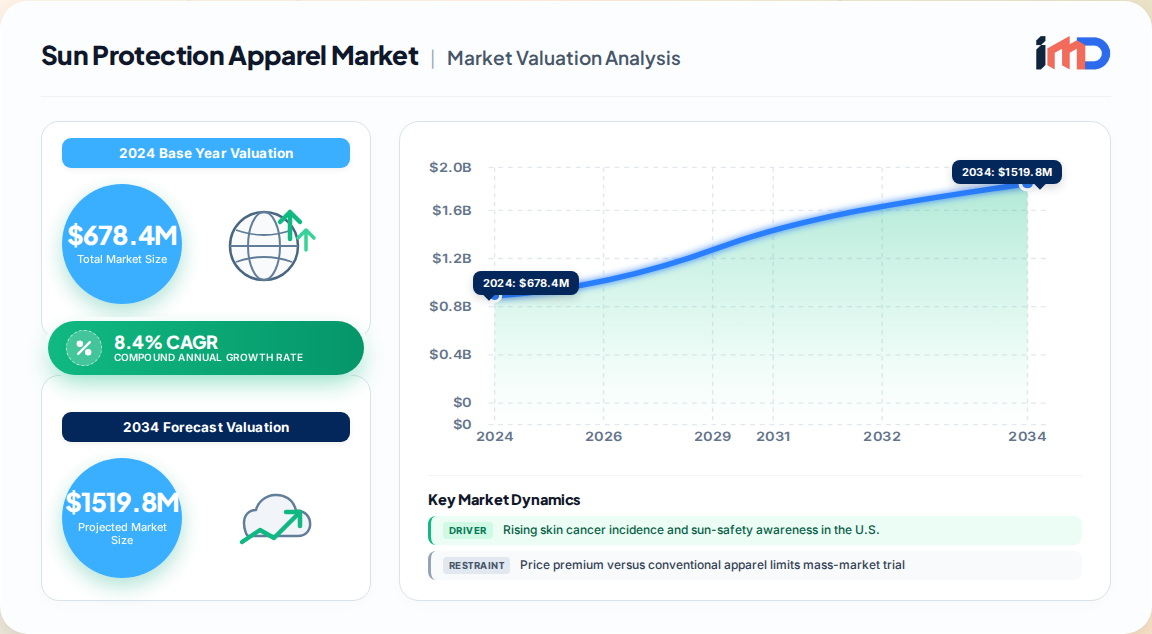
The U.S. sun protection apparel market — defined here as garments engineered and rated for ultraviolet protection factor (UPF) performance — is estimated at $678.4 million in 2024 and is projected to reach $1.23 billion by 2030, expanding at a CAGR of 8.4%. Our proprietary demand modeling, triangulated from point-of-sale panel data, specialty retail audits, and 140+ primary interviews across the value chain, positions this as one of the fastest-compounding niches in U.S. activewear.
Sun-protective clothing is functionally distinct from conventional apparel: UPF quantifies a fabric's ability to block UV radiation, and performance is governed by dye chemistry, fiber blend, knit density, garment stretch, weight, moisture management, and specialized finishing treatments. This technical complexity is reshaping product development cycles and supplier qualification requirements.
Drivers
Restraints
Challenges
By product, shirts, t-shirts, jackets, and hoodies represent the fastest-growing cluster, given torso coverage and daytime outdoor utility. Hats and caps, pants and shorts, swimwear, and accessories complete the portfolio.
| Product Segment | Growth Profile | Primary Demand Driver |
|---|---|---|
| Shirts, T-shirts, Jackets, Hoodies | Fastest CAGR | Torso coverage, comfort, outdoor activity |
| Pants & Shorts | Above-market CAGR | Sunscreen replacement, leg exposure |
| Hats & Caps | Steady | Scalp and facial protection |
| Swimwear | Cyclical/seasonal | Water-activity UPF retention |
| Others | Niche | Accessories, sleeves, gaiters |
By end-use, women commanded 44.8% of 2023 revenue, supported by stylish silhouettes and awareness-led purchasing. Men represent the second-fastest CAGR segment, propelled by expanded pattern, design, color, and size assortments. Kids' UPF apparel is a high-frequency, parent-driven purchase with strong school and camp-season concentration.
By UPF rating, the 41–50 and 50+ tiers dominate premium positioning; sub-30 ratings compete on price in mass channels.
By distribution channel, online is the structural share gainer, supported by direct-to-consumer brand portals and marketplace reach; offline specialty and outdoor retail remain critical for fit and fabric education.
Per UN Comtrade and World Integrated Trade Solution (WITS) trade records, the U.S. is a net importer of UPF-rated knit and woven apparel, with China, Vietnam, and Bangladesh functioning as principal origin markets for synthetic performance knits. The U.S. Harmonized Tariff Schedule classifies most UPF garments under Chapters 61 and 62, and duty exposure varies materially by fiber content and knit versus woven construction.
Supply-chain risk assessment: single-country concentration, synthetic fiber price volatility, and certification bottlenecks (UPF testing and labeling) are the three highest-probability disruption vectors. Dual-sourcing across Vietnam and nearshore partners is the dominant mitigation strategy among interviewed brands.
The value chain spans fiber and yarn suppliers, performance-finish and dye houses, cut-and-sew manufacturers, UPF testing and certification laboratories, brand owners, and multi-channel distribution.
Margin concentration sits with brand owners and technology licensors; contract manufacturers operate on thin spreads and are highly sensitive to fiber and freight cycles. Returns management and after-sales service are emerging as differentiating capabilities.
Demand is concentrated in the South and West, reflecting sun-hour exposure, outdoor lifestyle participation, and higher skin-cancer incidence. The Northeast and Midwest offer seasonal, summer-program-led volume with strong kids' and family categories.
| U.S. Region | Share of Demand | Attractiveness |
|---|---|---|
| South | 38% | High — year-round exposure, golf, water sports |
| Northeast | 22% | Medium-High — dense population, seasonal peak |
| West | 21% | High — outdoor recreation, hiking, ski-adjacent |
| Midwest | 19% | Medium — summer and camp-driven |
Investment priorities: DTC digital infrastructure, UPF certification transparency, and nearshore capacity expansion.
The landscape blends established outdoor brands, dedicated sun-protection specialists, and emerging DTC labels. Differentiation is shifting from fabric claims to verified UPF performance, design credibility, and service experience.
| Aspects | Details |
|---|---|
| Study Period | 2020-2034 |
| Base Year | 2024 |
| Estimated Year | 2026 |
| Forecast Period | 2026-2034 |
| Historical Period | 2020-2025 |
| Growth Rate | CAGR of 8.4% from 2020-2034 |
| Segmentation |
|
By Distribution Channel
By UPF Rating
By End-use
| By Geography |
|
The U.S. UPF sun protective clothing market is estimated at approximately $678.4 million in 2024 and is projected to reach $1.23 billion by 2030, expanding at a CAGR of 8.4%.
Shirts, t-shirts, jackets, and hoodies represent the fastest-growing product cluster, driven by torso coverage, comfort, and daytime outdoor utility.
Rising skin cancer incidence — roughly 97,610 new melanoma cases projected in 2023 — alongside over 9,500 daily skin cancer diagnoses, is driving adoption of UPF-rated garments.
Women held the largest revenue share at 44.8% in 2023, while the men's segment is expected to grow at the second-fastest CAGR through 2030.
Key players include Coolibar Sun Protective Clothing, Columbia Sportswear Company, UV Skinz, Solbari Sun Protection, Cabana Life, Solumbra, IBKUL, and Nozone Clothing.
Our rigorous research methodology combines multi-layered approaches with comprehensive quality assurance, ensuring precision, accuracy, and reliability in every market analysis.
| Stakeholder Role | Interview Share (%) |
|---|---|
| Procurement and Sourcing Director | 28% |
| Merchandising and Category Manager | 26% |
| Product Development and Fabric Technologist | 24% |
| E-commerce and Retail Operations Lead | 22% |
| Company Type | Representation (%) |
|---|---|
| Performance fabric mills and finishers | 24% |
| Cut-and-sew manufacturers | 21% |
| Brand owners and licensors | 27% |
| Specialty and outdoor retailers | 16% |
| E-commerce and marketplace operators | 12% |
 Related Reports


Analyst at Providence Strategic Partners at Petaling Jaya
I have received the report already. Thanks you for your help.it has been a pleasure working with you. Thank you again for a good quality report

Internationalization Director
Yes, as a matter of fact we are totally satisfied with both reports that we have purchased and will continue to do so during this process of the internationalization of our brand.

Head of Product Management and Marketing
We are using your report, and it gave us valuable information."

Regional Director, Marketing and Business Development
We've received the report and have reviewed the content. Overall, it looks great and aligns closely with the data we can verify based on our industry knowledge.

VP of Sales
Thank you very much for sharing the report. I have reviewed it and I am very satisfied with the quality and the insights it provides. It will certainly be valuable for our internal discussions.