1What is the current size of the global automotive air conditioners market?
The global automotive air conditioners market was valued at USD 38.23 billion in 2025 and is projected to reach USD 64.4 billion by 2035, growing at a CAGR of 5.35%.
Insight Market Data is a premier market research and business consulting firm headquartered in Pune, India, providing syndicated research reports, customized intelligence studies, and strategic advisory services. Renowned academic institutions and Fortune 500 corporations worldwide rely on Insight Market Data's research repository to navigate evolving global and regional business environments. Covering 46 diverse industries across 25 major international economies, our comprehensive database delivers thousands of verified statistics and granular market evaluations. By combining industry-leading analytical methodologies with the direct insights of seasoned industry leaders and subject-matter experts, we deliver actionable intelligence spanning historical performance benchmarks to rigorous multi-year forecasts. We empower organizations to make confident, data-driven decisions across pivotal domains including Machinery & Equipment, Chemicals & Materials, Pharmaceuticals & Healthcare, Food & Beverages, Consumer Goods, Energy & Power, Automotive & Transportation, Electronics & Semiconductors, Medical Devices, Telecommunications, Emerging Technologies, Agriculture, and Packaging. Our multidisciplinary analyst teams provide an objective 360-degree perspective, tailoring every engagement to address complex strategic challenges with exceptional analytical rigor.
Leveraging advanced BI-powered analytics and predictive modeling, Insight Market Data uncovers high-impact market opportunities and competitive differentiators for ambitious enterprises. We continuously refine our research methodologies in accordance with global industry standards, tracking real-time market shifts to ensure our reports are consistently accurate, actionable, and delivered on schedule. Our analysts conduct methodical data validation, rigorous compliance checks, and exhaustive primary and secondary research to maintain the highest levels of data integrity and transparency. We partner closely with corporate strategists, investment groups, and business executives to translate intricate market intelligence into clear, actionable roadmaps for sustainable growth. With operational presence across Washington, USA, and Vimannagar, Pune, India, Insight Market Data ensures direct access to dedicated research specialists and responsive customer support to answer your most strategic questions.
 Strategic Analysis of Automotive Air Conditioners Market
 by Technology (Manual, Automatic), by Vehicle Type (Passenger Vehicle, Commercial Vehicle), by Component (Compressor, Evaporator, Receiver, Condenser), by Distribution Channel (OEMs, Aftermarket), by North America (USA, Canada, Mexico), by Europe (Germany, France, UK, Italy, Spain, Rest of Europe), by Asia Pacific (China, Japan, India, South Korea, Rest of APAC), by South America (Brazil, Argentina, Rest of South America), by Middle East & Africa (Saudi Arabia, UAE, South Africa, Rest of MEA) Forecast 2026-2034

Research Analyst


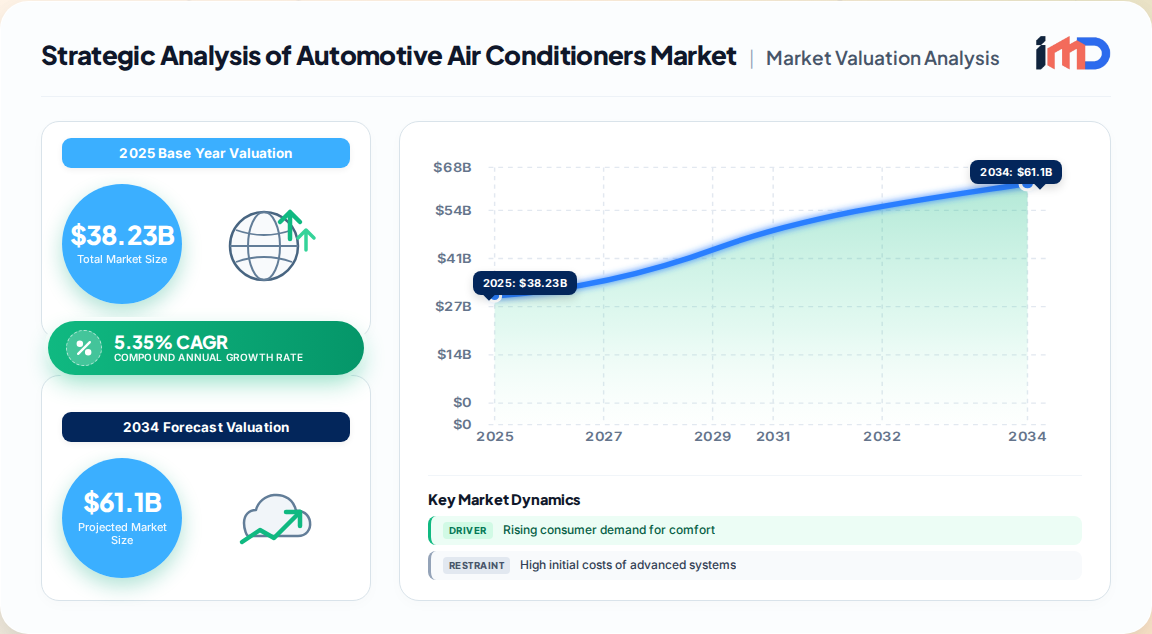
The global automotive air conditioners market is experiencing robust expansion, driven by escalating consumer expectations for in-cabin comfort, regulatory mandates for energy efficiency, and the accelerating transition to electric and hybrid vehicles. Our proprietary primary research estimates the market at USD 38.23 billion in 2025, projected to reach USD 64.4 billion by 2035, reflecting a CAGR of 5.35% over the forecast period. This growth is underpinned by sustained vehicle production increases, particularly in emerging economies, and the integration of smart climate control technologies that enhance both user experience and energy efficiency.
Asia-Pacific commands the dominant share of the global market, accounting for approximately 43% of total revenue in 2025, fueled by rapid industrialization, urbanization, and rising disposable incomes in countries such as China and India. North America and Europe remain significant markets, characterized by high adoption rates of automatic climate control systems and stringent environmental regulations. The market is characterized by moderate to high concentration, with leading suppliers investing heavily in R&D for eco-friendly refrigerants and lightweight, energy-efficient components.
Drivers:
Restraints:
The automotive air conditioners value chain comprises several stages, from raw material suppliers to end-users. Key activities include:
Our primary interviews with procurement directors and supply chain managers reveal that vertical integration is a key strategy among leading suppliers to mitigate supply chain risks and ensure quality control. For instance, several top players have acquired refrigerant production facilities to secure supply and reduce dependency on external vendors.
The market is moderately concentrated, with leading players such as Denso Corporation, Valeo SA, Hanon Systems, Mahle GmbH, Sanden Holdings Corporation, and Calsonic Kansei Corporation dominating the supply landscape. These companies differentiate through:
Our primary research indicates that top players are also focusing on mergers and acquisitions to consolidate market share and acquire specialized technologies. For example, recent acquisitions have targeted companies with expertise in electric compressors and thermal management systems for EVs.
Global trade in automotive air conditioning components is significant, with major exporting countries including China, Germany, Japan, and South Korea. According to UN Comtrade data, global exports of automotive air conditioning systems and components exceeded USD 12 billion in 2024, with China accounting for approximately 25% of total exports. The supply chain is highly globalized, with components often crossing multiple borders before final assembly.
Key supplier dynamics include:
Opportunities for growth are emerging in several underserved segments:
Our research methodology is built on a rigorous, multi-layered approach that ensures the highest level of data accuracy and market insight. We employ a 70/30 research split, with 70–80% primary research and 20–30% secondary research, guaranteeing an estimated data accuracy level of 85–90%.
This comprehensive methodology enables us to deliver actionable, proprietary insights that empower strategic decision-making.
| Aspects | Details |
|---|---|
| Study Period | 2020-2034 |
| Base Year | 2025 |
| Estimated Year | 2026 |
| Forecast Period | 2026-2034 |
| Historical Period | 2020-2025 |
| Growth Rate | CAGR of 5.35% from 2020-2034 |
| Segmentation |
|
By Component
By Distribution Channel
| By Geography |
|
The global automotive air conditioners market was valued at USD 38.23 billion in 2025 and is projected to reach USD 64.4 billion by 2035, growing at a CAGR of 5.35%.
Asia-Pacific is the largest and fastest-growing market, accounting for approximately 43% of global revenue in 2025, driven by high vehicle production in China and India.
Key drivers include rising consumer demand for comfort, growth of electric and hybrid vehicles, increasing vehicle production, and technological advancements in HVAC systems.
Major players include Denso Corporation, Valeo SA, Hanon Systems, Mahle GmbH, Sanden Holdings Corporation, and Calsonic Kansei Corporation.
Electric vehicles require energy-efficient air conditioning systems that minimize battery drain, creating demand for specialized electric compressors and eco-friendly refrigerants, with EVs expected to represent over 30% of global vehicle sales by 2030.
Our rigorous research methodology combines multi-layered approaches with comprehensive quality assurance, ensuring precision, accuracy, and reliability in every market analysis.
| Stakeholder Role | Interview Share (%) |
|---|---|
| Chief Technology Officer (CTO) | 25% |
| Director of Procurement | 30% |
| Product Line Manager – Thermal Systems | 25% |
| Supply Chain Manager | 20% |
| Company Type | Representation (%) |
|---|---|
| Tier-1 Automotive HVAC System Manufacturers | 30% |
| Compressor OEMs | 25% |
| Refrigerant Suppliers | 15% |
| Automotive OEM Procurement Teams | 20% |
| Aftermarket Distributors | 10% |
 Related Reports
