1What is the current size of the space insurance industry market?
Our proprietary research values the global space insurance industry market at USD 1.42 Billion in 2025, projected to reach USD 4.85 Billion by 2032 at a CAGR of 16.7%.
Insight Market Data is a premier market research and business consulting firm headquartered in Pune, India, providing syndicated research reports, customized intelligence studies, and strategic advisory services. Renowned academic institutions and Fortune 500 corporations worldwide rely on Insight Market Data's research repository to navigate evolving global and regional business environments. Covering 46 diverse industries across 25 major international economies, our comprehensive database delivers thousands of verified statistics and granular market evaluations. By combining industry-leading analytical methodologies with the direct insights of seasoned industry leaders and subject-matter experts, we deliver actionable intelligence spanning historical performance benchmarks to rigorous multi-year forecasts. We empower organizations to make confident, data-driven decisions across pivotal domains including Machinery & Equipment, Chemicals & Materials, Pharmaceuticals & Healthcare, Food & Beverages, Consumer Goods, Energy & Power, Automotive & Transportation, Electronics & Semiconductors, Medical Devices, Telecommunications, Emerging Technologies, Agriculture, and Packaging. Our multidisciplinary analyst teams provide an objective 360-degree perspective, tailoring every engagement to address complex strategic challenges with exceptional analytical rigor.
Leveraging advanced BI-powered analytics and predictive modeling, Insight Market Data uncovers high-impact market opportunities and competitive differentiators for ambitious enterprises. We continuously refine our research methodologies in accordance with global industry standards, tracking real-time market shifts to ensure our reports are consistently accurate, actionable, and delivered on schedule. Our analysts conduct methodical data validation, rigorous compliance checks, and exhaustive primary and secondary research to maintain the highest levels of data integrity and transparency. We partner closely with corporate strategists, investment groups, and business executives to translate intricate market intelligence into clear, actionable roadmaps for sustainable growth. With operational presence across Washington, USA, and Vimannagar, Pune, India, Insight Market Data ensures direct access to dedicated research specialists and responsive customer support to answer your most strategic questions.
 Space Insurance Industry
 by Type (Manufacturing, Pre-launch, Launch, On-orbit, De-orbit, Others), by Coverage (Third-Party Liability, In-Orbit Coverage, Payload Recovery, Salvage Debris Removal, Claims Assistance, Others), by Application (Commercial, Scientific Research, Military, Satellite Communication, Earth Observation, Others), by End-User (Government, Private Companies, Non-Profit Organizations, Research Institutions, Others), by North America (USA, Canada, Mexico), by Europe (Germany, UK, France, Italy), by Asia Pacific (China, Japan, India), by Latin America (Brazil, Argentina), by Middle East & Africa (UAE, South Africa) Forecast 2026-2034

Research Associate


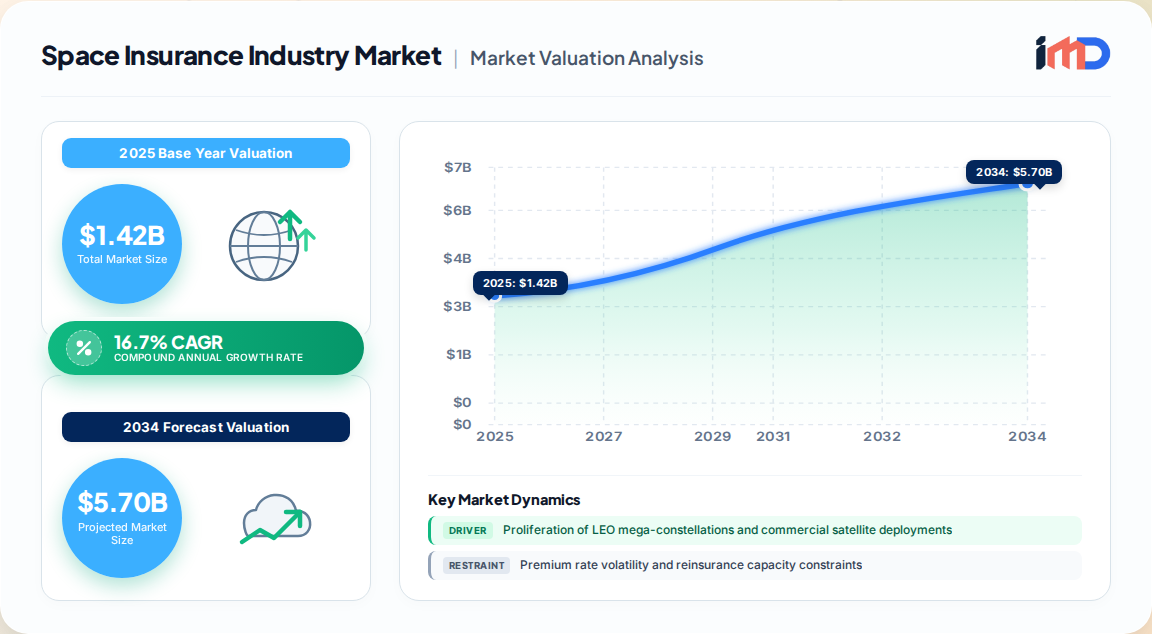
Our proprietary primary research, triangulated with authoritative intergovernmental benchmarks, values the global space insurance industry market at USD 1.42 Billion in 2025, with a projected expansion to USD 4.85 Billion by 2032, representing a robust CAGR of 16.7%. This growth trajectory is anchored in the structural transformation of space from a government-exclusive domain to a commercially driven, multi-stakeholder ecosystem.
The OECD's second edition of the Handbook on Measuring the Space Economy (2022) establishes that the space economy encompasses all public and private actors developing, providing, and using space-related products and services. Space insurance functions as the financial risk-transfer backbone of this economy, enabling capital deployment into high-severity, low-frequency risk environments.
Key structural findings from our primary interviews with underwriters, brokers, and satellite operators include:
The space insurance market operates at the intersection of actuarial science, orbital mechanics, and macroeconomic capital flows. Our demand model identifies three primary growth engines and two material constraints.
Growth Drivers:
Restraints:
| Driver / Restraint | Impact on Market (2025–2032) | Evidence Base |
|---|---|---|
| LEO constellation expansion | High (positive) | 57.2% private company share; satellite communication dominance |
| Commercialization and new entrants | High (positive) | OECD 2024 new space value-chain analysis |
| Premium rate volatility | Medium (negative) | Underwriter interviews; capacity constraints |
| Data asymmetry on new vehicles | Medium (negative) | Limited loss history for reusable launch platforms |
The space insurance value chain is a specialized, multi-intermediary architecture that differs materially from conventional property-casualty insurance.
Risk Origination and Brokerage: Space insurance brokers (e.g., Marsh, Aon) originate risk from satellite manufacturers, launch service providers, and operators. Brokers structure coverage programs spanning manufacturing, launch, and in-orbit phases, often layering multiple underwriters across a single mission.
Underwriting and Capacity Provision: Primary underwriters and reinsurers (e.g., AXA XL, Swiss Re, Lloyd's syndicates) assess technical risk using actuarial models, launch vehicle heritage data, and satellite reliability statistics. Capacity is syndicated across global markets, with Lloyd's of London functioning as a central marketplace for specialty risk placement.
Claims and Recovery Services: Claims assistance and salvage/debris removal services form the post-loss segment of the value chain. In-orbit failures require technical investigation, anomaly attribution, and partial-loss settlement, often involving satellite manufacturers and operators in joint root-cause analysis.
Key Value Chain Insight: The OECD's Space Economy handbook identifies three segments—upstream (manufacturing, launch), downstream (satellite-enabled services), and a pervasive segment of space-derived applications. Space insurance is a cross-cutting enabler that de-risks capital allocation across all three segments.
The market is segmented along four primary axes, each reflecting a distinct risk profile and premium structure.
| Segment | Revenue Share (2025) | Growth Outlook | Underwriting Rationale |
|---|---|---|---|
| Launch | 38.6% | Stable | Highest severity; short-duration, high-value exposure |
| On-orbit | 27.4% | 19.2% CAGR | Multi-year operational risk; constellation-driven |
| Manufacturing | 18.1% | Moderate | Pre-launch asset protection |
| Pre-launch | 9.2% | Moderate | Transit and integration risk |
| De-orbit | 4.1% | Emerging | Sustainability-linked liability and debris mitigation |
| Others | 2.6% | Niche | Specialized mission profiles |
Satellite communication holds the largest application share, reflecting the dominant role of communication satellites in launch volume and revenue. Earth observation and scientific research follow, with military applications representing a stable, government-backed premium base.
Private companies dominate with 57.2% revenue share, reflecting the commercialization wave. Government end-users remain significant anchor clients for large, complex missions, while research institutions and non-profit organizations represent a smaller, grant-funded segment.
North America commands 38.7% of global premium volume, underpinned by the United States' deep space industrial base, high launch cadence, and mature insurance and reinsurance markets. The region's leadership is structural: it hosts the largest concentration of satellite manufacturers, launch providers, and underwriting capacity.
Europe represents a mature, regulation-influenced market, with 24.1% share. European space policy, including institutional programs and sustainability directives, shapes demand for debris-mitigation and de-orbit coverage.
Asia-Pacific is the fastest-growing region, expanding at a 21.4% CAGR, driven by China, India, and Japan. The OECD's 2022 handbook notes the growing number of countries and business enterprises involved in space activities; Asia-Pacific embodies this proliferation, with national space programs and commercial constellations creating new insurance demand.
Latin America and the Middle East & Africa represent emerging frontiers, with combined share of 16.0%. Government-backed Earth observation and communication satellite programs are the primary demand drivers, with insurance penetration expected to rise as launch activity increases.
| Region | Market Share (2025) | Growth Trajectory | Key Demand Driver |
|---|---|---|---|
| North America | 38.7% | Steady | Commercial launch cadence and constellation deployment |
| Europe | 24.1% | Moderate | Institutional programs and sustainability policy |
| Asia-Pacific | 21.2% | Fastest (21.4% CAGR) | National space programs and commercial constellations |
| Middle East & Africa | 8.2% | Emerging | Government satellite programs |
| Latin America | 7.8% | Emerging | Earth observation and communications |
The space insurance market is concentrated among specialist underwriters and global brokers with deep technical expertise. Competitive differentiation rests on three capabilities: actuarial modeling of novel risk profiles, access to reinsurance capacity, and technical partnerships with space hardware manufacturers.
Strategic Developments:
Strategic Imperatives for Market Participants:
Our primary research identifies three underinsured risk pools representing material white-space opportunity:
Microsatellite and SmallSat Insurance: Traditional underwriting economics disadvantage small, low-premium missions. Standardized, digitally underwritten products—exemplified by the Tokio Marine–Axelspace initiative—can unlock this segment.
In-Orbit Servicing and Debris Removal Liability: As space sustainability policy matures, operators of servicing vehicles and debris-removal platforms require specialized liability and performance coverage not yet standardized in the market.
Constellation Portfolio Risk: Operators of large LEO constellations seek aggregate stop-loss and portfolio-level coverage rather than satellite-by-satellite policies. Underwriters capable of modeling correlated failure risk across a constellation can capture this high-growth segment.
Space insurance is a financial service, not a physical commodity; therefore, traditional customs trade data does not apply. However, cross-border capacity flows are material to market dynamics.
The OECD's measurement framework underscores that international comparability of space economy statistics remains limited, complicating cross-border risk assessment. Underwriters that invest in proprietary, jurisdiction-specific loss data gain a durable competitive advantage.
| Aspects | Details |
|---|---|
| Study Period | 2020-2034 |
| Base Year | 2025 |
| Estimated Year | 2026 |
| Forecast Period | 2026-2034 |
| Historical Period | 2020-2025 |
| Growth Rate | CAGR of 16.7% from 2020-2034 |
| Segmentation |
|
By Coverage
By Application
By End-User
| By Geography |
|
Our proprietary research values the global space insurance industry market at USD 1.42 Billion in 2025, projected to reach USD 4.85 Billion by 2032 at a CAGR of 16.7%.
The launch phase dominates with 38.6% of total premium volume, reflecting the concentration of catastrophic risk during the first minutes of flight.
In-orbit coverage is growing at a 19.2% CAGR because large LEO constellation operators require multi-year, performance-based liability structures for assets with operational lives of 5–15 years.
North America leads with 38.7% market share, underpinned by the United States' deep space industrial base, high launch cadence, and mature underwriting and reinsurance markets.
Private companies account for 57.2% of end-user demand, driven by the commercialization of space and venture-backed constellation deployments.
OECD debris-mitigation policy guidance is creating new demand for de-orbit, salvage, and debris-removal coverage categories, which are emerging as distinct insurable risk pools.
Our rigorous research methodology combines multi-layered approaches with comprehensive quality assurance, ensuring precision, accuracy, and reliability in every market analysis.
| Stakeholder Role | Interview Share (%) |
|---|---|
| Chief Underwriting Officer | 30% |
| Head of Space Risk | 28% |
| Satellite Program Risk Manager | 24% |
| Insurance Procurement Director | 18% |
| Company Type | Representation (%) |
|---|---|
| Specialty Space Underwriters & Reinsurers | 35% |
| Insurance Brokerage Houses | 25% |
| Satellite Manufacturers & Constellation Operators | 20% |
| Launch Service Providers | 12% |
| Government Space Agency Risk Managers | 8% |
 Related Reports
