1What is the South Sudan oil and gas upstream market size in 2026?
The market is valued at USD 534.02 million in 2026, growing at a CAGR of 3.31% to reach USD 628.53 million by 2031.
Insight Market Data is a premier market research and business consulting firm headquartered in Pune, India, providing syndicated research reports, customized intelligence studies, and strategic advisory services. Renowned academic institutions and Fortune 500 corporations worldwide rely on Insight Market Data's research repository to navigate evolving global and regional business environments. Covering 46 diverse industries across 25 major international economies, our comprehensive database delivers thousands of verified statistics and granular market evaluations. By combining industry-leading analytical methodologies with the direct insights of seasoned industry leaders and subject-matter experts, we deliver actionable intelligence spanning historical performance benchmarks to rigorous multi-year forecasts. We empower organizations to make confident, data-driven decisions across pivotal domains including Machinery & Equipment, Chemicals & Materials, Pharmaceuticals & Healthcare, Food & Beverages, Consumer Goods, Energy & Power, Automotive & Transportation, Electronics & Semiconductors, Medical Devices, Telecommunications, Emerging Technologies, Agriculture, and Packaging. Our multidisciplinary analyst teams provide an objective 360-degree perspective, tailoring every engagement to address complex strategic challenges with exceptional analytical rigor.
Leveraging advanced BI-powered analytics and predictive modeling, Insight Market Data uncovers high-impact market opportunities and competitive differentiators for ambitious enterprises. We continuously refine our research methodologies in accordance with global industry standards, tracking real-time market shifts to ensure our reports are consistently accurate, actionable, and delivered on schedule. Our analysts conduct methodical data validation, rigorous compliance checks, and exhaustive primary and secondary research to maintain the highest levels of data integrity and transparency. We partner closely with corporate strategists, investment groups, and business executives to translate intricate market intelligence into clear, actionable roadmaps for sustainable growth. With operational presence across Washington, USA, and Vimannagar, Pune, India, Insight Market Data ensures direct access to dedicated research specialists and responsive customer support to answer your most strategic questions.
 South Sudan Oil and Gas Upstream Industry
 by Location of Deployment (Onshore, Offshore), by Resource Type (Crude Oil, Natural Gas), by Well Type (Conventional, Unconventional), by Service (Exploration, Development and Production, Decommissioning), by Upper Nile, by Central Equatoria, by Unity, by Western Bahr el Ghazal, by Others Forecast 2026-2034

Research Analyst


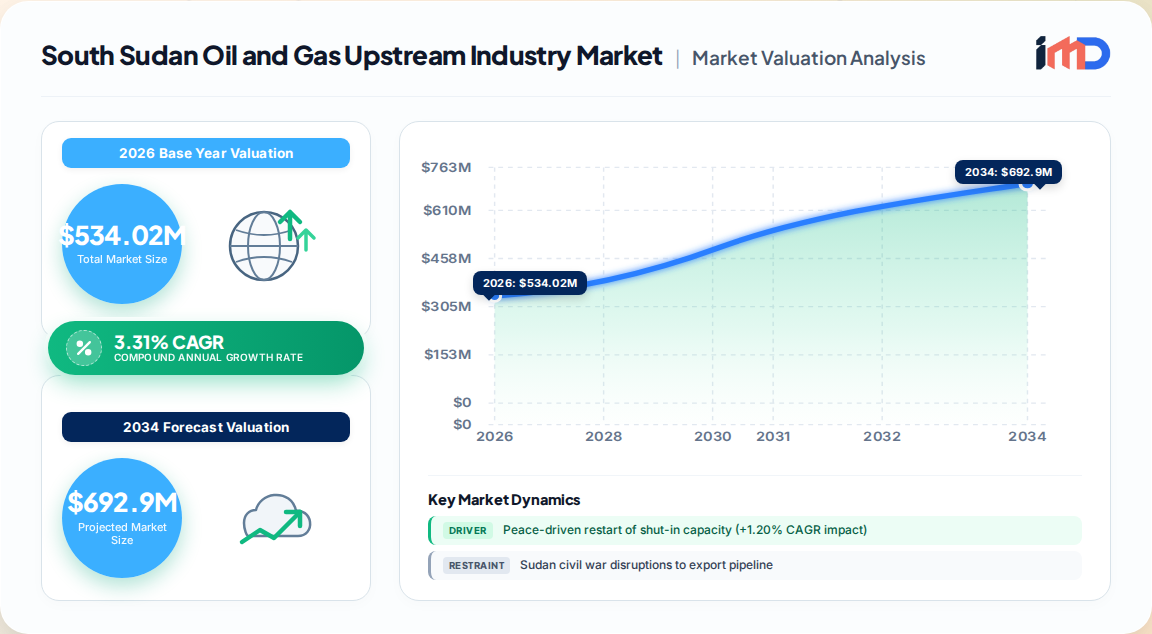
The South Sudan oil and gas upstream market represents one of Africa's most strategically significant yet operationally constrained hydrocarbon provinces. Our proprietary first-party research estimates the market at USD 534.02 million in 2026, projected to expand to USD 628.53 million by 2031, registering a CAGR of 3.31% over the forecast period. This trajectory builds upon a 2025 base of USD 516.91 million, reflecting a cautious but durable recovery from years of conflict-induced production disruptions.
South Sudan's upstream sector is almost entirely dominated by crude oil, which accounted for 99.66% of 2025 revenues (USD 515.15 million), while natural gas contributed a marginal USD 1.76 million. The sector's structural DNA remains onshore-centric, with onshore operations commanding 99.74% of the market share (USD 515.56 million) in 2025, leaving offshore activity at just USD 1.35 million. Conventional wells represent 100% of current well stock, though unconventional potential in under-explored basins is gaining attention.
The South Sudan upstream market is shaped by a complex interplay of peace-building dividends and persistent infrastructure and security risks. Our primary research identifies six key drivers and four primary restraints, each with quantified impacts on the forecast CAGR.
| Restraint | CAGR Impact | Geographic Relevance | Timeline |
|---|---|---|---|
| Sudan civil war disruptions | −1.8% | National | Short term (≤2 years) |
| Flood-induced spills | −0.6% | Oil-producing regions | Medium term (2–4 years) |
| PETRONAS exit and litigation | −0.4% | Select producing blocks | Short term (≤2 years) |
| High-TAN Dar blend costs | −0.3% | National | Ongoing |
Onshore operations are the bedrock of South Sudan's upstream sector. In 2025, onshore activities generated USD 515.56 million, or 99.74% of the market, centered on mature fields in Unity and Upper Nile states. Existing gathering lines and central processing facilities support cost-effective barrel delivery. However, periodic security incidents and road-haul bottlenecks occasionally disrupt materials flow.
Offshore acreage, while representing only USD 1.35 million in 2025, is forecast to register the fastest CAGR of 4.85% through 2031. Legacy aeromagnetic surveys suggest tilted fault blocks along the Red Sea margin, though a modern 2-D seismic grid has yet to be acquired. Commercial discovery would diversify geographic risk.
Crude oil dominates with 99.66% of 2025 revenues (USD 515.15 million). Enhanced oil recovery (EOR) pilots—polymer flooding and water-alternating-gas injection—are being tested to counter 8–10% annual field decline rates. Natural gas, at USD 1.76 million today, is expected to expand at a 4.63% CAGR through 2031, driven by flaring-reduction commitments and a small-scale LPG project slated for 2026.
| Segment | 2025 Value (USD Million) | Share | Forecast CAGR (2026–2031) |
|---|---|---|---|
| Onshore | 515.56 | 99.74% | 3.31% |
| Offshore | 1.35 | 0.26% | 4.85% |
| Crude Oil | 515.15 | 99.66% | 3.31% |
| Natural Gas | 1.76 | 0.34% | 4.63% |
| Conventional Wells | 516.91 | 100.00% | 3.31% |
| Development & Production | 361.42 | 69.92% | 3.31% |
| Exploration | 129.83 | 25.12% | 4.66% |
| Decommissioning | 25.66 | 4.96% | 3.31% |
Conventional wells accounted for 100% of the market share in 2025 and are expected to grow at a 3.31% CAGR through 2031. Unconventional exploration remains nascent, with no commercial tight-oil or shale-gas production. However, the Ministry of Petroleum has signaled interest in appraising tight formations in the Melut Basin, though no timeline has been announced.
Development and production services contributed 69.92% of 2025 revenues (USD 361.42 million). Exploration services, at USD 129.83 million, are forecast to grow at a 4.66% CAGR, outpacing development activity as new licensing rounds translate into seismic acquisition and appraisal drilling. Decommissioning remains a minor segment at USD 25.66 million, though aging infrastructure will drive gradual growth.
The South Sudan upstream market is highly concentrated, with three state-linked Asian majors—CNPC, Sinopec Group, and ONGC Videsh—commanding over 80% of operated output in 2024. These players operate through joint ventures with Nilepet, the national oil company, which holds carried interests in most producing blocks.
| Company | Role | Key Assets |
|---|---|---|
| China National Petroleum Corp. (CNPC) | Operator | Blocks 1/2/4 (Palogue, Unity) |
| Sinopec Group | Operator | Block 3/7 (Sudd) |
| ONGC Videsh Ltd. | Partner | Blocks 1/2/4, 5A |
| Nile Petroleum Corp. (Nilepet) | National oil company | JV partner across all blocks |
| Dar Petroleum Operating Co. | Operating company | Blocks 3/7 |
| Greater Pioneer Operating Co. | Operating company | Block 1/2/4 |
| Sudd Petroleum Operating Co. | Operating company | Block 5A |
| Strategic Fuel Fund (SFF) | Strategic investor | Block 5A |
| Wildcat Petroleum plc | Independent | Exploration acreage |
| Tri-Ocean Energy | Independent | Exploration acreage |
South Sudan's upstream opportunities are geographically concentrated but offer distinct risk-return profiles.
| Region | 2025 Share | Key Characteristics | Investment Appeal |
|---|---|---|---|
| Upper Nile | 52% | Mature fields (Palogue, Melut), proximity to pipeline | High (production optimization) |
| Central Equatoria | 18% | Exploration acreage, limited infrastructure | Medium (frontier) |
| Unity | 16% | Blocks 1/2/4, rehabilitation ongoing | High (restart potential) |
| Western Bahr el Ghazal | 9% | Under-explored, no production | Low (early-stage) |
| Others | 5% | Offshore Red Sea margin, pre-seismic | Speculative |
Our primary research identifies several underserved niches with high growth potential:
South Sudan's upstream sector is inextricably linked to export infrastructure and imported inputs.
| Aspects | Details |
|---|---|
| Study Period | 2020-2034 |
| Base Year | 2026 |
| Estimated Year | 2026 |
| Forecast Period | 2026-2034 |
| Historical Period | 2020-2025 |
| Growth Rate | CAGR of 3.31% from 2020-2034 |
| Segmentation |
|
By Well Type
By Service
| By Geography |
|
The market is valued at USD 534.02 million in 2026, growing at a CAGR of 3.31% to reach USD 628.53 million by 2031.
Onshore operations accounted for 99.74% of the market in 2025, with crude oil representing 99.66% of revenues, reflecting the country's pipeline-oriented infrastructure.
CNPC, Sinopec Group, and ONGC Videsh collectively control over 80% of operated output, alongside Nilepet and operating companies like Dar Petroleum and Greater Pioneer.
Peace-driven restart of shut-in capacity (+1.20% CAGR impact), licensing rounds attracting new capital (+0.80%), and the proposed Lamu export pipeline (+0.60%) are primary drivers.
Sudan civil war disruptions to export lines (−1.8% impact), flood-induced environmental liabilities (−0.6%), and the exit of PETRONAS with asset litigation (−0.4%) are major restraints.
Upper Nile state accounts for approximately 52% of the market, driven by mature fields like Palogue and Melut with existing infrastructure.
Our rigorous research methodology combines multi-layered approaches with comprehensive quality assurance, ensuring precision, accuracy, and reliability in every market analysis.
| Stakeholder Role | Interview Share (%) |
|---|---|
| Chief Operating Officer | 25% |
| Asset Manager | 30% |
| Exploration Director | 20% |
| Procurement Director | 15% |
| Regulatory Affairs Manager | 10% |
| Company Type | Representation (%) |
|---|---|
| National Oil Company (Nilepet) | 25% |
| International Oil Companies (IOCs) | 30% |
| Oilfield Service Providers | 20% |
| EPC Contractors | 15% |
| Independent Exploration Companies | 10% |
 Related Reports
