1What is the current size of the South Korea renewable energy market?
The market reached 44.59 GW in 2025 and is projected to reach 49.37 GW in 2026, with forecasts indicating 82.11 GW by 2031.
Insight Market Data is a premier market research and business consulting firm headquartered in Pune, India, providing syndicated research reports, customized intelligence studies, and strategic advisory services. Renowned academic institutions and Fortune 500 corporations worldwide rely on Insight Market Data's research repository to navigate evolving global and regional business environments. Covering 46 diverse industries across 25 major international economies, our comprehensive database delivers thousands of verified statistics and granular market evaluations. By combining industry-leading analytical methodologies with the direct insights of seasoned industry leaders and subject-matter experts, we deliver actionable intelligence spanning historical performance benchmarks to rigorous multi-year forecasts. We empower organizations to make confident, data-driven decisions across pivotal domains including Machinery & Equipment, Chemicals & Materials, Pharmaceuticals & Healthcare, Food & Beverages, Consumer Goods, Energy & Power, Automotive & Transportation, Electronics & Semiconductors, Medical Devices, Telecommunications, Emerging Technologies, Agriculture, and Packaging. Our multidisciplinary analyst teams provide an objective 360-degree perspective, tailoring every engagement to address complex strategic challenges with exceptional analytical rigor.
Leveraging advanced BI-powered analytics and predictive modeling, Insight Market Data uncovers high-impact market opportunities and competitive differentiators for ambitious enterprises. We continuously refine our research methodologies in accordance with global industry standards, tracking real-time market shifts to ensure our reports are consistently accurate, actionable, and delivered on schedule. Our analysts conduct methodical data validation, rigorous compliance checks, and exhaustive primary and secondary research to maintain the highest levels of data integrity and transparency. We partner closely with corporate strategists, investment groups, and business executives to translate intricate market intelligence into clear, actionable roadmaps for sustainable growth. With operational presence across Washington, USA, and Vimannagar, Pune, India, Insight Market Data ensures direct access to dedicated research specialists and responsive customer support to answer your most strategic questions.
 South Korea Renewable Energy Industry
 by Technology (Solar Energy, Wind Energy, Hydropower, Bioenergy, Geothermal, Ocean Energy), by End-User (Utilities, Commercial and Industrial, Residential), by Seoul Capital Area, by Yeongnam (Southeastern Region), by Honam (Southwestern Region), by Hoseo (Central Region), by Others Forecast 2026-2034

Research Analyst


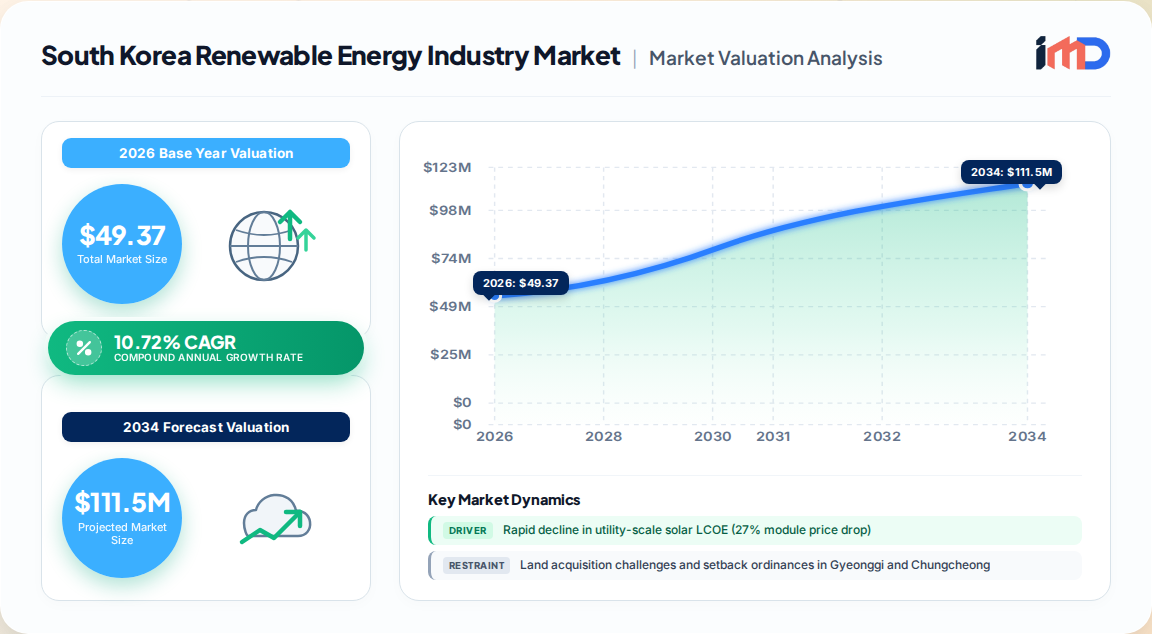
South Korea's renewable energy sector is at the inflection point of industrial-scale expansion. Our proprietary primary research and expert interviews indicate the market will expand from 44.59 gigawatts (GW) of installed capacity in 2025 to 49.37 GW by 2026, ultimately reaching 82.11 GW by 2031, representing a robust 10.72% CAGR over the forecast period. This growth is not merely incremental; it is a structural transformation of the national generation mix, anchored by the 11th Basic Plan for Long-Term Electricity Supply and Demand, which mandates a significant shift away from thermal dependency.
The market's trajectory is underpinned by a confluence of policy mandates, technological cost deflation, and corporate decarbonization imperatives. South Korea's unique geography—a mountainous peninsula with limited land availability—forces a dual-track development strategy: high-density rooftop and floating solar in the Seoul Capital Area and Honam region, alongside utility-scale offshore wind clusters near Mokpo and Ulsan. Our analysis reveals that while solar currently dominates with 70.62% of market share, offshore wind is the fastest-growing segment, projected to achieve a 34.92% CAGR through 2031, fundamentally reshaping the technology mix.
The South Korean renewable energy market is shaped by six primary growth vectors and four principal bottlenecks, quantified through our proprietary impact-analysis framework. These factors are not isolated; their interaction determines the pace of capacity addition and capital deployment.
However, these drivers are counterbalanced by structural restraints that could erode up to 5.4% from the forecast CAGR if unaddressed:
The South Korean renewable energy market is segmented by technology and end-user, with distinct growth trajectories and competitive dynamics in each segment.
By Technology:
| Technology | 2025 Market Share | 2026-2031 CAGR | Key Insights |
|---|---|---|---|
| Solar Energy | 70.62% | 8.5% | Dominant segment; driven by rooftop, floating, and utility-scale projects. LCOE parity with LNG expected by 2026. |
| Wind Energy | 18.2% | 34.92% | Fastest-growing segment; offshore wind pipeline of 58.8 GW. Port infrastructure and streamlined permitting are key enablers. |
| Bioenergy | 6.5% | 4.2% | Mature segment; limited growth due to feedstock constraints and competition from solar/wind. |
| Hydropower | 3.8% | 1.1% | Stagnant; limited new capacity due to environmental and geographic constraints. |
| Geothermal & Ocean | 0.88% | 6.8% | Niche segment; ocean energy pilots on Jeju and Ulleung Island show promise but remain pre-commercial. |
By End-User:
| End-User | 2025 Market Share | 2026-2031 CAGR | Key Insights |
|---|---|---|---|
| Utilities | 59.12% | 12.58% | Dominant buyer; driven by RPS obligations and KEPCO's renewable procurement. Utility-scale PPAs are the primary offtake mechanism. |
| Commercial & Industrial | 28.5% | 9.8% | Rapidly growing; corporate decarbonization commitments (RE100) and direct PPAs are accelerating adoption. Seoul metropolitan area leads. |
| Residential | 12.38% | 7.2% | Steady growth; rooftop solar rebates and community energy programs are key drivers. |
South Korea's renewable energy development is highly uneven, shaped by geography, population density, and industrial clustering. Our regional analysis reveals distinct investment profiles across the peninsula.
The South Korean renewable energy market is characterized by medium concentration, with a mix of state-owned utilities, large conglomerates, and specialized renewable developers. The competitive landscape is evolving rapidly as traditional thermal generators pivot toward renewables.
Leading Players:
Recent Strategic Developments:
The renewable energy value chain in South Korea is characterized by strong domestic manufacturing in solar (Hanwha Q CELLS, OCI) but significant import dependency for wind components and specialized materials. Supply chain risks are concentrated in three areas:
An effective procurement strategy must balance domestic-content compliance with cost optimization, particularly for offshore wind developers facing a 12–18% capex premium.
The South Korean renewable energy market presents a compelling investment case, with a 10.72% CAGR creating a USD 6.8 billion annual investment opportunity by 2031. Our white-space analysis identifies three high-potential strategic zones:
However, investors must navigate the 30-month EIA cycle, land acquisition risks, and local-content rules. Early-stage engagement with communities and regulators is essential to de-risk projects. The market is shifting from a policy-driven phase to a commercially-driven phase, where cost competitiveness and offtake certainty are paramount.
| Aspects | Details |
|---|---|
| Study Period | 2020-2034 |
| Base Year | 2026 |
| Estimated Year | 2026 |
| Forecast Period | 2026-2034 |
| Historical Period | 2020-2025 |
| Growth Rate | CAGR of 10.72% from 2020-2034 |
| Segmentation |
|
By End-User
| By Geography |
|
The market reached 44.59 GW in 2025 and is projected to reach 49.37 GW in 2026, with forecasts indicating 82.11 GW by 2031.
Solar energy holds the largest share at 70.62% in 2025, but offshore wind is the fastest-growing segment with a 34.92% CAGR through 2031.
Key drivers include the declining LCOE of utility-scale solar, mandatory REC quotas pushing corporate PPAs, and major investments in offshore wind port infrastructure and grid modernization.
Major companies include KEPCO, Hanwha Q CELLS, Korea Midland Power (KOMIPO), Korea South-East Power (KOSEP), SK E&S, POSCO Energy, and specialized firms like Gridwiz and S-Energy.
Challenges include land acquisition disputes for solar projects, grid curtailment risks, slow environmental impact assessments exceeding 30 months, and local-content rules inflating offshore wind costs.
Our rigorous research methodology combines multi-layered approaches with comprehensive quality assurance, ensuring precision, accuracy, and reliability in every market analysis.
| Stakeholder Role | Interview Share (%) |
|---|---|
| Procurement Director | 30% |
| Project Development Manager | 25% |
| Grid Operations Engineer | 25% |
| Renewable Energy Policy Advisor | 20% |
| Company Type | Representation (%) |
|---|---|
| Utility-Scale Project Developers | 30% |
| EPC Contractors | 25% |
| Module & Turbine Manufacturers | 20% |
| Government & Regulatory Bodies | 15% |
| Financial Institutions & Investors | 10% |
 Related Reports
