1What is the current size of the sound therapy market?
The global sound therapy market was valued at USD 2.44 billion in 2025 and is projected to reach USD 5.17 billion by 2035, growing at a CAGR of 7.8%.
Insight Market Data is a premier market research and business consulting firm headquartered in Pune, India, providing syndicated research reports, customized intelligence studies, and strategic advisory services. Renowned academic institutions and Fortune 500 corporations worldwide rely on Insight Market Data's research repository to navigate evolving global and regional business environments. Covering 46 diverse industries across 25 major international economies, our comprehensive database delivers thousands of verified statistics and granular market evaluations. By combining industry-leading analytical methodologies with the direct insights of seasoned industry leaders and subject-matter experts, we deliver actionable intelligence spanning historical performance benchmarks to rigorous multi-year forecasts. We empower organizations to make confident, data-driven decisions across pivotal domains including Machinery & Equipment, Chemicals & Materials, Pharmaceuticals & Healthcare, Food & Beverages, Consumer Goods, Energy & Power, Automotive & Transportation, Electronics & Semiconductors, Medical Devices, Telecommunications, Emerging Technologies, Agriculture, and Packaging. Our multidisciplinary analyst teams provide an objective 360-degree perspective, tailoring every engagement to address complex strategic challenges with exceptional analytical rigor.
Leveraging advanced BI-powered analytics and predictive modeling, Insight Market Data uncovers high-impact market opportunities and competitive differentiators for ambitious enterprises. We continuously refine our research methodologies in accordance with global industry standards, tracking real-time market shifts to ensure our reports are consistently accurate, actionable, and delivered on schedule. Our analysts conduct methodical data validation, rigorous compliance checks, and exhaustive primary and secondary research to maintain the highest levels of data integrity and transparency. We partner closely with corporate strategists, investment groups, and business executives to translate intricate market intelligence into clear, actionable roadmaps for sustainable growth. With operational presence across Washington, USA, and Vimannagar, Pune, India, Insight Market Data ensures direct access to dedicated research specialists and responsive customer support to answer your most strategic questions.

 sound therapy Market
 by By Therapy Type (Guided Meditation, Neurologic Music Therapy, Bonny Method, Nordoff-Robbins, Tuning Fork, Brainwave Entertainment), by By Application (Tinnitus & Hearing, Children & Learning, Emotional & Stress Relief, Others), by By Delivery Method (In-person Therapy Sessions, Online Therapy Platforms, Others), by By End User (Hospitals and Clinics, Wellness and Spa Centers, Home Users, Research and Academic Institutions, Rehabilitation Centers, Mental Health Facilities), by North America (USA, Canada, Mexico), by Europe (Germany, UK, France, Italy, Spain), by Asia Pacific (China, Japan, India, Australia, South Korea), by Latin America (Brazil, Argentina), by Middle East & Africa (UAE, Saudi Arabia, South Africa) Forecast 2026-2034

Research Analyst

 Related Reports

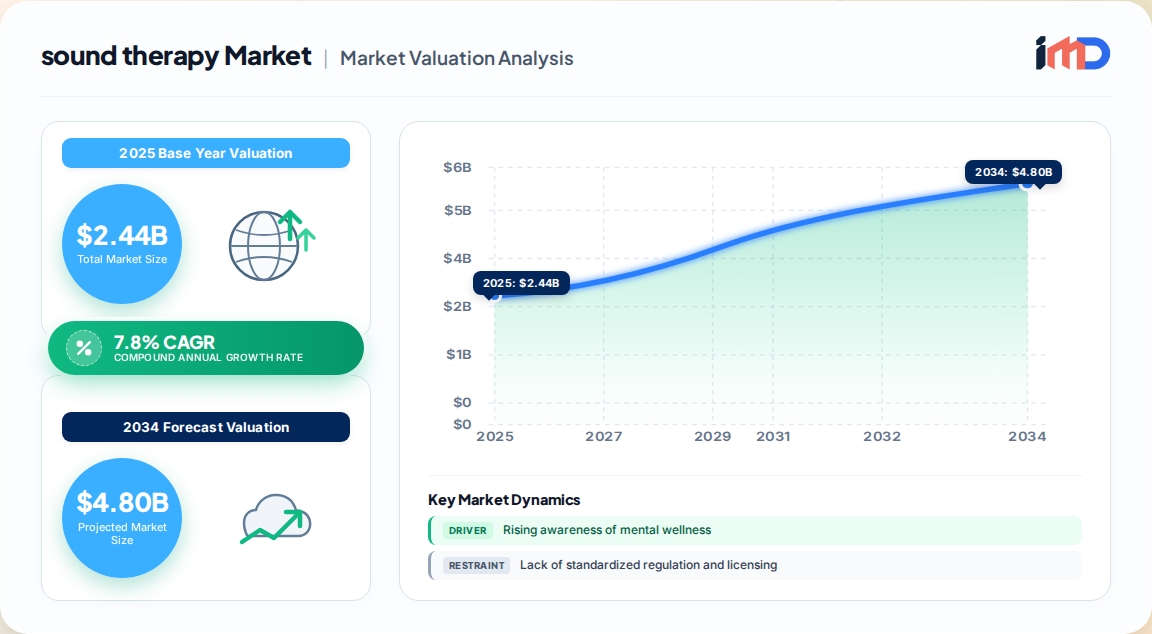
The global sound therapy market is undergoing a structural expansion, transitioning from a niche wellness practice to a mainstream, evidence-informed therapeutic modality. Our proprietary primary research estimates the market at USD 2.44 billion in 2025, on a trajectory to reach USD 5.17 billion by 2035, representing a robust CAGR of 7.8% over the forecast period. This growth is not merely a pandemic-era anomaly but a sustained shift in consumer health behavior and clinical practice.
The fundamental driver is the escalating global mental health burden. With the World Health Organization (WHO) reporting that approximately 970 million people globally live with a mental disorder, the demand for non-invasive, accessible, and complementary therapeutic interventions has never been higher. Sound therapy—encompassing guided meditation, neurologic music therapy, binaural beats, and nature soundscapes—is uniquely positioned to address stress, anxiety, and sleep disorders at scale.
North America remains the dominant regional market, commanding a 44.17% share in 2024, generating approximately USD 1.0 billion in revenue. This leadership is underpinned by advanced wellness infrastructure, high consumer awareness, and strong integration of sound therapy into clinical and corporate wellness settings. Europe follows as the second-largest market with a 30% share, valued at approximately USD 0.68 billion in 2024.
The market is propelled by a confluence of demographic, technological, and cultural factors. However, it also faces headwinds that must be navigated strategically.
Drivers:
Restraints:
The sound therapy market is diverse, with distinct segments exhibiting varying growth trajectories. Our analysis synthesizes data across therapy type, application, delivery method, and end user.
By Therapy Type: Guided meditation holds the largest share, favored for its accessibility and immediate relaxation benefits. However, Neurologic Music Therapy (NMT) is the fastest-growing segment, driven by its clinical application in neurorehabilitation, stroke recovery, and autism support. Nature sounds therapy also commands a significant share (36.2% in 2026), leveraging the innate human affinity for natural acoustics.
By Application: Tinnitus and hearing disorders represent the largest application segment, followed closely by emotional and stress relief, which is the fastest-growing application due to the global mental health crisis. Stress and anxiety management alone is projected to account for 39.1% of the market in 2026.
By Delivery Method: In-person therapy sessions dominate with a 40.8% share in 2026, reflecting the enduring value of human connection and guided experience. However, online therapy platforms are rapidly gaining ground, accelerated by tele-health adoption and AI-driven personalization.
By End User: Hospitals and clinics are the primary institutional end users, while home users represent the largest and fastest-growing consumer segment, empowered by digital delivery.
North America leads the market, with the U.S. being the largest contributor, driven by high healthcare expenditure and a robust wellness culture. The region's dominance is expected to persist, though growth will moderate as the market matures.
Europe is the second-largest market, with strong adoption in Germany, the UK, and France, supported by integrative healthcare policies and a growing number of wellness centers.
Asia-Pacific is anticipated to be the fastest-growing region, with a projected 30.2% share of the global market by 2026. Rapid urbanization, rising disposable incomes, and increasing awareness of mental health in countries like China, Japan, and India are fueling this growth. Latin America and the Middle East & Africa, while smaller in absolute terms, present untapped opportunities due to expanding middle classes and cultural acceptance of holistic healing practices.
The sound therapy market is highly fragmented, with a mix of specialized therapy providers, wellness centers, device manufacturers, and digital platform developers. Key players are focusing on strategic collaborations, product innovation, and evidence generation to strengthen their market position.
Recent developments include:
The competitive strategy is shifting towards personalization, data-driven outcomes, and integration with digital health ecosystems.
The sound therapy value chain comprises content creators and therapists, technology platforms and device manufacturers, distribution channels, and end users. Value is increasingly concentrated in the digital platform layer, where AI and data analytics enable personalization and scalable delivery. Content creators (therapists, musicians, sound engineers) provide the therapeutic assets, while device manufacturers (e.g., tuning forks, vibroacoustic beds) supply the physical tools. Distribution occurs through direct-to-consumer apps, healthcare providers, and wellness centers. The integration of these layers is critical for delivering seamless, effective therapy experiences.
Significant opportunities exist in the following white spaces:
The sound therapy market is primarily service-oriented, with a limited physical goods trade component. However, specific product categories such as singing bowls, tuning forks, and vibroacoustic devices are traded internationally. India and Nepal are significant export hubs for Himalayan singing bowls, while China and the U.S. lead in the manufacture of electronic sound therapy devices. Supply chain risks include raw material price volatility (metals for instruments) and logistics disruptions, but these are relatively minor given the market's knowledge-intensive nature. The digital delivery of therapy content is not subject to traditional trade barriers, enabling seamless global distribution.
The sound therapy market is poised for sustained growth, driven by technological innovation, evolving consumer preferences, and increasing clinical validation. By 2035, the market is expected to surpass USD 5.17 billion, with digital platforms and AI-powered personalization at the forefront. Stakeholders should prioritize evidence generation, strategic partnerships, and regulatory engagement to unlock the full potential of this dynamic market.
| Aspects | Details |
|---|---|
| Study Period | 2020-2034 |
| Base Year | 2025 |
| Estimated Year | 2026 |
| Forecast Period | 2026-2034 |
| Historical Period | 2020-2025 |
| Growth Rate | CAGR of 7.8% from 2020-2034 |
| Segmentation |
|
By Application
By Delivery Method
By End User
| By Geography |
|
The global sound therapy market was valued at USD 2.44 billion in 2025 and is projected to reach USD 5.17 billion by 2035, growing at a CAGR of 7.8%.
North America leads the market with a 44.17% share in 2024, generating approximately USD 1.0 billion in revenue, driven by high mental health awareness and advanced wellness infrastructure.
Key drivers include rising mental wellness awareness, technological advancements like AI personalization, growing demand for alternative therapies, and increasing integration of sound therapy in clinical settings.
Neurologic Music Therapy is the fastest-growing type segment, while emotional and stress relief is the fastest-growing application segment due to the global mental health crisis.
Challenges include the lack of standardized regulation and licensing, limited large-scale clinical evidence, and variability in service quality across regions.
Our rigorous research methodology combines multi-layered approaches with comprehensive quality assurance, ensuring precision, accuracy, and reliability in every market analysis.
| Stakeholder Role | Interview Share (%) |
|---|---|
| Chief Wellness Officers | 30% |
| Clinical Directors | 25% |
| Product Managers | 25% |
| Procurement Heads | 20% |
| Company Type | Representation (%) |
|---|---|
| Sound Therapy Platform Developers | 30% |
| Wellness Center Operators | 25% |
| Device Manufacturers | 20% |
| Digital Health Content Creators | 15% |
| Clinical Researchers | 10% |