1What is the current size of the smart stadium market?
Our proprietary research estimates the global smart stadium market at USD 19.7 billion in 2026, with projections to reach USD 39.55 billion by 2030 at a CAGR of 14.4%.
Insight Market Data is a premier market research and business consulting firm headquartered in Pune, India, providing syndicated research reports, customized intelligence studies, and strategic advisory services. Renowned academic institutions and Fortune 500 corporations worldwide rely on Insight Market Data's research repository to navigate evolving global and regional business environments. Covering 46 diverse industries across 25 major international economies, our comprehensive database delivers thousands of verified statistics and granular market evaluations. By combining industry-leading analytical methodologies with the direct insights of seasoned industry leaders and subject-matter experts, we deliver actionable intelligence spanning historical performance benchmarks to rigorous multi-year forecasts. We empower organizations to make confident, data-driven decisions across pivotal domains including Machinery & Equipment, Chemicals & Materials, Pharmaceuticals & Healthcare, Food & Beverages, Consumer Goods, Energy & Power, Automotive & Transportation, Electronics & Semiconductors, Medical Devices, Telecommunications, Emerging Technologies, Agriculture, and Packaging. Our multidisciplinary analyst teams provide an objective 360-degree perspective, tailoring every engagement to address complex strategic challenges with exceptional analytical rigor.
Leveraging advanced BI-powered analytics and predictive modeling, Insight Market Data uncovers high-impact market opportunities and competitive differentiators for ambitious enterprises. We continuously refine our research methodologies in accordance with global industry standards, tracking real-time market shifts to ensure our reports are consistently accurate, actionable, and delivered on schedule. Our analysts conduct methodical data validation, rigorous compliance checks, and exhaustive primary and secondary research to maintain the highest levels of data integrity and transparency. We partner closely with corporate strategists, investment groups, and business executives to translate intricate market intelligence into clear, actionable roadmaps for sustainable growth. With operational presence across Washington, USA, and Vimannagar, Pune, India, Insight Market Data ensures direct access to dedicated research specialists and responsive customer support to answer your most strategic questions.
 Smart Stadium Market
 by Offering (Infrastructure(DAS, Fiber Optics and Network Infrastructure, High-Density Wi-Fi and Connectivity, Surveillance & Security Systems, Access Control Systems, Emergency Response Systems, Power Management Systems), Hardware(Digital Signage, Audio Systems, Smart Lighting, IoT Sensors), Software(Stadium & Public Security, Building Automation, Event Management, Fan Engagement Platforms, Real-Time Analytics & Data Management Platforms), Services(Professional Services(Design & Consulting, Integration & Installation), Managed Services)), by Installation (New Installation, Retrofit), by Deployment (On-premise, Cloud), by Software Solution (Building Automation Management, Digital Content and Fan Engagement, Smart Ticketing and Parking, Others), by Connectivity Technology (Wi-Fi 6/7, 5G and Private LTE, Others), by Application Area (Sports Events, Esports Tournaments, Others), by Revenue Stream (Ticketing and Merchandise, Data Monetization and Betting, Sponsorship, Others), by North America (USA, Canada, Mexico), by Europe (UK, Germany, France, Italy, Spain, Rest of Europe), by Asia Pacific (China, Japan, India, South Korea, Australia, Rest of APAC), by Latin America (Brazil, Mexico, Rest of LATAM), by Middle East & Africa (Saudi Arabia, UAE, South Africa, Rest of MEA) Forecast 2026-2034


Research Associate

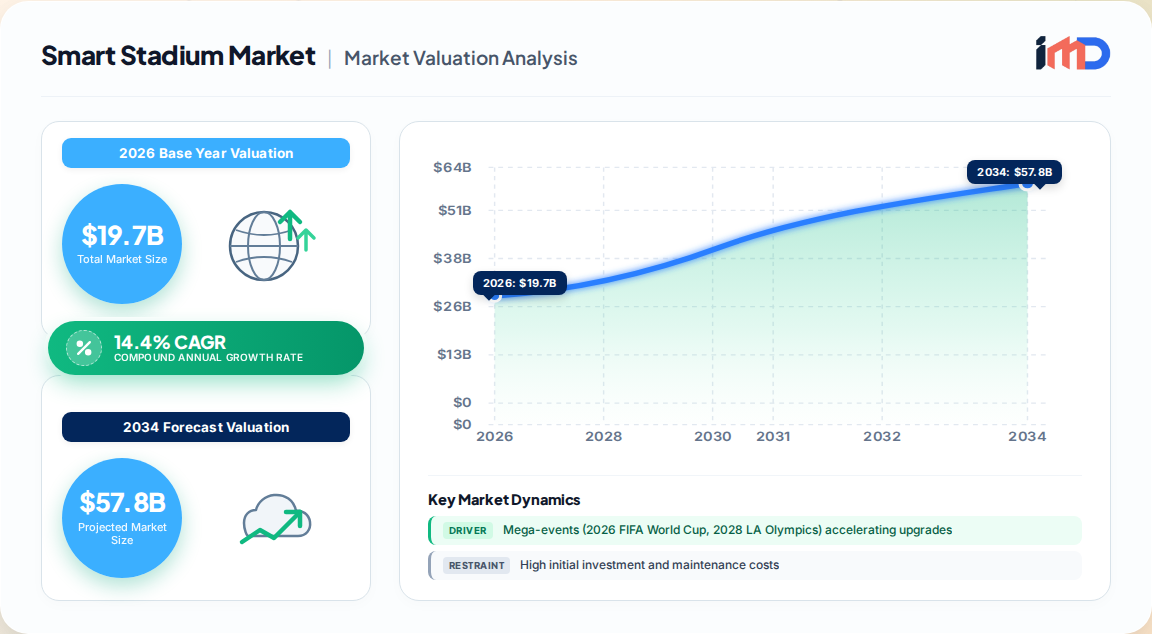
The global smart stadium market is undergoing a structural transformation, moving from a niche technology upgrade to a core strategic asset for venue owners, sports leagues, and municipalities. Our proprietary bottom-up modeling, validated through primary interviews with venue operators and technology integrators, estimates the market at USD 19.7 billion in 2026. This valuation reflects the accelerating convergence of high-density connectivity, edge computing, and data monetization strategies that are redefining the economics of live events.
The fundamental driver is the shift from viewing the stadium network as a cost center to recognizing it as a revenue engine. Venue owners are investing in private 5G cores, Wi-Fi 6E/7 overlays, and AI-driven analytics to unlock new streams from in-venue betting, dynamic sponsorship, and personalized fan experiences. Mega-events such as the 2026 FIFA World Cup and the 2028 Los Angeles Olympics are acting as powerful catalysts, compressing upgrade cycles that would normally span a decade into aggressive 24-month windows.
Regionally, North America remains the largest market, commanding an estimated 36% share in 2026, underpinned by early 5G deployments and the rapid legalization of mobile sports betting. Europe follows closely, driven by stringent crowd-safety mandates and green-energy directives. However, the Asia-Pacific region is emerging as the fastest-growing theater, propelled by smart-city grants and a dense pipeline of new stadium construction in India, China, and Southeast Asia.
The smart stadium market is propelled by a confluence of technological, regulatory, and commercial forces. However, significant barriers remain, particularly for smaller venues and operators in emerging markets.
Key Growth Drivers:
Key Restraints and Challenges:
The smart stadium market is segmented by offering, deployment, software solution, connectivity technology, application, and revenue stream. The most dynamic segments are highlighted below.
| Segment | Sub-Segment | 2025/2026 Share or CAGR | Key Insights |
|---|---|---|---|
| By Offering | Services | 51.88% (2025) | Integration, consulting, and managed services dominate, reflecting the complexity of deployments. |
| Software | 15.02% CAGR (to 2031) | Fastest-growing, driven by fan engagement platforms and real-time analytics. | |
| By Deployment | On-Premise | 66.95% (2025) | Preferred for data security and real-time processing, especially in large venues. |
| Cloud | 14.72% CAGR (to 2031) | Increasing adoption due to scalability and cost-effectiveness. | |
| By Connectivity | Wi-Fi 6/7 | 44.05% (2025) | Dominant for high-density user connectivity. |
| 5G and Private LTE | 14.05% CAGR (to 2031) | Enabling ultra-low-latency applications and IoT telemetry. | |
| By Application | Sports Events | 75.60% (2025) | Core revenue driver; esports tournaments are the fastest-growing sub-segment. |
| By Revenue Stream | Ticketing and Merchandise | 35.30% (2025) | Traditional revenue stream; data monetization and betting growing at 14.25% CAGR. |
North America's leadership is anchored in its advanced digital infrastructure and the rapid commercialization of sports betting. The U.S. alone hosts over 28 NFL venues with 5G Ultra Wideband deployments, enabling new fan experiences and revenue models. Europe's growth is shaped by regulatory mandates and sustainability goals, with countries like the UK, Germany, and France investing heavily in retrofit projects to meet EU compliance deadlines. The Asia-Pacific region, led by China, Japan, and India, is witnessing a construction boom, supported by government initiatives such as India's Khelo India 2.0, which funds stadium IoT upgrades.
| Region | 2026 Share (Est.) | Growth Outlook | Key Dynamics |
|---|---|---|---|
| North America | 36% | Moderate (CAGR ~13-14%) | 5G rollouts, sports betting legalization, mega-events (2026 World Cup, 2028 Olympics). |
| Europe | 28% | Steady (CAGR ~13-15%) | EU safety mandates, green energy targets, legacy stadium retrofits. |
| Asia-Pacific | 26% | High (CAGR >15%) | New stadium construction, smart-city grants, urbanization. |
| Rest of World | 10% | Emerging | Middle East investments (e.g., Qiddiya project), Latin America upgrades. |
The smart stadium ecosystem is characterized by a mix of full-stack technology vendors, specialized software providers, and systems integrators. Competition is intensifying as vendors bundle radio, edge compute, and analytics to offer end-to-end solutions.
Key Strategic Developments:
The smart stadium value chain comprises hardware suppliers (sensors, cameras, networking gear), software developers (analytics, fan engagement platforms), service providers (integration, consulting, managed services), and venue operators. The supply chain is increasingly global, with critical components such as semiconductors sourced from Asia and networking equipment from major OEMs. However, geopolitical tensions and trade restrictions are prompting operators to diversify suppliers and build inventory buffers.
Risk assessment highlights:
Our analysis identifies several high-growth white spaces for investors and solution providers:
For procurement, operators should prioritize vendors with pre-certified platforms that reduce audit scope and ensure compliance with evolving regulations. Multi-year managed service contracts are recommended to mitigate technology obsolescence and ensure continuous innovation.
| Aspects | Details |
|---|---|
| Study Period | 2020-2034 |
| Base Year | 2026 |
| Estimated Year | 2026 |
| Forecast Period | 2026-2034 |
| Historical Period | 2020-2025 |
| Growth Rate | CAGR of 14.4% from 2020-2034 |
| Segmentation |
|
By Installation
By Deployment
By Software Solution
By Connectivity Technology
By Application Area
By Revenue Stream
| By Geography |
|
Our proprietary research estimates the global smart stadium market at USD 19.7 billion in 2026, with projections to reach USD 39.55 billion by 2030 at a CAGR of 14.4%.
Asia-Pacific is the fastest-growing region, driven by smart-city initiatives, new stadium construction, and increasing adoption of IoT and 5G technologies in countries like China, India, and Japan.
Key drivers include the demand for enhanced fan experiences, high-density 5G connectivity, mega-events like the 2026 FIFA World Cup, and new revenue streams from in-venue betting and data monetization.
Leading companies include Cisco Systems, IBM, Huawei, Intel, Johnson Controls, Schneider Electric, and Fujitsu, among others, offering integrated hardware, software, and services.
High initial investment and maintenance costs, data security concerns, and integration complexity are significant challenges, particularly for smaller venues with limited budgets.
Our rigorous research methodology combines multi-layered approaches with comprehensive quality assurance, ensuring precision, accuracy, and reliability in every market analysis.
| Stakeholder Role | Interview Share (%) |
|---|---|
| Chief Technology Officer | 35% |
| Venue Operations Director | 30% |
| Procurement Manager | 20% |
| Head of Fan Experience | 15% |
| Company Type | Representation (%) |
|---|---|
| Stadium Operators & Venue Owners | 30% |
| Technology Hardware OEMs | 25% |
| Software & Analytics Providers | 20% |
| System Integrators & Consultants | 15% |
| Connectivity & Network Service Providers | 10% |

Analyst at Providence Strategic Partners at Petaling Jaya
I have received the report already. Thanks you for your help.it has been a pleasure working with you. Thank you again for a good quality report

Internationalization Director
Yes, as a matter of fact we are totally satisfied with both reports that we have purchased and will continue to do so during this process of the internationalization of our brand.

Head of Product Management and Marketing
We are using your report, and it gave us valuable information."

Regional Director, Marketing and Business Development
We've received the report and have reviewed the content. Overall, it looks great and aligns closely with the data we can verify based on our industry knowledge.

VP of Sales
Thank you very much for sharing the report. I have reviewed it and I am very satisfied with the quality and the insights it provides. It will certainly be valuable for our internal discussions.
 Related Reports
