1What is the current size of the small launch vehicle market?
The global small launch vehicle market was valued at USD 1.71 billion in 2025 and is projected to reach USD 1.94 billion in 2026, growing at a CAGR of 13.5% to USD 5.35 billion by 2034.
Insight Market Data is a premier market research and business consulting firm headquartered in Pune, India, providing syndicated research reports, customized intelligence studies, and strategic advisory services. Renowned academic institutions and Fortune 500 corporations worldwide rely on Insight Market Data's research repository to navigate evolving global and regional business environments. Covering 46 diverse industries across 25 major international economies, our comprehensive database delivers thousands of verified statistics and granular market evaluations. By combining industry-leading analytical methodologies with the direct insights of seasoned industry leaders and subject-matter experts, we deliver actionable intelligence spanning historical performance benchmarks to rigorous multi-year forecasts. We empower organizations to make confident, data-driven decisions across pivotal domains including Machinery & Equipment, Chemicals & Materials, Pharmaceuticals & Healthcare, Food & Beverages, Consumer Goods, Energy & Power, Automotive & Transportation, Electronics & Semiconductors, Medical Devices, Telecommunications, Emerging Technologies, Agriculture, and Packaging. Our multidisciplinary analyst teams provide an objective 360-degree perspective, tailoring every engagement to address complex strategic challenges with exceptional analytical rigor.
Leveraging advanced BI-powered analytics and predictive modeling, Insight Market Data uncovers high-impact market opportunities and competitive differentiators for ambitious enterprises. We continuously refine our research methodologies in accordance with global industry standards, tracking real-time market shifts to ensure our reports are consistently accurate, actionable, and delivered on schedule. Our analysts conduct methodical data validation, rigorous compliance checks, and exhaustive primary and secondary research to maintain the highest levels of data integrity and transparency. We partner closely with corporate strategists, investment groups, and business executives to translate intricate market intelligence into clear, actionable roadmaps for sustainable growth. With operational presence across Washington, USA, and Vimannagar, Pune, India, Insight Market Data ensures direct access to dedicated research specialists and responsive customer support to answer your most strategic questions.
 Small Launch Vehicle Market
 by Payload Capacity (Up to 500 kg, 501–2, 000 kg, 2, 001–5, 000 kg, Above 5, 000 kg), by Orbit (Low Earth Orbit (LEO), Sun-Synchronous Orbit (SSO), Medium Earth Orbit (MEO), Geostationary Transfer Orbit (GTO)), by End User (Commercial, Government & Defense, Research & Academic Institutions, Space Agencies), by Launch Platform (Ground Launch, Air Launch, Sea Launch, Mobile Launch Platforms), by Propulsion (Solid, Liquid, Hybrid), by North America (USA, Canada, Mexico), by Europe (Germany, UK, France, Italy, Spain, Rest of Europe), by Asia Pacific (China, Japan, India, South Korea, Australia, Rest of Asia Pacific), by South America (Brazil, Argentina, Rest of South America), by Middle East & Africa (UAE, Saudi Arabia, South Africa, Rest of MEA) Forecast 2026-2034

Research Associate


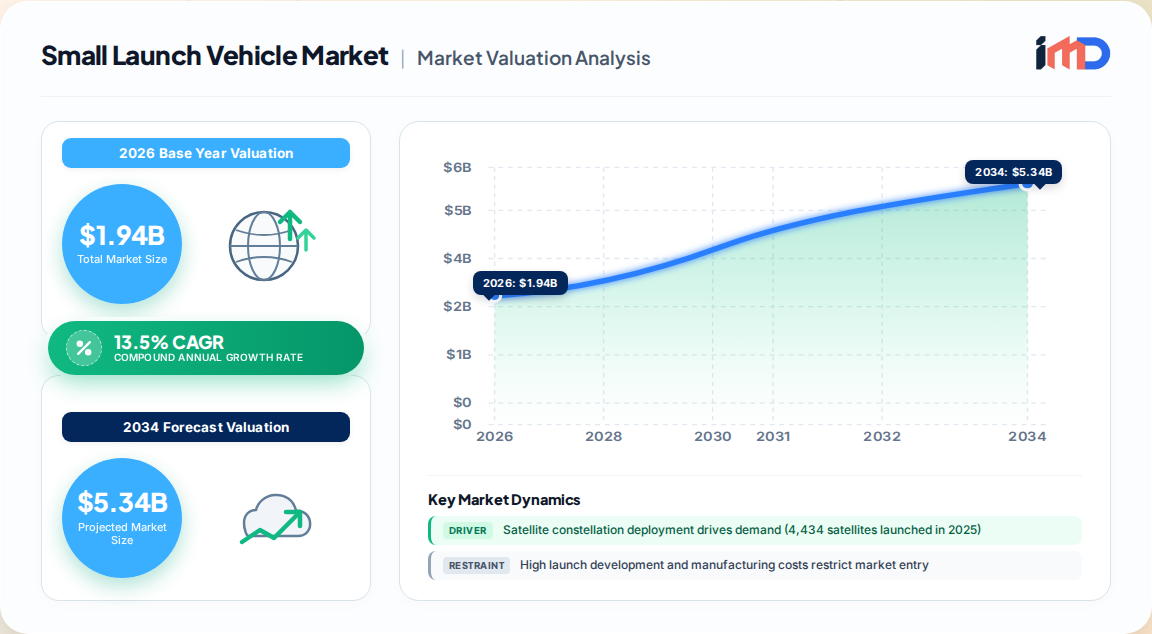
Global Small Launch Vehicle Market valuation stands at USD 1.94 Billion in 2026, projected to reach USD 5.35 Billion by 2034, registering a CAGR of 13.5% (2026–2034). Asia Pacific leads with 39.4% share (2025), while North America is the fastest-growing region at 15.26% CAGR. This trajectory is underpinned by a structural shift from rideshare to mission-specific dedicated launch services.
The market is no longer defined by undifferentiated transport capacity but by orbital insertion precision, cadence reliability, and specialized mission assurance.
| Stage | Key Activities | Representative Participants |
|---|---|---|
| R&D & Design | Propulsion, avionics, structural design | In-house engineering teams, specialized R&D firms |
| Component Manufacturing | Engines, tanks, composites, flight computers | Tier-2/3 aerospace suppliers |
| Vehicle Integration & Testing | Assembly, qualification, acceptance testing | Launch vehicle OEMs |
| Launch Services | Mission management, range operations, payload integration | Launch service providers |
| Downstream Demand | Satellite operators, defense agencies, research institutions | Commercial, government, academic end users |
Key Insight: Vertical integration is a strategic differentiator – operators controlling engine manufacturing and launch infrastructure achieve higher cadence and cost efficiency.
| Region | 2025 Share | Growth Outlook (CAGR) | Attractiveness Drivers |
|---|---|---|---|
| Asia Pacific | 39.4% | 13.0% (est.) | State-backed launch programs (CNSA, ISRO), high satellite launch volume, cost-competitive manufacturing |
| North America | 28.0% (est.) | 15.26% | Commercial constellation demand, defense procurement (STEP 2.0), private investment |
| Europe | 16.0% (est.) | 11.5% (est.) | Institutional programs (ESA, Avio/Vega-C), emerging startups |
| Middle East & Africa | 10.0% (est.) | 12.0% (est.) | Growing space ambitions, government funding, launch site advantages |
| South America | 6.6% (est.) | 10.5% (est.) | Emerging interest, potential launch site locations (e.g., Alcântara) |
Investment White-Space: Sea-launch infrastructure, reusable first-stage technology, and dedicated smallsat mission management platforms offer highest ROI potential.
The market is highly concentrated: Rocket Lab USA leads with 42.2% market share (2025); the top five players (Rocket Lab, Chinese operators, Avio/Vega-C, Firefly Aerospace, ISRO/NSIL) collectively hold 99.1%. This concentration reflects the criticality of flight heritage and reliability.
Strategic White-Space Opportunities:
The small launch vehicle market is not a conventional traded commodity; however, supply chain dynamics are critical:
Risk Assessment: Geopolitical tensions and export controls may constrain technology transfer, favoring domestic supply chains in the U.S., Europe, and China.
Strategic Recommendation: Invest in supplier qualification programs and secure long-term agreements for critical components to mitigate supply chain risks.
| Existing Markets | New Markets | |
|---|---|---|
| Existing Products | Market Penetration: Increase launch cadence and reliability for current smallsat operators | Market Development: Expand into emerging regions (Middle East, South America) and defense segments |
| New Products | Product Development: Reusable small launch vehicles, sea launch platforms, dedicated rideshare services | Diversification: In-space transportation, orbital servicing, and hypersonic testbeds |
Key Takeaway: Highest growth potential lies in product development (reusability) and market development (new geographies and defense customers).
The small launch vehicle market is poised for robust growth, driven by constellation deployment, defense modernization, and technological innovation. However, reliability, cost, and regulatory hurdles will separate winners from laggards. Providers that achieve operational excellence, secure government anchors, and innovate in reusability will capture disproportionate value. Our proprietary modeling indicates a 13.5% CAGR through 2034, with Asia Pacific retaining dominance and North America accelerating.
| Aspects | Details |
|---|---|
| Study Period | 2020-2034 |
| Base Year | 2026 |
| Estimated Year | 2026 |
| Forecast Period | 2026-2034 |
| Historical Period | 2020-2025 |
| Growth Rate | CAGR of 13.5% from 2020-2034 |
| Segmentation |
|

Analyst at Providence Strategic Partners at Petaling Jaya
I have received the report already. Thanks you for your help.it has been a pleasure working with you. Thank you again for a good quality report

Internationalization Director
Yes, as a matter of fact we are totally satisfied with both reports that we have purchased and will continue to do so during this process of the internationalization of our brand.

Head of Product Management and Marketing
We are using your report, and it gave us valuable information."

Regional Director, Marketing and Business Development
We've received the report and have reviewed the content. Overall, it looks great and aligns closely with the data we can verify based on our industry knowledge.

VP of Sales
Thank you very much for sharing the report. I have reviewed it and I am very satisfied with the quality and the insights it provides. It will certainly be valuable for our internal discussions.
By Orbit
By End User
By Launch Platform
By Propulsion
| By Geography |
|
The global small launch vehicle market was valued at USD 1.71 billion in 2025 and is projected to reach USD 1.94 billion in 2026, growing at a CAGR of 13.5% to USD 5.35 billion by 2034.
Asia Pacific held the largest share of 39.4% in 2025, driven by high satellite launch volumes and state-backed programs like CNSA and ISRO. North America is the fastest-growing region at 15.26% CAGR.
Key drivers include satellite constellation deployment (4,434 satellites launched in 2025), defense and national security programs (e.g., USSF's USD 237 million STEP 2.0 contract), and growing university and research satellite programs.
Rocket Lab USA leads with 42.2% market share in 2025, followed by Chinese operators, Avio/Vega-C, Firefly Aerospace, and ISRO/NewSpace India Limited, which collectively hold 99.1% of the market.
High development and manufacturing costs, limited payload capacity, stringent regulatory requirements, and reliability risks (e.g., flight anomalies) are key challenges. Rideshare competition also constrains per-mission yield.
Sea launch is the fastest-growing segment, projected to grow at a CAGR of 14.37% from 2026 to 2034, offering flexibility and equatorial launch advantages.
Our rigorous research methodology combines multi-layered approaches with comprehensive quality assurance, ensuring precision, accuracy, and reliability in every market analysis.
| Stakeholder Role | Interview Share (%) |
|---|---|
| Chief Technology Officer (CTO) | 30% |
| Mission Director | 25% |
| Procurement Manager | 25% |
| Space Systems Engineer | 20% |
| Company Type | Representation (%) |
|---|---|
| Launch Vehicle OEMs | 35% |
| Propulsion System Manufacturers | 20% |
| Satellite Constellation Operators | 20% |
| Government & Defense Agencies | 15% |
| Launch Infrastructure Providers | 10% |
 Related Reports
