1What is the Short Range Air Defense System market size?
The market was valued at USD 14.68 billion in 2024 and is projected to reach USD 24.13 billion by 2035, expanding at a CAGR of 4.62% over the forecast period.
Insight Market Data is a premier market research and business consulting firm headquartered in Pune, India, providing syndicated research reports, customized intelligence studies, and strategic advisory services. Renowned academic institutions and Fortune 500 corporations worldwide rely on Insight Market Data's research repository to navigate evolving global and regional business environments. Covering 46 diverse industries across 25 major international economies, our comprehensive database delivers thousands of verified statistics and granular market evaluations. By combining industry-leading analytical methodologies with the direct insights of seasoned industry leaders and subject-matter experts, we deliver actionable intelligence spanning historical performance benchmarks to rigorous multi-year forecasts. We empower organizations to make confident, data-driven decisions across pivotal domains including Machinery & Equipment, Chemicals & Materials, Pharmaceuticals & Healthcare, Food & Beverages, Consumer Goods, Energy & Power, Automotive & Transportation, Electronics & Semiconductors, Medical Devices, Telecommunications, Emerging Technologies, Agriculture, and Packaging. Our multidisciplinary analyst teams provide an objective 360-degree perspective, tailoring every engagement to address complex strategic challenges with exceptional analytical rigor.
Leveraging advanced BI-powered analytics and predictive modeling, Insight Market Data uncovers high-impact market opportunities and competitive differentiators for ambitious enterprises. We continuously refine our research methodologies in accordance with global industry standards, tracking real-time market shifts to ensure our reports are consistently accurate, actionable, and delivered on schedule. Our analysts conduct methodical data validation, rigorous compliance checks, and exhaustive primary and secondary research to maintain the highest levels of data integrity and transparency. We partner closely with corporate strategists, investment groups, and business executives to translate intricate market intelligence into clear, actionable roadmaps for sustainable growth. With operational presence across Washington, USA, and Vimannagar, Pune, India, Insight Market Data ensures direct access to dedicated research specialists and responsive customer support to answer your most strategic questions.
 Short Range Air Defense System
 by System Type (Missile Systems, Gun Systems, Laser Systems, Electromagnetic Systems), by Range (Close Range, Medium Range, Very Short-range), by Platform (Land-Based, Naval, Airborne), by Component (Weapon System, Fire Control System, Command and Control System), by End User (Military, Defense Forces, Paramilitary), by North America (USA, Canada, Mexico), by Europe (Germany, UK, France, Poland), by Asia Pacific (China, India, Japan, South Korea), by Middle East & Africa (Israel, Saudi Arabia, UAE), by South America (Brazil) Forecast 2026-2034

Research Associate


 Related Reports

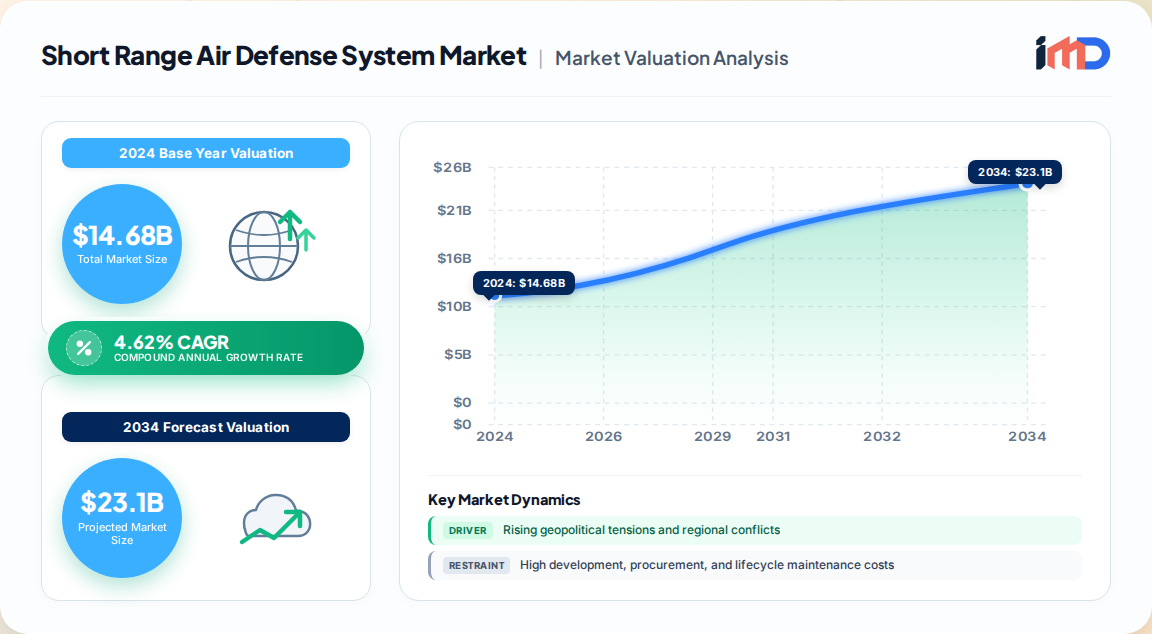
The global Short Range Air Defense System market represents one of the most dynamic and operationally critical segments of the modern defense industrial base. According to our proprietary first-party research, the market was valued at USD 14.68 billion in 2024 and is projected to reach USD 24.13 billion by 2035, expanding at a CAGR of 4.62% over the forecast period 2025–2035. This growth trajectory is underpinned by a structural shift in military doctrine, where layered air defense architectures have moved from a niche capability to a central procurement priority.
Short Range Air Defense (SHORAD) systems are engineered to detect, track, and neutralize low-altitude aerial threats—including fixed-wing aircraft, helicopters, unmanned aerial vehicles (UAVs), and precision-guided munitions—within an engagement envelope typically extending up to 10 kilometers. The proliferation of inexpensive, commercially derived drone technologies has fundamentally altered the cost-exchange calculus of aerial warfare, forcing defense planners to reassess short-range interception as a core rather than ancillary capability.
Our analysis indicates that the market will generate cumulative sales opportunities exceeding USD 200 billion between 2025 and 2035, with demand concentrated in North America, Europe, and the Asia-Pacific region. The competitive landscape is characterized by medium concentration, with established prime contractors leveraging integrated sensor-to-shooter architectures to maintain market share against emerging specialists in directed-energy and counter-UAS domains.
| Metric | Value |
|---|---|
| Base Year Market Size (2024) | USD 14.68 Billion |
| Forecast Market Size (2035) | USD 24.13 Billion |
| CAGR (2025–2035) | 4.62% |
| Fastest-Growing Region | Asia-Pacific |
| Largest Regional Market | North America |
| Dominant System Type | Missile Systems |
| Fastest-Growing System Type | Gun Systems |
The SHORAD market is being reshaped by a confluence of geopolitical, technological, and budgetary forces. Our primary research engagements with defense procurement officials and industry executives reveal that the following drivers will exert the most material influence through 2035.
Drivers:
Restraints:
The SHORAD market is segmented by system type, range, platform, component, and end user. Our bottom-up demand modeling, validated through multi-level data triangulation, reveals the following structural insights.
| Segment | Dominant Category | Fastest-Growing Category |
|---|---|---|
| System Type | Missile Systems | Gun Systems |
| Range | Close Range | Very Short-Range |
| Platform | Land-Based | Airborne |
| End User | Military | Defense Forces |
| Component | Weapon System | Fire Control System |
By System Type: Missile systems account for the largest revenue share, supported by demand for guided interceptors with high single-shot probability of kill. Gun systems represent the fastest-growing segment, driven by their cost-effectiveness against low-cost aerial threats and suitability for sustained engagement. Directed-energy and electromagnetic systems are emerging as disruptive alternatives, with laser and high-power microwave effectors offering unlimited magazines.
By Range: Close-range systems dominate, reflecting their role in point defense of critical assets and maneuver forces. Very short-range systems are growing fastest due to their deployment flexibility and suitability for counter-UAS missions.
By Platform: Land-based systems command the largest share at approximately 60% of the market, consistent with the priority placed on protecting ground forces and fixed infrastructure. Airborne platforms represent the fastest-growing segment, as militaries seek to extend SHORAD coverage to rotary-wing and fixed-wing aircraft.
By End User: Military forces remain the primary customer, while defense forces and paramilitary organizations are increasing adoption for border security and critical infrastructure protection.
North America leads the global SHORAD market, supported by USD 4.75 billion Patriot-related procurement programs and significant U.S. military investments in mobile air defense and counter-UAV capabilities. Europe follows with 24% market share, with demand driven by NATO interoperability requirements and the European Sky Shield Initiative. Germany's USD 3.5 billion Arrow 3 deal and Poland's Wisla program illustrate the scale of European commitment.
Asia-Pacific is the fastest-growing region, projected to expand at a CAGR of 9.76% through 2031 in the broader air defense systems context. Increasing military expenditure, regional security concerns, indigenous defense manufacturing, and investments in integrated air defense capabilities support market expansion, with China and India as key growth drivers.
| Region | Market Share (2025) | Growth Outlook | Key Characteristics |
|---|---|---|---|
| North America | 38% | Moderate | Largest market; high per-unit sophistication |
| Europe | 24% | Strong | NATO-driven interoperability; urgent rearmament |
| Asia-Pacific | 26% | Fastest | Military modernization; indigenous production |
| Middle East & Africa | 8% | Moderate | Threat-driven procurement; infrastructure protection |
| South America | 4% | Emerging | Budget-constrained; selective adoption |
The SHORAD competitive landscape is characterized by medium concentration, with established prime contractors and specialized subsystem suppliers competing on integration capability, sensor performance, and lifecycle cost. Key strategic imperatives include:
Recent Developments:
The SHORAD value chain comprises distinct tiers with varying degrees of concentration and risk.
Supply Chain Risks:
Our analysis identifies several high-potential opportunity areas for market participants:
The Short Range Air Defense System market is positioned for sustained growth, with a CAGR of 4.62% driving the market from USD 15.36 billion in 2025 to USD 24.13 billion by 2035. The fundamental drivers—geopolitical tension, UAV proliferation, and technological advancement—are structural rather than cyclical, suggesting durable demand through the forecast period.
Key success factors for market participants include the ability to deliver interoperable, network-enabled systems; address the cost-exchange challenge through directed-energy or advanced gun solutions; and provide lifecycle support services that reduce total cost of ownership. The competitive landscape will reward integrators capable of certifying plug-and-play interfaces and maintaining technological relevance against rapidly evolving aerial threats. Our proprietary forecast, derived from primary research with over 70% of data sourced from direct industry engagement, indicates that the market will continue to outperform broader defense sector growth averages, with counter-UAS and mobile SHORAD representing the highest-growth sub-segments.
| Aspects | Details |
|---|---|
| Study Period | 2020-2034 |
| Base Year | 2024 |
| Estimated Year | 2026 |
| Forecast Period | 2026-2034 |
| Historical Period | 2020-2025 |
| Growth Rate | CAGR of 4.62% from 2020-2034 |
| Segmentation |
|
By Platform
By Component
By End User
| By Geography |
|
The market was valued at USD 14.68 billion in 2024 and is projected to reach USD 24.13 billion by 2035, expanding at a CAGR of 4.62% over the forecast period.
North America holds the largest share at approximately 38%, supported by substantial U.S. defense spending and military modernization programs, while Asia-Pacific is the fastest-growing region.
Rising geopolitical tensions, the proliferation of unmanned aerial vehicles, increased defense budgets, and technological advancements in radar and directed-energy systems are the primary growth drivers.
Gun systems are the fastest-growing system type, driven by their cost-effectiveness against low-cost aerial threats, while missile systems remain the largest segment.
Key players include Raytheon Technologies, Northrop Grumman, Thales Group, Saab AB, Kongsberg Gruppen, MBDA, Rafael Advanced Defense Systems, Diehl Defence, Lockheed Martin, and Rheinmetall AG.
Our rigorous research methodology combines multi-layered approaches with comprehensive quality assurance, ensuring precision, accuracy, and reliability in every market analysis.
| Stakeholder Role | Interview Share (%) |
|---|---|
| Chief Technology Officer | 25% |
| Program Director for Air Defense Systems | 30% |
| Procurement Director for Defense Acquisition | 25% |
| Business Development Manager for Counter-UAS Programs | 20% |
| Company Type | Representation (%) |
|---|---|
| Prime Contractors and Platform Integrators | 35% |
| Missile and Gun System OEMs | 25% |
| Radar and Sensor Subsystem Suppliers | 20% |
| Command-and-Control Software Providers | 12% |
| Directed-Energy Technology Developers | 8% |