1What is the size of the Saudi Arabia contract logistics market?
Our proprietary research estimates the Saudi Arabia contract logistics market at USD 1.27 billion in 2026, projected to reach USD 1.51 billion by 2031.
Insight Market Data is a premier market research and business consulting firm headquartered in Pune, India, providing syndicated research reports, customized intelligence studies, and strategic advisory services. Renowned academic institutions and Fortune 500 corporations worldwide rely on Insight Market Data's research repository to navigate evolving global and regional business environments. Covering 46 diverse industries across 25 major international economies, our comprehensive database delivers thousands of verified statistics and granular market evaluations. By combining industry-leading analytical methodologies with the direct insights of seasoned industry leaders and subject-matter experts, we deliver actionable intelligence spanning historical performance benchmarks to rigorous multi-year forecasts. We empower organizations to make confident, data-driven decisions across pivotal domains including Machinery & Equipment, Chemicals & Materials, Pharmaceuticals & Healthcare, Food & Beverages, Consumer Goods, Energy & Power, Automotive & Transportation, Electronics & Semiconductors, Medical Devices, Telecommunications, Emerging Technologies, Agriculture, and Packaging. Our multidisciplinary analyst teams provide an objective 360-degree perspective, tailoring every engagement to address complex strategic challenges with exceptional analytical rigor.
Leveraging advanced BI-powered analytics and predictive modeling, Insight Market Data uncovers high-impact market opportunities and competitive differentiators for ambitious enterprises. We continuously refine our research methodologies in accordance with global industry standards, tracking real-time market shifts to ensure our reports are consistently accurate, actionable, and delivered on schedule. Our analysts conduct methodical data validation, rigorous compliance checks, and exhaustive primary and secondary research to maintain the highest levels of data integrity and transparency. We partner closely with corporate strategists, investment groups, and business executives to translate intricate market intelligence into clear, actionable roadmaps for sustainable growth. With operational presence across Washington, USA, and Vimannagar, Pune, India, Insight Market Data ensures direct access to dedicated research specialists and responsive customer support to answer your most strategic questions.
 Saudi Arabia Contract Logistics Market
 by Service Type (Transportation, Warehousing & Distribution, Value-Added Services), by Contract Duration (1-3 Years, Above 3 Years), by End-User Industry (Manufacturing & Automotive, Food & Beverage, Retail & E-Commerce, Healthcare & Pharmaceuticals, Chemicals, Other Industries), by Northern and Central Region, by Western Region, by Eastern Region, by Southern Region Forecast 2026-2034

Research Associate


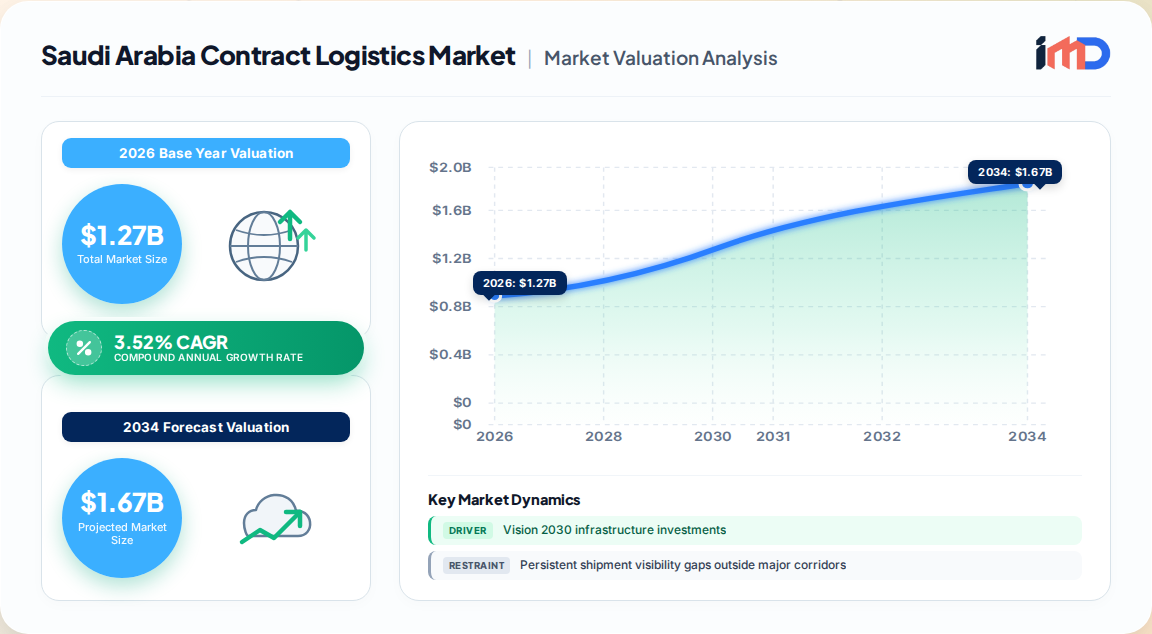
The Saudi Arabia contract logistics market represents a critical enabler of the Kingdom's economic transformation, with our proprietary research valuing the market at USD 1.23 billion in 2025 and estimating USD 1.27 billion in 2026. This sector is projected to expand to USD 1.51 billion by 2031, registering a steady CAGR of 3.52% over the forecast period. This growth is not merely incremental; it is structural, underpinned by the national ambition to elevate the transport and logistics sector's GDP contribution from 6% to 10% by 2030.
While the broader Saudi logistics market (including in-house operations) exceeds USD 57 billion, the contract logistics segment—focused on outsourced, integrated supply chain solutions—is entering a phase of accelerated maturity. The market is transitioning from traditional asset-based models to sophisticated, technology-driven orchestration. This evolution is characterized by a low market concentration, where a mix of global integrators, regional champions, and emerging local specialists compete for share in a rapidly modernizing landscape.
| Metric | Value |
|---|---|
| Base Year Market Size (2025) | USD 1.23 Billion |
| Forecast Market Size (2026) | USD 1.27 Billion |
| Forecast Market Size (2031) | USD 1.51 Billion |
| CAGR (2026–2031) | 3.52% |
| Largest Service Segment (2025) | Transportation (64.30%) |
| Fastest Growing End-User | Healthcare & Pharmaceuticals (4.12% CAGR) |
| Dominant Contract Type | Long-term (>3 years, 55.40%) |
The trajectory of the Saudi contract logistics market is shaped by a confluence of mega-trends and structural friction points. Our analysis quantifies the impact of each driver and restraint on the forecast CAGR, providing a clear picture of the market's underlying mechanics.
Key Growth Drivers:
Primary Restraints:
Understanding the contract logistics market requires granular analysis of its service components, contractual structures, and vertical demand drivers.
By Service Type: Transportation services remain the backbone of the market, commanding a 64.30% share in 2025. This dominance is anchored by the Kingdom's 73,000-kilometer highway network, which facilitates the movement of goods along the Riyadh–Dammam–Jeddah corridor. However, value-added services (VAS) such as kitting, labeling, and postponement are gaining traction as clients seek leaner inventories. Warehousing and distribution, while essential, face capacity constraints in prime urban centers, pushing rental rates upward. Our data indicates VAS is growing at a 3.05% CAGR, signaling a shift toward higher-margin, customized solutions.
By Contract Duration: The market exhibits a clear preference for long-term partnerships, with agreements exceeding three years accounting for 55.40% of the market in 2025. These contracts are projected to grow at a 3.72% CAGR through 2031. This trend reflects shippers' desire for supply chain continuity and the need for providers to amortize investments in automation and fleet technology over longer horizons. Short-term contracts (1–3 years) are more prevalent in seasonal or project-based segments.
By End-User Industry: Retail and e-commerce constitute the largest demand vertical, representing 26.60% of the market in 2025. This is driven by the proliferation of online marketplaces and changing consumer expectations for same-day or next-day delivery. Healthcare and pharmaceuticals represent the fastest-growing vertical, forecast to expand at a 4.12% CAGR, necessitating specialized cold-chain and regulatory-compliant logistics solutions. Manufacturing and automotive remain significant, particularly in industrial zones like KAEC and Jubail, while chemicals and F&B offer stable, volume-driven demand.
| Service Type | 2025 Share | Forecast CAGR (2026–2031) |
|---|---|---|
| Transportation | 64.30% | ~3.6% |
| Warehousing & Distribution | ~30% | ~3.3% |
| Value-Added Services | ~6% | 3.05% |
| End-User Industry | 2025 Share | Forecast CAGR (2026–2031) |
|---|---|---|
| Retail & E-commerce | 26.60% | ~3.8% |
| Manufacturing & Automotive | ~22% | ~3.5% |
| Food & Beverage | ~18% | ~3.4% |
| Healthcare & Pharmaceuticals | ~12% | 4.12% |
Geographic demand is highly concentrated, reflecting the Kingdom's demographic and economic geography. The Northern and Central Region dominates with a 38.0% share of the contract logistics market, driven by Riyadh's role as the administrative and corporate capital. The presence of the Special Integrated Logistics Zone (SILZ), which offers a 50-year tax holiday and 4-hour customs clearance, is a magnet for multinational distribution hubs.
The Western Region follows with 27.4% share, anchored by Jeddah Islamic Port, which handles over 65% of the Kingdom's imports. The port's ongoing expansion and the development of King Abdullah Economic City (KAEC) are key enablers. The Eastern Region accounts for 20.6%, primarily serving the oil and gas and petrochemical corridors of Dammam and Jubail. The Southern Region (14.0%) is an emerging market, with industrial diversification programs in Jazan and Asir gradually stimulating demand for contract logistics services.
| Region | Market Share (2025) | Key Growth Drivers |
|---|---|---|
| Northern & Central | 38.0% | Riyadh HQ concentration, SILZ, e-commerce fulfillment |
| Western | 27.4% | Jeddah Islamic Port, KAEC manufacturing clusters |
| Eastern | 20.6% | Oil & gas, petrochemicals, Ras Al Khair |
| Southern | 14.0% | Industrial diversification, Jazan SEZ |
The Saudi contract logistics market is characterized by low concentration, with no single player holding a dominant share. The competitive field comprises global integrators, regional 3PLs, and local champions, each leveraging distinct advantages.
The strategic imperative for all players is to move up the value chain. Pure transportation services are commoditizing, while value-added services and integrated 4PL orchestration offer higher margins. Partnerships and M&A activity are expected to intensify as providers seek to acquire capabilities in automation, cold chain, and e-commerce fulfillment.
The contract logistics value chain in Saudi Arabia is evolving from a linear model to a networked ecosystem.
Saudi Arabia's contract logistics market is heavily influenced by trade flows. The Kingdom is a net importer of goods, with major import partners including China, the UAE, and the US. Jeddah Islamic Port and King Abdullah Port are the primary gateways for imports, handling everything from consumer electronics to industrial machinery.
Our analysis identifies several underpenetrated opportunities in the Saudi contract logistics market:
For shippers, selecting the right contract logistics partner is a strategic decision. Our interviews with procurement directors reveal key criteria:
For providers, a differentiated value proposition is essential. Rather than competing on price, successful providers are bundling services (e.g., transportation + warehousing + customs brokerage) and offering outcome-based pricing models. Long-term contracts with performance guarantees are becoming the norm, aligning incentives between shipper and provider.
| Existing Markets | New Markets | |
|---|---|---|
| Existing Products/Services | Market Penetration: Expand share in road transportation and warehousing in Riyadh and Jeddah through competitive pricing and service quality. | Market Development: Introduce contract logistics services to emerging industrial zones (e.g., Jazan, Ras Al Khair) and Tier-2 cities. |
| New Products/Services | Product Development: Launch cold-chain logistics, reverse logistics, and automation-as-a-service offerings tailored to Saudi regulations (e.g., SASO, SFDA). | Diversification: Offer end-to-end supply chain orchestration (4PL) and consulting services for giga-projects (NEOM, Red Sea). |
This matrix highlights the strategic pathways for contract logistics providers. Market penetration is the low-risk option, while diversification offers the highest growth potential but requires significant capability building. Most providers will pursue a combination of these strategies, leveraging partnerships to fill capability gaps.
| Aspects | Details |
|---|---|
| Study Period | 2020-2034 |
| Base Year | 2026 |
| Estimated Year | 2026 |
| Forecast Period | 2026-2034 |
| Historical Period | 2020-2025 |
| Growth Rate | CAGR of 3.52% from 2020-2034 |
| Segmentation |
|
By End-User Industry
| By Geography |
|
Our proprietary research estimates the Saudi Arabia contract logistics market at USD 1.27 billion in 2026, projected to reach USD 1.51 billion by 2031.
The market is forecast to grow at a CAGR of 3.52% from 2026 to 2031, driven by Vision 2030 infrastructure investments and e-commerce expansion.
Transportation services hold the largest share, accounting for 64.30% of the market in 2025, due to the Kingdom's extensive road network.
Key companies include Almajdouie Group, Aramex, GAC, Bahri Logistics, NAQEL Express, DHL Group, and Saudi Post | SPL.
The Northern and Central Region dominates with a 38.0% share in 2025, driven by Riyadh's economic centrality and the Special Integrated Logistics Zone.
Our rigorous research methodology combines multi-layered approaches with comprehensive quality assurance, ensuring precision, accuracy, and reliability in every market analysis.
| Stakeholder Role | Interview Share (%) |
|---|---|
| CEO / COO / Managing Director | 30% |
| Procurement Director | 25% |
| Supply Chain Manager | 25% |
| Logistics Technology Officer | 20% |
| Company Type | Representation (%) |
|---|---|
| Shippers (Manufacturers, Retailers, E-commerce) | 40% |
| Contract Logistics Providers (3PLs) | 30% |
| Freight Forwarders and Customs Brokers | 15% |
| Warehouse Operators and Real Estate Developers | 10% |
| Technology and Automation Vendors | 5% |
 Related Reports
