1What is the size of the RoRo shipping market in 2025?
The global RoRo shipping market is estimated at USD 35.20 billion in 2025 and is projected to reach USD 46.78 billion by 2030, growing at a CAGR of 5.95%.
Insight Market Data is a premier market research and business consulting firm headquartered in Pune, India, providing syndicated research reports, customized intelligence studies, and strategic advisory services. Renowned academic institutions and Fortune 500 corporations worldwide rely on Insight Market Data's research repository to navigate evolving global and regional business environments. Covering 46 diverse industries across 25 major international economies, our comprehensive database delivers thousands of verified statistics and granular market evaluations. By combining industry-leading analytical methodologies with the direct insights of seasoned industry leaders and subject-matter experts, we deliver actionable intelligence spanning historical performance benchmarks to rigorous multi-year forecasts. We empower organizations to make confident, data-driven decisions across pivotal domains including Machinery & Equipment, Chemicals & Materials, Pharmaceuticals & Healthcare, Food & Beverages, Consumer Goods, Energy & Power, Automotive & Transportation, Electronics & Semiconductors, Medical Devices, Telecommunications, Emerging Technologies, Agriculture, and Packaging. Our multidisciplinary analyst teams provide an objective 360-degree perspective, tailoring every engagement to address complex strategic challenges with exceptional analytical rigor.
Leveraging advanced BI-powered analytics and predictive modeling, Insight Market Data uncovers high-impact market opportunities and competitive differentiators for ambitious enterprises. We continuously refine our research methodologies in accordance with global industry standards, tracking real-time market shifts to ensure our reports are consistently accurate, actionable, and delivered on schedule. Our analysts conduct methodical data validation, rigorous compliance checks, and exhaustive primary and secondary research to maintain the highest levels of data integrity and transparency. We partner closely with corporate strategists, investment groups, and business executives to translate intricate market intelligence into clear, actionable roadmaps for sustainable growth. With operational presence across Washington, USA, and Vimannagar, Pune, India, Insight Market Data ensures direct access to dedicated research specialists and responsive customer support to answer your most strategic questions.
 roro shipping Market
 by Vessel Type (Pure Car Carrier, Pure Car and Truck Carrier, Conventional RoRo Ship, LNG-Powered and Hybrid RoRo Vessel), by Cargo Type (Passenger Vehicles, Heavy Equipment, Commercial Trucks and Buses, Military and Defense Cargo, Non-Wheeled Modular Units), by Application (International Shipping, Domestic Shipping), by Type (New Car Shipping, Used Car Shipping), by End User (Automotive OEMs and Exporters, Construction and Mining Firms, Defense Agencies and Contractors, Heavy Manufacturing and Energy Firms, Vehicle Leasing and Rental Providers, Humanitarian Operators), by Asia Pacific (China, Japan, South Korea, India, Vietnam, Thailand, Indonesia, Australia), by Europe (Germany, Belgium, Netherlands, UK, Norway, Sweden, Italy, Poland, Romania), by North America (USA, Canada, Mexico), by South America (Brazil, Chile, Colombia, Peru), by Middle East & Africa (Saudi Arabia, UAE, South Africa, Kenya, Nigeria) Forecast 2026-2034

Research Associate


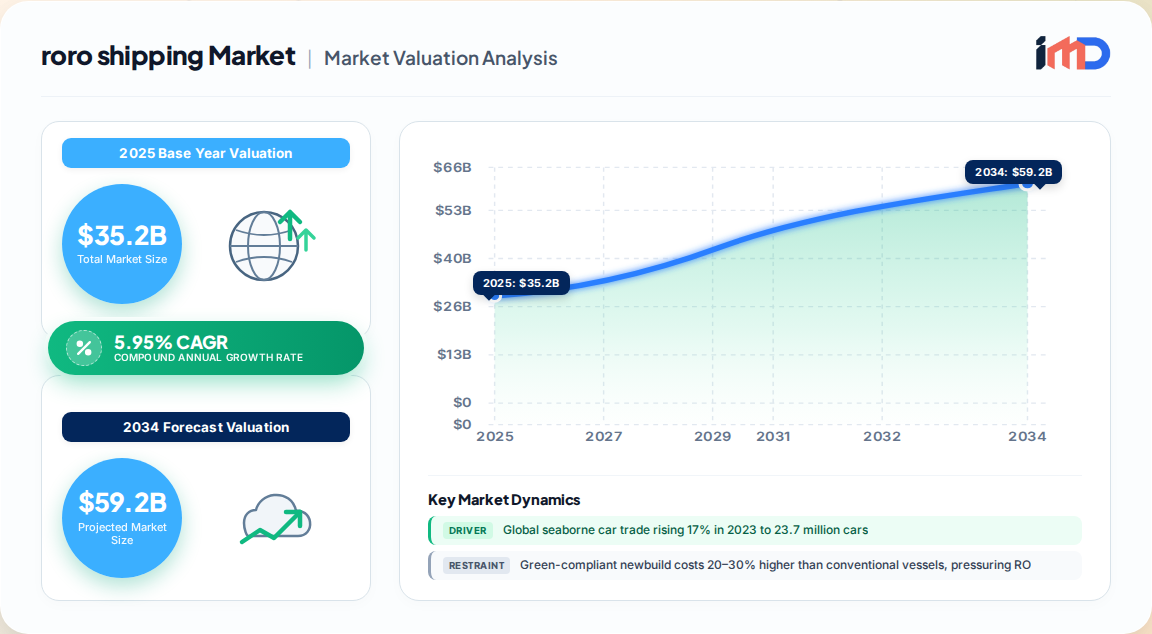
The global RoRo shipping market is estimated at USD 35.20 billion in 2025 and is forecast to reach USD 46.78 billion by 2030, expanding at a CAGR of 5.95% over the forecast period. This trajectory is anchored in the structural recovery of global vehicle trade and the accelerating electrification of automotive exports.
Roll-on/Roll-off shipping remains the backbone of wheeled-cargo logistics — vehicles, trucks, buses, construction and mining equipment, and defense materiel are driven or towed directly onto specialized vessels via built-in ramps. This eliminates container handling, compresses port turnaround times, and materially lowers damage risk.
Our proprietary bottom-up modeling, triangulated across vessel-level deployments, port throughput data, and OEM outbound logistics contracts, indicates the market is entering a capacity-constrained upcycle. Orderbooks for PCTCs are heavily committed through 2027, and charter rates remain elevated relative to pre-pandemic norms — a signal of durable structural demand rather than a cyclical spike.
The RoRo shipping market is propelled by a small set of high-conviction demand engines, counterbalanced by capital-intensity and infrastructure bottlenecks.
Key Drivers:
Key Restraints:
The vessel-type architecture of the RoRo market is consolidating around Pure Car and Truck Carriers, with green propulsion emerging as the decisive differentiator.
| Vessel Type | Capacity Range | Strategic Role | Growth Outlook |
|---|---|---|---|
| Pure Car Carriers (PCC) | 4,000–8,000 CEUs | High-density vehicle transport | Mature, steady |
| Pure Car & Truck Carriers (PCTC) | Up to 9,200 CEUs | Mixed cargo flexibility across decks | Highest growth |
| Conventional RoRo | Varies | Mixed rolling stock and trailers | Stable |
| LNG-Powered & Hybrid RoRo | Emerging | Compliance-driven, lower emissions | Fastest-growing niche |
Capacity escalation is a defining feature of the current cycle. Chinese automaker BYD unveiled the 'BYD Shenzhen' with 9,200 CEUs capacity in early 2025, while Höegh Autoliners introduced its 200-meter Aurora Class vessels capable of carrying 9,100 CEUs in 2024. Wallenius Wilhelmsen has ordered vessels with 11,700 CEU capacity — the 'Shaper+' Class, featuring 14 decks, 238m LOA, and 40m beam — with deliveries starting late 2027.
These mega-carriers deliver meaningful unit-cost advantages but require port berths and ramp infrastructure capable of handling them, deepening the divide between tier-one and tier-two RoRo ports.
Cargo mix is diversifying beyond passenger vehicles, though automotive remains the gravitational center.
End-user demand is led by automotive OEMs and exporters, who are increasingly signing multi-year, fleet-guaranteed contracts to lock in capacity on green-compliant vessels. Construction and mining firms, defense agencies, heavy manufacturing and energy companies, and fleet leasing/rental providers round out a layered customer base.
Asia Pacific is the largest export powerhouse, Europe the most regulated and sustainability-driven hub, and the Americas and MEA a blend of import demand and emerging export capability.
Asia Pacific (largest volume origin): China, Japan, South Korea, and India drive outbound vehicle traffic. Intra-Asia short-sea RoRo trade is rising fast, with OEMs shipping finished vehicles to Vietnam, Thailand, and Indonesia in under five days. China's EV export push has shifted routing patterns westward to Europe and southward to Southeast Asia and Australia. India and parts of Southeast Asia remain constrained by older terminals lacking dedicated RoRo ramps.
Europe (key hub and regulatory leader): Germany, Belgium, and the Netherlands anchor RoRo operations, with ports such as Zeebrugge, Bremerhaven, and Gothenburg serving as critical automotive import and redistribution nodes. The EU's Fit for 55 package is forcing faster adoption of low-sulfur fuels, shore power, and LNG-ready vessels than anywhere else. Eastern Europe — notably Poland and Romania — is emerging as a RoRo re-export zone for used vehicles and military cargo.
North America: Import-heavy at Baltimore, Brunswick, and Veracruz. U.S. outbound RoRo is growing in construction equipment to Latin America and military hardware to allied nations. Mexico is emerging as a manufacturing and export hub, with Veracruz expanding RoRo terminal capacity by over 20% since 2022.
Latin America: A net importer of used vehicles, buses, and utility trucks, led by Brazil and Chile. Renewable energy projects are generating occasional RoRo demand for oversized components.
Middle East & Africa: The most asymmetrical growth region. Saudi Arabia and the UAE are investing in dedicated RoRo port zones under Vision 2030, while African ports such as Mombasa, Lagos, and Durban handle large used-vehicle volumes with long turnaround times and inconsistent documentation.
The RoRo shipping market is fragmented, with a mix of global carriers and regional specialists competing on fleet scale, green technology, route diversity, and customer integration. Market concentration is low, and leadership is as much relationship-driven as capacity-driven.
Leading operators are repositioning as technology integrators — embedding IoT sensors, cargo tracking tags, and remote diagnostics into decks and vehicle bays to offer real-time visibility, temperature monitoring, and automated stowage optimization.
Notable recent developments:
Strategic imperatives for operators include securing long-term OEM capacity agreements, investing in dual-fuel and ammonia-ready tonnage, and digitizing terminal interfaces to reduce dwell time.
Our opportunity assessment identifies several under-served pockets within the RoRo shipping market:
The RoRo value chain spans OEM outbound logistics, shipping lines, port authorities, terminal operators, freight forwarders, and inland distribution providers. Vertical integration — ocean transport, inland logistics, and terminal operations — is a growing competitive advantage.
Principal supply chain risks:
Mitigation strategies center on multi-year cargo guarantees, diversified port portfolios, and fuel-flexible vessel designs that preserve optionality across bunkering regimes.
| Aspects | Details |
|---|---|
| Study Period | 2020-2034 |
| Base Year | 2025 |
| Estimated Year | 2026 |
| Forecast Period | 2026-2034 |
| Historical Period | 2020-2025 |
| Growth Rate | CAGR of 5.95% from 2020-2034 |
| Segmentation |
|
By Application
By Type
By End User
| By Geography |
|
The global RoRo shipping market is estimated at USD 35.20 billion in 2025 and is projected to reach USD 46.78 billion by 2030, growing at a CAGR of 5.95%.
Asia Pacific leads in export volume, driven by China, Japan, South Korea, and India, while Europe is the most regulated and sustainability-driven hub, with ports such as Zeebrugge and Bremerhaven anchoring automotive imports.
Pure Car and Truck Carriers (PCTCs) show the highest growth, with modern vessels reaching capacities up to 9,200 CEUs and next-generation orders exceeding 11,700 CEUs, such as Wallenius Wilhelmsen's Shaper+ Class.
Primary drivers include the EV export surge requiring battery-safe vessel configurations, expansion of short-sea routes, nearshoring of manufacturing, defense cargo demand, and IMO-driven fleet renewal toward LNG and dual-fuel vessels.
Leading operators include NYK Line, K Line, COSCO Shipping, Wallenius Wilhelmsen, Höegh Autoliners, Grimaldi Group, Eukor Car Carriers, and Stena RoRo, competing on fleet scale, green technology, and route diversity.
EV exports are driving demand for vessels with dedicated battery-fire safety zones, in-transit charging capacity, and revised weight-distribution management, with K Line introducing EV-optimized PCTCs featuring advanced fire suppression in 2024.
Our rigorous research methodology combines multi-layered approaches with comprehensive quality assurance, ensuring precision, accuracy, and reliability in every market analysis.
| Stakeholder Role | Interview Share (%) |
|---|---|
| Fleet Operations Director | 32% |
| OEM Supply Chain Manager | 28% |
| Port and Terminal Operations Head | 22% |
| Marine Engineering and Decarbonization Lead | 18% |
| Company Type | Representation (%) |
|---|---|
| PCTC and PCC Fleet Operators | 34% |
| Automotive OEM Outbound Logistics Teams | 24% |
| Port Authorities and RoRo Terminal Operators | 18% |
| Shipbuilders and Naval Architects | 14% |
| Heavy Equipment and Defense Cargo Shippers | 10% |
 Related Reports
