1What is the current size of the global rocket engine market?
The global rocket engine market was valued at USD 5.00 Billion in 2025 and is projected to reach USD 10.32 Billion by 2034, growing at a CAGR of 8.38%.
Insight Market Data is a premier market research and business consulting firm headquartered in Pune, India, providing syndicated research reports, customized intelligence studies, and strategic advisory services. Renowned academic institutions and Fortune 500 corporations worldwide rely on Insight Market Data's research repository to navigate evolving global and regional business environments. Covering 46 diverse industries across 25 major international economies, our comprehensive database delivers thousands of verified statistics and granular market evaluations. By combining industry-leading analytical methodologies with the direct insights of seasoned industry leaders and subject-matter experts, we deliver actionable intelligence spanning historical performance benchmarks to rigorous multi-year forecasts. We empower organizations to make confident, data-driven decisions across pivotal domains including Machinery & Equipment, Chemicals & Materials, Pharmaceuticals & Healthcare, Food & Beverages, Consumer Goods, Energy & Power, Automotive & Transportation, Electronics & Semiconductors, Medical Devices, Telecommunications, Emerging Technologies, Agriculture, and Packaging. Our multidisciplinary analyst teams provide an objective 360-degree perspective, tailoring every engagement to address complex strategic challenges with exceptional analytical rigor.
Leveraging advanced BI-powered analytics and predictive modeling, Insight Market Data uncovers high-impact market opportunities and competitive differentiators for ambitious enterprises. We continuously refine our research methodologies in accordance with global industry standards, tracking real-time market shifts to ensure our reports are consistently accurate, actionable, and delivered on schedule. Our analysts conduct methodical data validation, rigorous compliance checks, and exhaustive primary and secondary research to maintain the highest levels of data integrity and transparency. We partner closely with corporate strategists, investment groups, and business executives to translate intricate market intelligence into clear, actionable roadmaps for sustainable growth. With operational presence across Washington, USA, and Vimannagar, Pune, India, Insight Market Data ensures direct access to dedicated research specialists and responsive customer support to answer your most strategic questions.
 Rocket Engine Market
 by Type (Liquid Rocket Engine, Solid Rocket Engine, Hybrid Rocket Engine), by Application (Spacecraft, Ballistic Missiles), by End User (Civil and Commercial, Military and Government), by Component (Motor Casing, Nozzle, Propellant, Turbopump, Combustion Chamber, Igniter Hardware, Valve, Others), by Thrust Class (High Thrust, Medium Thrust, Low Thrust), by Engine Cycle (Gas Generator Cycle, Staged Combustion Cycle, Expander Cycle, Pressure Fed Cycle), by North America (USA, Canada, Mexico), by Europe (Germany, UK, France, Italy, Spain), by Asia Pacific (China, Japan, India, South Korea, Australia), by South America (Brazil, Mexico), by Middle East & Africa (Saudi Arabia, UAE, South Africa) Forecast 2026-2034

Research Associate


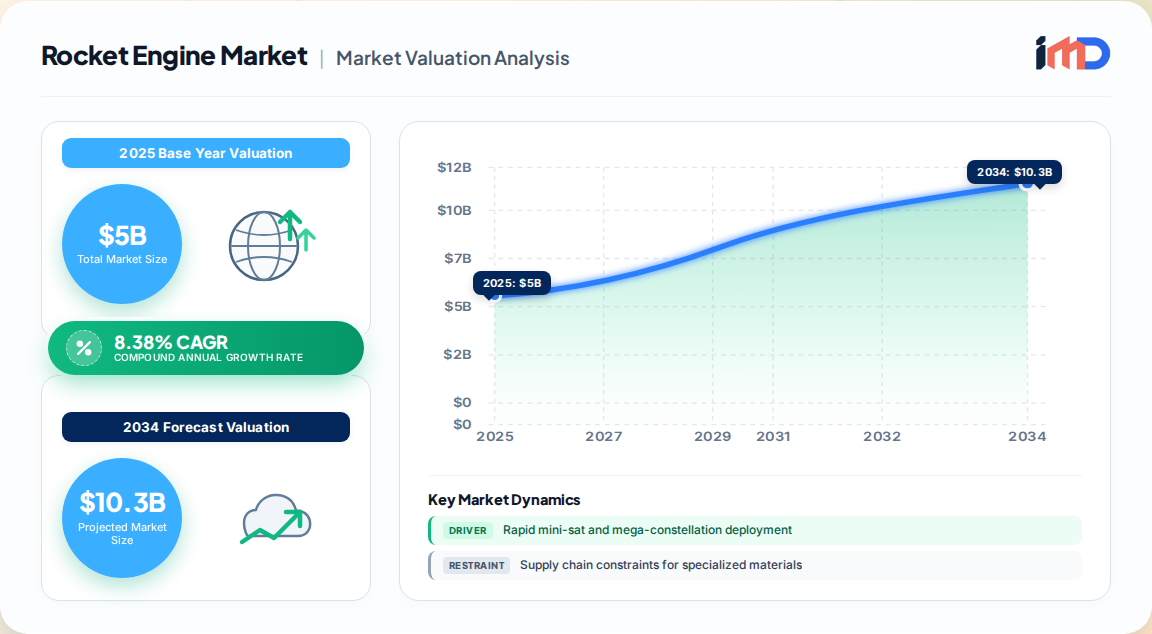
The global rocket engine market is entering a structural expansion phase, with proprietary first-party estimates valuing the market at USD 5.00 Billion in 2025 and projecting USD 10.32 Billion by 2034, representing a CAGR of 8.38% over the forecast period. This growth is underpinned by a fundamental shift from bespoke, low-cadence production toward repeatable, airline-like operations. Reusable launch vehicle economics, mega-constellation deployment, and sovereign deep-space funding are converging to create a multi-year demand super-cycle for liquid engines, solid motors, and hybrid propulsion systems.
The market is characterized by high concentration among tier-one propulsion integrators and a widening base of agile, venture-backed entrants. Liquid rocket engines commanded 63.22% of propulsion-type share in 2025, while rocket engines as a product type are forecast to grow at 8.05% CAGR, outpacing rocket motors. North America retains the largest regional share at 38.55%, but Asia-Pacific is the fastest-growing geography at 8.01% CAGR, driven by state-led programs in China, India, and Japan.
The rocket engine value chain is vertically integrated at the tier-one level but highly fragmented across specialized suppliers.
| Value Chain Stage | Key Activities | Representative Participants |
|---|---|---|
| Raw Materials & Specialty Alloys | High-temperature alloys, composites, propellant chemicals | Specialty metal producers, chemical suppliers |
| Precision Components | Turbopumps, valves, injectors, nozzles, igniters | Precision machining and additive manufacturing firms |
| Engine Integration & Assembly | Combustion chamber, thrust chamber assembly, controls | Tier-one propulsion integrators (e.g., SpaceX, Blue Origin, Aerojet Rocketdyne) |
| Testing & Qualification | Static fire, environmental testing, certification | Government test ranges, commercial test facilities |
| Launch Services & Operations | Integration, launch, refurbishment | Launch service providers, space agencies |
The rocket engine market is not a conventional commodity trade market; cross-border flows are dominated by government-to-government transfers, licensed production, and component-level trade.
North America holds the largest market share at 38.55% in 2025, driven by mature launch infrastructure, extensive government demand (NASA, DoD), and private-sector experimentation. The U.S. is the epicenter of reusable launch innovation, with high-frequency Falcon 9 missions and the debut of New Glenn’s booster landing in November 2025. Canada contributes through space robotics and specialized aerospace capabilities.
Europe emphasizes institutional space access, collaborative programs, and technology sovereignty. ESA’s EUR 22.3 Billion commitment sustains engine and stage work on Ariane 6 and next-generation vehicles. France, Germany, Italy, Spain, and the UK contribute through national programs and industrial specialization. The region is also advancing green-propellant adoption.
Asia-Pacific is the fastest-growing region at 8.01% CAGR, with strong activity in China, India, Japan, South Korea, and Australia. China maintains a broad state-led space ecosystem, including a filed constellation of approximately 200,000 satellites. India’s 2026 space allocation supports crewed flight preparation and next-generation launch vehicle roadmap. Japan emphasizes reliable launch and advanced research.
These regions are developing space capabilities through public investment, international partnerships, and capacity building. Brazil and Mexico are strengthening aerospace and space-sector participation in Latin America. The Middle East is expanding space programs through investment and workforce development, while Africa builds expertise primarily through satellite, research, and education initiatives.
The competitive landscape is highly concentrated among tier-one propulsion integrators, with a growing number of agile entrants.
While rocket engines are not traded as commodities, component-level and subsystem trade is significant.
| Segment | Sub-Segment | 2025 Share / CAGR |
|---|---|---|
| By Type | Liquid Rocket Engine | 63.22% share |
| Solid Rocket Engine | — | |
| Hybrid Rocket Engine | 8.91% CAGR (2026–2031) | |
| By Application | Spacecraft | — |
| Ballistic Missiles | — | |
| By End User | Civil and Commercial | 58.95% share |
| Military and Government | 7.86% CAGR (2026–2031) | |
| By Component | Motor Casing | 45.1% share |
| Nozzle | — | |
| Propellant | 7.62% CAGR (2026–2031) | |
| Turbopump | — | |
| Combustion Chamber | — | |
| By Thrust Class | High Thrust | — |
| Medium Thrust | — | |
| Low Thrust | — | |
| By Engine Cycle | Gas Generator Cycle | — |
| Staged Combustion Cycle | — | |
| Expander Cycle | — | |
| Pressure Fed Cycle | — |
The rocket engine market is poised for robust growth, driven by reusability, constellation deployment, and sovereign space ambitions. Leaders must align propulsion architectures with mission requirements, invest in test infrastructure and digital engineering, and build resilient supply chains. With a projected USD 10.32 Billion market by 2034 and a CAGR of 8.38%, the industry offers substantial opportunities for incumbents and new entrants alike.
| Aspects | Details |
|---|---|
| Study Period | 2020-2034 |
| Base Year | 2025 |
| Estimated Year | 2026 |
| Forecast Period | 2026-2034 |
| Historical Period | 2020-2025 |
| Growth Rate | CAGR of 8.38% from 2020-2034 |
| Segmentation |
|
By End User
By Component
By Thrust Class
By Engine Cycle
| By Geography |
|
The global rocket engine market was valued at USD 5.00 Billion in 2025 and is projected to reach USD 10.32 Billion by 2034, growing at a CAGR of 8.38%.
North America holds the largest market share at 38.55% in 2025, driven by mature launch infrastructure and high government and commercial demand.
Key drivers include rapid mega-constellation deployment, reusable launch vehicle economics, government deep-space funding, and the hypersonic weapons propulsion race.
Hybrid propulsion is forecast to grow at 8.91% CAGR during 2026–2031, while rocket engines as a type are expected to grow at 8.05% CAGR.
Key players include SpaceX, Blue Origin, Aerojet Rocketdyne, Mitsubishi Heavy Industries, Safran, IHI Corporation, CASC, and Yuzhnoye SDO, among others.
Challenges include supply chain constraints for specialized materials, high capital intensity and long qualification cycles, and stringent regulatory compliance.
Our rigorous research methodology combines multi-layered approaches with comprehensive quality assurance, ensuring precision, accuracy, and reliability in every market analysis.
| Stakeholder Role | Interview Share (%) |
|---|---|
| Chief Technology Officer | 25% |
| Propulsion Program Director | 30% |
| Supply Chain Manager | 20% |
| Senior Systems Engineer | 25% |
| Company Type | Representation (%) |
|---|---|
| Liquid Engine OEMs | 30% |
| Solid Motor Manufacturers | 20% |
| Additive Manufacturing Suppliers | 15% |
| Precision Component Suppliers | 20% |
| Launch Service Providers | 15% |
 Related Reports
