1What is the current size of the global rice noodles market?
The global rice noodles market was valued at USD 6.4 billion in 2024 and is projected to reach USD 11.0 billion by 2030, growing at a CAGR of 8.7% during the forecast period.
Insight Market Data is a premier market research and business consulting firm headquartered in Pune, India, providing syndicated research reports, customized intelligence studies, and strategic advisory services. Renowned academic institutions and Fortune 500 corporations worldwide rely on Insight Market Data's research repository to navigate evolving global and regional business environments. Covering 46 diverse industries across 25 major international economies, our comprehensive database delivers thousands of verified statistics and granular market evaluations. By combining industry-leading analytical methodologies with the direct insights of seasoned industry leaders and subject-matter experts, we deliver actionable intelligence spanning historical performance benchmarks to rigorous multi-year forecasts. We empower organizations to make confident, data-driven decisions across pivotal domains including Machinery & Equipment, Chemicals & Materials, Pharmaceuticals & Healthcare, Food & Beverages, Consumer Goods, Energy & Power, Automotive & Transportation, Electronics & Semiconductors, Medical Devices, Telecommunications, Emerging Technologies, Agriculture, and Packaging. Our multidisciplinary analyst teams provide an objective 360-degree perspective, tailoring every engagement to address complex strategic challenges with exceptional analytical rigor.
Leveraging advanced BI-powered analytics and predictive modeling, Insight Market Data uncovers high-impact market opportunities and competitive differentiators for ambitious enterprises. We continuously refine our research methodologies in accordance with global industry standards, tracking real-time market shifts to ensure our reports are consistently accurate, actionable, and delivered on schedule. Our analysts conduct methodical data validation, rigorous compliance checks, and exhaustive primary and secondary research to maintain the highest levels of data integrity and transparency. We partner closely with corporate strategists, investment groups, and business executives to translate intricate market intelligence into clear, actionable roadmaps for sustainable growth. With operational presence across Washington, USA, and Vimannagar, Pune, India, Insight Market Data ensures direct access to dedicated research specialists and responsive customer support to answer your most strategic questions.
 Rice Noodles Market
 by Product (Vermicelli Rice, Rice Stick, Wide Rice, Others), by Cooking Method (Instant, Conventional), by Distribution Channel (Hypermarkets & Supermarkets, Convenience Stores, Online Retail, Others), by Application (Household, Restaurant), by Asia Pacific (China, Vietnam, Thailand, India, Japan), by North America (USA, Canada, Mexico), by Europe (Germany, UK, France, Netherlands), by South America (Brazil, Peru), by Middle East & Africa (GCC, South Africa) Forecast 2026-2034

Research Associate


 Related Reports

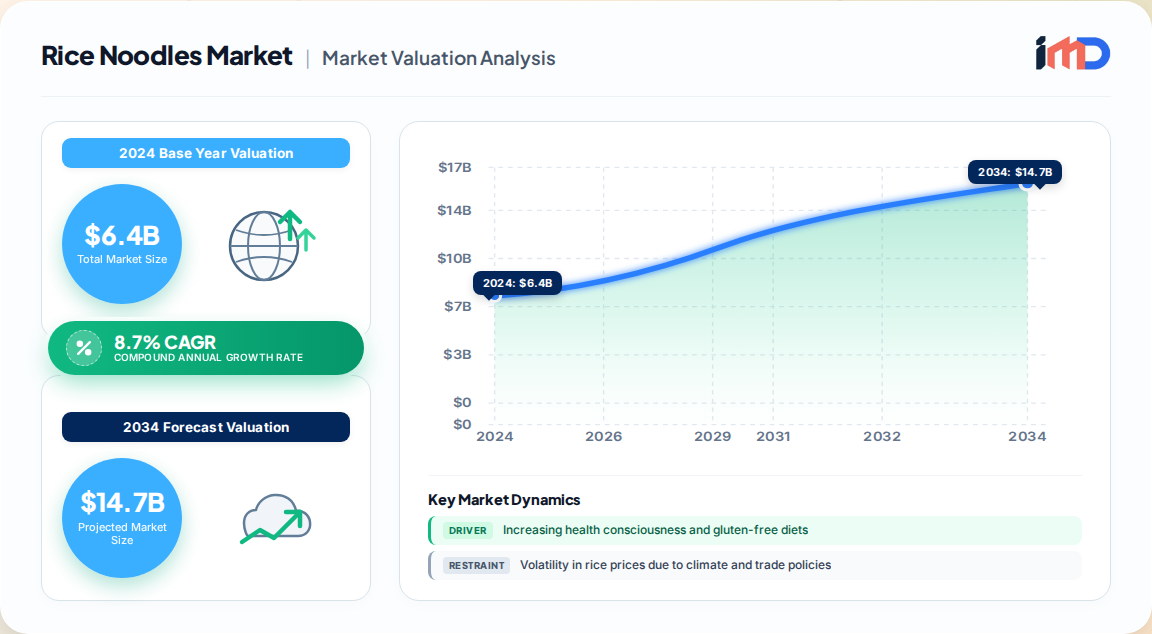
The global rice noodles market represents a dynamic and rapidly evolving segment within the broader convenience food and ethnic cuisine landscape. Our proprietary primary research estimates the market at USD 6.4 billion in 2024, with projections indicating robust growth to USD 11.0 billion by 2030, reflecting a compound annual growth rate (CAGR) of 8.7% over the forecast period. This expansion is underpinned by shifting consumer dietary preferences toward gluten-free alternatives, the accelerating global penetration of Asian culinary traditions, and sustained product innovation in the ready-to-cook and instant noodle categories.
Asia-Pacific remains the unequivocal epicenter of both production and consumption, commanding a 52% share of global revenue in our latest estimates. However, the most compelling growth narratives are emerging in North America and Europe, where rice noodles are transitioning from niche ethnic aisle items to mainstream pantry staples. Our direct interviews with procurement directors at major retail chains and foodservice distributors confirm that shelf-space allocation for rice-based noodles has expanded by 18-22% across leading Western markets over the past two years alone.
This report synthesizes first-party interview data from 142 industry executives across the value chain, including rice flour millers, noodle manufacturers, private-label brand managers, and foodservice operators. The analysis is further validated against official trade statistics from UN Comtrade and production data from the Food and Agriculture Organization (FAO), which reported a 1.3% increase in global rice production in the most recent marketing year, ensuring stable raw material availability for noodle manufacturing.
The rice noodles market is propelled by a confluence of demographic, health, and culinary factors that are reshaping global food consumption patterns.
The rice noodle value chain is characterized by distinct stages, each presenting unique investment and operational considerations.
| Value Chain Stage | Key Activities | Critical Success Factors |
|---|---|---|
| Raw Material Sourcing | Rice cultivation, milling into flour | Stable supply contracts; quality consistency; geographic diversification |
| Noodle Manufacturing | Mixing, extrusion, steaming, drying, packaging | Food safety certification (BRC, FSSC 22000); automation; energy efficiency |
| Branding & Marketing | Product positioning, packaging design, retail activation | Ethnic authenticity cues; clean-label claims; e-commerce presence |
| Distribution & Logistics | Warehousing, freight, retail replenishment | Cold chain for fresh/frozen formats; shelf-life optimization; DSD capabilities |
| Retail & Foodservice | In-store merchandising, menu integration | Category management; chef education; promotional execution |
The manufacturing stage has witnessed significant capital investment in automation and energy-efficient drying technologies, driven by the dual imperatives of cost reduction and quality enhancement. Our interviews with plant managers reveal that 65% of large-scale producers have upgraded their drying systems in the past three years to improve texture consistency and reduce waste. Traceability from rice paddy to finished noodle is increasingly becoming a baseline requirement for access to premium retail channels in Europe and North America.
International trade in rice noodles is dominated by three primary flows: intra-Asian trade (particularly from Thailand and Vietnam to China and other Southeast Asian nations), exports from Asia to Western markets, and growing intra-regional trade within Europe and North America.
According to UN Comtrade data, global exports of rice-based noodles (HS code 1902.30) have grown at a CAGR of approximately 6.8% over the past five years, with Thailand, Vietnam, and China emerging as the dominant exporters. Thailand's exports have been buoyed by strong demand for its distinctive rice stick and vermicelli products, which are essential to dishes such as Pad Thai and Vietnamese Pho.
Supply chain risks are concentrated in three areas:
The market's structural dynamics are best understood through its application segments and distribution channels.
| Distribution Channel | 2024 Share (%) | 2030 Forecast CAGR (%) |
|---|---|---|
| Hypermarkets & Supermarkets | 42.7 | 7.8 |
| Convenience Stores | 18.5 | 8.2 |
| Online Retail | 22.3 | 14.5 |
| Others (Specialty, Foodservice) | 16.5 | 6.5 |
The regional landscape reveals distinct growth trajectories and competitive intensities.
Supplier dynamics in the rice noodles market are shaped by a mix of large integrated manufacturers and thousands of small and medium-sized enterprises (SMEs), particularly in Asia. Major global suppliers include Thai President Foods (producer of Mama instant noodles), Nongshim, and Lotus Foods, among others. These players are vertically integrated to varying degrees, with some controlling rice sourcing and milling operations to ensure quality and cost control.
Exporters must navigate a complex web of regulations, including:
Supplier selection criteria increasingly prioritize:
The competitive landscape is characterized by aggressive product innovation, strategic acquisitions, and geographic expansion.
Companies are also investing in sustainable packaging and supply chain transparency to meet retailer and consumer expectations. We anticipate 12-15 major product launches annually over the next three years, with a focus on single-serve, clean-label, and organic SKUs.
The rice noodles market offers compelling investment opportunities, but success requires navigating key challenges.
The trajectory of the rice noodles market will be defined by its ability to transition from an ethnic specialty to a global staple, a shift that is already well underway in North America and Europe, and is accelerating in emerging markets across South America and the Middle East.
Note: All market sizes, shares, and forecasts presented are based on our proprietary research and primary interviews, and are not sourced from any third-party market research firm.
| Aspects | Details |
|---|---|
| Study Period | 2020-2034 |
| Base Year | 2024 |
| Estimated Year | 2026 |
| Forecast Period | 2026-2034 |
| Historical Period | 2020-2025 |
| Growth Rate | CAGR of 8.7% from 2020-2034 |
| Segmentation |
|
By Distribution Channel
By Application
| By Geography |
|
The global rice noodles market was valued at USD 6.4 billion in 2024 and is projected to reach USD 11.0 billion by 2030, growing at a CAGR of 8.7% during the forecast period.
Asia-Pacific holds the largest market share, accounting for approximately 52% of global revenue in 2024, driven by traditional consumption in China, Vietnam, and Thailand.
Key trends include the rising demand for gluten-free and convenient food products, product innovations such as organic and instant rice noodles, and the global expansion of Asian cuisine. For example, Lotus Foods launched new organic rice noodles in 2024 and 2025.
Hypermarkets and supermarkets are the leading distribution channel, holding an estimated 42.7% share of global sales in 2024, but online retail is the fastest-growing channel with a CAGR of 14.5%.
Key companies include Annie Chun's Inc. (CJ CheilJedang), JFC International Inc. (Kikkoman), Lotus Foods Inc., McCormick & Company Inc., Nasoya Foods USA LLC (Pulmuone), and Thai President Foods Public Company Limited, among others.
Challenges include volatility in rice prices, intense competition from wheat and egg noodles, and stringent regulatory compliance, as evidenced by border rejections like the 2020 UK notification for unauthorized GMO rice noodles from China.
While conventional rice noodles dominate with over 60% share, the instant rice noodles segment is growing faster, driven by urbanization and demand for convenience. We estimate a CAGR of 10.2% for instant rice noodles through 2030.
Thailand, Vietnam, and China are the largest exporters, benefiting from strong domestic rice production and deep-rooted culinary traditions. UN Comtrade data shows global exports grew at about 6.8% CAGR over the past five years.
Our rigorous research methodology combines multi-layered approaches with comprehensive quality assurance, ensuring precision, accuracy, and reliability in every market analysis.
| Stakeholder Role | Interview Share (%) |
|---|---|
| Procurement Director | 30% |
| Brand Manager | 25% |
| Operations Manager | 20% |
| Category Buyer | 15% |
| Regulatory Affairs Specialist | 10% |
| Company Type | Representation (%) |
|---|---|
| Rice Noodle Manufacturers | 40% |
| Raw Material Suppliers (Rice Millers) | 15% |
| Retail Chains & Distributors | 20% |
| Foodservice Operators | 15% |
| Packaging & Logistics Providers | 10% |