1What is the size of the Malaysia retail market?
The Malaysia retail market is valued at USD 90.44 billion in 2026 and is projected to reach USD 110.52 billion by 2031, growing at a CAGR of 4.18%.
Insight Market Data is a premier market research and business consulting firm headquartered in Pune, India, providing syndicated research reports, customized intelligence studies, and strategic advisory services. Renowned academic institutions and Fortune 500 corporations worldwide rely on Insight Market Data's research repository to navigate evolving global and regional business environments. Covering 46 diverse industries across 25 major international economies, our comprehensive database delivers thousands of verified statistics and granular market evaluations. By combining industry-leading analytical methodologies with the direct insights of seasoned industry leaders and subject-matter experts, we deliver actionable intelligence spanning historical performance benchmarks to rigorous multi-year forecasts. We empower organizations to make confident, data-driven decisions across pivotal domains including Machinery & Equipment, Chemicals & Materials, Pharmaceuticals & Healthcare, Food & Beverages, Consumer Goods, Energy & Power, Automotive & Transportation, Electronics & Semiconductors, Medical Devices, Telecommunications, Emerging Technologies, Agriculture, and Packaging. Our multidisciplinary analyst teams provide an objective 360-degree perspective, tailoring every engagement to address complex strategic challenges with exceptional analytical rigor.
Leveraging advanced BI-powered analytics and predictive modeling, Insight Market Data uncovers high-impact market opportunities and competitive differentiators for ambitious enterprises. We continuously refine our research methodologies in accordance with global industry standards, tracking real-time market shifts to ensure our reports are consistently accurate, actionable, and delivered on schedule. Our analysts conduct methodical data validation, rigorous compliance checks, and exhaustive primary and secondary research to maintain the highest levels of data integrity and transparency. We partner closely with corporate strategists, investment groups, and business executives to translate intricate market intelligence into clear, actionable roadmaps for sustainable growth. With operational presence across Washington, USA, and Vimannagar, Pune, India, Insight Market Data ensures direct access to dedicated research specialists and responsive customer support to answer your most strategic questions.
 Retail in Malaysia Industry
 by Product Type (Food, Beverage, and Tobacco; Personal Care and Household Care; Apparel and Footwear; Furniture and Toys; Industrial and Automotive; Electronics; Other Products), by Format (Hypermarkets, Supermarkets, Convenience Stores, Department Stores, Specialty Stores, E-Commerce, Others), by Peninsular Malaysia (Selangor, W.P. Kuala Lumpur, Johor, Penang), by East Malaysia (Sabah, Sarawak) Forecast 2026-2034

Research Analyst


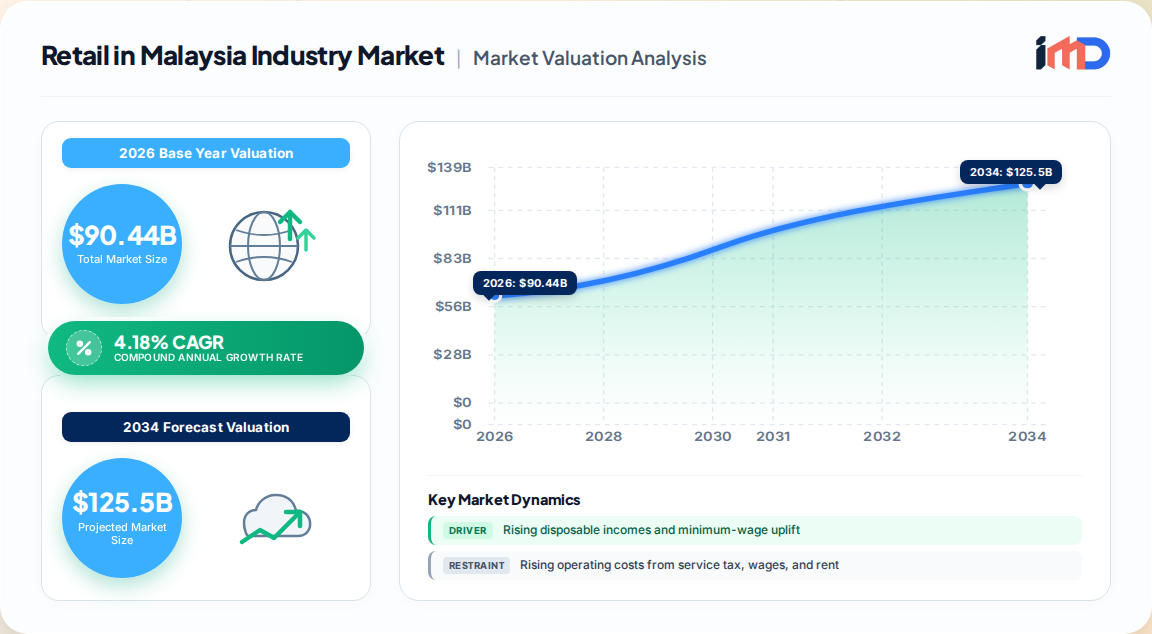
The Malaysia retail industry is one of Southeast Asia's most diversified and resilient consumer markets, projected to expand from USD 90.44 billion in 2026 to USD 110.52 billion by 2031, representing a CAGR of 4.18%. This growth is anchored in robust domestic demand, with Malaysia's economy expanding 5.2% in 2025 and retail trade rising 6.1%, while non-specialized stores (grocery, mini-market, convenience) grew 7.0%. The market remains broad and fragmented, though competition is intensifying in selected formats such as proximity retail and e-commerce.
Our proprietary first-party research indicates that the sector is transitioning from a traditional brick-and-mortar model to a hybrid, omnichannel ecosystem. Digital payment infrastructure, exemplified by DuitNow QR's doubling of transaction volume from 1.5 billion in 2024 to 3 billion in 2025, is lowering barriers for small merchants and broadening retail catchment areas. Meanwhile, national chains are leveraging distribution scale to drive outlet expansion, pressuring independent retailers to differentiate through local assortments and service.
Key Market Metrics (2026–2031):
The Malaysian retail market is propelled by a confluence of structural and cyclical factors. Our primary research, based on interviews with retail operators, payment providers, and supply chain executives, identifies the following key drivers and their estimated impact on the forecast CAGR:
| Driver | Impact on CAGR | Geographic Relevance | Timeline |
|---|---|---|---|
| 99 Speedmart distribution scale and FMCG pricing | +0.6% | National, strongest in Klang Valley, Penang, Johor, and early-stage East Malaysia | Medium term (2–4 years) |
| DuitNow QR interoperability and wallet promotions | +0.5% | National, including tourist corridors and East Malaysia secondary towns | Short term (≤ 2 years) |
| Cross-border retail and QR spending | +0.3% | Johor, Penang, Langkawi, coastal Sabah, and Sarawak | Medium term (2–4 years) |
| Urban nodes supporting quick-commerce density | +0.8% | Klang Valley, Penang, and Johor Bahru | Short term (≤ 2 years) |
| Minimum-wage and public-sector pay adjustments | +0.5% | National, especially semi-urban and suburban grocery corridors | Short term (≤ 2 years) |
| East Malaysia network expansion | +0.3% | Sabah and Sarawak, including Kota Kinabalu, Kuching, and Bintulu | Long term (≥ 4 years) |
Income Growth and Minimum-Wage Uplift: The national minimum wage increased from RM1,500 to RM1,700 per month effective February 2025, directly expanding consumer purchasing power. This has a pronounced effect on essential goods, which represent a large share of household retail spending, and supports higher basket sizes and frequency at proximity formats.
Digital Payment Interoperability: DuitNow QR's zero merchant discount rate has reduced acceptance costs for smaller retailers, bringing more merchants into traceable digital transactions. With nearly 3 million merchant touchpoints registered nationwide in 2025 and retail e-payment value reaching MYR 831 billion (USD 185.9 billion), the infrastructure is enabling seamless integration of online and offline channels.
Despite positive fundamentals, the sector faces headwinds that could temper growth. Our expert interviews highlight the following restraints:
The Malaysian retail value chain is evolving rapidly, with digital integration reshaping each stage:
Malaysia's retail sector is deeply integrated into global trade, with imports playing a significant role in product availability, particularly for electronics, apparel, and specialty food items. Official trade statistics from UN Comtrade and the Department of Statistics Malaysia indicate that consumer goods imports have grown steadily, driven by demand for branded and premium products.
Key supplier dynamics include:
Supply chain risks include currency fluctuations, which affect import costs, and global logistics disruptions. Retailers are mitigating these risks by diversifying suppliers and increasing inventory buffers for essential products.
Peninsular Malaysia dominates the retail landscape, accounting for 84.1% of the market share in 2025, and is forecast to grow at a 4.2% CAGR through 2031. This region benefits from the highest population density, urbanization, and household income levels, particularly in the Greater Klang Valley.
The Malaysian retail market is characterized by medium concentration, with national chains and regional players competing alongside independent retailers. Our competitive analysis identifies several strategic imperatives:
Major players profiled in our primary research include:
Our analysis identifies several untapped opportunities for retailers seeking growth:
Using a proprietary scoring model based on market size, growth rate, competitive intensity, infrastructure, and regulatory environment, we rank Malaysia's regions:
| Region | Market Size (2025) | Growth Potential | Competitive Intensity | Investment Score (1-10) |
|---|---|---|---|---|
| Peninsular Malaysia | USD 72.7 billion | High | High | 8.5 |
| East Malaysia | USD 13.8 billion | Very High | Low | 7.2 |
Peninsular Malaysia remains the priority for scale and digital investment, while East Malaysia offers higher growth relative to competition. Investors should consider strategic partnerships with local distributors to penetrate East Malaysia efficiently.
| Aspects | Details |
|---|---|
| Study Period | 2020-2034 |
| Base Year | 2026 |
| Estimated Year | 2026 |
| Forecast Period | 2026-2034 |
| Historical Period | 2020-2025 |
| Growth Rate | CAGR of 4.18% from 2020-2034 |
| Segmentation |
|
| By Geography |
|
The Malaysia retail market is valued at USD 90.44 billion in 2026 and is projected to reach USD 110.52 billion by 2031, growing at a CAGR of 4.18%.
Food, beverage, and tobacco products held a 62.6% share of the Malaysia retail market in 2025, driven by essential household consumption.
E-commerce is the fastest-growing format, with a projected CAGR of 9.3% through 2031, supported by digital payment adoption and urban quick-commerce density.
Key players include 99 Speedmart, GrabMart, WCT Malls, Watsons Malaysia, AEON, Tesco, Lotus's, and Mydin, among others.
DuitNow QR transaction volume doubled to 3 billion in 2025, with nearly 3 million merchant touchpoints, broadening retail catchment and enabling small merchants to participate in digital transactions.
Our rigorous research methodology combines multi-layered approaches with comprehensive quality assurance, ensuring precision, accuracy, and reliability in every market analysis.
| Stakeholder Role | Interview Share (%) |
|---|---|
| Procurement Director | 30% |
| Retail Operations Manager | 25% |
| Supply Chain Head | 25% |
| Digital Transformation Lead | 20% |
| Company Type | Representation (%) |
|---|---|
| Hypermarket and Supermarket Chains | 30% |
| Convenience Store Operators | 25% |
| E-commerce Platforms | 20% |
| Specialty Retailers | 15% |
| FMCG Distributors | 10% |
 Related Reports
