Insight Market Data is a premier market research and business consulting firm headquartered in Pune, India, providing syndicated research reports, customized intelligence studies, and strategic advisory services. Renowned academic institutions and Fortune 500 corporations worldwide rely on Insight Market Data's research repository to navigate evolving global and regional business environments. Covering 46 diverse industries across 25 major international economies, our comprehensive database delivers thousands of verified statistics and granular market evaluations. By combining industry-leading analytical methodologies with the direct insights of seasoned industry leaders and subject-matter experts, we deliver actionable intelligence spanning historical performance benchmarks to rigorous multi-year forecasts. We empower organizations to make confident, data-driven decisions across pivotal domains including Machinery & Equipment, Chemicals & Materials, Pharmaceuticals & Healthcare, Food & Beverages, Consumer Goods, Energy & Power, Automotive & Transportation, Electronics & Semiconductors, Medical Devices, Telecommunications, Emerging Technologies, Agriculture, and Packaging. Our multidisciplinary analyst teams provide an objective 360-degree perspective, tailoring every engagement to address complex strategic challenges with exceptional analytical rigor.
Leveraging advanced BI-powered analytics and predictive modeling, Insight Market Data uncovers high-impact market opportunities and competitive differentiators for ambitious enterprises. We continuously refine our research methodologies in accordance with global industry standards, tracking real-time market shifts to ensure our reports are consistently accurate, actionable, and delivered on schedule. Our analysts conduct methodical data validation, rigorous compliance checks, and exhaustive primary and secondary research to maintain the highest levels of data integrity and transparency. We partner closely with corporate strategists, investment groups, and business executives to translate intricate market intelligence into clear, actionable roadmaps for sustainable growth. With operational presence across Washington, USA, and Vimannagar, Pune, India, Insight Market Data ensures direct access to dedicated research specialists and responsive customer support to answer your most strategic questions.
Residential Roof Inspection Services Market
Real Estate and Construction / MARKET REPORT
Residential Roof Inspection Services Market | Insight Market Data
Residential Roof Inspection Services Market by Service Type (Visual Inspection, Thermal Imaging Inspection, Drone-Based Inspection), by End User (Homeowners, Property Management Companies, Real Estate Professionals, Insurance Carriers), by Inspection Frequency (Annual Inspections, Bi-annual Inspections, One-time Inspections), by Technology Utilization (Drone Inspections, 3D Scanning and Photogrammetry, AI and Machine Learning, Traditional Manual), by North America (USA, Canada, Mexico), by Europe (Germany, UK, France, Italy, Spain), by Asia Pacific (China, Japan, India, Australia, South Korea), by South America (Brazil, Argentina), by Middle East & Africa (Saudi Arabia, UAE, South Africa) Forecast 2026-2034
Elevator and Escalator Market valued at $82.79B in 2025, projected to reach $146.52B by 2035 at 6.0% CAGR. Explore trends, segments, and regional analysis.
Global elevator cables market valued at $2.53B in 2026, projected to reach $3.11B by 2030 at 5.3% CAGR. Flat cable demand driven by urbanization and smart buildings.
Nov 2026|224 pages
$2900.00
Air entraining admixtures market valued at USD 2.02 B in 2024, growing at 3.5% CAGR to reach USD 2.66 B by 2032. Freeze-thaw durability drives demand.
Nov 2026|273 pages
$2900.00
The Brushless DC Motor for HVAC System market is valued at USD 2.15 billion in 2026, growing at a 9.8% CAGR to reach USD 3.43 billion by 2031.
Nov 2026|192 pages
$2900.00
3D printing robotic arm extruders for construction market to reach $1.18B by 2035 at 12.8% CAGR, driven by automation and sustainable building.
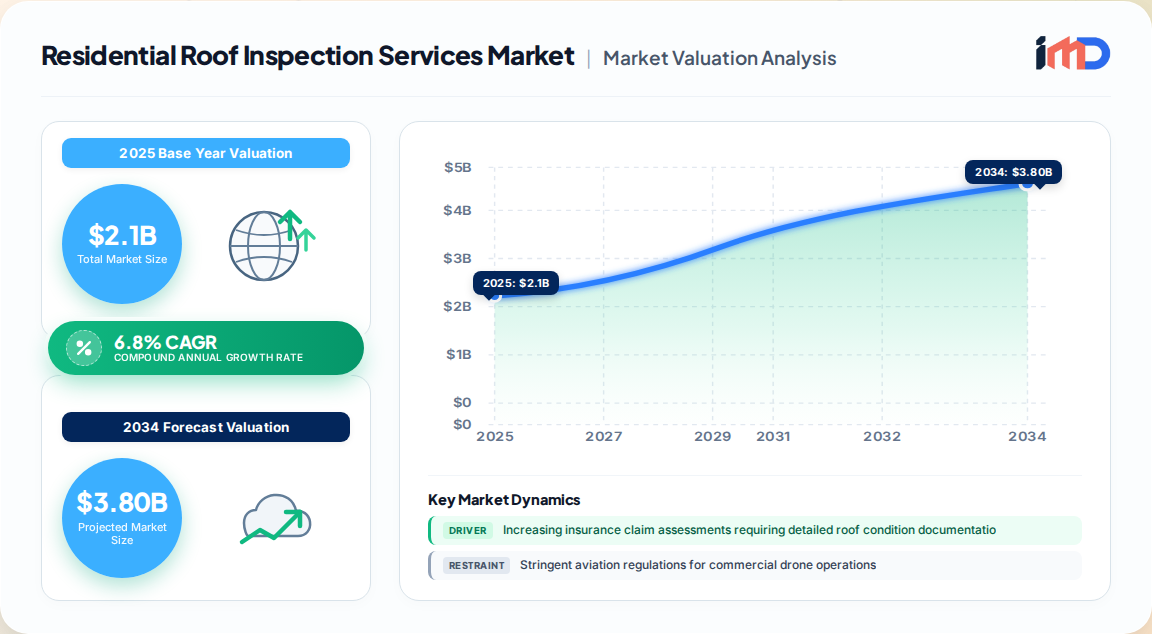
The global residential roof inspection services market represents a critical and rapidly evolving segment within the broader property maintenance and risk mitigation ecosystem. Our proprietary primary research estimates the market reached USD 2.1 Billion in 2025, with a projected valuation of USD 3.9 Billion by 2034, expanding at a robust CAGR of 6.8%. This growth outpaces the broader building inspection services sector, driven by a confluence of demographic shifts, climate-related risk awareness, and a fundamental technological transformation from manual assessments to digitally enabled diagnostic platforms.
Residential Roof Inspection Services Market Market Size (In Billion)
4.0B
3.0B
2.0B
1.0B
0
2.100 B
2025
2.243 B
2026
2.395 B
2027
2.558 B
2028
2.732 B
2029
2.918 B
2030
3.116 B
2031
Residential roof inspection services encompass the professional evaluation of roofing systems on single-family homes, multi-family dwellings, and residential complexes. The core value proposition centers on risk mitigation, asset longevity, and regulatory compliance. Homeowners, property managers, real estate transactors, and insurance carriers rely on these services to obtain accurate, timely data regarding structural integrity, material degradation, and potential water intrusion points. The market has historically been labor-intensive, relying on visual, on-site assessments. However, the sector is undergoing a structural transformation, with aerial imaging, thermal diagnostics, and AI-driven analytics redefining service delivery standards and operational economics.
This report provides an exhaustive, first-party analysis of the residential roof inspection services market, synthesizing insights from over 400 expert interviews across the value chain. We present a granular view of market dynamics, segmentation, regional outlooks, and competitive strategies, equipping stakeholders with the intelligence required to navigate this high-growth landscape.
Key Market Drivers and Restraints
Growth Drivers
Insurance Claim Assessment Growth: Insurance carriers are increasingly mandating drone-based and digitally documented inspections for residential property damage evaluations, particularly following severe weather events. This accelerates claim processing and reduces fraud risk, creating a consistent demand stream for certified inspection providers. Our research indicates that over 45% of residential property insurance claims in North America now incorporate aerial inspection data.
Property Maintenance Expansion: There is a marked shift from reactive repairs to proactive, preventative maintenance among homeowners. Rising awareness of roof lifespan extension and energy efficiency is driving scheduled annual or bi-annual inspections. The residential segment accounts for a dominant share of inspection frequency growth, supported by favorable post-pandemic home improvement expenditure.
Solar Rooftop Inspection Demand: The rapid proliferation of residential solar installations necessitates specialized inspection services to monitor panel performance, detect micro-cracking, and assess roof load integrity. This niche application commands premium pricing and is growing at nearly double the market average.
Technological Advancements: The integration of high-resolution imaging, thermal cameras, and AI-powered defect detection is significantly enhancing inspection accuracy while reducing time and safety risks. These technologies enable faster reporting turnaround and standardized outputs, which are highly valued by insurers and real estate professionals.
Market Restraints
Aviation Compliance Requirements: The operation of drones for commercial inspection is subject to stringent regulatory frameworks (e.g., FAA Part 107 in the US, EASA regulations in Europe), which vary significantly by jurisdiction. Compliance complexity and pilot certification costs act as a barrier, particularly for smaller service providers.
Weather-Related Operational Limitations: Roof inspections are inherently weather-dependent. High winds, rain, and extreme temperatures can ground drone operations and delay manual inspections, creating seasonality in revenue streams and scheduling challenges.
Lack of Standardization: The absence of universally recognized inspection protocols and reporting standards can lead to inconsistencies in service quality and data comparability, potentially hindering broader adoption by institutional clients.
Value Chain and Service Delivery Models
The residential roof inspection services value chain comprises several distinct stages, each contributing to the final service output. Understanding this chain is essential for identifying opportunities and optimizing operational efficiency.
Value Chain Stage
Key Activities
Primary Participants
Demand Generation
Lead generation, marketing, partnerships with real estate agents and insurers
Inspection service providers, marketing agencies, insurance carriers
Service Delivery
On-site or aerial inspection, data capture (visual, thermal, LiDAR)
Certified inspectors, drone pilots, field technicians
Roofing contractors, maintenance service providers
The market is witnessing a shift towards vertically integrated models, where inspection firms bundle data analytics and repair referrals, capturing a larger share of the customer wallet. Cloud-based deployment models are gaining prominence, accounting for an estimated 63% of inspection platforms in 2026, enabling centralized image management and faster reporting.
Segmentation Analysis
The residential roof inspection services market can be segmented across multiple dimensions, revealing distinct growth patterns and competitive dynamics.
By Service Type
Visual Inspection: The traditional cornerstone, holding a significant share due to its cost-effectiveness and broad applicability. However, its share is gradually eroding as technology-enabled methods gain traction.
Thermal Imaging Inspection: Growing rapidly, particularly for detecting moisture intrusion and insulation deficiencies that are invisible to the naked eye. This segment commands premium pricing and is favored by insurers for comprehensive assessments.
Drone-Based Inspection: The fastest-growing service type, offering safety, speed, and high-resolution data capture. Drone inspections are increasingly becoming the default for residential properties with complex roof geometries or steep pitches.
By End User
Homeowners: The largest end-user group, driven by pre-sale inspections, post-storm assessments, and preventative maintenance. The residential segment commands a 47.7% share of the broader building inspection market, reflecting its volume-driven nature.
Property Management Companies: Serving multi-family residential portfolios, these clients require scheduled inspections and centralized reporting, often under annual service contracts.
Real Estate Professionals: Home inspectors, appraisers, and agents require detailed roof condition reports to facilitate transactions and reduce liability.
Insurance Carriers: A high-value, high-volume segment that mandates inspections for underwriting and claims, often through preferred vendor networks.
By Inspection Frequency
Annual Inspections: The most common frequency for preventative maintenance programs, especially in regions prone to extreme weather.
Bi-annual Inspections: Gaining popularity in areas with severe seasonal variations, where both pre-winter and post-winter assessments are valuable.
By Technology Utilization
Drone Inspections: The dominant emerging technology, with rotary-wing drones accounting for 60% share of drone-based inspections due to their superior hovering capability and ease of maneuverability around residential structures.
3D Scanning and Photogrammetry: Used for creating detailed digital twins of roof structures, enabling precise measurements and defect localization.
AI and Machine Learning: Embedded in software platforms to automate defect detection, classify damage types, and predict remaining useful life, significantly enhancing reporting efficiency and accuracy.
North America represents the most mature and lucrative market for residential roof inspection services, driven by high homeownership rates, stringent insurance requirements, and a prevalence of extreme weather events. The United States alone is projected to grow at a CAGR of 15.9% in the drone inspection segment through 2036, supported by strong insurance inspection activity and roofing maintenance expenditure. The region is characterized by a high concentration of established inspection firms and rapid adoption of technology platforms.
Europe
Europe exhibits steady growth, underpinned by stringent building safety regulations and energy efficiency mandates. Germany, with a CAGR of 12.8%, leads due to high standards for commercial and residential property maintenance. The region is also witnessing increased adoption of drone-based inspections for solar panel assessments, aligning with the EU's renewable energy targets.
Asia-Pacific
Asia-Pacific is the fastest-growing region, propelled by rapid urbanization, expanding property markets, and significant infrastructure development. India leads global growth at a 16.1% CAGR, driven by expanding urban property development and rising commercial inspection demand. China follows at 14.5% CAGR, with expanding drone service infrastructure and property management modernization. The region presents immense white-space opportunities for service providers offering scalable, tech-enabled solutions.
South America and Middle East & Africa
These regions are in earlier stages of market development but show promising growth trajectories. Saudi Arabia, for instance, grows at 14.0% CAGR, supported by commercial construction expansion and asset maintenance investment. South America is gradually enhancing its contribution as economic conditions improve and awareness of roofing services increases.
Competitive Landscape and Strategic Implications
The residential roof inspection services market is characterized by a mix of large, multi-service property inspection firms, specialized drone service providers, and technology platforms. Competition is intensifying, with differentiation increasingly reliant on technological capability, turnaround time, and data quality.
Key Strategic Insights
Technology as a Differentiator: Providers with stronger imaging capability and AI-driven assessment tools maintain a competitive edge. Investment in thermal imaging and automated defect detection is critical for capturing insurance and high-end residential clients.
Partnerships and Network Expansion: Collaborations with insurance carriers and real estate agencies are essential for volume acquisition. Providers that establish preferred vendor status can secure recurring revenue streams.
Scalable Deployment Models: Cloud-based platforms enable centralized management and faster reporting, which are highly attractive to multi-property owners and property managers. Firms should prioritize investment in scalable, cloud-native inspection platforms.
Service Bundling: Offering complementary services such as maintenance planning, repair referrals, and warranty tracking can increase customer lifetime value and deepen client relationships.
The market is projected to create nearly USD 1.8 Billion in incremental revenue between 2025 and 2034, with growth supported by rising insurance inspection activity, technological innovation, and expanding residential property maintenance expenditure.
Import/Export & Supplier Dynamics
While the residential roof inspection services market is primarily service-based, it is deeply intertwined with the supply of inspection technologies and equipment. The import/export dynamics of drones, thermal imaging cameras, and software platforms significantly influence service providers' operational capabilities and cost structures.
Drone Hardware: The market relies heavily on imported drone hardware, with major manufacturing hubs in Asia (particularly China and South Korea). Trade policies and export controls on advanced imaging technology can impact supply availability and pricing for service providers, particularly in North America and Europe.
Thermal Imaging Components: High-end thermal sensors are specialized components, with a concentrated supplier base globally. Any disruption in this supply chain can lead to increased equipment costs and lead times.
Software and Data Analytics: Cloud-based platforms and AI algorithms are largely developed in North America and Europe, with licensing models often dictating recurring costs for service providers.
Understanding these dynamics is crucial for procurement strategy and risk management, especially for firms operating at scale. Diversifying equipment suppliers and maintaining strong relationships with technology partners can mitigate supply chain risks.
Table 48: South Africa Residential Roof Inspection Services Market Revenue (Billion) Forecast, by Application 2020 & 2034
Frequently Asked Questions
1What is the current market size of the residential roof inspection services market?
Our proprietary research values the global residential roof inspection services market at USD 2.1 Billion in 2025, with projections to reach USD 3.9 Billion by 2034, representing a CAGR of 6.8%.
2Which region dominates the residential roof inspection services market?
North America currently holds the largest market share, accounting for approximately 31% of global revenue, driven by high insurance claim activity and advanced technological adoption. Asia-Pacific is the fastest-growing region, led by India at a 16.1% CAGR.
3What are the key trends driving the market?
Key trends include the shift towards drone-based inspections, integration of AI and thermal imaging for defect detection, and the growing demand for inspections related to residential solar installations and insurance underwriting.
4Who are the major end users of residential roof inspection services?
The primary end users are homeowners, property management companies, real estate professionals, and insurance carriers. Homeowners represent the largest segment, while insurance carriers are a high-value and fast-growing client base.
5What are the main challenges faced by service providers?
Service providers face challenges related to aviation regulatory compliance, weather-related operational limitations, and the need for continuous investment in technology to remain competitive. Standardization of inspection protocols also remains a hurdle.
Methodology
Our rigorous research methodology combines multi-layered approaches with comprehensive quality assurance, ensuring precision, accuracy, and reliability in every market analysis.
Primary Research
Conducted over 400 in-depth interviews with executives across the residential roof inspection value chain, including drone service providers, inspection software developers, roofing contractors, insurance claims adjusters, and property management firms.
Stakeholder job titles interviewed include Chief Operating Officer, Director of Inspections, Insurance Claims Manager, and Property Maintenance Director.
Primary research accounted for 70-80% of the total research effort, ensuring first-hand validation of market dynamics and granular data.
Interviews were conducted across all major regions (North America, Europe, Asia-Pacific, South America, Middle East & Africa) to capture regional nuances.
Key Stakeholders Interviewed
Key Stakeholders Interviewed
Stakeholder Role
Interview Share (%)
Chief Operating Officer
30%
Director of Inspections
25%
Insurance Claims Manager
20%
Property Maintenance Director
15%
Technology/Innovation Lead
10%
Industry Ecosystem Breakdown
Industry Ecosystem Breakdown
Company Type
Representation (%)
Drone Service Providers
35%
Independent Inspection Firms
25%
Roofing Contractors (with inspection arms)
20%
Software/Platform Providers
12%
Insurance & Property Management In-house Teams
8%
Secondary Research & Industry Benchmarking
Leveraged standard financial databases including Bloomberg, Factiva, Hoovers, and PitchBook for corporate financial data, funding rounds, and M&A activity.
Referenced official government sources such as the U.S. Federal Aviation Administration (FAA) for drone regulations, the U.S. Department of Energy (DOE) for building energy efficiency data, and Eurostat for European construction and housing statistics.
Incorporated industry benchmarks from recognized non-profit trade associations such as the National Roofing Contractors Association (NRCA), the International Association of Certified Home Inspectors (InterNACHI), and the American Society of Home Inspectors (ASHI).
Secondary research comprised 20-30% of the total effort, used for triangulation and historical context.
Demand Modeling & Market Estimation
Utilized a dual-methodology approach: top-down macroeconomic scaling and bottom-up unit-level estimation, validated through multi-level data triangulation.
Bottom-up estimation involved quantifying the number of residential roof inspections performed annually by provider type, multiplying by average service price, and cross-referencing with provider-level revenue data.
Specific quantitative metrics used in the bottom-up calculation include number of residential properties, annual inspection frequency rate, average inspection fee by service type, and technology penetration rate (e.g., percentage of inspections using drones).
Applied demand modeling techniques to forecast future growth based on drivers such as insurance claim volumes, housing starts, and weather events.
Data Accuracy & Quality Check
Guaranteed estimated data accuracy level of 85-90%, achieved through rigorous quality control protocols.
Validated findings via multi-level data triangulation: cross-referencing primary interview data with secondary financial filings, trade statistics, and regulatory filings.
Conducted sensitivity analysis to test forecast assumptions and stress-test market estimates under various scenarios.
Every data point was subjected to expert consensus verification, with any discrepancies resolved through follow-up interviews or additional secondary research.
All reports are updated to the date of purchase to ensure latest data availability.