1What is the current size of the QR Code Tombstone Market?
The QR Code Tombstone Market is estimated at USD 1.42 Billion in 2026 and is projected to reach USD 3.31 Billion by 2033, growing at a CAGR of 12.8%.
Insight Market Data is a premier market research and business consulting firm headquartered in Pune, India, providing syndicated research reports, customized intelligence studies, and strategic advisory services. Renowned academic institutions and Fortune 500 corporations worldwide rely on Insight Market Data's research repository to navigate evolving global and regional business environments. Covering 46 diverse industries across 25 major international economies, our comprehensive database delivers thousands of verified statistics and granular market evaluations. By combining industry-leading analytical methodologies with the direct insights of seasoned industry leaders and subject-matter experts, we deliver actionable intelligence spanning historical performance benchmarks to rigorous multi-year forecasts. We empower organizations to make confident, data-driven decisions across pivotal domains including Machinery & Equipment, Chemicals & Materials, Pharmaceuticals & Healthcare, Food & Beverages, Consumer Goods, Energy & Power, Automotive & Transportation, Electronics & Semiconductors, Medical Devices, Telecommunications, Emerging Technologies, Agriculture, and Packaging. Our multidisciplinary analyst teams provide an objective 360-degree perspective, tailoring every engagement to address complex strategic challenges with exceptional analytical rigor.
Leveraging advanced BI-powered analytics and predictive modeling, Insight Market Data uncovers high-impact market opportunities and competitive differentiators for ambitious enterprises. We continuously refine our research methodologies in accordance with global industry standards, tracking real-time market shifts to ensure our reports are consistently accurate, actionable, and delivered on schedule. Our analysts conduct methodical data validation, rigorous compliance checks, and exhaustive primary and secondary research to maintain the highest levels of data integrity and transparency. We partner closely with corporate strategists, investment groups, and business executives to translate intricate market intelligence into clear, actionable roadmaps for sustainable growth. With operational presence across Washington, USA, and Vimannagar, Pune, India, Insight Market Data ensures direct access to dedicated research specialists and responsive customer support to answer your most strategic questions.
 QR Code Tombstone Market
 by Material Type (Granite, Marble, Bronze, Concrete), by Application (Home Use, Commercial(Cemeteries, Funeral Homes)), by Design (Traditional, Modern Aesthetic, Custom), by Size (Standard, Large, Small), by North America (USA, Canada, Mexico), by Europe (Germany, UK, France, Italy, Spain), by Asia Pacific (China, Japan, India, South Korea), by South America (Brazil, Argentina), by Middle East & Africa (South Africa, UAE, Saudi Arabia) Forecast 2026-2034

Senior Research Analyst


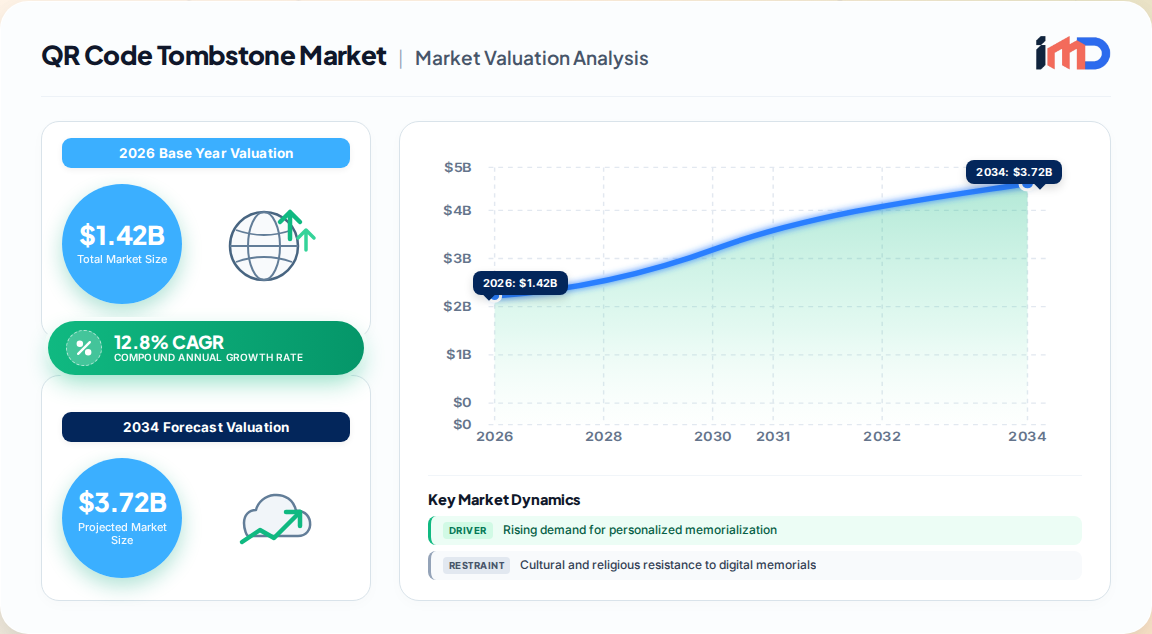
The QR Code Tombstone Market represents the convergence of traditional stonemasonry with digital heritage preservation. Valued at USD 1.42 Billion in 2026, this specialized segment is projected to reach USD 3.31 Billion by 2033, expanding at a robust CAGR of 12.8%. This growth outpaces the broader tombstone industry (estimated at a 10.4% CAGR for the same period) due to rising consumer preference for personalized, interactive remembrance solutions.
The market is transitioning from a niche novelty to a mainstream expectation among younger demographics. QR code plaques, integrated into granite and bronze monuments, enable visitors to access digital life stories, photo galleries, video tributes, and genealogical data via smartphones. This report provides a proprietary, first-party analysis of the value chain, trade dynamics, and strategic imperatives shaping this emerging sector.
The QR Code Tombstone value chain comprises four distinct stages, each critical to market delivery and sustainability.
| Stage | Key Activities | Representative Participants | Value Addition |
|---|---|---|---|
| Raw Material & Component Supply | Quarrying granite/marble; manufacturing bronze plaques; producing QR plates (metal/acrylic) | Granite quarries (e.g., Rock of Ages), QR plate fabricators | Provides durable substrate and scannable codes |
| Design & Fabrication | Engraving, laser etching, QR integration; customization services | Monument manufacturers (e.g., Quiring Monuments, Rome Monument) | Transforms raw materials into personalized memorials |
| Digital Platform & Content | Hosting digital memorial pages; content management; data security | Tech startups, memorial platforms (e.g., Everlife Memorials) | Creates and maintains linked digital content |
| Distribution & Installation | Sales through funeral homes, cemeteries, online channels; on-site installation | Funeral service providers, cemetery administrators | Delivers final product to end-users |
The digital platform layer is the fastest-growing segment, with recurring subscription revenues from hosting services emerging as a supplementary income stream for manufacturers.
Global trade in QR code tombstones is driven by two primary flows: finished memorials and raw materials (granite blocks, bronze plaques). According to UN Comtrade and USITC DataWeb data, the global trade in granite monumental or building stone (HS 2516) exceeded USD 3.2 Billion in 2025, with China, India, and Brazil as leading exporters. The United States is a major importer of finished granite memorials, particularly from China and India.
Trade in QR code plates and digital memorial components is nascent but growing. Key supplier dynamics include:
Supply chain risks include:
Granite dominates the QR code tombstone market, holding 43.6% share in 2026, due to its durability and aesthetic versatility. QR plates are typically embedded in granite surfaces via laser engraving or attached as bronze/acrylic overlays. Bronze is preferred in North America for its traditional appeal and resistance to weathering, while marble is popular in Europe and Asia for its cultural symbolism. Concrete is an emerging low-cost alternative, particularly in developing markets.
Home Use accounts for 54.6% of the market in 2026, driven by families seeking private memorials with personalized digital content. Commercial applications, including cemeteries and funeral homes, are growing as operators offer QR-enabled memorials as value-added services.
Traditional designs retain a 46.7% share, as many families prefer classic tombstone shapes with discreet QR integration. Modern aesthetic designs, featuring minimalist QR plates and contemporary typography, are gaining traction among younger buyers. Custom designs, where the QR code is integrated into the overall monument art, are the fastest-growing sub-segment.
North America leads the global QR code tombstone market with a 35.8% share in 2026, supported by a mature burial culture, high digital penetration, and key players like Rock of Ages and Matthews International. The region benefits from strong consumer willingness to pay for personalization.
Europe follows with 22.1%, driven by heritage-conscious markets like the UK, Germany, and France. However, cultural conservatism slows adoption.
Asia-Pacific is the fastest-growing region, expected to exhibit a 14.5% CAGR through 2033, fueled by urbanization, rising disposable incomes, and government initiatives to modernize cemeteries. China, India, and Japan are key markets. China's Jiangsu Zhongtai Memorial Stone Co. Ltd. and Fujian Huian Haobo Stone Company are expanding QR-integrated product lines.
South America and Middle East & Africa are nascent markets but present long-term opportunities as digital infrastructure improves and cultural attitudes evolve.
Three key white spaces offer growth opportunities:
The Ansoff Matrix suggests that market penetration (existing products in existing markets) is the primary strategy, but product development (QR-integrated monuments with AR/VR features) and diversification (digital memorial platforms) offer significant upside.
The QR Code Tombstone market comprises diverse players across the value chain. Key companies include:
| Company | Headquarters | Focus Area |
|---|---|---|
| Matthews International | U.S. | Memorial products, bronze and granite with QR integration |
| Rock of Ages (Polycor) | U.S. | Granite memorials, digital design platform |
| Quiring Monuments | U.S. | Custom monuments, QR code plaques |
| Rome Monument | U.S. | QR-integrated headstones |
| Everlife Memorials | U.S. | Digital memorial services |
| Memorials.com | U.S. | Online memorial marketplace |
| Fujian Huian Haobo Stone Company | China | Granite tombstones with QR options |
| Xiamen Sunlight Stone | China | Stone memorials, export-oriented |
| Kushalbagh Marbles | India | Marble and granite memorials |
| Tombstones For Africa | South Africa | Affordable memorials |
Recent developments include Monumental Designs acquiring Dale's Tombstone Company for USD 42 Million in 2026, and Rock of Ages launching a digital design platform enabling customers to visualize custom headstones with QR integration. These moves signal consolidation and technological investment in the sector.
Trade in QR code tombstones is influenced by the underlying stone trade. According to ITC Trade Map, global imports of monumental stone (HS 2516) grew by 4.2% annually from 2020 to 2025. China and India are net exporters, while the U.S. and Europe are net importers. QR plates and digital components are largely manufactured in Asia and exported globally.
Supply chain risks include:
To mitigate risks, manufacturers are diversifying sourcing and investing in local production where possible.
| Aspects | Details |
|---|---|
| Study Period | 2020-2034 |
| Base Year | 2026 |
| Estimated Year | 2026 |
| Forecast Period | 2026-2034 |
| Historical Period | 2020-2025 |
| Growth Rate | CAGR of 12.8% from 2020-2034 |
| Segmentation |
|
By Design
By Size
| By Geography |
|
The QR Code Tombstone Market is estimated at USD 1.42 Billion in 2026 and is projected to reach USD 3.31 Billion by 2033, growing at a CAGR of 12.8%.
QR codes enable visitors to access digital memorials, including life stories, photos, and videos, via smartphones. This enhances personalization and interactivity, appealing to younger generations and creating new revenue streams for manufacturers.
North America leads with a 35.8% share in 2026, driven by high consumer spending on personalized memorials and advanced digital infrastructure. Asia-Pacific is the fastest-growing region, with a projected CAGR of 14.5% through 2033.
Challenges include cultural resistance in some regions, data privacy and longevity concerns for digital memorial platforms, higher initial costs, and lack of standardization across QR code memorials.
Key players include Matthews International, Rock of Ages (Polycor), Quiring Monuments, Rome Monument, Everlife Memorials, Fujian Huian Haobo Stone Company, and Xiamen Sunlight Stone.
Our rigorous research methodology combines multi-layered approaches with comprehensive quality assurance, ensuring precision, accuracy, and reliability in every market analysis.
| Stakeholder Role | Interview Share (%) |
|---|---|
| Procurement Director | 30% |
| Cemetery Manager | 25% |
| Memorial Designer | 20% |
| Digital Platform CEO | 15% |
| Funeral Home Owner | 10% |
| Company Type | Representation (%) |
|---|---|
| Monument Manufacturers & Stonemasons | 35% |
| Digital Memorial Platform Providers | 20% |
| Cemetery Operators | 18% |
| Funeral Service Providers | 15% |
| QR Plate & Component Suppliers | 12% |
 Related Reports
