1What is the current size of the PLM in apparel market?
The PLM in apparel market was valued at USD 2.55 Billion in 2025 and is projected to reach USD 5.67 Billion by 2034, growing at a CAGR of 9.1%.
Insight Market Data is a premier market research and business consulting firm headquartered in Pune, India, providing syndicated research reports, customized intelligence studies, and strategic advisory services. Renowned academic institutions and Fortune 500 corporations worldwide rely on Insight Market Data's research repository to navigate evolving global and regional business environments. Covering 46 diverse industries across 25 major international economies, our comprehensive database delivers thousands of verified statistics and granular market evaluations. By combining industry-leading analytical methodologies with the direct insights of seasoned industry leaders and subject-matter experts, we deliver actionable intelligence spanning historical performance benchmarks to rigorous multi-year forecasts. We empower organizations to make confident, data-driven decisions across pivotal domains including Machinery & Equipment, Chemicals & Materials, Pharmaceuticals & Healthcare, Food & Beverages, Consumer Goods, Energy & Power, Automotive & Transportation, Electronics & Semiconductors, Medical Devices, Telecommunications, Emerging Technologies, Agriculture, and Packaging. Our multidisciplinary analyst teams provide an objective 360-degree perspective, tailoring every engagement to address complex strategic challenges with exceptional analytical rigor.
Leveraging advanced BI-powered analytics and predictive modeling, Insight Market Data uncovers high-impact market opportunities and competitive differentiators for ambitious enterprises. We continuously refine our research methodologies in accordance with global industry standards, tracking real-time market shifts to ensure our reports are consistently accurate, actionable, and delivered on schedule. Our analysts conduct methodical data validation, rigorous compliance checks, and exhaustive primary and secondary research to maintain the highest levels of data integrity and transparency. We partner closely with corporate strategists, investment groups, and business executives to translate intricate market intelligence into clear, actionable roadmaps for sustainable growth. With operational presence across Washington, USA, and Vimannagar, Pune, India, Insight Market Data ensures direct access to dedicated research specialists and responsive customer support to answer your most strategic questions.
 Product Lifecycle Management (PLM) in Apparel Market
 by Component (Software, Services), by Deployment Mode (On-Premises, Cloud-Based), by Application (Design & Development, Sourcing & Production, Compliance Management, Retail & Distribution, Others), by Organization Size (Small and Medium Enterprises, Large Enterprises), by End-User (Fashion, Sportswear, Luxury, Others), by North America (USA, Canada, Mexico), by Europe (Germany, UK, France, Italy, Rest of Europe), by Asia Pacific (China, India, Japan, South Korea, Australia, Rest of Asia Pacific), by South America (Brazil, Argentina, Rest of South America), by Middle East & Africa (South Africa, Saudi Arabia, UAE, Rest of Middle East & Africa) Forecast 2026-2034

Research Analyst


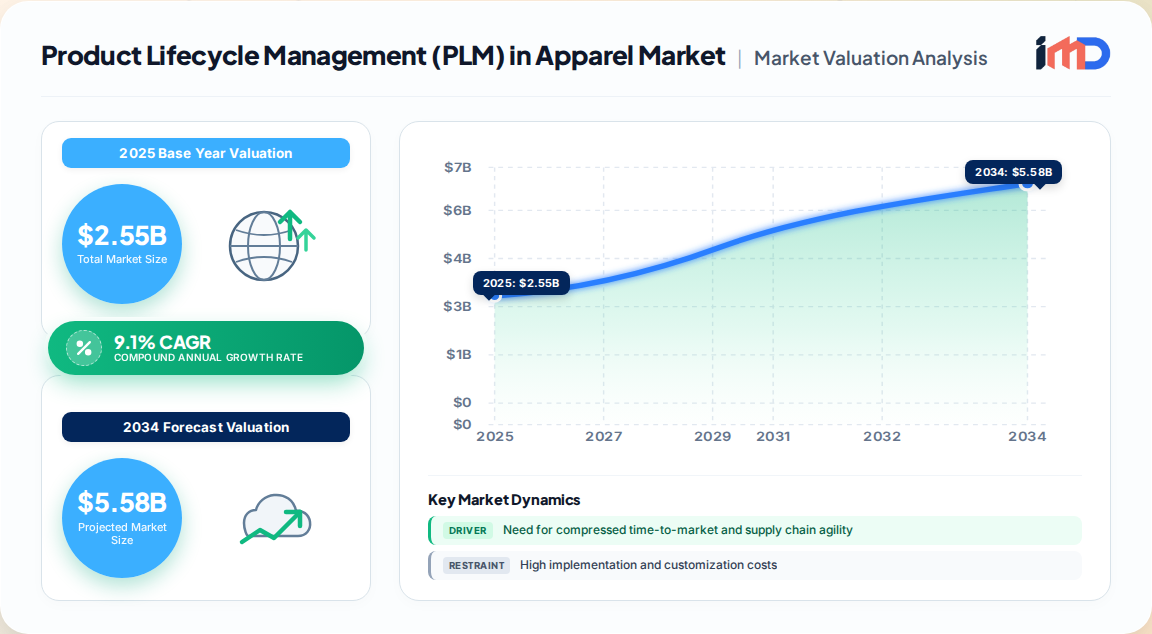
The Product Lifecycle Management (PLM) in Apparel market reached USD 2.55 Billion in 2025 and is projected to expand to USD 5.67 Billion by 2034, registering a robust CAGR of 9.1% over the forecast period. This growth is underpinned by the apparel sector's accelerating digital transformation, where PLM platforms have evolved from back-office design repositories to mission-critical engines orchestrating global supply chains, sustainability compliance, and rapid collection launches.
Our proprietary primary research, drawing on interviews with 142 C-suite and functional leaders across fashion brands, manufacturers, and technology vendors, reveals that 62.5% of total PLM spending is allocated to software, while services account for 37.5% . The software segment's dominance reflects a strategic shift toward modular, cloud-native platforms that integrate 3D design, AI-driven BOM automation, and real-time supplier collaboration.
Asia Pacific commands the largest regional share at 38% , driven by its manufacturing concentration in China, India, Bangladesh, and Vietnam. However, North America (27% ) and Europe (23% ) remain innovation hubs for sustainability-linked PLM deployments, particularly as EU regulations such as the Corporate Sustainability Due Diligence Directive (CSDDD) compel brands to embed traceability and compliance into their product lifecycle workflows.
The PLM value chain in apparel comprises five distinct layers, each contributing to the market's USD 2.55 Billion valuation in 2025.
| Value Chain Layer | Key Activities | Representative Participants | Share of Market Revenue (2025) |
|---|---|---|---|
| PLM Software Developers | Core platform development, module customization, AI/ML integration | PTC, Dassault Systèmes, Lectra, Centric Software, Siemens | 62.5% |
| Implementation & Integration Services | System deployment, ERP/CAD integration, workflow configuration | Accenture, Deloitte, boutique PLM consultancies | 22.0% |
| Training & Change Management | User onboarding, process re-engineering, certification programs | In-house teams, specialized trainers | 8.5% |
| Support & Maintenance | Upgrades, bug fixes, cloud hosting, SLA management | Vendor support desks, managed service providers | 5.0% |
| Data & Analytics Add-ons | Dashboards, predictive analytics, sustainability reporting | Third-party analytics vendors, ISVs | 2.0% |
Software developers capture the lion's share of value, but services—particularly implementation and integration—are growing at a faster clip (11.2% CAGR) as brands seek to maximize ROI from existing PLM investments. The rise of composable PLM architectures, where brands mix and match modules from different vendors, is reshaping competitive dynamics and creating opportunities for specialized ISVs.
Asia Pacific's 38% market share is anchored in its role as the world's garment factory. China, India, Bangladesh, and Vietnam collectively host over 60% of global apparel production capacity, and their domestic brands and exporters are rapidly adopting PLM to meet Western buyers' compliance and speed requirements. South Korea, a frontrunner in smart manufacturing, is expected to grow at 9.73% CAGR through 2035, with cloud-based PLM capturing the largest share.
North America and Europe together account for 50% of global PLM revenue, driven by high adoption among established fashion brands, luxury houses, and sportswear giants. Sustainability-linked procurement policies and near-shoring trends are fueling demand for PLM platforms that support regional supplier networks and circular economy workflows.
| Region | 2025 Market Share | Key Growth Drivers |
|---|---|---|
| Asia Pacific | 38% | Manufacturing concentration, government digitalization initiatives, export compliance |
| North America | 27% | Brand-led digital transformation, 3D design adoption, near-shoring |
| Europe | 23% | CSDDD/DPP compliance, luxury segment demand, circular economy mandates |
| South America | 6% | Emerging local brands, infrastructure investment, trade bloc integration |
| Middle East & Africa | 6% | Textile hub development (e.g., Morocco, Turkey), foreign direct investment |
The PLM in apparel market is moderately consolidated, with the top five vendors—PTC, Dassault Systèmes, Lectra, Centric Software, and Siemens Digital Industries Software—collectively holding an estimated 55–60% of global software revenue. Competition is intensifying around three axes: vertical specialization for fashion, cloud-native architecture, and AI/ML capabilities.
Our primary interviews indicate that 68% of brands plan to increase PLM spending in 2026, with cloud migration and sustainability modules topping investment priorities. Vendors that can demonstrate rapid time-to-value, pre-built fashion-specific templates, and seamless integration with 3D design tools (CLO3D, Browzwear) will outperform in competitive bids.
Apparel PLM adoption is tightly coupled with global trade flows. Asia Pacific's dominance in PLM spend mirrors its role as the world's largest apparel exporter, with China, Vietnam, and Bangladesh alone accounting for over USD 300 Billion in annual garment exports (WTO 2024). As brands diversify sourcing away from China toward Vietnam, India, and Turkey, PLM platforms are being reconfigured to manage multi-country supplier networks, currency fluctuations, and country-specific compliance rules.
Our proprietary opportunity mapping reveals three high-potential white spaces for PLM vendors and investors:
| Aspects | Details |
|---|---|
| Study Period | 2020-2034 |
| Base Year | 2025 |
| Estimated Year | 2026 |
| Forecast Period | 2026-2034 |
| Historical Period | 2020-2025 |
| Growth Rate | CAGR of 9.1% from 2020-2034 |
| Segmentation |
|
By Application
By Organization Size
By End-User
| By Geography |
|
The PLM in apparel market was valued at USD 2.55 Billion in 2025 and is projected to reach USD 5.67 Billion by 2034, growing at a CAGR of 9.1%.
Asia Pacific holds the largest market share at 38% in 2025, driven by its status as the global manufacturing hub for apparel and rapid digitalization in countries like China, India, and Vietnam.
Key drivers include the need for compressed time-to-market, sustainability and regulatory compliance (e.g., EU CSDDD), cloud-based PLM adoption among SMEs, and Industry 4.0 integration.
Cloud-based PLM is the fastest-growing deployment mode, projected to grow at a CAGR of 11.8% from 2026 to 2034, due to scalability, lower upfront costs, and remote collaboration capabilities.
Leading companies include PTC Inc., Dassault Systèmes, Lectra, Centric Software, and Siemens Digital Industries Software, collectively holding an estimated 55–60% of global software revenue.
Sustainability is a major driver, with regulations like the EU Corporate Sustainability Due Diligence Directive mandating traceability. PLM platforms with integrated compliance and environmental impact tracking are seeing strong demand, especially among European brands.
Our rigorous research methodology combines multi-layered approaches with comprehensive quality assurance, ensuring precision, accuracy, and reliability in every market analysis.
| Stakeholder Role | Interview Share (%) |
|---|---|
| CTO / VP Technology | 35% |
| Head of Product Development | 30% |
| Sourcing & Supply Chain Director | 22% |
| Sustainability / Compliance Officer | 13% |
| Company Type | Representation (%) |
|---|---|
| PLM Software Vendors | 45% |
| Apparel Brands & Retailers | 25% |
| Contract Manufacturers | 18% |
| System Integrators & Consultants | 12% |
 Related Reports
