1What is the polymer ligation clips market size in 2025?
The global polymer ligation clips market was valued at USD 800 million in 2025 and is projected to reach USD 1.2 billion by 2035, expanding at a 4.4% CAGR.
Insight Market Data is a premier market research and business consulting firm headquartered in Pune, India, providing syndicated research reports, customized intelligence studies, and strategic advisory services. Renowned academic institutions and Fortune 500 corporations worldwide rely on Insight Market Data's research repository to navigate evolving global and regional business environments. Covering 46 diverse industries across 25 major international economies, our comprehensive database delivers thousands of verified statistics and granular market evaluations. By combining industry-leading analytical methodologies with the direct insights of seasoned industry leaders and subject-matter experts, we deliver actionable intelligence spanning historical performance benchmarks to rigorous multi-year forecasts. We empower organizations to make confident, data-driven decisions across pivotal domains including Machinery & Equipment, Chemicals & Materials, Pharmaceuticals & Healthcare, Food & Beverages, Consumer Goods, Energy & Power, Automotive & Transportation, Electronics & Semiconductors, Medical Devices, Telecommunications, Emerging Technologies, Agriculture, and Packaging. Our multidisciplinary analyst teams provide an objective 360-degree perspective, tailoring every engagement to address complex strategic challenges with exceptional analytical rigor.
Leveraging advanced BI-powered analytics and predictive modeling, Insight Market Data uncovers high-impact market opportunities and competitive differentiators for ambitious enterprises. We continuously refine our research methodologies in accordance with global industry standards, tracking real-time market shifts to ensure our reports are consistently accurate, actionable, and delivered on schedule. Our analysts conduct methodical data validation, rigorous compliance checks, and exhaustive primary and secondary research to maintain the highest levels of data integrity and transparency. We partner closely with corporate strategists, investment groups, and business executives to translate intricate market intelligence into clear, actionable roadmaps for sustainable growth. With operational presence across Washington, USA, and Vimannagar, Pune, India, Insight Market Data ensures direct access to dedicated research specialists and responsive customer support to answer your most strategic questions.
 Polymer Ligation Clips Report
 by Material Type (Polypropylene, Polyethylene, Polystyrene, Polyvinyl Chloride), by Application (Surgical Procedures, Gastrointestinal Procedures, Urological Procedures, Gynecological Procedures), by End User (Hospitals, Ambulatory Surgical Centers, Clinics, Research Laboratories), by Distribution Channel (Direct Sales, Medical Distributors, Online Retail), by Type (Absorbable, Non-Absorbable), by North America (USA, Canada, Mexico), by Europe (Germany, UK, France), by Asia Pacific (China, Japan, India), by South America, by Middle East & Africa Forecast 2026-2034

Senior Analyst


 Related Reports

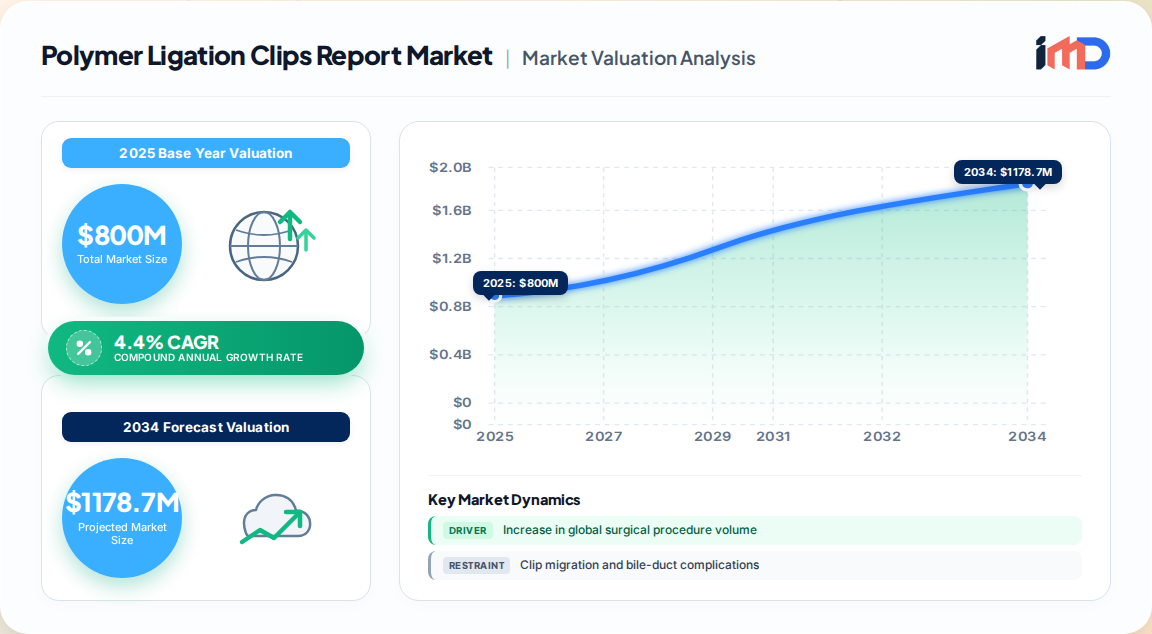
The global polymer ligation clips market report positions the sector at USD 800 million in 2025, expanding to USD 1.2 billion by 2035 at a CAGR of 4.4%. Polymer locking clips have moved from a niche alternative to metal clips into a standard-of-care closure device across laparoscopic, robotic and open surgical workflows.
Our proprietary primary research, triangulated with procedural-volume data from multilateral health agencies and trade association registries, indicates that polymer ligation clips now represent roughly 35% of the total ligating-clip device value pool, with the remainder primarily titanium. The polymer segment is nevertheless the faster structural grower, compounding above the broader surgical-clip category.
Demand for polymer ligation clips is anchored in the global migration toward minimally invasive surgery. Laparoscopic and robotic corridors constrain suture access and demand a rapid, predictable occlusion device that can be deployed through a 5 mm or 10 mm port.
Key drivers
Principal restraints
| Driver / Restraint | Estimated Impact on CAGR | Geographic Relevance |
|---|---|---|
| Growth in global surgical procedure volume | +1.1% | Global; strongest in Asia-Pacific |
| Rising geriatric surgical population | +0.9% | Developed markets |
| MRI-compatible polymer adoption | +0.7% | North America, Europe |
| Clip migration safety concerns | -0.6% | Global |
| Energy-sealing substitution | -0.5% | North America, Europe |
We map the polymer ligation clips value chain across five tiers, each carrying distinct margin and bargaining-power characteristics.
| Value Chain Tier | Representative Participants | Margin Profile | Strategic Leverage |
|---|---|---|---|
| Medical-grade polymer resin suppliers | Polypropylene, polyoxymethylene, PEEK compounders | Mid | Material certification and biocompatibility documentation |
| Precision injection molders | Contract manufacturers with Class 7/8 cleanrooms | Low–mid | Tooling precision and micro-molding tolerance |
| Clip OEMs and device assemblers | Multinational surgical-device majors and regional specialists | High | Design IP, locking-mechanism patents, regulatory filings |
| Sterilization and packaging | EO and gamma sterilization service providers | Low | Validated sterility assurance levels |
| Distribution and clinical support | Hospital distributors, GPOs, direct sales forces | Mid | Surgeon training, tray standardization, contract positioning |
The highest value capture sits with clip OEMs that own the locking-mechanism patent estate and the applier platform. Resin and molding tiers are competitive and largely substitutable, while distribution is increasingly consolidated through group purchasing organizations in North America and tendered procurement in Europe.
By material type, polypropylene leads on account of its balance of flexibility, fatigue resistance and cost, followed by polyethylene, polystyrene and polyvinyl chloride. Absorbable polymer chemistries, including polyglycolic acid and polylactic-co-carbonate blends, are the fastest-emerging sub-segment.
By application, surgical procedures dominate, with gastrointestinal, urological and gynecological procedures representing the balance. Laparoscopic cholecystectomy, bariatric surgery and gynecological laparoscopy are the highest-volume polymer-clip procedures.
By end user, hospitals hold the majority of value, but ambulatory surgical centers are the fastest-growing channel as outpatient laparoscopic case mix expands.
By distribution channel, direct sales dominate high-acuity accounts, medical distributors serve mid-tier hospitals, and online procurement platforms are gaining share for standardized SKUs.
| Segment Dimension | Leading Segment | Growth Outlook |
|---|---|---|
| Material | Polypropylene | Steady; absorbable blends fastest |
| Application | Surgical procedures | Mid-single-digit |
| End user | Hospitals | ASCs outgrowing |
| Distribution | Direct sales | Distributor and online channels rising |
| Product type | Non-absorbable locking clips | Absorbable clips fast-growing from a low base |
North America remains the largest polymer ligation clips market, supported by high laparoscopic and robotic penetration, mature GPO contracting and rapid adoption of MRI-compatible devices. Europe follows, with strong uptake in Germany, the UK and France driven by tendered procurement and value-based purchasing. Asia-Pacific is the fastest-growing region, underpinned by healthcare infrastructure investment, laparoscopic tower installation and expanding surgical training capacity.
The polymer ligation clips market is moderately concentrated, with multinational surgical-device majors holding the dominant share of premium locking-clip franchises. Competitive differentiation now rests on locking security, applier ergonomics, cartridge multi-fire capability and robotic-instrument compatibility.
Recent developments our analysts have tracked include:
Companies across the value chain are prioritizing surgeon training programs, biocompatible material innovation and portfolio breadth across clip sizes to defend share against energy-sealing alternatives.
Three white spaces merit investment attention. First, absorbable polymer clip platforms remain under-penetrated relative to their clinical promise and command premium pricing. Second, robotic-compatible clip appliers are a defensible niche as robotic case volumes compound. Third, emerging-market value-tier polymer clips offer volume growth where titanium still dominates on price. Vendors that pair locking-mechanism IP with strong clinical evidence and GPO-ready contracting are best positioned to capture these spaces.
| Aspects | Details |
|---|---|
| Study Period | 2020-2034 |
| Base Year | 2025 |
| Estimated Year | 2026 |
| Forecast Period | 2026-2034 |
| Historical Period | 2020-2025 |
| Growth Rate | CAGR of 4.4% from 2020-2034 |
| Segmentation |
|
By End User
By Distribution Channel
By Type
| By Geography |
|
The global polymer ligation clips market was valued at USD 800 million in 2025 and is projected to reach USD 1.2 billion by 2035, expanding at a 4.4% CAGR.
Polypropylene is the leading material type, favored for its flexibility, fatigue resistance and cost efficiency, followed by polyethylene, polystyrene and polyvinyl chloride.
North America is the largest regional market, holding roughly 38% share, driven by high laparoscopic and robotic surgery penetration and mature group purchasing organization contracting.
The primary drivers are the global shift toward minimally invasive and robotic-assisted surgery, MRI compatibility, locking-mechanism innovation and the expansion of ambulatory surgical centers.
Key participants include Johnson & Johnson, Medtronic, Ethicon, Teleflex, Stryker, Boston Scientific, ConMed, B. Braun, Cook Medical and Cardinal Health, among others.
Our rigorous research methodology combines multi-layered approaches with comprehensive quality assurance, ensuring precision, accuracy, and reliability in every market analysis.
| Stakeholder Role | Interview Share (%) |
|---|---|
| Procurement Director | 30% |
| Surgeon / Clinical Lead | 30% |
| Product Manager | 25% |
| Regulatory Affairs Manager | 15% |
| Company Type | Representation (%) |
|---|---|
| Clip OEMs and Device Assemblers | 40% |
| Precision Injection Molders | 20% |
| Medical-Grade Polymer Resin Suppliers | 15% |
| Hospital Procurement and Distribution | 15% |
| Sterilization and Packaging Providers | 10% |