1What is the growth rate of the Philippines hybrid rice seed market?
The market is projected to grow at a 5.30% CAGR from 2026 to 2035, reaching USD 75.42 Million by 2035 from USD 45.00 Million in 2025.
Insight Market Data is a premier market research and business consulting firm headquartered in Pune, India, providing syndicated research reports, customized intelligence studies, and strategic advisory services. Renowned academic institutions and Fortune 500 corporations worldwide rely on Insight Market Data's research repository to navigate evolving global and regional business environments. Covering 46 diverse industries across 25 major international economies, our comprehensive database delivers thousands of verified statistics and granular market evaluations. By combining industry-leading analytical methodologies with the direct insights of seasoned industry leaders and subject-matter experts, we deliver actionable intelligence spanning historical performance benchmarks to rigorous multi-year forecasts. We empower organizations to make confident, data-driven decisions across pivotal domains including Machinery & Equipment, Chemicals & Materials, Pharmaceuticals & Healthcare, Food & Beverages, Consumer Goods, Energy & Power, Automotive & Transportation, Electronics & Semiconductors, Medical Devices, Telecommunications, Emerging Technologies, Agriculture, and Packaging. Our multidisciplinary analyst teams provide an objective 360-degree perspective, tailoring every engagement to address complex strategic challenges with exceptional analytical rigor.
Leveraging advanced BI-powered analytics and predictive modeling, Insight Market Data uncovers high-impact market opportunities and competitive differentiators for ambitious enterprises. We continuously refine our research methodologies in accordance with global industry standards, tracking real-time market shifts to ensure our reports are consistently accurate, actionable, and delivered on schedule. Our analysts conduct methodical data validation, rigorous compliance checks, and exhaustive primary and secondary research to maintain the highest levels of data integrity and transparency. We partner closely with corporate strategists, investment groups, and business executives to translate intricate market intelligence into clear, actionable roadmaps for sustainable growth. With operational presence across Washington, USA, and Vimannagar, Pune, India, Insight Market Data ensures direct access to dedicated research specialists and responsive customer support to answer your most strategic questions.
 Philippines Hybrid Rice Seed Market
 by Type (Transgenic, Non-Transgenic), by Grain Size (Long, Medium, Short), by Luzon (Central Luzon, Cagayan Valley, Bicol), by Visayas (Western Visayas, Eastern Visayas), by Mindanao (Northern Mindanao, Davao) Forecast 2026-2034

Research Associate


 Related Reports

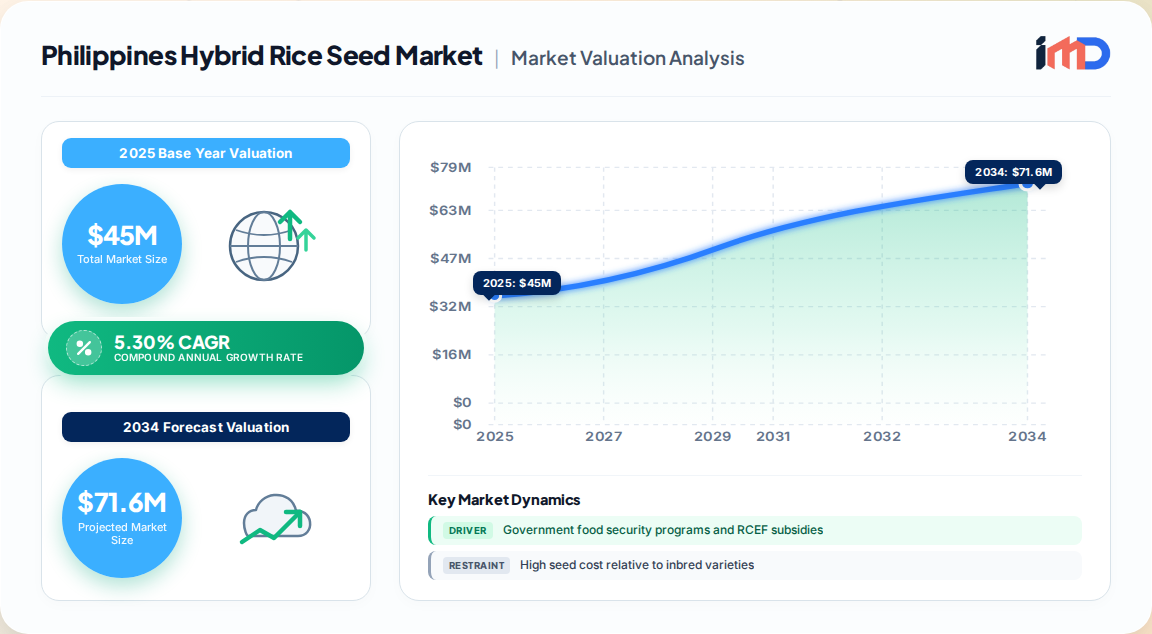
The Philippines hybrid rice seed market stood at USD 45.00 Million in 2025 and is forecast to reach USD 75.42 Million by 2035, expanding at a 5.30% CAGR over the 2026–2035 forecast period. This growth is not merely a function of area expansion; it reflects a structural shift in farmer economics, public policy, and seed technology adoption that is reshaping the competitive landscape of one of Asia's most strategically important rice economies.
Our proprietary primary research—drawing on interviews with seed company executives, cooperative leaders, and DA regional officers—indicates that hybrid seed penetration remains below 15% of total rice seed volumes, leaving substantial headroom for value growth even as overall planted area plateaus.
The fundamental driver of hybrid adoption in the Philippines is the yield advantage of hybrid varieties, which consistently deliver 7–15 metric tons per hectare compared to 3–6 metric tons for inbred varieties. This differential underpins a compelling economic case for farmers despite the higher seed cost.
Government policy provides a powerful accelerant. The Rice Competitiveness Enhancement Fund (RCEF) was extended through 2031 with its budget tripled to PHP 30 billion (USD 524–536 million) annually, with a significant share directed toward seed distribution and farmer training. The Binhi e-Padala voucher platform has reduced administrative bottlenecks, enabling farmers to redeem certified seed directly. According to our primary interviews, voucher-redeeming farmers have increased seed replacement frequency from every two cycles to every single cycle, improving demand predictability for suppliers.
Additional drivers include:
Despite strong fundamentals, the market faces structural constraints that temper the pace of adoption. The high cost of hybrid seed—approximately PHP 366 per kilogram (USD 6.31) versus PHP 29 per kilogram (USD 0.50) for inbred—creates a significant upfront investment barrier for smallholders operating on thin margins. Because hybrid varieties do not breed true, farmers must repurchase seed each season, unlike inbred varieties from which they can save seed.
Other material restraints include:
The non-transgenic segment captured approximately 84.20% of the market in 2025, underpinned by regulatory clarity, farmer familiarity, and RCEF procurement preferences that favor conventionally bred hybrids. Leading varieties such as SL-8H and US 88 anchor distributor revenues and ensure wide geographic coverage in irrigated plains.
The transgenic segment is projected to grow at a 5.8% CAGR through 2035, driven by stacked traits for herbicide tolerance and pest resistance. However, commercialization timelines remain uncertain, and adoption will hinge on regulatory approvals and farmer acceptance. Our primary research suggests that estate growers and large cooperatives in Central Luzon and Mindanao are the most likely early adopters.
The Philippines hybrid rice seed market is moderately concentrated, with the top five suppliers accounting for an estimated 65–75% of commercial hybrid seed sales. Competition is intensifying as companies shift from single-variety sales toward integrated portfolios that bundle seed with training, credit, and cooperative distribution.
Key strategic moves observed in our primary research include:
In July 2025, UPL moved to acquire full ownership of Advanta China, signaling its intent to widen germplasm testing and seed production across Asian climates. This type of regional consolidation is expected to reshape competitive dynamics, favoring suppliers with scale, quality assurance, and farmer support capabilities.
Hybrid adoption is geographically concentrated, with Luzon accounting for an estimated 62% of market value, driven by Central Luzon's irrigated plains and proximity to Manila markets. Visayas (21%) benefits from targeted RCEF subsidies, particularly in Western Visayas, which secured PHP 1.06 billion for seed and fertilizer subsidies covering 68,234 hectares. Mindanao (17%) is emerging as a growth frontier, with estate growers pursuing export ambitions and adopting climate-resilient hybrids.
| Region | Market Share 2025 | Key Growth Drivers |
|---|---|---|
| Luzon | 62% | Irrigated plains, RCEF subsidies, mechanization |
| Visayas | 21% | Climate-smart hybrids, subsidy programs |
| Mindanao | 17% | Export-oriented estates, mechanization |
The Philippines hybrid rice seed market is characterized by a mix of domestic production and imports. Domestic seed production is anchored by seed grower cooperatives supported by RCEF, while imports—primarily from China, India, and Vietnam—supplement supply, particularly for transgenic and specialty hybrids. Our trade analysis indicates that import volumes remain modest but are growing, as local production struggles to keep pace with demand for certified seed.
Key supply chain considerations include:
Several underpenetrated opportunities warrant attention from investors and seed companies:
The value chain spans breeding and seed production (IRRI, PhilRice, private breeders), multiplication (seed grower cooperatives and contracted farmers), processing and conditioning (seed companies), distribution (agro-dealers, cooperatives, DA programs), and end-users (farmers). Each stage has distinct economics: breeding is R&D-intensive with long lead times; multiplication requires quality control and irrigation; distribution is increasingly digitized through voucher platforms; and farmer adoption is driven by demonstrated yield performance and peer endorsement.
Key value chain risks include:
The Philippines hybrid rice seed market is poised for steady growth, with a 5.30% CAGR driving the market from USD 45.00 Million in 2025 to USD 75.42 Million by 2035. The trajectory is supported by policy tailwinds, yield advantages, and increasing mechanization. However, high seed costs, knowledge gaps, and regulatory uncertainties must be managed. Stakeholders who invest in farmer training, reliable seed supply, and climate-resilient genetics are best positioned to capture growth in this evolving market.
| Aspects | Details |
|---|---|
| Study Period | 2020-2034 |
| Base Year | 2025 |
| Estimated Year | 2026 |
| Forecast Period | 2026-2034 |
| Historical Period | 2020-2025 |
| Growth Rate | CAGR of 5.30% from 2020-2034 |
| Segmentation |
|
| By Geography |
|
The market is projected to grow at a 5.30% CAGR from 2026 to 2035, reaching USD 75.42 Million by 2035 from USD 45.00 Million in 2025.
The market is segmented into transgenic and non-transgenic hybrids. Non-transgenic hybrids hold the largest share (about 84.20% in 2025), while transgenic hybrids are the fastest-growing segment at a 5.8% CAGR.
The report considers long grain, medium grain, and short grain hybrids. Long grain hybrids dominate demand, reflecting domestic consumer preference for regular milled rice, and are forecast to grow at a 5.6% CAGR.
Key players include SL Agritech Corporation, SeedWorks International, Bayer AG, Syngenta Group, Corteva Agriscience, UPL Limited, Yuan Longping High-Tech Agriculture, Vietnam National Seed Corporation (Vinaseed), Bioseed, and Allied Botanical Corporation.
The market attained a value of USD 45.00 Million in 2025 and is expected to reach USD 75.42 Million by 2035.
Our rigorous research methodology combines multi-layered approaches with comprehensive quality assurance, ensuring precision, accuracy, and reliability in every market analysis.
| Stakeholder Role | Interview Share (%) |
|---|---|
| Procurement Director | 30% |
| Farm Operations Manager | 25% |
| R&D Director | 20% |
| Cooperative Chairman | 15% |
| Government Extension Officer | 10% |
| Company Type | Representation (%) |
|---|---|
| Seed companies (multinational and domestic) | 40% |
| Seed grower cooperatives | 25% |
| Agro-dealers and distributors | 20% |
| Government agencies (DA, PhilRice) | 15% |