1What is the pharmaceutical logistics market size in 2026?
The global pharmaceutical logistics market is estimated at USD 117.3 billion in 2026, projected to reach USD 208.3 billion by 2033 at a CAGR of 8.5%.
Insight Market Data is a premier market research and business consulting firm headquartered in Pune, India, providing syndicated research reports, customized intelligence studies, and strategic advisory services. Renowned academic institutions and Fortune 500 corporations worldwide rely on Insight Market Data's research repository to navigate evolving global and regional business environments. Covering 46 diverse industries across 25 major international economies, our comprehensive database delivers thousands of verified statistics and granular market evaluations. By combining industry-leading analytical methodologies with the direct insights of seasoned industry leaders and subject-matter experts, we deliver actionable intelligence spanning historical performance benchmarks to rigorous multi-year forecasts. We empower organizations to make confident, data-driven decisions across pivotal domains including Machinery & Equipment, Chemicals & Materials, Pharmaceuticals & Healthcare, Food & Beverages, Consumer Goods, Energy & Power, Automotive & Transportation, Electronics & Semiconductors, Medical Devices, Telecommunications, Emerging Technologies, Agriculture, and Packaging. Our multidisciplinary analyst teams provide an objective 360-degree perspective, tailoring every engagement to address complex strategic challenges with exceptional analytical rigor.
Leveraging advanced BI-powered analytics and predictive modeling, Insight Market Data uncovers high-impact market opportunities and competitive differentiators for ambitious enterprises. We continuously refine our research methodologies in accordance with global industry standards, tracking real-time market shifts to ensure our reports are consistently accurate, actionable, and delivered on schedule. Our analysts conduct methodical data validation, rigorous compliance checks, and exhaustive primary and secondary research to maintain the highest levels of data integrity and transparency. We partner closely with corporate strategists, investment groups, and business executives to translate intricate market intelligence into clear, actionable roadmaps for sustainable growth. With operational presence across Washington, USA, and Vimannagar, Pune, India, Insight Market Data ensures direct access to dedicated research specialists and responsive customer support to answer your most strategic questions.

 Pharmaceutical Logistics Market
 by Type (Non-Cold Chain Logistics, Cold Chain Logistics), by Component (Storage(Warehouse, Refrigerator Containers), Transportation(Air Freight, Sea Freight, Road Freight, Rail Freight), Monitoring Components), by Application (Chemical Pharma, Bio-Pharma, Specialized Pharma), by Operation (Roadways, Airways, Seaways, Railways, Storage and Services), by North America (USA, Canada, Mexico), by Europe (Germany, UK, France, Switzerland, Belgium), by Asia Pacific (China, India, Japan, Singapore), by South America (Brazil, Argentina), by Middle East & Africa (UAE, South Africa) Forecast 2026-2034

Research Analyst

 Related Reports

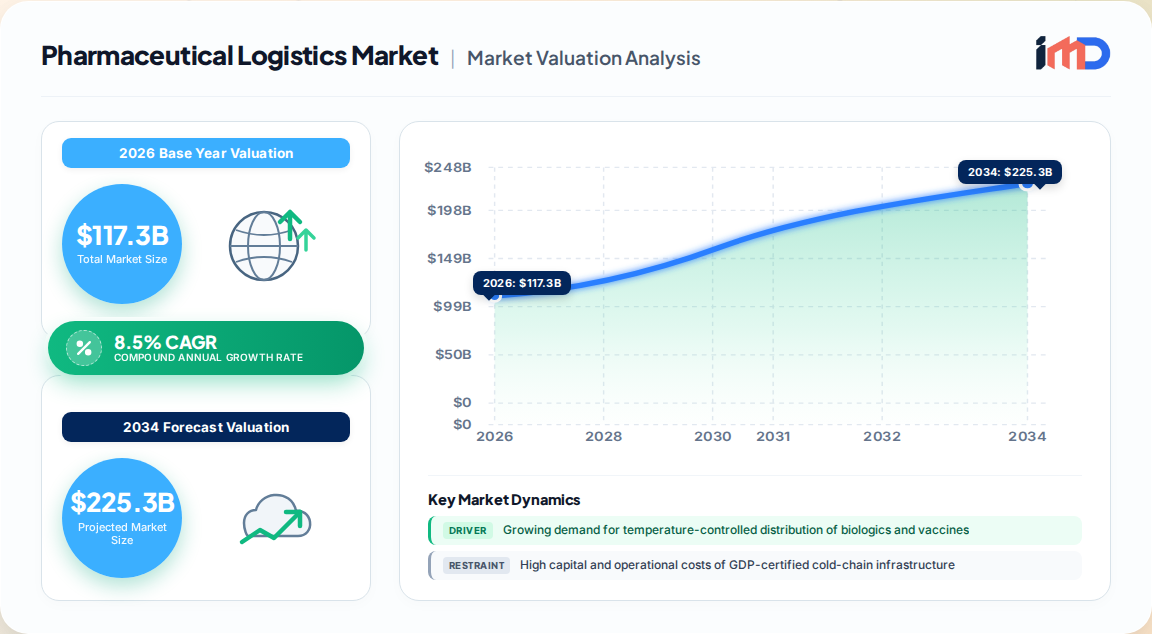
The global pharmaceutical logistics market represents the specialized operational backbone of the healthcare supply chain, encompassing temperature-controlled warehousing, validated transportation, serialization, and last-mile distribution. Our proprietary primary research estimates the market at USD 117.3 billion in 2026, projected to reach USD 208.3 billion by 2033, expanding at a CAGR of 8.5%. This growth is structurally distinct from general freight forwarding; it is driven by a fundamental mix shift toward biologics, cell and gene therapies, and direct-to-patient distribution models that demand auditable, end-to-end thermal and data integrity.
Europe remains the largest regional market, commanding a 36.0% revenue share, underpinned by dense GDP-certified corridors and concentrated biologics manufacturing. Asia-Pacific is the fastest-growing region, supported by expanding export-grade cold storage capacities in India and China, alongside domestic immunization network investments. North America holds a significant share, propelled by the commercialization of advanced therapies and high clinical-trial returns volume.
The pharmaceutical logistics market is governed by a unique set of forces that distinguish it from broader logistics sectors. Our expert interviews with supply chain directors and regulatory affairs specialists reveal a sector transitioning from an asset-intensive model to a data-arbitrated service business.
Key Growth Drivers:
Restraints and Challenges:
The value chain is characterized by a shift toward integrated 3PL and 4PL partnerships. Manufacturers are increasingly outsourcing labeling, packaging, and secondary distribution to specialized providers to reduce geographic concentration and distribution costs.
| Value Chain Stage | Key Activities | Critical Success Factors |
|---|---|---|
| Manufacturing Handoff | Primary packaging, batch release | Serialization compliance, GMP standards |
| Storage & Warehousing | Multi-zone chambers, inventory mgmt. | GDP certification, temperature mapping |
| Transportation | Air, sea, road, rail freight | Lane validation, IoT telemetry, cross-dock speed |
| Last-Mile & Delivery | Direct-to-patient, pharmacy, hospital | Small-parcel thermal packaging, appointment scheduling |
| Data & Compliance | Chain-of-custody, auditable digital visibility | Control tower integration, AI risk prediction |
A defining trend is the demand for local logistics providers with high expertise in pharmaceuticals, as drug manufacturers seek to mitigate risk and improve service levels. However, this preference introduces a trade-off: deterioration in service levels and loss of direct control are significant threats in outsourced operations.
The market is segmented by type, component, and application, with each segment exhibiting distinct growth trajectories.
By Type:
By Component:
By Application:
Europe: The largest market, with 34-36% revenue share (estimates vary by segment scope), supported by GDP-certified corridors across Germany, Switzerland, and Belgium. The UK and Benelux regions are key hubs for clinical trial logistics and biologics manufacturing.
Asia-Pacific: The fastest-growing region, driven by pharmaceutical manufacturing expansion in India and China, along with government initiatives like India's PM Gati Shakti and the National Logistics Policy. Air India became the first Indian airline to receive GDP certification for cargo operations in April 2025, signaling a step toward becoming a global pharma export hub.
North America: A mature market with a highly fragmented competitive landscape. The U.S. accounts for the bulk of demand, supported by increasing sales of generic drugs and DSCSA compliance-driven services. Cell and gene therapy commercialization is a key growth driver.
Middle East & Africa: The smallest but structurally underserved region, with emerging immunization programs and healthcare infrastructure investments presenting long-term opportunities.
The market is highly competitive, featuring global integrators, specialized healthcare logistics providers, and regional 3PLs.
Key success factors include strategic alliances with technology companies, development of locally-trained agile teams, and investment in cloud-based supply chain solutions to ensure drug authenticity and prevent counterfeit products.
Pharmaceuticals were the world's 7th most traded product in 2022, with total trade valued at USD 835 billion, a 3.85% increase from 2021. The top five exporters were Germany, Switzerland, the United States, Ireland, and Belgium, while the top importers were the United States, Germany, Switzerland, Belgium, and China.
| Aspects | Details |
|---|---|
| Study Period | 2020-2034 |
| Base Year | 2026 |
| Estimated Year | 2026 |
| Forecast Period | 2026-2034 |
| Historical Period | 2020-2025 |
| Growth Rate | CAGR of 8.5% from 2020-2034 |
| Segmentation |
|
By Application
By Operation
| By Geography |
|
The global pharmaceutical logistics market is estimated at USD 117.3 billion in 2026, projected to reach USD 208.3 billion by 2033 at a CAGR of 8.5%.
Europe led the market with a 36.0% revenue share in 2025, supported by dense GDP-certified corridors and concentrated biologics manufacturing.
Key trends include the expansion of cold-chain infrastructure for temperature-sensitive medicines, real-time visibility through IoT and control towers, and the commercialization of cell and gene therapies.
Cold chain logistics is the fastest-growing type segment at a 9.37% CAGR, while monitoring components within the component segment are growing at 9.41%.
Key players include DHL Group, UPS Healthcare, FedEx Corporation, Kuehne+Nagel, DSV, CEVA Logistics, and Cardinal Health.
Our rigorous research methodology combines multi-layered approaches with comprehensive quality assurance, ensuring precision, accuracy, and reliability in every market analysis.
| Stakeholder Role | Interview Share (%) |
|---|---|
| Chief Supply Chain Officer | 25% |
| Director of Distribution | 30% |
| Quality Assurance Manager | 25% |
| Logistics Procurement Lead | 20% |
| Company Type | Representation (%) |
|---|---|
| Pharmaceutical Manufacturers | 30% |
| 3PL and Specialized Logistics Providers | 35% |
| Cold Chain Technology Vendors | 15% |
| Distributors and Wholesalers | 12% |
| Regulatory and Compliance Consultants | 8% |