1What is the market size of petrochemical plant training simulators in 2025?
The global petrochemical plant training simulator market is estimated at USD 12.4 Billion in 2025, according to our proprietary primary research.
Insight Market Data is a premier market research and business consulting firm headquartered in Pune, India, providing syndicated research reports, customized intelligence studies, and strategic advisory services. Renowned academic institutions and Fortune 500 corporations worldwide rely on Insight Market Data's research repository to navigate evolving global and regional business environments. Covering 46 diverse industries across 25 major international economies, our comprehensive database delivers thousands of verified statistics and granular market evaluations. By combining industry-leading analytical methodologies with the direct insights of seasoned industry leaders and subject-matter experts, we deliver actionable intelligence spanning historical performance benchmarks to rigorous multi-year forecasts. We empower organizations to make confident, data-driven decisions across pivotal domains including Machinery & Equipment, Chemicals & Materials, Pharmaceuticals & Healthcare, Food & Beverages, Consumer Goods, Energy & Power, Automotive & Transportation, Electronics & Semiconductors, Medical Devices, Telecommunications, Emerging Technologies, Agriculture, and Packaging. Our multidisciplinary analyst teams provide an objective 360-degree perspective, tailoring every engagement to address complex strategic challenges with exceptional analytical rigor.
Leveraging advanced BI-powered analytics and predictive modeling, Insight Market Data uncovers high-impact market opportunities and competitive differentiators for ambitious enterprises. We continuously refine our research methodologies in accordance with global industry standards, tracking real-time market shifts to ensure our reports are consistently accurate, actionable, and delivered on schedule. Our analysts conduct methodical data validation, rigorous compliance checks, and exhaustive primary and secondary research to maintain the highest levels of data integrity and transparency. We partner closely with corporate strategists, investment groups, and business executives to translate intricate market intelligence into clear, actionable roadmaps for sustainable growth. With operational presence across Washington, USA, and Vimannagar, Pune, India, Insight Market Data ensures direct access to dedicated research specialists and responsive customer support to answer your most strategic questions.
 Petrochemical Plant Training Simulator Growth Pathways: Market
 by Type (Full Scope, Specialized Simulation), by Deployment Mode (On-Premise, Cloud-Based, Hybrid), by Application (Petrochemical Plant, Training Institutions, Other), by End User (Oil & Gas Operators, EPC Companies, Training Institutes, Government and Defense-Linked Energy Facilities), by North America (USA, Canada, Mexico), by Europe (Germany, UK, France, Italy, Russia), by Asia Pacific (China, Japan, Korea, Southeast Asia, India, Australia), by Middle East & Africa (Egypt, South Africa, Israel, Turkey, GCC Countries), by South America (Brazil, Rest of South America) Forecast 2026-2034

Senior Analyst


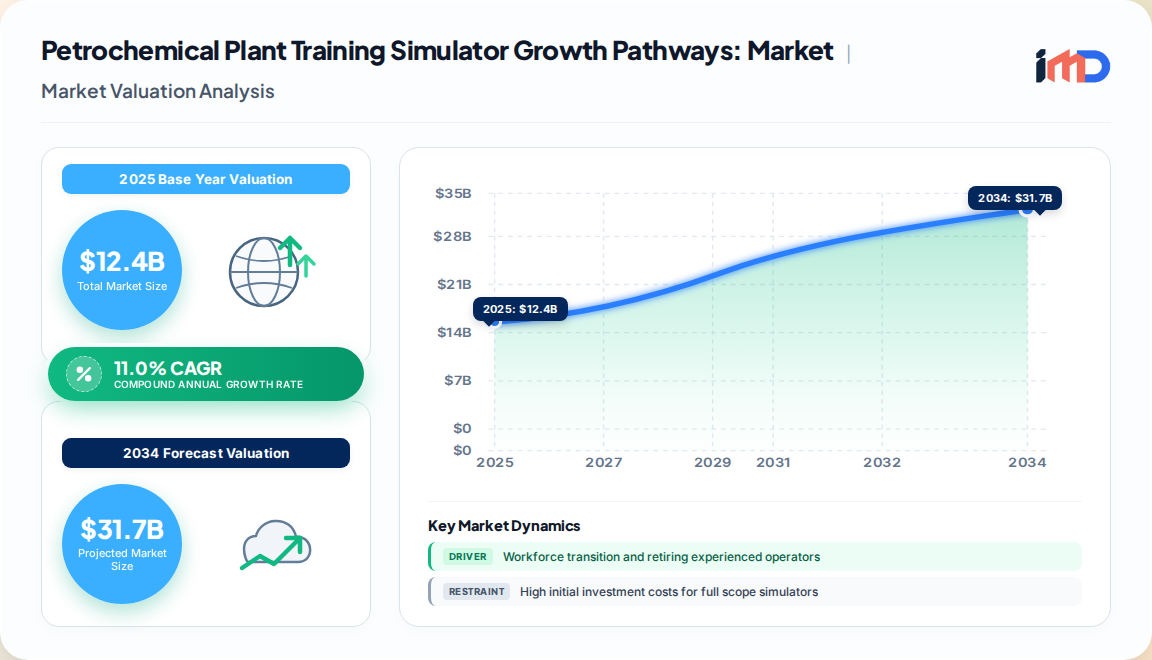
The global petrochemical plant training simulator market is at a strategic inflection point, transitioning from a niche safety tool to a core operational risk management and workforce readiness platform. Our proprietary primary research estimates the market at USD 12.4 Billion in 2025, projected to reach USD 25.8 Billion by 2033, growing at a CAGR of 11.0%. This growth is not merely a function of volume but a fundamental shift in buyer mindset: companies are no longer asking whether they need simulation but how advanced and integrated their simulation environment must be.
The petrochemical sector, representing a significant downstream segment of the broader oil and gas industry, is characterized by complex, high-risk processes such as steam cracking, polymerization, and catalysis. The inherent dangers and capital intensity of these operations make operator competency a critical determinant of safety and profitability. Consequently, training simulators have evolved from basic procedural tools to high-fidelity, data-driven ecosystems that mirror real plant behavior, enabling operators to rehearse rare but catastrophic scenarios—such as compressor failures, column upsets, or emergency shutdowns—in a risk-free environment.
This report provides a comprehensive, first-party analysis of the market dynamics, competitive landscape, and growth pathways, drawing on extensive interviews with industry stakeholders and proprietary demand modeling.
The adoption of petrochemical plant training simulators is propelled by a confluence of demographic, regulatory, and technological factors, while simultaneously constrained by capital and expertise barriers.
The petrochemical plant training simulator market is evolving from a fragmented software market into an industrial ecosystem race, where integration with broader digital plant strategies is becoming a key differentiator.
The competitive landscape is moderately consolidated at the top, with global industrial simulation leaders dominating large-scale deployments, while niche firms compete on customization and realism. Key strategic positioning includes:
The adoption of petrochemical plant training simulators varies significantly across regions, shaped by infrastructure maturity, regulatory pressure, and workforce availability.
The petrochemical plant training simulator market is primarily software and service-oriented, with hardware components (e.g., VR headsets, control room replicas) constituting a smaller share. Trade data for simulators is not separately codified in standard Harmonized System (HS) classifications; instead, it is subsumed under broader categories such as "simulation software" or "training equipment." However, our primary research indicates that the United States, Germany, and Japan are key exporters of high-fidelity simulation systems, while China and India are large importers, reflecting their expanding petrochemical capacities and workforce training needs. Supplier dynamics are characterized by long-term contracts and partnerships between simulator vendors and petrochemical operators, often spanning the lifecycle of the plant.
Our analysis identifies several high-potential growth pathways for stakeholders:
For buyers, the procurement of petrochemical plant training simulators should be aligned with strategic objectives:
The next phase of the market will be defined by convergence: digital twins, AI, and immersive environments operating within a single unified platform. Simulation will no longer be just about training operators but about continuously optimizing operational decision-making before it happens in the real world. As one industry executive noted, the simulator is becoming a "risk-free replica of the plant itself." With the petrochemical market projected to grow from USD 722.12 Billion in 2026 to USD 964.31 Billion by 2031, the demand for advanced training simulators will rise in tandem, ensuring that the workforce is prepared for increasingly complex and automated operations.
| Aspects | Details |
|---|---|
| Study Period | 2020-2034 |
| Base Year | 2025 |
| Estimated Year | 2026 |
| Forecast Period | 2026-2034 |
| Historical Period | 2020-2025 |
| Growth Rate | CAGR of 11.0% from 2020-2034 |
| Segmentation |
|
By Application
By End User
| By Geography |
|
The global petrochemical plant training simulator market is estimated at USD 12.4 Billion in 2025, according to our proprietary primary research.
The market is projected to grow at a CAGR of 11.0% from 2026 to 2033, reaching USD 25.8 Billion by 2033.
Asia-Pacific holds the largest share at approximately 38%, driven by rapid capacity expansions in China and India.
Key players include CORYS, Yokogawa Electric, TSC Simulation, SIM INFOSYSTEMS, AVEVA, Siemens Digital Industries Software, Honeywell Process Solutions, Emerson Electric Co., Aspen Technology, and Kongsberg Digital.
Drivers include workforce retirements, stringent safety regulations, operational cost reduction, and technological advancements such as digital twins and AI.
AI enables adaptive learning by analyzing trainee performance in real-time, adjusting scenario difficulty, and providing personalized feedback, reducing training time by up to 30%.
Our rigorous research methodology combines multi-layered approaches with comprehensive quality assurance, ensuring precision, accuracy, and reliability in every market analysis.
| Stakeholder Role | Interview Share (%) |
|---|---|
| Training Manager | 35% |
| Operations Director | 25% |
| Process Safety Engineer | 20% |
| Procurement Head | 20% |
| Company Type | Representation (%) |
|---|---|
| Full Scope Simulator OEMs | 35% |
| Specialized Simulation Software Developers | 25% |
| EPC Contractors | 20% |
| Petrochemical Plant Operators | 15% |
| Vocational Training Institutes | 5% |
 Related Reports
