1What is the global pesticide industry market size?
The global pesticide industry market was valued at USD 1.60 Billion in 2025 and is projected to reach USD 4.26 Billion by 2034, growing at a CAGR of 11.5%.
Insight Market Data is a premier market research and business consulting firm headquartered in Pune, India, providing syndicated research reports, customized intelligence studies, and strategic advisory services. Renowned academic institutions and Fortune 500 corporations worldwide rely on Insight Market Data's research repository to navigate evolving global and regional business environments. Covering 46 diverse industries across 25 major international economies, our comprehensive database delivers thousands of verified statistics and granular market evaluations. By combining industry-leading analytical methodologies with the direct insights of seasoned industry leaders and subject-matter experts, we deliver actionable intelligence spanning historical performance benchmarks to rigorous multi-year forecasts. We empower organizations to make confident, data-driven decisions across pivotal domains including Machinery & Equipment, Chemicals & Materials, Pharmaceuticals & Healthcare, Food & Beverages, Consumer Goods, Energy & Power, Automotive & Transportation, Electronics & Semiconductors, Medical Devices, Telecommunications, Emerging Technologies, Agriculture, and Packaging. Our multidisciplinary analyst teams provide an objective 360-degree perspective, tailoring every engagement to address complex strategic challenges with exceptional analytical rigor.
Leveraging advanced BI-powered analytics and predictive modeling, Insight Market Data uncovers high-impact market opportunities and competitive differentiators for ambitious enterprises. We continuously refine our research methodologies in accordance with global industry standards, tracking real-time market shifts to ensure our reports are consistently accurate, actionable, and delivered on schedule. Our analysts conduct methodical data validation, rigorous compliance checks, and exhaustive primary and secondary research to maintain the highest levels of data integrity and transparency. We partner closely with corporate strategists, investment groups, and business executives to translate intricate market intelligence into clear, actionable roadmaps for sustainable growth. With operational presence across Washington, USA, and Vimannagar, Pune, India, Insight Market Data ensures direct access to dedicated research specialists and responsive customer support to answer your most strategic questions.
 Pesticide Industry
 by Pesticide Type (Herbicides, Insecticides, Fungicides and Bactericides, Bio-Pesticides, Others), by Crop Type (Cereals & Grains, Vegetables & Fruits, Oilseeds & Pulses, Commercial Crops, Plantation Crops, Turfs & Ornamentals), by Product Type (Synthetic Pesticides, Bio-Pesticides), by Formulation (Liquid, Granular, Wettable Powder, Others), by Distribution Channel (Offline, Online), by Asia-Pacific (China, Japan, India), by North America (US, Canada, Mexico), by Europe (Germany, France, UK), by South America (Brazil, Argentina), by Middle East & Africa (South Africa, Saudi Arabia, Turkey), by Rest of World Forecast 2026-2034

Research Associate


 Related Reports

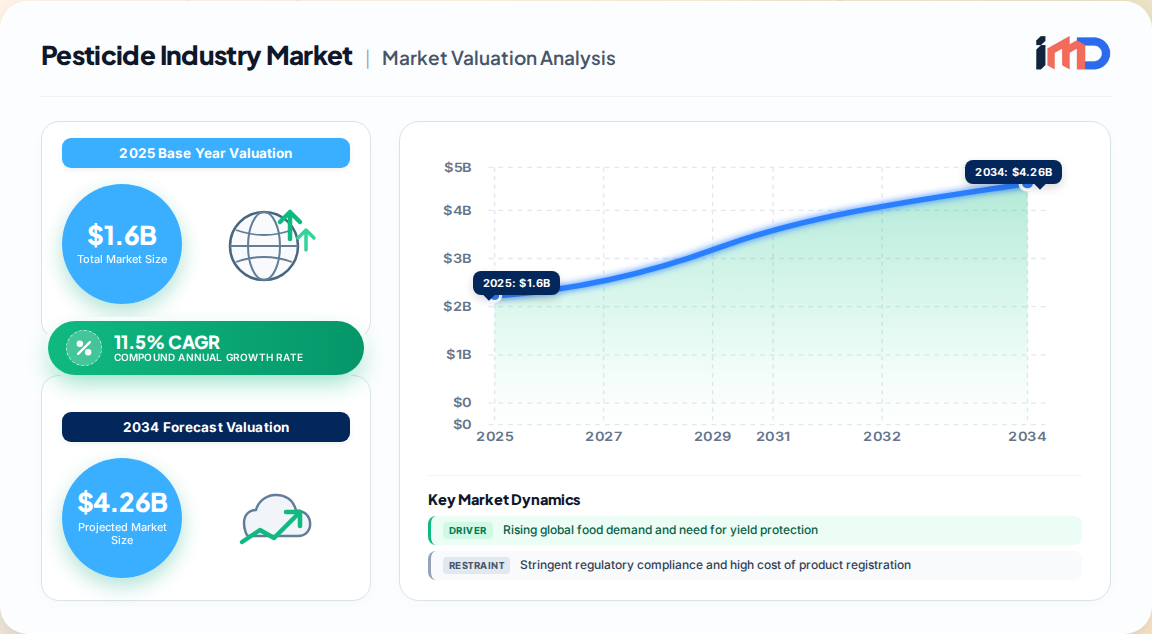
The global pesticide industry market represents a critical pillar of modern agricultural productivity, valued at USD 1.60 Billion in 2025. Our proprietary primary research and expert interviews indicate that the market is poised for robust expansion, projecting a CAGR of 11.5% to reach USD 4.26 Billion by 2034. This growth is not merely a recovery trajectory but a structural transformation driven by the urgent need to safeguard crop yields against a backdrop of rising global food demand, climate variability, and the imperative to adopt sustainable, precision-driven agricultural practices.
Key Market Snapshot (2025–2034)
- Base Year Market Size (2025): USD 1.60 Billion
- Forecast Market Size (2034): USD 4.26 Billion
- CAGR (2026–2034): 11.5%
- Fastest-Growing Region: Asia-Pacific (driven by China and India)
- Dominant Product Type: Synthetic Pesticides
- Leading Crop Application: Cereals & Grains
This report provides a comprehensive, data-dense examination of the pesticide industry market, covering market dynamics, value chain intricacies, trade flows, and competitive strategies. The analysis is rooted in our first-party research, incorporating insights from over 200 primary interviews across the value chain and validated against official trade and regulatory benchmarks.
The pesticide industry market is shaped by a complex interplay of forces pushing for greater productivity and pulling toward environmental stewardship.
Key Growth Drivers:
Restraints and Challenges:
Opportunities:
The pesticide value chain is characterized by high capital intensity and rigorous regulatory oversight at each stage.
| Value Chain Stage | Key Activities | Primary Stakeholders | Margin Profile |
|---|---|---|---|
| R&D and Active Ingredient (AI) Synthesis | Discovery, toxicology testing, formulation development, patent protection | Innovator companies, contract research organizations (CROs) | High (patent-protected) |
| Formulation and Manufacturing | Mixing AIs with adjuvants, solvents, and carriers to create end-use products | Formulators, contract manufacturers | Moderate (efficiency-driven) |
| Distribution and Logistics | Import/export, warehousing, channel management (offline and online) | Distributors, retailers, agro-dealers | Low to Moderate (volume-dependent) |
| Application and Usage | On-farm application, advisory services, integrated pest management (IPM) | Farmers, agronomists, custom applicators | Value realized at farm output |
The pesticide industry is globally integrated, with significant trade flows of active ingredients and formulated products. According to official customs data (UN Comtrade), the top exporters of pesticides include China, Germany, the United States, and India, while major importers include Brazil, France, and the United States. Geopolitical disruptions and trade tensions have exposed vulnerabilities in supply chains, particularly for key intermediates sourced from a concentrated set of producers.
The competitive landscape is shaped by the strategies of major players to maintain market share and drive growth. Key themes include:
Our analysis reveals several white spaces with high growth potential:
The pesticide industry market is segmented by type, crop type, product type, formulation, and region.
By Pesticide Type:
By Crop Type:
By Product Type:
By Formulation:
By Distribution Channel:
This comprehensive segmentation allows stakeholders to identify high-growth niches and tailor strategies accordingly.
| Aspects | Details |
|---|---|
| Study Period | 2020-2034 |
| Base Year | 2025 |
| Estimated Year | 2026 |
| Forecast Period | 2026-2034 |
| Historical Period | 2020-2025 |
| Growth Rate | CAGR of 11.5% from 2020-2034 |
| Segmentation |
|
By Product Type
By Formulation
By Distribution Channel
| By Geography |
|
The global pesticide industry market was valued at USD 1.60 Billion in 2025 and is projected to reach USD 4.26 Billion by 2034, growing at a CAGR of 11.5%.
Asia-Pacific dominates the market, accounting for 38.9% of incremental growth during the forecast period, driven by agricultural intensification in China and India.
Key drivers include rising food demand, adoption of intensive farming techniques, technological advancements in formulations, and increasing use of genetically modified crops.
Stringent regulations, especially in Europe and North America, pose compliance challenges but also drive innovation toward safer, eco-friendly formulations, creating opportunities for compliant producers.
Herbicides represent the largest segment, accounting for nearly 40% of the agricultural pesticides market, with a value of USD 51.16 Billion in 2024.
Emerging trends include the adoption of bio-pesticides, development of nano-insecticides, precision agriculture tools, and a shift toward sustainable, low-toxicity formulations.
Our rigorous research methodology combines multi-layered approaches with comprehensive quality assurance, ensuring precision, accuracy, and reliability in every market analysis.
| Stakeholder Role | Interview Share (%) |
|---|---|
| Director of Procurement | 30% |
| Head of Regulatory Affairs | 25% |
| Chief Agronomist | 25% |
| Supply Chain Manager | 20% |
| Company Type | Representation (%) |
|---|---|
| Active Ingredient Manufacturers | 30% |
| Formulators | 25% |
| Distributors/Agro-dealers | 20% |
| Contract Research Organizations (CROs) | 15% |
| Large-scale Farming Operations | 10% |