1What is the current size of the global Part Truck Load market?
Our proprietary research values the global Part Truck Load market at USD 198.2 billion in 2025, with a projected CAGR of 7.3% to reach USD 348.5 billion by 2033.
Insight Market Data is a premier market research and business consulting firm headquartered in Pune, India, providing syndicated research reports, customized intelligence studies, and strategic advisory services. Renowned academic institutions and Fortune 500 corporations worldwide rely on Insight Market Data's research repository to navigate evolving global and regional business environments. Covering 46 diverse industries across 25 major international economies, our comprehensive database delivers thousands of verified statistics and granular market evaluations. By combining industry-leading analytical methodologies with the direct insights of seasoned industry leaders and subject-matter experts, we deliver actionable intelligence spanning historical performance benchmarks to rigorous multi-year forecasts. We empower organizations to make confident, data-driven decisions across pivotal domains including Machinery & Equipment, Chemicals & Materials, Pharmaceuticals & Healthcare, Food & Beverages, Consumer Goods, Energy & Power, Automotive & Transportation, Electronics & Semiconductors, Medical Devices, Telecommunications, Emerging Technologies, Agriculture, and Packaging. Our multidisciplinary analyst teams provide an objective 360-degree perspective, tailoring every engagement to address complex strategic challenges with exceptional analytical rigor.
Leveraging advanced BI-powered analytics and predictive modeling, Insight Market Data uncovers high-impact market opportunities and competitive differentiators for ambitious enterprises. We continuously refine our research methodologies in accordance with global industry standards, tracking real-time market shifts to ensure our reports are consistently accurate, actionable, and delivered on schedule. Our analysts conduct methodical data validation, rigorous compliance checks, and exhaustive primary and secondary research to maintain the highest levels of data integrity and transparency. We partner closely with corporate strategists, investment groups, and business executives to translate intricate market intelligence into clear, actionable roadmaps for sustainable growth. With operational presence across Washington, USA, and Vimannagar, Pune, India, Insight Market Data ensures direct access to dedicated research specialists and responsive customer support to answer your most strategic questions.
 Part Truck Load Market
 by Truck Type (Dry Van, Refrigerated, Flatbed, Tanker), by Service (Dedicated Contract Carriage, Spot Freight, Expedited), by Mode of Transport (Roadways, Intermodal, Rail), by End Use (Retail & E-commerce, Manufacturing, Construction, Agriculture, Oil & Gas, Healthcare), by Size of Truck (Light Trucks, Medium Trucks, Heavy Trucks, Ultra Heavy Trucks), by North America (USA, Canada, Mexico), by Europe (Germany, UK, France, Italy, Spain), by Asia Pacific (China, India, Japan, South Korea, Australia), by South America (Brazil, Argentina, Chile), by Middle East & Africa (UAE, Saudi Arabia, South Africa) Forecast 2026-2034

Research Analyst


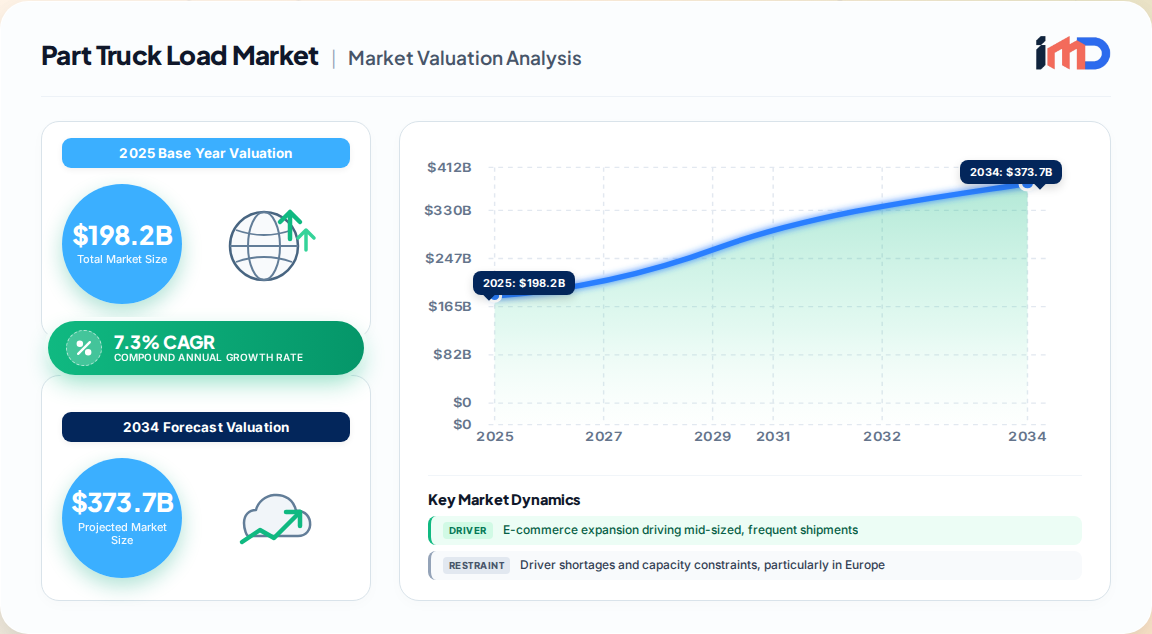
The global part truck load (PTL) market is experiencing a structural renaissance, driven by the fragmentation of supply chains and the relentless expansion of e-commerce. Our proprietary primary research estimates the market at USD 198.2 billion in 2025, projected to reach USD 348.5 billion by 2033, expanding at a CAGR of 7.3%. Unlike the full truckload (FTL) segment, which grew at a modest 5.9% over the same period, PTL is capitalizing on the need for agility, mid-sized shipment frequency, and asset-light logistics models. Asia-Pacific commands the dominant share at 42%, fueled by India's aggressive infrastructure modernization and China's manufacturing recalibration. This report dissects the operational, technological, and regulatory forces reshaping PTL logistics, offering a data-driven blueprint for carriers, shippers, and investors.
The PTL market's growth is underpinned by a fundamental shift in order profiles. Shippers are increasingly penalized for carrying excess inventory, prompting a migration from bulk FTL contracts to flexible PTL arrangements. This shift is not merely cyclical; it is a structural realignment of freight economics.
Drivers:
Restraints:
The PTL value chain is characterized by a highly fragmented supply base, sophisticated aggregation platforms, and an increasingly demanding shipper base. Value creation has shifted from asset ownership to network orchestration and visibility.
| Value Chain Stage | Key Activities | Primary Participants | Value Addition |
|---|---|---|---|
| First-Mile Pickup | Collection, consolidation, labeling | Local fleet operators, franchisees | Route density optimization |
| Hub & Spoke Sorting | Cross-docking, load planning, consolidation | 3PLs, express networks (e.g., Delhivery, XpressBees) | Sorting automation, load factor maximization |
| Line-Haul Transit | Intercity movement, multi-drop routing | Medium/heavy truck operators | Cost-efficient long-haul transport |
| Last-Mile Delivery | Deconsolidation, final delivery | Local delivery partners | Speed, geographic coverage |
| Digital Orchestration | Tracking, route optimization, payment | SaaS platforms, fintech integrations | Transparency, cost control |
The adoption of AI-driven freight orchestration platforms is a critical differentiator. For instance, SemiCab's Apex platform, launched in November 2025, integrates with existing TMS to enhance shipment visibility and network utilization across the USD 450 billion U.S. FTL/P&TL industry. Carriers that fail to digitalize face exclusion from high-value contracts requiring real-time API connectivity.
While PTL is a service market, its demand is inextricably linked to goods trade flows. The World Trade Organization (WTO) reports that global merchandise trade volume grew by 2.7% in 2024, with a projected 3.0% growth in 2025. This trade expansion directly translates to increased PTL demand for port-to-warehouse and cross-border mid-volume movements.
Supplier dynamics for PTL operators are strained by equipment costs. The 25% U.S. tariff on truck components and elevated interest rates have increased the cost of fleet renewal, delaying the adoption of fuel-efficient vehicles and telematics.
Asia-Pacific leads with a 42% revenue share, but growth will be uneven. India is the standout, with the India Partial Truck Load market valued at USD 23.3 billion in 2025, projected to reach USD 37.0 billion by 2030 at a CAGR of 9.7%. The development of 35 Multimodal Logistics Parks (MMLPs) under Bharatmala and express networks from Delhivery, XpressBees, and TCI Express will reduce logistics costs by 20-25%, making PTL increasingly competitive against FTL.
North America accounts for 22% of global PTL revenue. The U.S. general freight trucking industry reached USD 300.1 billion in 2026, up 3.4% year-over-year, but profit margins have contracted from 17.7% in 2021 to 14.7% in 2026 due to overcapacity and cost inflation. PTL growth will outpace FTL as shippers seek to reduce minimum shipment sizes.
Europe commands 24% but faces headwinds from driver shortages and regulatory compliance. The market is ripe for consolidation as small operators exit.
Emerging Hotspots:
The PTL market is highly fragmented, with no single player holding more than 5% global share. Competitive advantage is derived from network density, technological integration, and vertical specialization.
| Company | Headquarters | Primary Strategy | Recent Development |
|---|---|---|---|
| Maersk | Denmark | Integrated logistics; opened 165,000 sq. ft. Ground Freight facility in Fontana, CA (Jan 2026) to enhance PTL distribution | Expanding North American PTL footprint |
| DHL Supply Chain | Germany | Asset-light 3PL; leveraging digital platforms for PTL aggregation | Investing in AI route optimization |
| Kuehne + Nagel | Switzerland | Focus on temperature-controlled PTL for pharma | European cold chain expansion |
| XPO Logistics | USA | Less-than-truckload (LTL) and PTL hybrid networks | Automated hub investments |
| Delhivery | India | Express PTL network with automated sorting centers | 3.5 million sq. ft. supply chain expansion |
| Snowman Logistics | India | Cold chain PTL with IoT monitoring | 5PL services rollout |
| TCI Express | India | Hub-and-spoke PTL for mid-market | Real-time tracking integration |
Strategic Imperatives:
The PTL market presents three underpenetrated white spaces:
Ansoff Matrix for PTL Operators:
| Existing Markets | New Markets | |
|---|---|---|
| Existing Services | Market Penetration: Increase load factor via digital aggregation | Market Development: Enter cold chain PTL verticals |
| New Services | Product Development: Launch AI-based route optimization SaaS | Diversification: Offer cross-border customs brokerage |
Shippers are increasingly adopting multi-vendor PTL strategies to mitigate risk and optimize costs.
The PTL market is poised for robust growth, but profitability will be determined by operational excellence and digital sophistication. Carriers must invest in hub automation, driver retention, and real-time visibility platforms to capture share from the unorganized sector. Shippers should diversify their PTL carrier base and leverage digital procurement tools to lock in capacity. The 7.3% CAGR to 2033 is not guaranteed; it hinges on infrastructure delivery in Asia-Pacific and regulatory stability in Europe and North America.
| Aspects | Details |
|---|---|
| Study Period | 2020-2034 |
| Base Year | 2025 |
| Estimated Year | 2026 |
| Forecast Period | 2026-2034 |
| Historical Period | 2020-2025 |
| Growth Rate | CAGR of 7.3% from 2020-2034 |
| Segmentation |
|
By Mode of Transport
By End Use
By Size of Truck
| By Geography |
|
Our proprietary research values the global Part Truck Load market at USD 198.2 billion in 2025, with a projected CAGR of 7.3% to reach USD 348.5 billion by 2033.
Asia-Pacific holds the largest share at 42% in 2025, driven by India's 9.7% CAGR and infrastructure investments like the Bharatmala Pariyojana.
E-commerce expansion, digital toll and fuel solutions, and infrastructure development are primary drivers. For instance, India's e-commerce market is expected to reach USD 363.3 billion by 2030, significantly boosting PTL demand.
PTL involves sharing truck space for shipments that don't require a full trailer, offering cost efficiency for mid-sized loads. FTL commands a premium for dedicated capacity but grew slower at 5.9% CAGR compared to PTL's 7.3%.
Driver shortages, fuel price volatility, and regulatory compliance (e.g., ELD mandates) are significant challenges. Europe faces acute driver shortages, while U.S. carriers grapple with a 25% tariff on truck components.
Key players include Maersk, DHL Supply Chain, Kuehne + Nagel, XPO Logistics, Delhivery, and TCI Express. These companies are investing in digital platforms and cold chain capabilities to capture growth.
Cold chain PTL is a high-growth niche, especially in India where 90% of cold chain infrastructure is fragmented. Companies like Snowman Logistics are rolling out IoT-enabled 5PL services to meet pharma and food demand.
AI-driven freight orchestration platforms, FASTag integration, and digital fuel payments are enhancing efficiency. For example, FASTag has reduced toll stoppage times from 8 minutes to under 1 minute in India.
Our rigorous research methodology combines multi-layered approaches with comprehensive quality assurance, ensuring precision, accuracy, and reliability in every market analysis.
| Stakeholder Role | Interview Share (%) |
|---|---|
| Procurement Directors | 35% |
| Logistics Managers | 30% |
| Supply Chain VPs | 20% |
| Fleet Operations Heads | 15% |
| Company Type | Representation (%) |
|---|---|
| Third-Party Logistics (3PL) Providers | 30% |
| Trucking Companies & Fleet Operators | 25% |
| E-commerce & Retail Shippers | 20% |
| Manufacturing & Industrial Shippers | 15% |
| Technology & Digital Freight Platforms | 10% |
 Related Reports
