1What is the size of the Oman e-commerce market?
The Oman e-commerce market is estimated at USD 2.94 billion in 2025, rising to USD 3.26 billion in 2026 and projected to reach USD 4.62 billion by 2031 at a CAGR of 7.22%.
Insight Market Data is a premier market research and business consulting firm headquartered in Pune, India, providing syndicated research reports, customized intelligence studies, and strategic advisory services. Renowned academic institutions and Fortune 500 corporations worldwide rely on Insight Market Data's research repository to navigate evolving global and regional business environments. Covering 46 diverse industries across 25 major international economies, our comprehensive database delivers thousands of verified statistics and granular market evaluations. By combining industry-leading analytical methodologies with the direct insights of seasoned industry leaders and subject-matter experts, we deliver actionable intelligence spanning historical performance benchmarks to rigorous multi-year forecasts. We empower organizations to make confident, data-driven decisions across pivotal domains including Machinery & Equipment, Chemicals & Materials, Pharmaceuticals & Healthcare, Food & Beverages, Consumer Goods, Energy & Power, Automotive & Transportation, Electronics & Semiconductors, Medical Devices, Telecommunications, Emerging Technologies, Agriculture, and Packaging. Our multidisciplinary analyst teams provide an objective 360-degree perspective, tailoring every engagement to address complex strategic challenges with exceptional analytical rigor.
Leveraging advanced BI-powered analytics and predictive modeling, Insight Market Data uncovers high-impact market opportunities and competitive differentiators for ambitious enterprises. We continuously refine our research methodologies in accordance with global industry standards, tracking real-time market shifts to ensure our reports are consistently accurate, actionable, and delivered on schedule. Our analysts conduct methodical data validation, rigorous compliance checks, and exhaustive primary and secondary research to maintain the highest levels of data integrity and transparency. We partner closely with corporate strategists, investment groups, and business executives to translate intricate market intelligence into clear, actionable roadmaps for sustainable growth. With operational presence across Washington, USA, and Vimannagar, Pune, India, Insight Market Data ensures direct access to dedicated research specialists and responsive customer support to answer your most strategic questions.
 Oman E-commerce Market
 by Business Model (B2B, B2C), by Device Type for B2C E-Commerce (Smartphone and Mobile, Desktop and Laptop, Others), by Payment Method for B2C E-Commerce (Credit and Debit Cards, Digital Wallets, Cash on Delivery, Bank Transfers, Others), by Product Category for B2C E-Commerce (Beauty and Personal Care, Consumer Electronics, Fashion and Apparel, Food and Beverages, Furniture and Home, Media, Toys and Hobby, Luxury Goods, Others), by Oman (Muscat, Al Batinah North, Dhofar, Al Dakhiliyah, Al Sharqiyah, Other Governorates) Forecast 2026-2034

Research Analyst


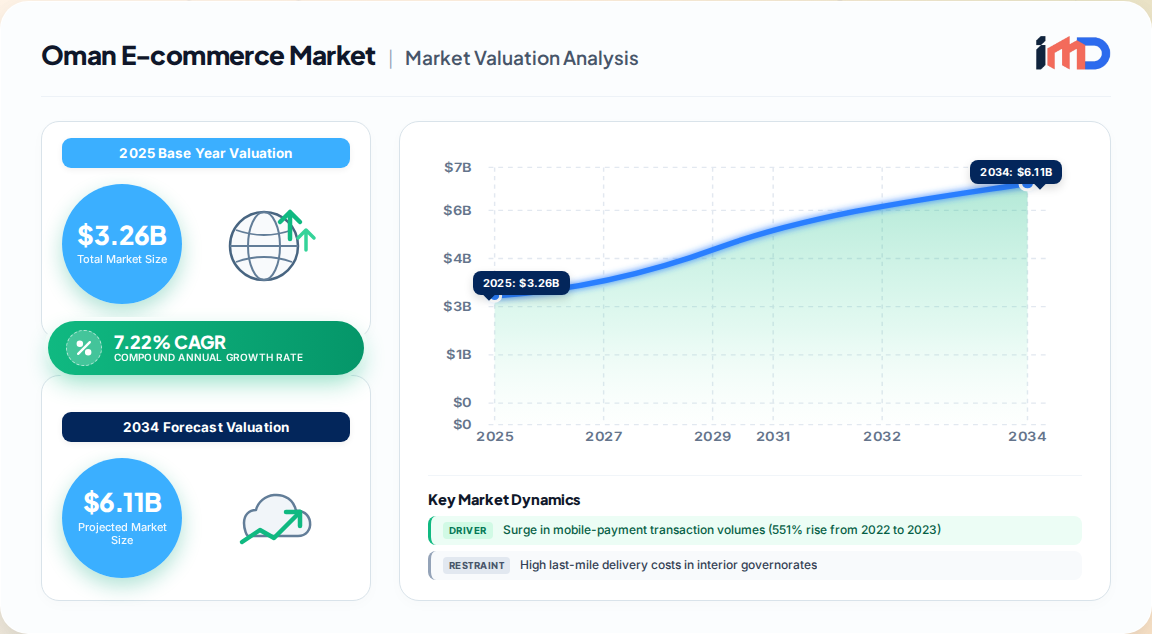
The Oman e-commerce market is undergoing a structural transformation from a nascent digital retail channel into a core component of the Sultanate's non-oil economy. Our proprietary primary research and expert interview program estimates the market at USD 2.94 billion in 2025, rising to USD 3.26 billion in 2026 and projected to reach USD 4.62 billion by 2031, representing a CAGR of 7.22% over the forecast period (2026–2031).
Despite this growth trajectory, e-commerce still accounts for only approximately 1% of total retail sales in Oman, signaling substantial untapped headroom relative to regional peers. The market is at an inflection point where payment modernization, government digital-economy policy, and a young, mobile-first consumer base are converging to compress the path-to-purchase and expand the addressable buyer pool.
The expansion of the Oman e-commerce market is underpinned by a distinct set of demand-side and policy-side catalysts that our bottom-up modeling identifies as the primary growth levers.
Despite the favorable growth outlook, several structural bottlenecks temper short-term conversion rates and elevate logistics risk for merchants.
Our segmentation framework captures the full breadth of the Oman e-commerce landscape across business model, device type, payment method, and product category.
| Segment Dimension | Leading Segment (2025) | Share / Value | Fastest-Growing Segment | Growth Rate |
|---|---|---|---|---|
| Business Model | B2C | 70.89% revenue share | B2B | 7.43% CAGR |
| Device Type (B2C) | Smartphones | 82.67% share | Smartphones | 7.31% CAGR |
| Payment Method (B2C) | Credit & Debit Cards | 43.92% share | Digital Wallets | 8.27% CAGR |
| Product Category (B2C) | Fashion & Apparel | 28.59% share | Food & Beverages | 8.02% CAGR |
Business Model Dynamics: B2C remains the revenue engine, but B2B is emerging as the next frontier as small and medium enterprises automate procurement through digital platforms. The B2B segment is projected to expand at a 7.43% CAGR through 2031, narrowing the share gap over the forecast horizon.
Device and Payment Convergence: Smartphones captured 82.67% of the Oman e-commerce market share in 2025, reflecting near-ubiquitous mobile internet access where 95% of internet users access via smartphones. Digital wallets, growing at 8.27% CAGR, are progressively eroding card-network reliance, opening lanes for fintech newcomers focused on installment plans and micro-credit.
Product Category Shifts: Fashion and apparel leads with 28.59% share, but food and beverages is the growth standout at 8.02% CAGR, driven by grocery delivery app adoption and subscription-based services.
Market activity is heavily concentrated in the capital region, with a long tail of governorate-level demand that logistics providers are still learning to serve profitably.
The government's OMR 3.4 billion (USD 8.8 billion) infrastructure program finances 5G rollout and data-center capacity, aiming to ensure that rural buyers experience latency comparable to urban peers. Mandatory integration with the Naql address platform is a critical enabler for successful deliveries and smoother returns across governorates.
The regulatory environment has strengthened materially, shifting from a permissive framework to one with explicit consumer-protection and data-governance obligations.
| Regulation / Initiative | Year | Relevance to E-commerce |
|---|---|---|
| Electronic Transactions Law | 2008 | Legalized digital signatures and electronic transactions; stipulated penalties for electronic crimes |
| Ministerial Resolution No. 499/2023 | 2023 | Established the Maroof Oman trust-badge program for seller authentication and service-quality rating |
| Personal Data Protection Law (PDPL) | 2022 (effective 2024) | Requires prior written consent for processing personal data; controls cross-border data transfer; compliance grace period to February 5, 2026 |
| Royal Decree No. 39/2025 | 2025 | Introduces penalties up to OMR 50,000 for online fraud, reinforcing buyer protection |
More than 70% of the digital-transformation roadmap was complete by November 2024, eliminating paper-based licensing that had slowed start-up formation. The Maroof Oman trust badge now authenticates seller credentials, bridging a key trust gap for first-time online buyers.
The Oman e-commerce market is characterized by medium market concentration, with a blend of global marketplaces, regional platforms, and domestic players competing across price, assortment, and delivery speed.
Strategic priorities for incumbents and entrants include investing in Arabic-language interfaces and biometric authentication to bridge trust gaps, expanding last-mile partnerships in interior governorates, and building installment-plan and micro-credit offerings to capture wallet-driven demand.
The e-commerce value chain in Oman spans platform operators, payment gateways, logistics and last-mile providers, and cross-border clearance intermediaries. Key structural features include:
| Aspects | Details |
|---|---|
| Study Period | 2020-2034 |
| Base Year | 2025 |
| Estimated Year | 2026 |
| Forecast Period | 2026-2034 |
| Historical Period | 2020-2025 |
| Growth Rate | CAGR of 7.22% from 2020-2034 |
| Segmentation |
|
By Payment Method for B2C E-Commerce
By Product Category for B2C E-Commerce
| By Geography |
|
The Oman e-commerce market is estimated at USD 2.94 billion in 2025, rising to USD 3.26 billion in 2026 and projected to reach USD 4.62 billion by 2031 at a CAGR of 7.22%.
Key drivers include the surge in mobile-payment transaction volumes (up 551% between 2022 and 2023), expansion of the Central Bank's national e-payment gateway (87% digital transaction penetration by end-2024), and Vision 2040 digital-economy programs.
Fashion and apparel led with 28.59% share in 2025, while food and beverages is the fastest-growing category at an 8.02% CAGR through 2031.
Credit and debit cards accounted for 43.92% share of the Oman e-commerce market in 2025, while digital wallets are advancing at an 8.27% CAGR through 2031.
Smartphones captured 82.67% of the Oman e-commerce market share in 2025 and are expected to grow at a 7.31% CAGR through 2031.
Major players include Amazon, eBay, Temu, AliExpress, and Namshi, alongside domestic enablers such as Thawani Technologies, Asyad Express, and Oman Post's Matjar service.
Our rigorous research methodology combines multi-layered approaches with comprehensive quality assurance, ensuring precision, accuracy, and reliability in every market analysis.
| Stakeholder Role | Interview Share (%) |
|---|---|
| Chief Digital Officer / Head of E-commerce | 35% |
| Payment Product Manager | 25% |
| Supply Chain & Logistics Director | 22% |
| Regulatory & Compliance Lead | 18% |
| Company Type | Representation (%) |
|---|---|
| E-commerce Platform Operators (B2C/B2B Marketplaces) | 30% |
| Payment Gateway & Fintech Providers | 20% |
| Logistics & Last-Mile Delivery Firms | 20% |
| SME Merchants & Retailers | 18% |
| Regulatory & Trade Bodies | 12% |
 Related Reports
